In collaboration with Christian Tarsney, I’ve developed a new theory of population ethics, which I call the Saturation View. I think that, from a purely intellectual perspective, it’s probably the best idea I’ve ever had. It was certainly great fun to work on.
It's a bit long for a blog post, so please check out the full draft paper here. (This is a relatively quick first draft to get the idea out there; it'll get revised and improved.) The rest of this post will give an overview:
In Reasons and Persons, Parfit presented the challenge of developing “Theory X”: a population axiology that dissolves the Mere Addition Paradox, avoiding the Repugnant Conclusion without facing other unacceptable conclusions. I think the Saturation View is a plausible candidate for Theory X.
As background motivation, I think there are fairly strong arguments for total utilitarianism as an axiology. On this view, one outcome is better than another iff the sum total of wellbeing is greater. But there are four sets of implications of the view that I find very unintuitive:
- The Very Repugnant Conclusion: Take any population A that consists of some number of extraordinarily well-off lives. For any number n and any negative welfare level z, there is some population Z, consisting of n lives at welfare z and a sufficiently large population of lives that are just barely worth living, such that Z is better than A.
- So, for example, a billion galaxies of bliss is worse than a billion billion galaxies of extreme suffering plus some very large number of lives that are barely worth living.
- Extreme Fanaticism. Consider a guarantee of some outcome B, where B is extremely good, some outcome Y, where Y is extremely bad, and some probability p. No matter how good B is, no matter how bad Y is, and no matter how small p is, there is some outcome C such that a probability p of C, and a probability (1-p) of Y, is better than the guarantee of B.
- So, for example, a billion galaxies of bliss for sure is worse than a 99.99999% chance of a billion billion galaxies of extreme suffering plus a 0.00001% chance of some sufficiently good outcome.
- Infinitarian Issues. On the standard understanding of infinity, a population of an infinite number of beings at wellbeing +2 has the same total wellbeing as a population of an infinite number of beings at wellbeing +1; the former seems better than the latter, but the total view doesn’t have that implication. What’s more, the total wellbeing of a population of an infinite number of beings at wellbeing +2 and an infinite number of beings at wellbeing -1 is undefined; this is also true of the total wellbeing of a population of an infinite number of beings at wellbeing +1 and an infinite number of beings at wellbeing -2. But, again, the former seems better than the latter.
- Responses to these issues have been proposed, but they come with their own issues.
- Monoculture Recommendation. Take some fixed pot of resources that can be used to create lives. There is no population that can be created with those resources that is better than a population that consists only of qualitatively identical replicas of a small number of beings.
- And, in practice, it is likely that the best possible future, on many population axiologies, consists almost wholly of a monoculture. Some people have called this “tiling the universe with hedonium”.
The first three problems have been widely discussed in academic philosophy. The last has not. But it turns out that taking the last of these problems seriously ends up giving us the resources to avoid the first three, too. In particular, on one way (but not the only way) of accounting for the value of variety — the Saturation View — we can dissolve the Mere Addition Paradox and offer a principled response to the fanaticism and infinitarian problems, too.
I’m not claiming that you should believe Saturationism outright. In particular, its implications in some highly-negative worlds are hard to stomach, though I think similar implications are unavoidable for any view that avoids fanatical implications. But I believe that the four problems I list are the most major issues for the total view, and, in my view, Saturationism offers a considerably more plausible way of addressing these issues than any alternative to date.
The full draft is here. It does a number of things:
- Present the monoculture problem, and give arguments for thinking that variety is intrinsically valuable.
- Give an informal statement of Saturationism, and a toy example of the view. The full formal statement is in the appendix.
- Show how accepting the value of variety dissolves the Mere Addition Paradox.
- Show how Saturationism avoids fanaticism in a particularly plausible way.
- Show how Saturationism avoids many problems in infinite-population settings.
- Show that Saturationism’s violation of separability (which almost any view other than totalism or the critical-level view will suffer from) is more limited and tamer than other non-separable axiologies.
- Discuss the difficulty of handling highly negative-value worlds. (The bulk of this draft focuses on worlds with positive value or only somewhat negative value.)
This is still draft work, and I expect the finished product to end up different in a number of ways. I mainly haven’t done citations, I expect there will be a number of errors I haven’t yet noticed, and I also expect that there are many challenges for the view that I haven’t yet identified. The full paper will be co-authored with Christian Tarsney.


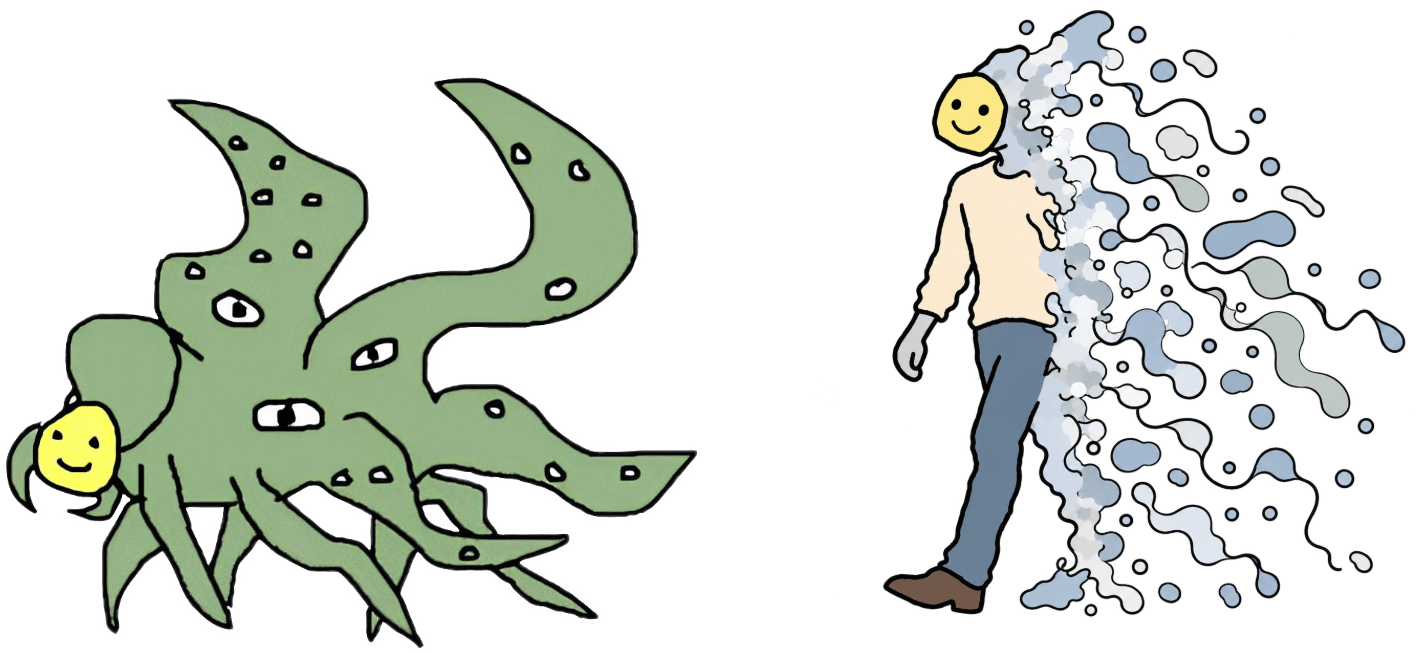
Coming back to this with another thought*: I don't think the saturation view avoids the Very Repugnant Conclusion.
If computational functionalism is true, then it seems that there can be arbitrarily many distinct experiences that are considered good or bad according to the saturation view, because you can construct arbitrarily complicated computations. (Even if computational functionalism is false, there might still be arbitrarily many good or bad experiences.)
Therefore: rather than constructing a world with a very large number of beings experiencing mildly happy lives, suppose instead that those beings have arbitrarily complex experiences that include both very good and very bad experiences, where the experiences almost perfectly cancel out, and the net result is that each being's life is just barely worth living. On the saturation view, these lives aggregate linearly because all their experiences are unique, and thus the saturation view is forced to accept VRC.
*my previous thoughts were on the follow-up post