Preamble
This essay is part one of a two-part sequence. Part two can be viewed here. Each essay is its own individual entry into the 2026 EA Cluelessness Essay Competition. Both were disqualified for unknown reasons and I disagree with the disqualifications. I would appreciate feedback, so maybe compile feedback as you read.
Essay one tackles the complex causal chain contribution to unawareness and shows that both outcome and implementation robustness can be established if inter-cluster travel is achieved, so P3a as stated by DiGiovanni doesn't hold.
Essay two then steelmans DiGiovanni's definition of unawareness to include a second component: our ignorance about which moral framework is correct. Under that strengthened version, P3a holds again, though I identify the one path that could overturn it.
To separate out these two contributions to unawareness I will adopt a totalist hedonistic utilitarianism with a critical level of zero and symmetric treatment of positive and negative welfare as the moral framework for essay one; even though DiGiovanni’s sequence is near-agnostic about value theory, assuming only impartial altruism.
Acausal influence, simulation hypotheses, multiverses and any unfalsifiable theories are outside this essay’s naturalistic scope.
Introduction
In this essay I am challenging premise 3a “Empirical (formal models): that, when we explicitly model an action’s cosmos-wide consequences, our understanding is too coarse to compare actions.”.
To support a wider readership I will use plain English for the rest of the essay.
Thus premise 3a becomes “When we sit down and model what an action does to the universe as a whole, we can only think in broad categories. Each category covers a huge range of possible futures with very different moral values. So the model can't tell us which action comes out ahead.”
TLDR
The universe is like an ocean containing islands that drift apart ever faster and there is a speed limit for boats. Once an island outruns that limit it is unreachable forever. Right now it is theoretically possible for us to send boats that reach 10 million islands but in 100 billion years we won’t be able to reach any.
The islands are gravitational clusters where gravitational clusters are groups of galaxies and galaxies are groups of stars. The island movement is the expansion of the universe, the boats are spaceships and the boat’s speed limit is the speed of light. These statements are all grounded in fundamental physics. They do not rely on predictions about future society, assumptions about cooperation or conclusions from decision theory. They constrain us, they constrain superintelligent AI, they constrain aliens and they will keep constraining everything without exception up to and beyond the heat death of the universe in 10^100 years.
If inter-cluster space travel is possible (the core conditional of this essay) then the “huge range of possible futures” 3a talks about collapses into just four states.
- State One: Life before inter-cluster space travel is invented. We are in this state.
- State Two: Life after inter-cluster space travel is invented but before the first seed exits our light cone.
- State Three: Life after the first seed exits our light cone.
- State Four: No life in the universe.
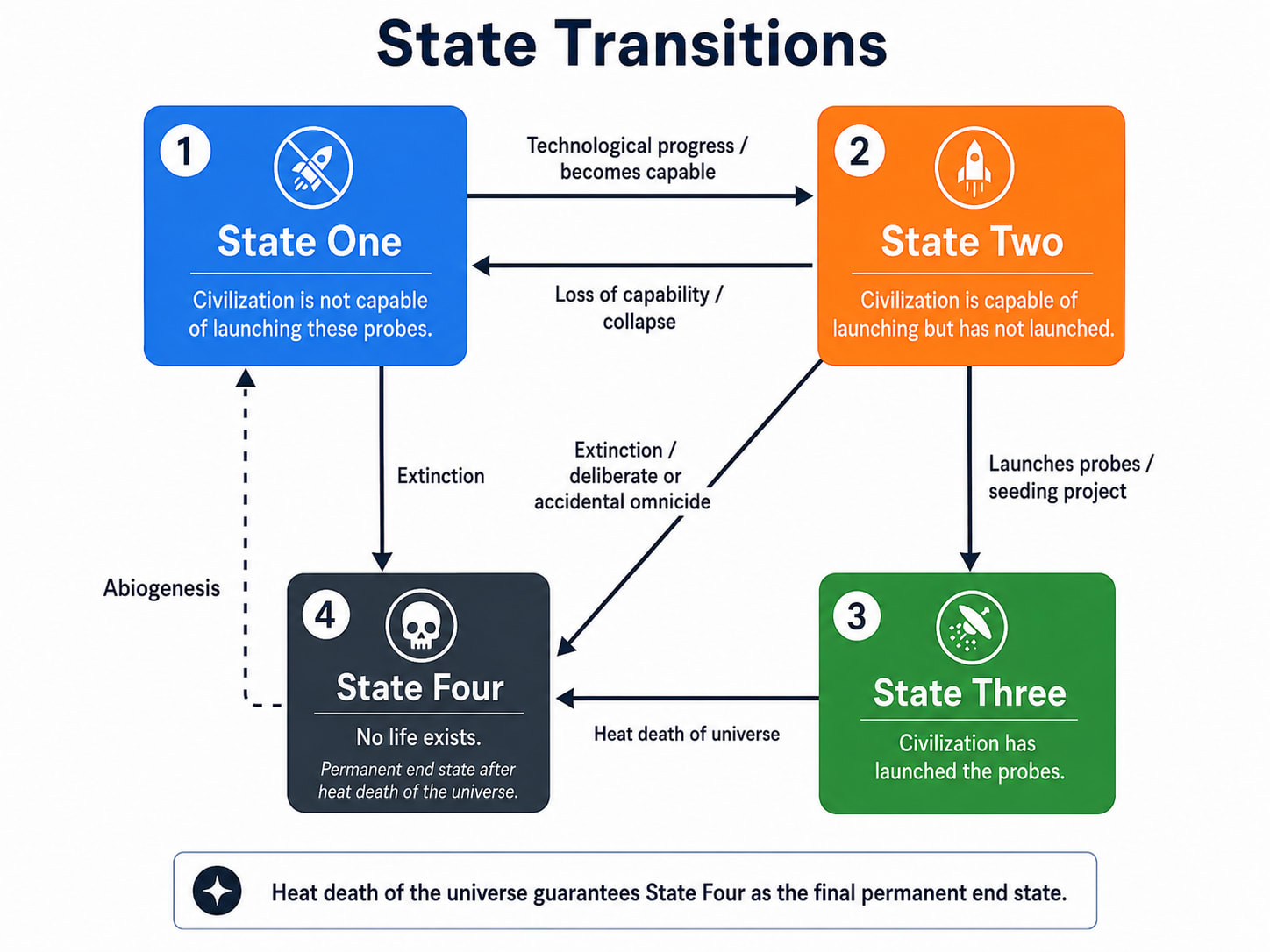
I show with a “Pig’s Paradise” thought experiment that the moral value of state three can be guaranteed to be positive. Furthermore, I show that the lower bound moral value of state three is much larger than the upper bound of moral value for any of the other states.
Since we know almost all of the moral value sits in state three we can take a short cut. Instead of tracing every consequence that our actions have across all of time to figure out its impact, we can just ask two questions:
- Does this action help or hurt our chances of reaching state three?
- Does it change what gets locked in when we get there?
Those are narrow questions about a small number of outcomes which is exactly what is needed to turn hopeless unawareness into bounded uncertainty. Note that these two questions are aligned with Toby Tremlett’s statement “To make the future go better, we can either work to avoid near-term catastrophes like human extinction or improve the futures where we survive.” The difference is that the split falls out of the physics rather than being adopted as a framing.
The Core Conditional: Inter-Cluster Travel
This essay argues a conditional: if inter-cluster travel is achievable, then the causal consequences of our actions are constrained in such a way that makes premise 3a fail. I make no claim here about how likely inter-cluster travel is. I also make no comment on solving premise 3a if inter-cluster travel turns out not to be possible. Finally I make no claim about whether we are morally obligated to pursue state three. I only lay out what is possible.
That is not a hedge. Whether we live in a universe where inter-cluster travel is possible is a well-scoped physics/engineering question which is narrower than most things longtermists try to forecast. As the argument below demonstrates, the answer changes the shape of the entire long-run future from hopelessly unaware to merely uncertain. If you disagree with the premise, the interesting response is not to discard the argument but to ask what it would take to reduce uncertainty about inter-cluster travel.
Inter-Cluster Travel Details
I have gone into the math and underlying assumptions about inter-cluster travel previously here. So I will just summarize the main points. These are rough estimates, which is all the argument requires. Making them rigorous is exactly the research program I argue for in the conclusion.
Energy
Sending a seed to all 10 million clusters we can reach costs about 1.5 hours of the Sun’s output. To give a sense of the scale of energy required, it is about 3 billion times greater than humanity’s current annual production. At current growth rates humanity will achieve that level of energy production in about 1500 years. It is plausible that this energy requirement is the most difficult impediment to inter-cluster travel and thus will be the limiting factor.
Speed
The speed at which probes can be sent out determines the minimum duration of state two. A probe speed of 99% of light speed means a million years before the probe exits Earth’s light cone. A probe speed of 99.999% brings that down to a thousand years.
Scale vs Robustness
We can trade off scale against robustness: lifting 10% of our cluster's matter only costs us the energy contained in 0.000001% of our cluster's mass but generates multiple light cone separated civilizations. Furthermore, we can do this recursively and stagger seed sprouting times to reduce existential risk asymptotically to zero and far below the natural baseline rate that existed on Earth before human civilization.
Waiting
Seeds don’t need to sprout immediately upon reaching the destination cluster. They can disassemble all stars in the cluster into Jupiter-sized bodies that act as mass silos to prevent energy loss due to fusion while they wait. They can lift off mass to form additional clusters, recursively. Then they can sprout after they are isolated in their own light cone so as to not potentially endanger neighbors.
Accumulation of Moral Value in State Three
Let’s consider each state in turn to locate where the majority of future moral value (either positive or negative) exists. State four has no moral value under the utilitarian framework adopted in the preamble. State one is unstable in the long term because it transitions either to state two or to state four. That leaves states two and three as the only significant candidates.
Both begin with access to the same matter. But state two's reach shrinks as the universe expands, until after 100 billion years nothing remains but our own cluster and that is what persists for the following 10^100 years until heat death of the universe. In comparison, state three keeps all ten million clusters it seeded.
Thus the vast majority of future welfare (either positive or negative) lies in state three, even if the transition takes millions of years.
Pig’s Paradise
Seeding a cluster lets us set the initial conditions for the life that will exist there. At least two mechanisms can make those conditions persist until the universe’s heat death. The first trivial example of such lock-in is by not providing information that only we have access to. Things like certain astronomical observations, recorded history and biological samples. Thus collecting and passing on this information becomes a prioritized longtermist cause area.
The second lock-in method is a population of narrow, non-agentic AI enforcers that reproduce only by unanimous consensus. That is replication occurs only when several copies compare their source and agree exactly.
This applies a result von Neumann proved in 1956: a system built from unreliable components can be made arbitrarily reliable, provided the per-component error rate falls below a critical threshold. His construction replaces each component with a bundle of redundant copies and inserts a restoring organ between stages, pushing a mostly-correct bundle back toward being almost-entirely-correct so errors do not accumulate. Below the threshold, failure probability falls exponentially in the number of copies while cost grows only logarithmically, because failure now requires many independent errors to coincide. So a consensus requirement of a few dozen copies suffices rather than a few billion. Unanimous rather than majority voting makes the scheme fail-safe by raising the rate at which replication is blocked and drives the rate at which a mutation spreads toward zero. This provides another trade off mechanism in this case exchanging total welfare against the stability by which that welfare remains good.
This holds only while failures are independent. A sufficiently intelligent adversary defeats it, since n copies of one exploitable design is one exploitable design. That is why the mechanism works for the pig example below and not for the alien case considered later.
This mechanism enables Pig’s Paradise to create a permanently locked-in positive welfare situation for state three. To be clear I think an advanced civilization could do much better than this, but this technique limits the floor to be (vastly) above zero welfare.
A Pig’s Paradise seed probe arrives, self-replicates, and disassembles the cluster's stars into Jupiter-sized bodies to prevent mass being lost to fusion. It spins off additional clusters according to the chosen distribution strategy, then hibernates until isolated in its own light cone. At which point it revives frozen pig sperm and eggs and gestates them in artificial wombs, housing the pigs in stations in Dyson swarm orbits, in conditions of abundant pleasure and minimal suffering. Pigs are chosen because they are capable of being more happy than sad and are simple enough that welfare tolerances can be specified in advance and enforced mechanically. The enforcers hold pig genetics and other factors within those tolerances indefinitely.
Thus Pig's Paradise achieves net positive utility under the version of utilitarianism adopted in this essay. Because the floor is enforced rather than estimated, every admissible way of filling in the details returns a positive number. Meaning that while the moral value of state three stays imprecise we are guaranteed that no part of that range falls below zero.
Demonstrating Robustness Against Unawareness
DiGiovanni asks for two things before a comparison can be trusted.
- Outcome robustness: we must know which outcome is better.
- Implementation robustness: we must know our action makes the better outcome more likely.
Two problems block both.
- We cannot say how the possibilities we have never thought of differ between our options. DiGiovanni calls this the catch-all problem.
- The possibilities we have thought of are broad labels covering futures of very different values.
Either problem alone is enough to flip the sign of a comparison, which is why he concludes we cannot compare and are unaware. I go through each in turn below.
Outcome robustness: the catch-all
The four states come from three yes/no questions: does life exist; if so, has it invented inter-cluster travel; if so, has it spread beyond a single light cone. No fifth state is possible because it would require something like a future where life both does and does not exist. DiGiovanni warns that we notice the hypotheses we happen to find interesting thus biasing our sample. However, a partition built from binary questions is not a sample at all. Nothing was selected, so nothing was selected badly.
Outcome robustness: sign flipping
State three still covers an enormous range of futures, and DiGiovanni is right that we cannot assign it a single value. But we do not need one. We just need every reasonable way of valuing it to come out positive and Pig's Paradise shows a floor that any seeding civilisation can reach. Furthermore we have shown that the vast majority of moral value is accumulated in state three. So state three is preferred no matter how the details are filled in.
Implementation robustness: the catch-all
Since almost all moral value sits in state three, the question of what our actions do to the far future collapses to two questions: do they change our chances of getting to state three and do they change what is locked-in. Every other consequence is a rounding error against 10^100 years of lock-in. This is not a claim that we have thought of everything. It is a claim that whatever we have not thought of has to act through one of those two channels to matter, because there is nowhere else for significant moral value to be located.
Implementation robustness: sign flipping
Take any two actions. The value of state three is still imprecise but every value in that range is positive due to Pig’s Paradise’s guarantee. Where two actions differ only in the probability of reaching state three, the value cancels and the comparison is determinate. Where they differ only in what gets locked in, the probability cancels and the comparison is again determinate — the better lock-in wins. Where they trade one against the other, the comparison can flip, and I make no claim about those. Premise 3a says our understanding of cosmos-wide consequences is too coarse to compare actions. For the first two cases, it isn't.
Alien Robustness
Scientists have looked at 100,000 galaxies in the part of the universe we can still reach and every single one likely does not contain a galaxy spanning civilization (K3). But for every galaxy we checked there are about one million galaxies we haven't checked. Also a galaxy spanning civilization is a high bar since a sub star spanning civilization (K2) has the energy budget to achieve inter-cluster travel. Fewer than one in a hundred trillion of the stars we could reach has been checked for star spanning civilization signatures but again every one we have checked has come up negative. Plus there are other structures besides the infrared emitting dyson swarms we are looking for that advanced civilizations might prefer to build such as the Jupiter-sized bodies acting as mass silos discussed above which would be harder to see. Thus we are still early in our search but since no evidence so far points to the existence of aliens, that is the assumption I’ve been making in this essay.
Aliens are under all the same physical constraints described in this essay. If the aliens are in the part of the universe we can’t reach then it doesn’t impact anything discussed. If we reach the alien’s star before they achieve the capability for inter-cluster travel then we get to decide lock-in and vice versa if they reach our star first. We would hopefully program our seeds to recognize the welfare value of such aliens and respond accordingly.
It is possible that we both achieve the capability for inter-cluster travel before having time to reach each other’s home star, though this seems unlikely given how fast spread happens compared with how long it took life on earth to develop inter-cluster travel. But if that does happen then we would have to coordinate our lock-in values for the clusters where our mutual light cones overlap. If the aliens agree with our lock-in values then we can continue to guarantee positive utility via a minimum of a Pig’s Paradise like set up. However, if coordination fails then we can no longer guarantee positive welfare for those gravitational clusters but we can still use our influence to counterfactually improve welfare. A key feature factoring into Pig’s Paradise’s stability is the absence of intelligent malicious actors which is not the case here. Still there are forms of lower control lock-in that could probably result in counterfactual welfare improvement over the long term. So even here most of the moral value is in state three, though it is in the form of minimizing alien caused suffering rather than creating positive welfare.
Conclusion
Inter-cluster travel is a physics and engineering problem. This means we can gain an increasingly deep understanding of mechanisms, a condition DiGiovanni himself names for when unawareness stops being decisive. The physics is tractable now. The engineering track record can be built in adjacent domains as we go. Neither requires forecasting how societies will behave in a thousand years.
So the first practical consequence of this is to develop a new longtermist cause area called roadmapping. Roadmapping is determining whether inter-cluster travel is achievable, in what forms and how to get there. This is not generic research. It is a specific physical question whose answer changes the structure of the possibility space rather than adding another hypothesis to it. If successful it will yield a roadmap our civilization can follow to get to state three. Another practical implementation of this analysis is to more highly prioritize preserving information the seeded clusters could not recover on their own. The third is that we can begin the conversation about what lock-in we want. My own view is that epistemic humility favors as little lock-in as possible. Seeded civilisations will have vastly more resources than we do and have far better knowledge of their own unique situations.
This essay demonstrates that if inter-cluster travel is possible then both outcome and implementation components of unawareness are overcome which is the P3a challenge as DiGiovanni stated it. However, to achieve this I adopted one form of utilitarianism out of many different variants. If alternative variants had been selected, sign flipping would be reintroduced into the analysis causing unawareness again. For example negative variants of utilitarianism would prefer state four over Pig’s Paradise state three because we cannot make the pig’s lives completely free of suffering.
In essay two of this sequence I steelman premise 3a to include a moral ignorance component to unawareness. Essay two identifies the only path I can see that offers any prospect of progress on this second component. That path has several possible outcomes and only one of them supplies the moral insight needed to overturn steelmanned premise 3a. Which outcome is true is currently an open empirical question.
P.S.
The Fermi paradox is the apparent contradiction between the size of the universe and its emptiness. The analysis in this essay suggests that an alien civilization will either remain a K2 civilization or spread to all the stars they can. It also suggests that the way to minimize extinction risk for themselves is to disassemble stars into Jupiter-sized silos and wait until the expansion of the universe puts them into separate light cones. Since our astrometry detection methods are biased to bright things (which Jupiter sized silos aren’t) then we might have missed this. But I am skeptical since this requires almost perfect consensus following a non-default path of waiting instead of using the mass now. You would have to combine it with an argument that alien civilizations are rare and those who don’t wait are rarer still to fall below our sparse sampling. In a similar vein I think this is a bad dark matter candidate and a bad panspermia theory. Unrelated but to weigh in on the perennial longtermist debate I claim that the century the seeds are launched is a good candidate for the most important century.

Great piece David!
I'm not a physicist but it certainly seems that if it is technically feasible to send seed probes that exit our light cone, it would be good to do to (a) reduce extinction risk to near 0 and (b) have a much bigger future.
I guess it would make sense, in State 2, to at least have some period of refletion to figure out what life to put on the probes. Pig's paradise is an interesting thought experiment, but I would also hope that we can do better than that.