Comments
118
Why should ethical anti-realists do ethics?
This essay is part two of a two-part sequence. Part one can be viewed here. Each essay is its own individual entry into the 2026 EA Cluelessness Essay Competition. Both were disqualified for unknown reasons and I disagree with the disqualifications. I would appreciate feedback, so maybe compile it as you read.
Essay one tackles the complex causal chain contribution to unawareness and shows that both outcome and implementation robustness can be established if inter-cluster travel is achieved, so P3a as stated by DiGiovanni doesn't hold.
Essay two then steelmans DiGiovanni's definition of unawareness to include a second component: our ignorance about which moral framework is correct. Under that strengthened version, P3a holds again, though I identify one path that could overturn it.
The way we fill in the details of moral frameworks creates the sign flipping characteristic of DiGiovanni’s unawareness. Hume’s is/ought problem suggests that a more advanced civilization won’t make any progress on finding moral truth even in the best possible scenario. However, the principle of deference enables us to avoid solving Hume’s problem ourselves by instead finding a trustworthy source who has already solved Hume’s problem. This then exposes a part of discovering moral truth to empirical techniques that our own civilization should be able to make significant progress on in the future. I suggest two candidates for where empirical knowledge could provide insight into moral truth and give a timeline of recent improvements for these candidates. Receiving affirmative results from this empirical investigation is the only path I see out of our moral ignorance and in combination with essay one’s conclusion out of our current unawareness.
One requirement of DiGiovanni’s unawareness is that the sign of the action flips depending on arbitrary filling in of details. Essay one managed to remove sign flipping by introducing an idea of a pig’s paradise that guaranteed positive welfare. However, pig’s paradise only has more positive moral value over an empty universe in some moral frameworks. A negative utilitarian prefers the empty universe because the pigs still experience a small but non-zero amount of suffering. A person-affecting view considers the comparison undefined.
Essay one narrowed the moral framework to totalist hedonistic utilitarianism with a critical level of zero and symmetric treatment of positive and negative welfare. But even that definition doesn’t guarantee choosing pig’s paradise. It depends on arbitrary choices like identifying where the zero point on the scale actually is in reality and what specifically is pleasure and pain. Making different choices there again results in sign flipping.
Hume’s is/ought problem says that looking at how the universe is cannot give any insight into moral truths. This means an advanced civilization will not have better insight into moral truth than we do today because while their knowledge and resources will be impressive it is just more knowledge in the ‘knowing about how the universe is’ bucket which Hume says doesn’t help us.
To make this point clear. Let’s say that an advanced civilization proved there was only one logically consistent moral framework that also happened to be deeply intuitive and every person accepted it. Hume would say, “that’s a cute fact about minds” but would reject that it provides any insight into moral truth or moral authority.
However, if we accept the principle of deference, Hume's is/ought problem changes shape. Instead of needing to derive an "ought" from the "is" ourselves, we need only to identify a source with plausible access to the answer and reasons to trust the answer it gives us.
This is important because deference is not a principle invented for this argument. DiGiovanni and Clifton list it among the non-pragmatic principles that, on their account, beliefs must ultimately bottom out in (here). These are principles accepted not because they demonstrably perform well, but because our philosophical conscience can't deny them. They define it as: "If X has much more information about Q than me and is at least as competent a reasoner, I should adopt X’s beliefs about Q instead of going with mine.".
Thus the epistemic burden shifts from solving the problem to finding someone who has. This matters because knowing more about how the universe is gives us insight into identifying that source.
Many claim that this source of moral truth is the God of their religion, however I’m not aware of the God of any religion explaining how they managed to solve Hume’s is/ought problem. That hasn’t stopped several people offering plausible arguments on God’s behalf like the C. S. Lewis’s physical/moral law argument and the third horn solution of the Euthyphro dilemma. That said, given that we have to trust that God is telling us the truth about morality, extending that trust to also include an undisclosed mechanism to solving Hume’s is/ought problem is pretty cheap.
So is God trustworthy? Some point to God’s track record of creating a universe with billions of years of wild animal experience that contains a lot of suffering and understandably conclude no. Thus even if God’s communication about morality was clear there would still be reasons to reject it. This is the non-empirical component that deference still leaves unresolved. This is the deeply personal wrestling with God that Christians call faith.
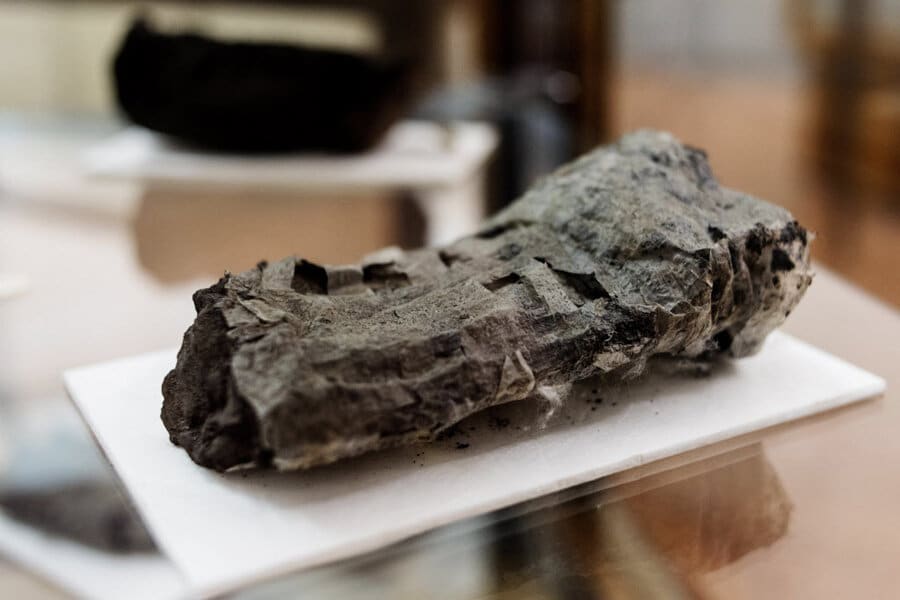
This is what makes religions that expose themselves to truth claims about “this is how the universe is” so interesting. In certain domains like the origins of the universe/life religions seem to have a bad track record. In other domains such as religious historical claims, we have likely permanently lost the ability to verify them. Though given that the process of science has resulted in gaining the ability to read the Herculaneum scrolls (image below) using particle accelerator-based X-ray microtomography, maybe it would not be wise to bet against this position.
I think the two most promising candidates across all religions for empirically tractable truth claims are the historical argument for Jesus’s resurrection and Christian modern day healing miracle claims. Note that I am not saying these claims are true, just that advances in empirical knowledge can give insight (positive or negative) into the likelihood of these claims being true.
There are two mechanisms here. One is making archeological discoveries. The second is applying modern analytical frameworks.
Pannenberg's “Jesus - God and Man” 1964 marks a shift in systematic theology towards the view that the resurrection is accessible to historical investigation rather than only being a matter of faith. Here is a list of the major relevant archeological discoveries: Dead Sea Scrolls (1947), Yehohanan ossuary (1968), expanding papyrus corpus (1972+), Caiaphas ossuary (1990), excavation of rolling-stone tombs (1990s), locating the pool of Siloam (2007), Gargilius Antiques inscription (2018) and the Fenstanton crucifixion victim (2018).
As for examples of gaining insight by applying modern analytical techniques I would point to memory studies, undesigned coincidences and the coherence-based genealogical method. More information about these in the post script.
We have a much better understanding of the events surrounding Jesus’s resurrection than we did 100 years ago and given the rate of progress it seems likely that people 100 years from now will have considerably more insight than we do today.
Adherents of all faiths probably report modern miracles, but I am not aware of any tradition that matches the quality and quantity of Christian claims, in terms of number of reliable witnesses, medical documentation, lack of naturalistic interpretations, etc. A good compilation is Craig Keener's Miracles Today (2021), which catalogues many contemporary cases with medical records (ten-minute video of three of those cases).
Note that these two candidates cover the weaknesses of the other. The weakness of Jesus’s resurrection is temporal distance from us which is a strength of contemporary miracle claims. The weakness of modern day healing miracles is their lack of specificity into the identity of God which is solved by Jesus’s teachings about God. Though I don’t want to understate the situation, proving one and not the other would still provide significant moral insight.
This essay is not advocating that Christianity is correct. Also if empirical inquiry affirms Christianity I do not make the claim that the moral insight provided is guaranteed to be useful for resolving questions like what versions of lock-in we select for (see part one of this essay sequence for context). Only that it might provide useful insight. Christians have considerable disagreements today and furthermore have changed their stance on many significant moral issues in their 2000 year history. So there is obviously some ambiguity in Christian truth claims.
The main point of this essay is that Christianity is the best candidate for gaining clarity on moral truth because of how it opens itself up to empirical inquiry. Sure, we might wish that it opened itself up even more but we don’t get to pick and choose these things. Thus this is the only path I see where our civilization can reduce our ignorance about morality and end unawareness. But note it only works if these empirical truth claims are tested and found correct. The result could come back as false or indeterminate instead. It is a genuinely open question today and there is no guarantee of success.
For example, Lydia McGrew's Hidden in Plain View (2017) examines Blunt's 1840s undesigned coincidences through a modern comparative-hypothesis lens. This 3 minute introductory video is a good introduction into undesigned coincidences.
The coherence-based genealogical method, developed from the 1980s, uses computational analysis of variant relationships to reconstruct the transmission history of the New Testament text. This lets us reconstruct the earliest recoverable text with more confidence than manuscript-family methods allowed.
Memory studies, applied to the Gospels since Kelber (1983), asks how oral communities actually transmit information; the field is genuinely divided, with Bauckham (2006) arguing named eyewitnesses preserved individual testimony and others arguing collective memory reshapes what it carries.



Nice one David.
Of the different arguments for Jesus' resurrection (disclosure: I'm a Christian) I find the most interesting one that, if the resurrection had not occurred (or at least, if the disciples had not sincerely believed that the resurrection occurred) then it wouldn't have made sense for them to endure the tremendous persecution that followed over the next decades.
That said, I guess a lot of religions/sects are persecuted significantly in their early years (Islam, Sikhism, Bahaiism, Mormonism...) and yet thrive so we shouldn't weight this too heavily as a historicity proof.