Comments
Note: This post was crossposted from the Coefficient Giving Farm Animal Welfare Research Newsletter by the Forum team, with the author's permission. The author may not see or respond to comments on this post.
It can feel hard to help factory-farmed animals. We’re up against a trillion-dollar global industry and its army of lobbyists, marketeers, and apologists. This industry wields vast political influence in nearly every nation and sells its products to most people on earth.
Against that, we are a movement of a few thousand full-time advocates operating on a shoestring. Our entire global movement — hundreds of groups combined — brings in less funds in a year than one meat company, JBS, makes in two days.
And we have the bigger task. The meat industry just wants to preserve the status quo: virtually no regulation and ever-growing demand for factory farming. We want to upend it — and place humanity on a more humane path.
Yet, somehow, we’re winning. After decades of installing battery cages, gestation crates, and chick macerators, the industry is now removing them. Once-dominant industries, like fur farming, are collapsing. And advocates are building momentum toward bigger reforms for all farmed animals.
Here are my top ten wins from this year:
1. Liberté et Égalité, for Chickens. France’s largest chicken producer, the LDC Group, committed to adopting the European Chicken Commitment for its two flagship brands by 2028 — a shift that French advocacy group L214 estimates will cover 40% of the national chicken market, or up to 400 million birds each year. Across the Channel, British supermarket chain Waitrose transitioned all its own-brand chicken to comply with the parallel UK Better Chicken Commitment.
2. Guten Cluck! The Wurst Is Over for German Animals. Germany’s top retailer, Edeka, committed to making all of its own-brand chicken products compliant with Germany’s equivalent of the European Chicken Commitment by 2030 — a pledge that all four of the country’s largest retailers have now made. Germany’s biggest chicken producer, the PHW Group, plans to phase out all low-welfare fresh chicken by 2040. And retailer Aldi Süd will soon stop selling the very lowest-welfare meat across all species.
3. Shell Yeah! Corporations Crack on Cage-Free. The US egg-laying flock is now about 46% cage-free, up from 39% at year-end last year — more progress in one year than the egg industry made in decades prior to 2015. America’s three-largest fast food chains — McDonald’s, Starbucks, and Subway — are now 100% cage-free in the US. Globally, 92% of corporate cage-free pledges with deadlines through 2024 have been fully implemented, per the Open Wing Alliance — a number that will dip once the wave of 2025 deadlines comes due, but still a remarkable milestone.
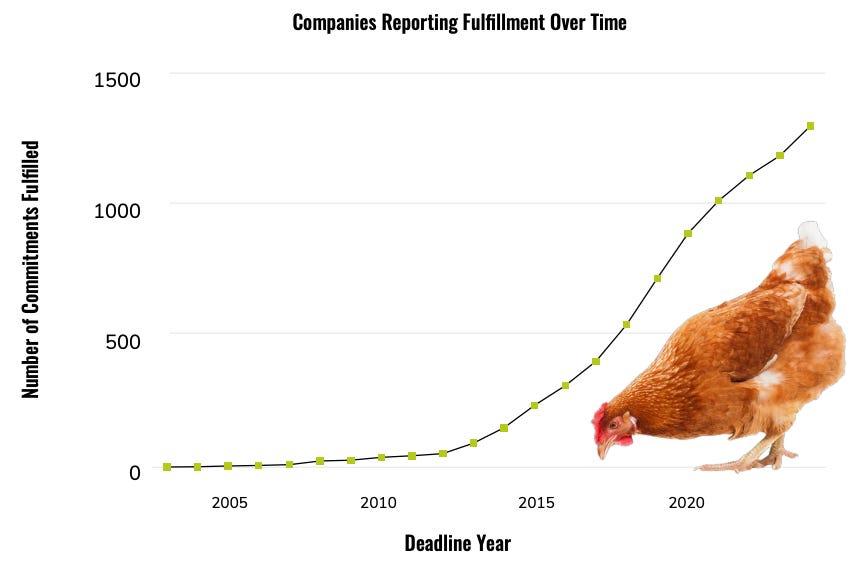
4. Sow Long, Crates. After years of dragging their trotters, major chains finally moved on gestation crates. McDonald’s, Burger King, and Starbucks all reported that >95% of their North American pork now comes from “group-housed sows,” who aren’t crated for most of their pregnancies. (Advocates are working to extend that to all of their pregnancies). Supermarket giants Albertsons and Ahold Delhaize took major steps toward group-housed supply chains. A federal appellate court upheld Massachusetts’ ban on selling pork from crated pigs, while the Supreme Court refused to hear yet another pork industry challenge to California’s ban.
5. An Eggs-it Strategy for Chick Killing. A full 28% of Europe’s hens now come from in-ovo sexed eggs, sparing 175 million male chicks to date from being hatched and killed. The Netherlands published a roadmap to phase out most chick killing, joining France, Germany, Austria, and Italy in ending the practice. Brazil installed its first in-ovo sexing machine. And US consumers got their first chance to buy in-ovo sexed eggs, as NestFresh launched its “Humanely Hatched” line and competitor Kipster said it will follow soon.
6. Tank Goodness for Stunning Progress. Five top UK retailers — Co-op, Waitrose, Morrisons, Iceland, and Ocado — committed to stunning shrimp and prawns before slaughter, instead of suffocating them, as did French retailer Les Mousquetaires and Dutch retailer Jumbo. Newly installed machines will now stun over four billion shrimp annually. The world’s largest shrimp certifier, Best Aquaculture Practices, pledged to end the creatively cruel practice of eyestalk ablation on the 1,900 farms it certifies by 2030. The Aquaculture Stewardship Council launched its new Farm Standard, which includes pioneering welfare reforms covering over a billion farmed fish annually.
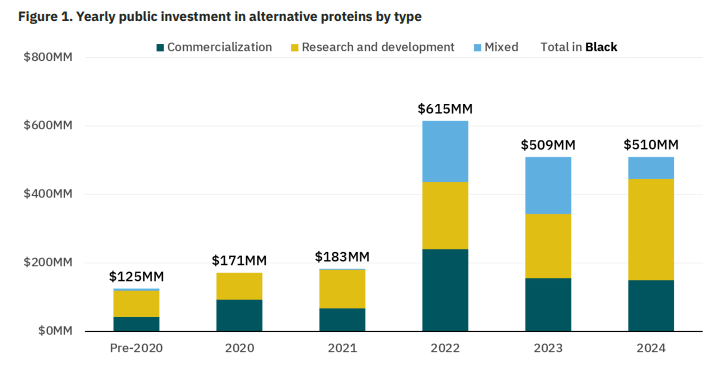
7. Lettuce Celebrate, and Peas Be With You. India, the Netherlands, and South Korea all announced new investments in alternative proteins, as fresh data shows the world’s governments have now invested over $2 billion in the space. Three major European retailers — Rewe, Lidl, and Ahold-Delhaize — set goals to increase the share of their sales that are plant-based by 2030-35. And in a rare bright spot for plant-based meat, sales actually grew in France, Germany, Italy, and Spain.
8. “S” is for Superior Standards: Europe’s S-List Passes Reforms. Switzerland adopted a world-first rule requiring all meat, eggs, and dairy be labeled with any painful procedures performed on the animals without pain relief. Slovenia agreed to phase out both cages for hens and castration without pain relief for piglets. Spain implemented some basic pig welfare reforms and launched a State Council for Animal Protection — with farmed animals explicitly in its remit. Scotland adopted its first official welfare guidance for farmed salmon. And Sweden hit 100% cage-free, mostly thanks to corporate progress. In a frustrating twist for the alliteratively-inclined, Norway also proposed new reforms, including banning cages for hens and farrowing crates for pigs, and supporting an end to low-welfare broiler chicken breeds and male chick killing.
9. Legis-late to the Party: Brussels Sprouts An E-U Turn on Animal Welfare. After years of stalling, the European Commission restarted work to overhaul the EU’s outdated farm animal welfare laws, finally launching a public consultation that — thanks to advocates — drew more than 150,000 submissions. The new Commissioner for Animal Welfare promised to introduce the reform package late next year — a deadline that he may need more encouragement to keep.
10. Fur-well Fur, Faux Real. Poland, long Europe’s largest fur producer, enacted a national ban on fur farming after decades of activism. Switzerland went one better, banning the import of fur altogether. Previously enacted bans on fur farming came into force in Norway and Slovakia. Vogue publisher Condé Nast stopped featuring fur, fellow publishing giant Hearst followed suit, and even New York Fashion Week banned fur from the runway. With global fur farming numbers in free fall, the industry’s once-luxurious sheen is looking rather moth-eaten.

The people doing good
I recently attended the annual Animal Advocates Online Meditation Retreat, led by the Venerable Tashi Nyima — a monk, longtime animal activist, and one of the calmest and most joyful people I’ve met. Someone asked how he maintains that calm and joy amid so much suffering in the world. He answered, simply: “I focus on the people doing good.”
Our natural tendency is to focus on the bad. The hens locked in cages. The broiler chickens limping in pain. The fish suffocating in silence. Or the people who enable it: greedy executives, cowardly politicians, indifferent media. And all of that is real.
But so too is the good. The progress listed above is not the result of luck or fate. It is the result of people’s actions: advocates who relentlessly campaigned for reforms, volunteers who contacted companies and politicians, and donors who generously funded them.
You are one of those people. You may have been dismissed as a do-gooder, a sentimentalist, or even a fanatic. And you are — in the very best way. The abolitionist and RSPCA co-founder William Wilberforce, put it best: “If to be feelingly alive to the sufferings of my fellow-creatures is to be a fanatic, I am one of the most incurable fanatics ever permitted to be at large.”
You have chosen to be feelingly alive to the suffering of your fellow creatures — and to spend your time, money, and focus to help them. You do this knowing they will never thank you, never recognize you, never even know your name. You do it simply because it is the right thing to do.
Thank you for making that choice. And happy holidays.

Thank you to all the animal advocates fighting tirelessly to make these wins happen - and here's to the many more wins yet to come.