Comments
This is interesting and bleak. Thanks Pablo.
This is interesting and bleak. Thanks Pablo.
It's good to get more detail on these topics. Well done for investigating and sharing. This reads as though substantially written by LM, which makes me generically worry it might be confabulated or misrepresented in places. You should disclose use of LM for writing if so.
Thanks for writing this up! I work for Wild Animal Initiative, and we’re generally very interested in funding work on these kinds of questions, we’ve even done work on related questions ourselves (see e.g. my recent review paper). We’ve funded a few external projects on wild fish welfare (for a published study, see e.g. Freire & Nicol 2024 [info about the grant]).
Some additional unstructured comments:
This post was originally published on my Substack. I’m sharing it here because parasite–host interactions in wild fish may have substantial and largely neglected welfare implications, while we still know remarkably little about the experiences of the animals involved. The post is intended mainly to highlight this empirical gap and some potentially tractable directions for further research.
Cataracts cover much of both eyes of a fish who is still feeding and moving normally. A bird approaches from above, unseen. The attack succeeds. If anyone is keeping count, the fish is recorded as a death from predation.
This is not a hypothetical case. In fish from Kalmar Sound, the trematode Diplostomum, whose larvae settle in the lens of the eye, was found in 86 of the 88 fish examined, while all 88 had detectable eye-fluke-induced cataracts. Cataracts covered more than half of both eyes in 35% of the sample. Among those tested against a simulated attack from above, none with more than half of both eyes covered responded by fleeing. This does not prove that they were caught more often in the wild, but the burden of proof seems to lie on the other side: anyone who thinks partial blindness of this magnitude does not increase vulnerability to predation has to explain why it would not.
What matters here, in any case, is not the death itself. Cataracts have been described for decades and appear in prevalence studies. What disappears from the record is the interval: the time that fish spent unable to see properly does not show up as harm in any statistic, and the death, when it comes, is attributed to a predator.
That interval is what this post is about. Identifying a parasite is one thing. Knowing what these relationships do to the individuals involved, and for how long, is another.
The gap is not random either. Much of the available literature addresses questions about aquaculture, fisheries management, or food safety, and answering those questions has produced an enormous amount of useful knowledge. We can identify species with molecular precision and describe lesions at the histological level. But these are questions about what causes mortality among fish in aquaculture, what reduces catches, or what can make people sick when they eat fish. The duration, intensity, and course of these relationships are studied far less, not because nobody finds them interesting, but because they are rarely what the study was designed to find out.
The previous case might suggest an overly reassuring conclusion: perhaps the only problem is that we record deaths badly. That is not the case. Before we can even ask what happens in one of these relationships, we first need to know who is actually there. And we struggle with that too.
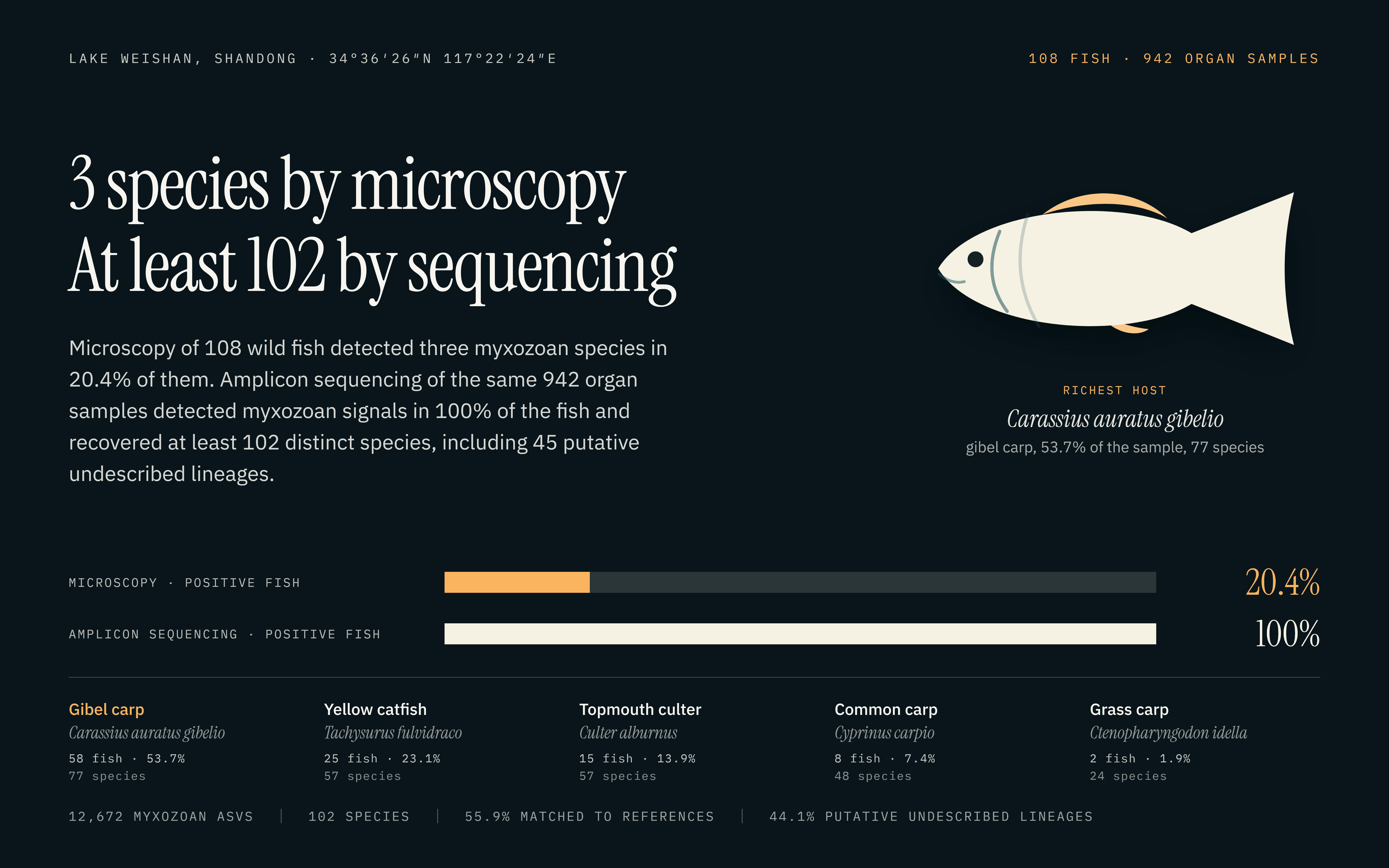
In 2026, researchers looked for myxozoans, microscopic parasitic animals related to jellyfish and corals, in 942 samples from 108 fish in Lake Weishan, China. Using conventional methods, they found three species and signs of their presence in about one in five fish.
When the same samples were analysed using genetic sequencing, the results revealed at least 102 different types, with signals in every fish examined.
Finding genetic material is not the same thing as finding an established parasite. Some of those signals might correspond to organisms that were present without causing appreciable effects, traces swallowed by the fish with the water, or forms that never managed to establish themselves. We do not know how many fall into each category, and distinguishing between them is part of the problem.
Even so, the result changes the starting point. The list we had been working with was not simply a slightly shorter version of the real list. It was a list of something else: what a microscope happens to reveal. A more than thirtyfold difference in the number of types detected can appear even in the part of the problem we should be best at: figuring out who is there. That makes it hard to be optimistic about the more difficult question of what that presence means.
Ligula intestinalis is a tapeworm that lives inside fish and can reach a size that is hard to picture. In two lakes in Kenya, worms weighed as much as 20% of the fish’s body weight. In a 70-kilogram human, the same proportion would mean carrying a 14-kilogram worm. But the parasite does more than take up space. In some fish, the worm can disrupt normal reproduction.
The effects also change as the worm develops. The parasite cannot reproduce inside a fish and only becomes an adult after reaching a fish-eating bird (which means the fish has to be eaten first). In Lake Nyasa/Malawi, researchers found that fish carrying worms that had developed enough to survive inside a bird were easier to catch and spent more time near the surface, where birds hunt. Before reaching that stage, fish carrying the parasite behaved much more like fish without Ligula. This may be a form of manipulation by the parasite.
So picture two fish counted in the same statistic. One carries a worm at an early stage and behaves much like a fish without Ligula. The other carries a worm at a later stage, perhaps already enormous, and spends more time near the surface. Both simply count as carrying Ligula. And neither entry tells us how long either fish has been living in that state.
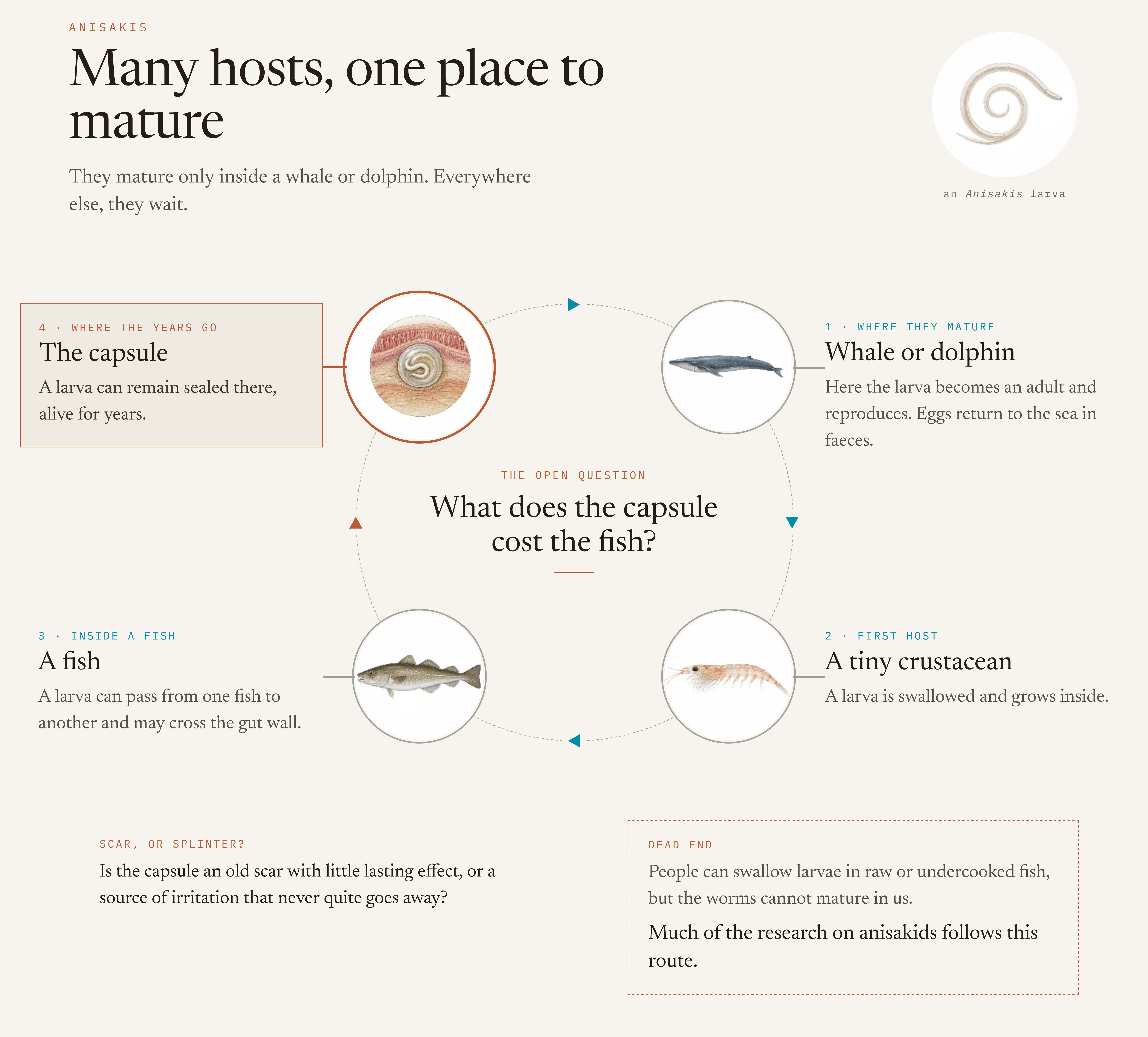
Anisakis larvae enter a fish when the fish eats another animal carrying them. Once inside the gut, they may move elsewhere in the body. In experiments, larvae taken from one fish and fed to another passed through the wall of the stomach or intestine. Most ended up in the body cavity, while a few reached the muscle. The fish may then surround a larva with a capsule. But the parasite will not become an adult there. That can happen only if the fish is eaten by a whale or dolphin. Until then, the larvae can remain alive for years.
This is not something that happens to just a handful of fish. On the central coast of Chile, 180 fish from three species were examined. In two of the three species, every individual carried anisakid larvae. In the third, roughly one in three did. The fish came from artisanal catches purchased at local markets, so this is not a perfect snapshot of what is happening in the sea, but the numbers are hard to ignore.
There is a mountain of research on anisakids. Much of that work asks what happens when people eat fish carrying them, rather than what carrying the larvae does to the fish.
What is it like to spend years with anisakid larvae encapsulated in muscle and body cavity? Two very different answers are possible, and neither can currently be ruled out. The capsule might work like an old scar, something the body dealt with once and then largely forgot about. Or it might behave more like a splinter that is never quite fully sealed off, causing a small but persistent irritation. There is one asymmetry worth noting: larger larvae are found in older fish, which suggests that the larvae remain alive and grow inside their capsules. Splinters do not grow.
The difference is the difference between a parasite that barely matters and one that makes life worse for almost every fish in some populations. It is unusual to find such a basic question still open in a field this large.
So far, I have written as though the problem were simply what happens to the fish. But if the question is how much suffering exists in these relationships, there is another part of the story: the parasites themselves.
We do not know whether anisakids, Diplostomum, or Ligula are sentient. The first are nematodes; the other two are flatworms. All have nervous systems. In free-living nematodes such as C. elegans, researchers have found responses to harmful stimuli, associative learning, and changes in behaviour based on previous experience. There are comparable findings in free-living flatworms.
Those comparisons come with an important caveat. Some parasitic worms have reduced sensory structures compared with free-living forms. This is far from universal, but it gives us some reason for caution. And the cases here are not equivalent. An anisakid larva actively migrates through tissues and can remain capable of penetrating a gut wall after long periods inside a fish. For Ligula and Diplostomum, we have much less evidence of the kinds of behaviour that would help answer the question.
Still, it is worth being clear about why we do not know more. It is not that the relevant experiments were done and produced negative results. They have barely been done at all. The indicators used to discuss whether crabs or octopuses can suffer, such as learning to avoid a place where they were harmed, giving up something valuable to escape an unpleasant stimulus, or rubbing or protecting an injured area, have hardly been investigated in these worms. The absence of evidence here is largely an absence of research.
The numbers make this worth taking seriously. A single fish can carry dozens or hundreds of larvae, so in the relationships described above most of the individuals involved are on the parasite side, not the fish side. Counting only fish leaves them all out. And the lives being left out are not obviously good ones: the great majority of these worms are digested, attacked by an immune system, or sealed in a capsule, while others die without ever reproducing.
“Fish” and “parasite” name positions in a biological relationship, not moral categories. That complicates anything we might want to do about the suffering described in this post. Deworming or treatment can kill parasites who already exist. Interrupting the life cycle may instead prevent future parasites from coming into existence. What looked like a straightforward problem of suffering may turn out to be a conflict of interests between the individuals involved.
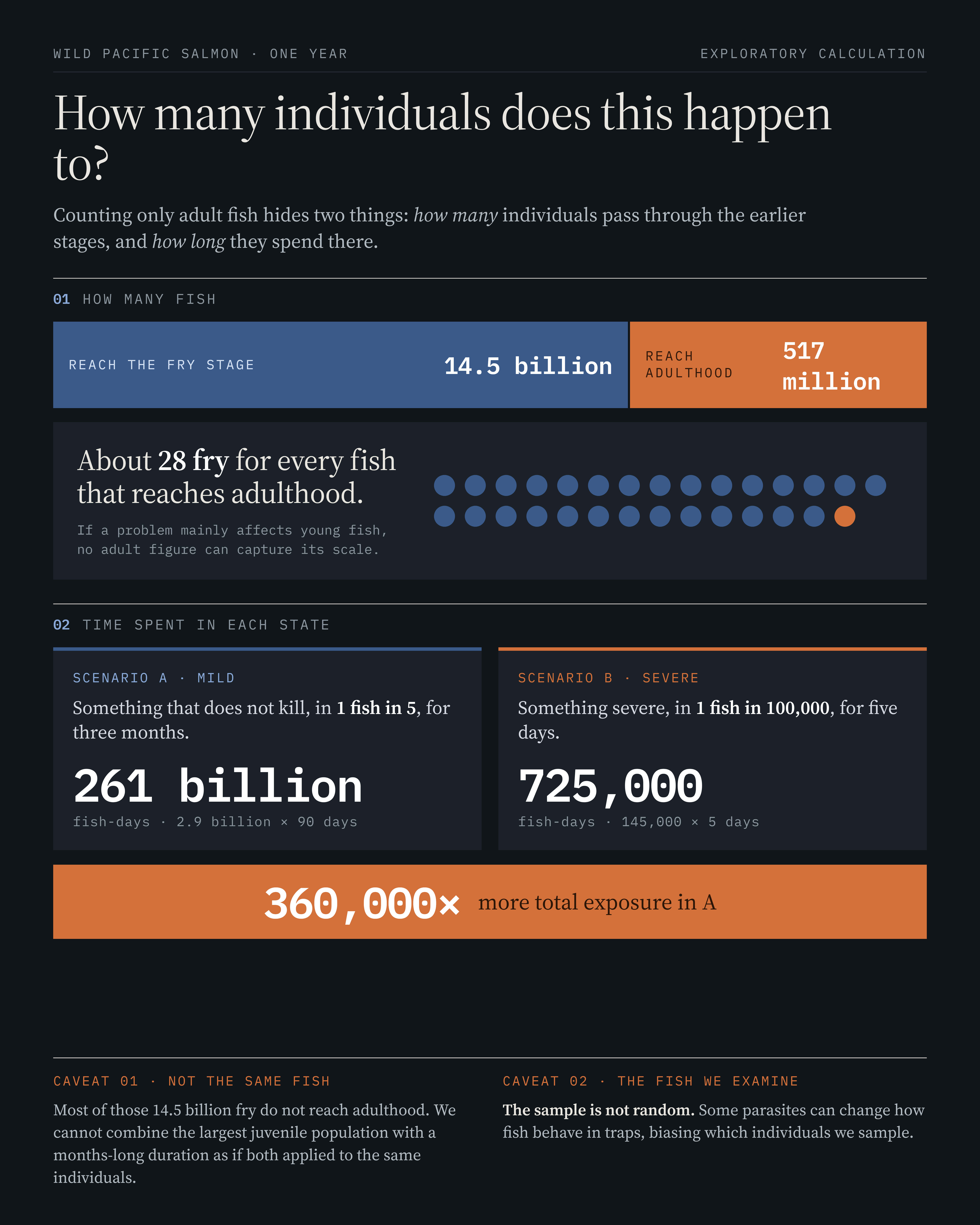
Abraham Rowe and Mal Graham of Good Structures made a useful exploratory calculation using salmon. Their model estimates that around 14.5 billion fish reach the fry stage each year, compared with roughly 517 million that reach adulthood. That is about twenty-eight fry for every fish who makes it that far.
The figures are deliberately approximate, but the difference illustrates something important. Looking only at adult fish can hide an enormous number of individuals that pass through earlier stages of life. If a parasitic relationship mainly affects younger fish, no figure based only on adults can capture its scale.
And the number of individuals affected is not the only thing we can miss. We can also miss time. Imagine a mild problem, something that does not kill, affecting one in five fish for three months. One fifth of 14.5 billion is 2.9 billion fish. Multiply that by 90 days and you get about 261 billion fish-days spent with that problem. Now imagine something horrific happening to one fish in every hundred thousand for five days. Using the same 14.5 billion as our starting point gives about 725,000 fish-days. The first scenario involves roughly 360,000 times as much total exposure as the second. What we should do with that difference is a question for the next section. For now, I only want the scale to be visible.
There is an important caveat. Most of those 14.5 billion fry die within weeks, so the fish that exist in enormous numbers at early stages are not necessarily the same fish that could spend months carrying a parasite. We cannot simply combine the largest estimate of juvenile numbers with a long duration and assume that both apply to the same individuals. The point is more modest: both the number of individuals passing through a state and the amount of time they spend in it can differ enormously from what an adult prevalence figure suggests.
And there is one more problem: the fish we actually examine. A trap only catches fish that choose to swim into it, so it tends to collect the bold and the curious. Parasites can also affect those same traits. Comparing sampling methods across freshwater fish communities, researchers found that how many parasites you find depends partly on how you caught the fish. In other words, the fish that end up in our datasets are not necessarily a random sample of the fish in the water. What we find can depend partly on how we look.
Comparing a small amount of very severe suffering with a much larger amount of milder suffering is not simply an empirical question. It is a question about how to balance intensity against duration and against the number of individuals involved.
Someone who simply adds up all the suffering can end up treating the milder problem as more important once it affects enough individuals for long enough. On that view, a 360,000-fold difference in exposure can matter enormously. Other views give more importance to preventing the worst suffering, even when it happens to fewer individuals. Some go so far as to say that sufficiently severe suffering should always come first, no matter how much milder suffering there is. Between these positions are many alternatives in which severity can matter more without deciding everything. The same comparison can therefore lead to very different conclusions depending on how much priority we give to the worst suffering.
I am not going to defend any of those views here. The point for this post is simpler: choosing a theory does not save us from doing the empirical work. Whatever view we adopt, we still need to know how many individuals are affected, for how long, and what happens to them while they are in that state. For almost every parasitic relationship discussed here, we are missing much of that information.
My bet is on anisakids, even when considering fish parasites more broadly.
That is not because I assume that relationships involving anisakids entail more suffering than those involving Diplostomum, Ligula, myxozoans, or any other parasite. What makes them stand out is the combination of scale and uncertainty. They are extraordinarily common in some fish populations, and the larvae can stay alive inside a fish for years. Yet despite a vast literature on the group, we still have almost no idea what happens to the individuals involved during that time. That is what makes them worth studying first.
I will say what would change my mind. Follow the same individually marked fish for months, count their larvae, and if the ones carrying most of them eat as well, grow as fast, move as much, and escape as effectively as the rest, I would substantially revise my view. That study needs no new technology. It needs us to measure what these fish can do instead of cataloguing what is inside them at a single point in time.
And that kind of knowledge can make intervention possible. Oral rabies vaccination has been distributed to wild animals for decades. Nothing comparable exists for anything described in this post. Nothing like it existed for rabies either, until someone did the work.
We have an increasingly good map of who lives inside wild fish. We still have nothing comparable for the suffering that may be taking place there.


Anyone running mark-recapture work on wild fish could add a parasite count to their existing protocol and check, over a season, whether load predicts feeding, growth or escape performance. A small grant would be enough to pay someone to do it.
This is a really good suggestion. One of the things that makes this question attractive is precisely that it may not require a standalone research programme: parasite counts could potentially be added at relatively low marginal cost to existing longitudinal work on wild fish.
That kind of design would also address one of the main gaps I was trying to highlight in the post. Rather than just measuring prevalence at a single point in time, it could tell us whether the number of parasites present is associated with differences in feeding, growth, behaviour, or escape performance over time.
It would be very useful to identify groups already doing mark–recapture work where this could be incorporated. Thanks for pointing this out!