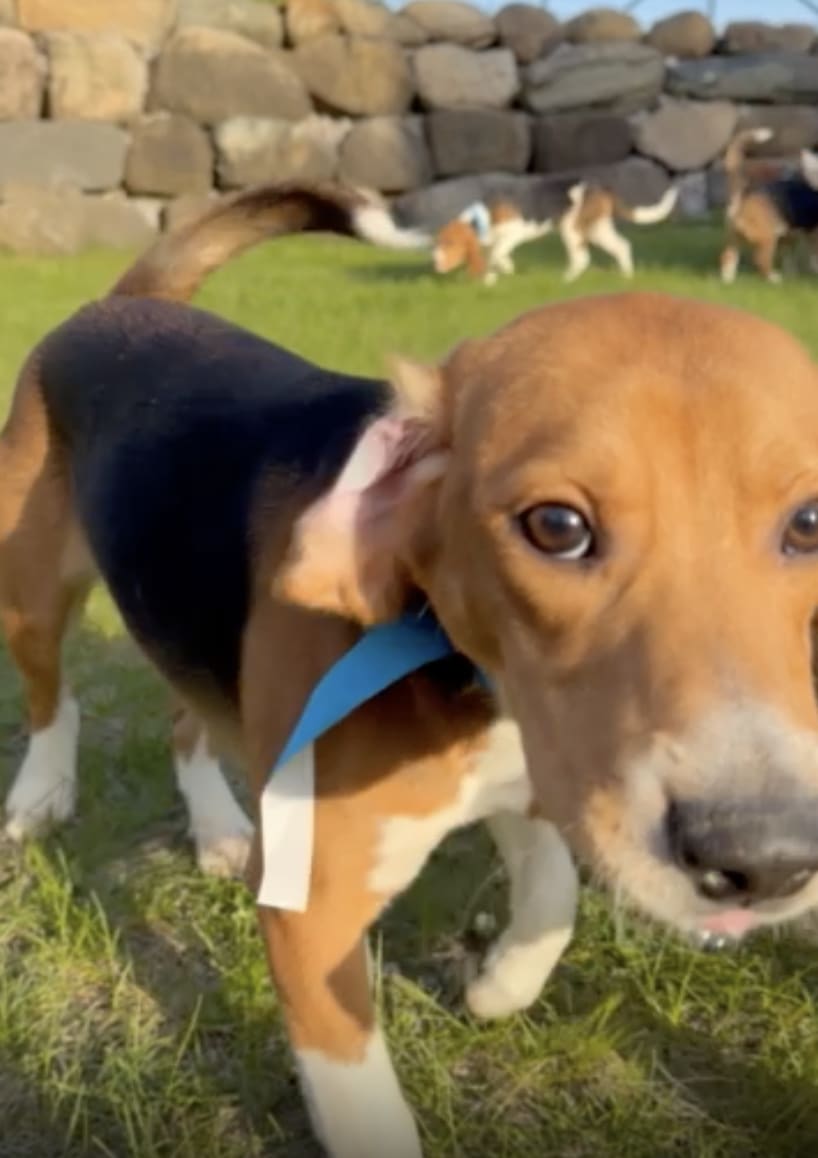
In recent months, I twice traveled to Wisconsin to join attempts to break into Ridglan Farms and rescue dogs from tiny wire cages where they would otherwise spend the majority of their lives before being subjected to horrific experiments and killed.
The first time, we were successful – around 100 humans rescued 22 beagles who have been adopted out to loving homes. I was arrested, though I still have not been charged.
The second time, we failed. Despite having around 1000 people, police turned Ridglan into a fortress, using chemical weapons and rubber bullets to repel us. I was pepper sprayed in the face. Though we didn’t get any dogs out that day, the pressure and publicity we created were instrumental in leading to the conclusion of negotiations to buy all the dogs. 1500 dogs are being saved, some of them emerging into sunlight for the first time as I write this.
I’m excited about this social movement. Social movements carry tremendous power to enact change, which I think I'm beginning to realize alongside the EA community. I'm (perhaps unreasonably) hopeful that the open rescue movement can move on to bigger things, including ending factory farming. The way the movement is currently set up, dogs and animal experiments are a sort of gateway drug to animal rights generally. So along the way to ending factory farming, we might wind up ending animal testing.
While I’m extremely confident that ending factory farming is a good thing, I’m more conflicted about animal testing. I care a lot about the animals, but I’m also the kind of utilitarian who would gladly walk into Omelas.
I was a little surprised to not easily find a utilitarian analysis of animal testing on this forum. To me, it seems squarely an EA topic: > 100 million animals are experimented on annually in the US, often enduring significant torture. On the other hand, scientific advancements are vital to reducing suffering in the near and far future.
Since I couldn't find an accessible utilitarian exploration of animal testing, I decided to take a stab at one myself. I would love feedback, particularly from people who have familiarity with the scientific elements of animal and non animal methods!
When we say animal testing, what do we mean?
Animals are used in a number of different capacities. Here are the major ones I can think of:
Testing a proposed medical intervention for efficacy (with the assumption that this will translate to humans)
Testing a proposed medical intervention for safety (with the assumption that this will translate to humans)
Safety and efficacy testing for cosmetic products
Exploratory scientific research (What happens if we deprive a cat of REM sleep?)
Safety/efficacy testing for animal medications (like a vaccine for dogs)
Of these, I feel confident in saying that the third needs to end. The others very plausibly provide significant value. I’m not going to talk much about the last one because it seems less morally questionable and smaller scale.
Is animal testing effective?
Animal rights activists are quick to claim that animal testing is useless. They cite studies showing that animal testing is not useful. This claim has always seemed a bit sketchy to me.
First of all, these low numbers (like the 5% in that study) typically only apply to the context of testing drugs that are already developed. They don’t address the utility of animals in general exploratory academic research, which may be high. For example, analysis of giant squid brains was instrumental to neuroscience.
Second, it’s not clear to me that 5% is too low to be worth it. Perhaps if we didn’t use animals, we would wind up developing far fewer drugs. Maybe all the animals in the studies that didn’t wind up working were necessary sacrifices to figure out which drugs were actually useful.
Wayne Pacelle, who was instrumental in negotiating the rescue of the 1500 dogs, cited a statistic in favor of ending animal testing: apparently, the fourth leading cause of death for Americans is adverse reactions to drugs. This is supposed to be evidence that our animal testing for safety is not working. But it seems this could just as easily cut the other way. Drug safety is a really big deal, and so we should do extra testing to make sure drugs are safe. Maybe without animal testing, adverse drug reactions would be the number one leading cause of death.
All this said, there is strong evidence that at the very least, animal studies are not very good. Here’s what Gwern said over a decade ago, more researched and eloquently than I could:
On the general topic of animal model external validity & translation to humans, a number of op-eds, reviews, and meta-analyses have been done; reading through the literature up to March 2013, I would summarize them as indicating that the animal research literature in general is of considerably lower quality than human research, and that for those and intrinsic biological reasons, the probability of meaningful transfer from animal to human can be astoundingly low, far below 50% and in some categories of results, 0%.
The primary reasons identified for this poor performance are generally: small samples (much smaller than the already underpowered norms in human research), lack of blinding in taking measurements, pseudo-replication due to animals being correlated by genetic relatedness/living in same cage/same room/same lab, extensive non-normality in data, large differences between labs due to local differences in reagents/procedures/personnel illustrating the importance of “tacit knowledge”, publication bias (small cheap samples + little perceived ethical need to publish + no preregistration norms), unnatural & unnaturally easy lab environments (more naturalistic environments both offer more realistic measurements & challenge animals), large genetic differences due to inbreeding/engineering/drift of lab strains mean the same treatment can produce dramatically different results in different strains (or sexes) of the same species, different species can have different responses, and none of them may be like humans in the relevant biological way in the first place.
That was 2013, but from what I understand, most of these issues remain.
Should we just do drug testing on humans instead?
This is not just a silly rhetorical point. There are a lot of reasons why human testing is preferable. Humans can consent; animals cannot. Humans can advocate for themselves if they are being exploited; animals cannot. Humans are a good biological model for how drugs behave in humans; animals are not. Human experiences have high ecological validity for understanding how things will affect humans; animal experiences do not. Humans can describe effects they are experiencing in language to experimenters; animals cannot. Humans can be meaningfully financially compensated for their experience; animals cannot.
For drug safety and efficacy studies, testing on humans might just mean skip animal trials entirely and proceed to human trials. Whether you do animal testing or skip right to humans, you would have already done other analyses of safety and efficacy, possibly including digital modeling, cell cultures, having scientists think about it, etc.
There are two main arguments that we should first do drug trials on animals: 1) society would never allow human testing, and 2) animals are less morally meaningful than humans.
The first of these arguments is not very strong. We already do study experimental drugs on humans. The covid vaccine was never tested on animals (perhaps this is the greatest testament to ending animal testing – when we desperately needed a vaccine, we started with humans, and it worked out). Many of us have been asked by our doctors to sign up for experimental studies. I doubt removing the prior step of animal testing would change people’s participation much.
Next, what about the idea that animals have less moral worth than humans? The moral worth of animals is a question I’ve struggled with a lot, even though I’m scared to discuss it with my animal rights friends. Animals certainly matter enough that factory farming is the greatest atrocity in human history. But if a runaway trolley was going to kill one human or three dogs, I’m not sure which track I’d choose.
People have done rigorous (and controversial) work on this: Rethink Priorities puts pigs at around 50% the moral weight of a human. This link doesn’t speak to mice and dogs, but presumably they would get similar treatment. Given this, if it’s the case that utility demands we experiment on either a mouse or a human, it seems we should choose a mouse. But that assumes that both experiments are equally effective. In reality, it is likely that human experiments model human results more than twice as well as mouse results – remember that 5% from above! And so utility demands we actually experiment on humans instead of animals.
What about other methods?
NAMs, they call it. Non Animal Methods. And it means a bunch of different methods, which seem to boil down to cell cultures, virtual models, and human volunteers.
From what I can tell, any serious scientist would agree that NAMs are good as, at the very least, a supplement to animal testing. NAMs can and already are augmenting, reducing, or fully replacing animal testing in some areas. NAMs increase reliability of studies. This is good. The question is, to what extent does this mean that animal testing is entirely unneeded? Does it vary area to area? And as NAMs improve in coming years, how will this change?
I don’t have a clear answer to these questions – I'm not a scientist and I have not done extensive research – though I’m suspicious that under current technology, the vast majority of animal testing is already entirely unnecessary.
Is all the harm worth it?
Let’s say animal testing does work, and that NAMs do not sufficiently replace its efficacy. This may very well be the case. Is animal testing then justified?
Some of the worst harms of animal testing, in my view, are the conditions the animals endure even when they are not being tested on. The example I know best is the Ridglan dogs – they spent the majority of their lives in tiny indoor cages, and had routine eye surgeries performed without anesthetic. I don’t know as much about mice and other animals but I doubt they are in a mousy paradise when they are bred in bulk and shipped around to labs. The stories I’ve heard from scientist friends indicate that welfare standards are bad and compliance is worse.
It occurs to me that at the very least, if we are to experiment on animals, they should be given good lives, and treated like royalty. But treating animals well might make it hard to operate animal testing at scale, just as treating farm animals humanely would result in there being orders of magnitude fewer farm animals. So if we view animal testing as necessary, it may be the case that poor treatment of animals is necessary too, to ensure we operate at scale and advance science and medicine rapidly.
There are other harms to animal testing. It is financially costly and takes a significant toll on the psyches of the experimenters. These costs probably pale in comparison to the harm to the animals, though.
And then there are the actual experiments the animals must endure. These range from benign to horrific. Is this worth it?
Before I became animal rights pilled, I laughed at an experiment I heard about in undergrad. The goal was to understand how thirst works, and there were two hypotheses: either thirst was a result of a dry mouth, or thirst was a result of a body lacking hydration. To tease these apart, experimenters cut out a dog’s esophagus while keeping the dog alive. Instead of the esophagus leading from the mouth to the stomach, they had the esophagus lead from the dog’s mouth to the ground. When the dog drank water, water went down the dog’s throat, and then spilled on the ground. The dog kept drinking and drinking and drinking, and yet it could not quench its thirst. Thus, we know that thirst is not merely a function of how dry your mouth is.
I don’t know what happened to the dog after. If it was lucky, the dog was humanely euthanized as soon as possible. If not, it probably died from dehydration. I do not know how many dogs they had to go through until they got the surgery right. I hope it wasn’t many. I don’t know how useful the study was. Now we know something about thirst that really should be obvious to anyone who has a mouth and thinks about it for twenty seconds. I don’t know if this study could have been done in a less harmful way. Perhaps a human could have been instructed to keep water in their mouth for a couple hours without swallowing, and then report if they are thirsty. I don’t know if this allowed us to develop any important technologies. I can’t think of any.
That said, animal studies have absolutely been incredible for the development of modern medicine. We have treatments for so many diseases, we know about nutrition and lifestyle and vaccines. Even a lot of suffering might be worth it if it helps thousands of generations of humans.
But will it? There is the idea that NAMs, and particularly AI, will advance within the near future to be able to make all these advances without the use of animals. Perhaps all these things would be solved in 10 years. But what if 1,000 humans will die of a certain painful cancer before then unless we conduct painful radiation experiments on 50,000 mice this year. We’ve got another runaway trolley – would you pull the lever?
Conclusion
The movement is now thinking about MBR Acres New York, the final major dog breeder for experiments. MBR holds thousands of other animals including cats, ferrets, and pigs. I do not yet know if we will be doing protests, political organizing, media, some crazy shit (nonviolently), or all of the above. Regardless, it is a great opportunity to end dog testing in the US, and to channel a lot of this energy into other animal causes. In particular, towards saving farmed animals, but also, likely to ending animal testing. From what I can tell, this is a good thing.
I want to start by noting that I am amazed and somewhat in awe of what's been accomplished by the EA animal welfare movement. I am enthusiastically supportive of all campaigns that make living and dying conditions less bad for farmed animals.
I worked on such campaigns for almost 20 years, and I'm proud of that work.
That said, I do think it's a strategic error that the EA animal movement has so thoroughly moved on from advocacy for animal liberation and diet change.&n...
Author: Grace Ryba (she/her), Executive Director
TL;DR:
* BluePerch is a new animal welfare grantmaker.
* Grant applications aren't open yet - we're aiming to open applications in roughly mid-2027.
* We welcome early expressions of interest from potential grantseekers so we can notify you when applications open - express your interest here or see further details below.
* We're also seeking boa...
The National Risk Register is a morbidly fascinating document I've stumbled across recently. It aims to provide the UK Government's public-facing opinion on what the most serious risks facing the UK are. It's unclear how much this document is used in justifying internal decisions made across UK Government. However, one document its cited in is the Pandemic Prepared...