Thought it worth recommending Bryan Caplan’s “Open Borders: The Science and Ethics of Immigration”, which I’ve read and found to give a good overview of the argument in favour of increasing levels of immigration and making borders more open.
Headline finding: I audited 17 AI Safety Talent programmes. Zero of 17 have published any comparison group, rejected-applicant follow-up, matched control or randomisation. Not one. Every programme that mentions a counterfactual does it by asking participants to self-report.
Background
At least $70 million...
I want to start by noting that I am amazed and somewhat in awe of what's been accomplished by the EA animal welfare movement. I am enthusiastically supportive of all campaigns that make living and dying conditions less bad for farmed animals.
I worked on such campaigns for almost 20 years, and I'm proud of that work.
That said, I do think it's a strategic error that the EA animal movement has so thoroughly moved on from advocacy for animal liberation and diet change.&n...
Author: Grace Ryba (she/her), Executive Director
TL;DR:
* BluePerch is a new animal welfare grantmaker.
* Grant applications aren't open yet - we're aiming to open applications in roughly mid-2027.
* We welcome early expressions of interest from potential grantseekers so we can notify you when applications open - express your interest here or see further details below.
* We're also seeking boa...
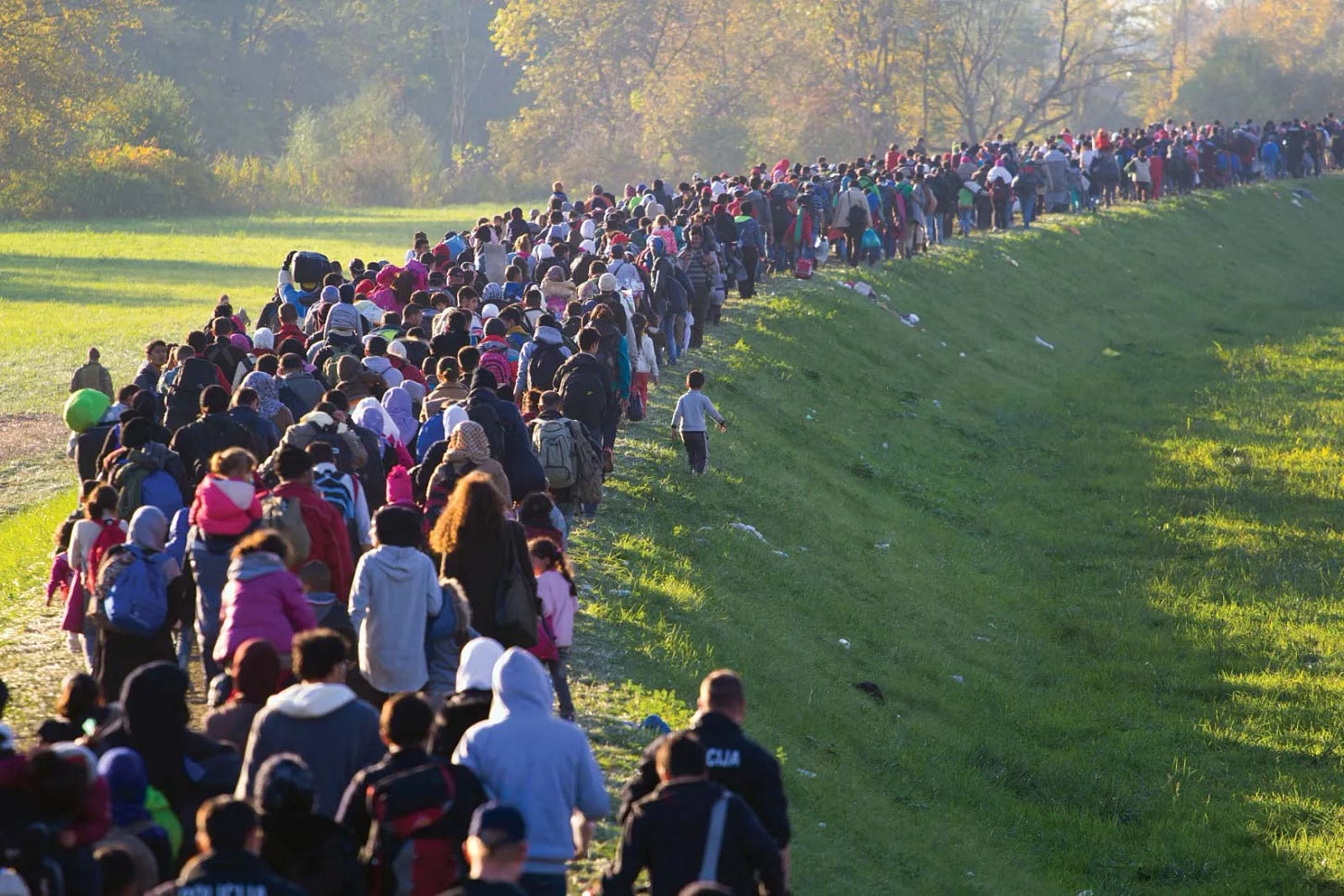
One point stood out: even if open borders (or a relatively more relaxed immigration policy) would have some costs (perhaps a higher burden on the welfare state or increased crime in some cases) to receiving countries, these costs would pale in comparison to the benefits that would accrue to newcomers. They would be able to escape conditions of (often dire) poverty and seek new opportunities. From a cosmopolitan perspective, receiving countries, especially in the developed world, should then be willing to pay some cost to enable this to happen.
We ended up discussing at some length Peter Singer’s famous drowning-child case. The thought experiment goes as follows. Suppose you are walking by a pond and you see a child drowning in it. However, you are dressed in a nice suit and shoes, which will be ruined if you jump in to save the child. (So, saving the child is not costless for you.) May you walk on by? The natural thought is: no. The cost to you is insignificant compared with the value of the child’s life.
Singer then goes on to argue that mere distance is not morally relevant. It shouldn’t matter that the child in the pond is nearby, whereas the global needy (suffering from famines or malaria epidemics) are far away. Singer thus thinks that we are obligated to donate substantially to global poverty relief.
EffectiveAltruists (EAs) build on Singer’s ideas to argue that we should use the best available evidence to figure out ways to do the most good in the world. Some causes will be much more effective at relieving suffering than others (compare: donating to malaria reduction vs. giving to the local opera house). EAs then contend that we should prioritize the more effective causes, other things equal.
What should EAs think about migration? An initially plausible thought is that they should favor much more open borders (if not fully open borders). From a consequentialist, cost-benefit perspective, this would yield the most good. Hundreds of millions (if not billions) of lives would be greatly improved as people relocate to find new opportunities. The costs to those living in developed countries would pale in comparison—just as the cost of having one’s suit and shoes ruined in Singer’s pond case pales in comparison.
Here, I want to raise some worries for this initial thought. I’m not arguing against EA; I think it’s a plausible doctrine. What I want to contest is whether this initial cost-benefit analysis is accurate, given the evidence we have about migration, institutions, and prosperity.
2. Immigration and Institutions
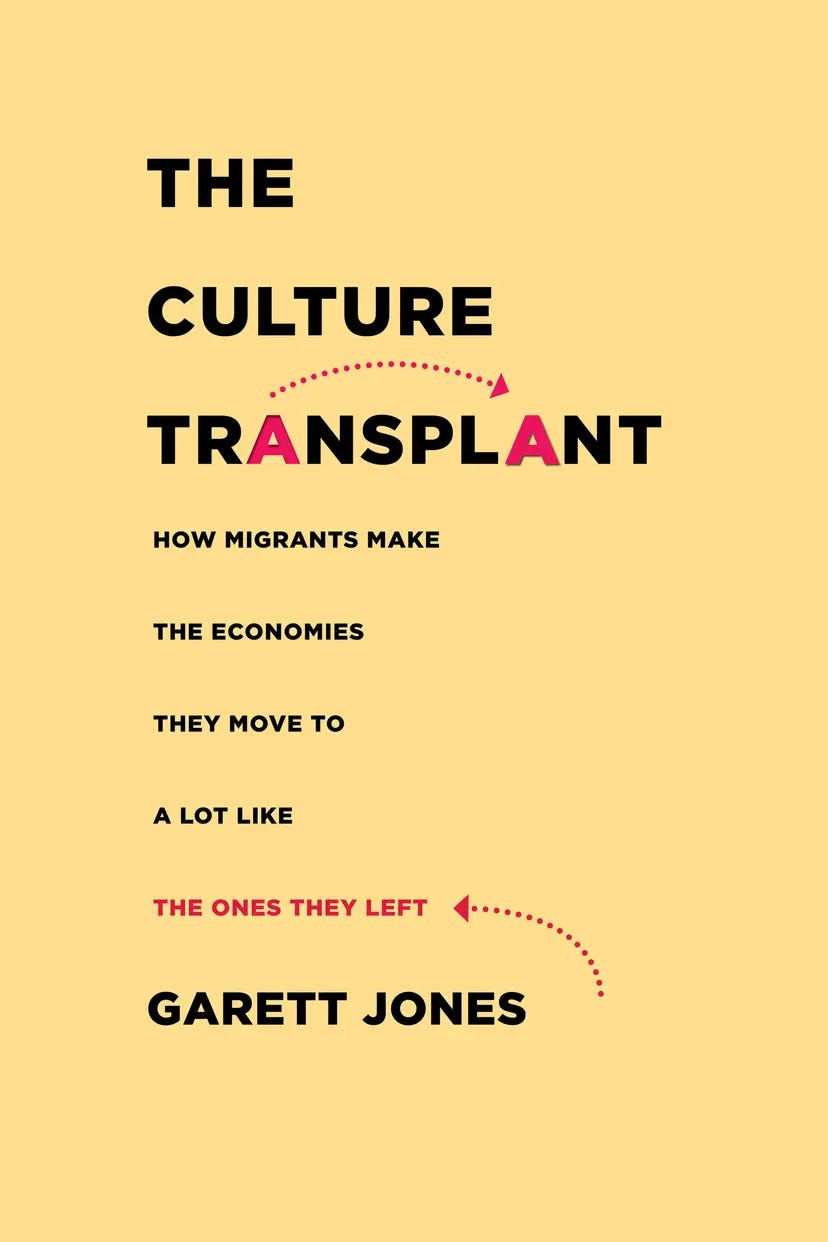
In recent years, the economist Garett Jones has, more than anyone else, defended the idea that migration changes institutions. In his provocatively titled book (pictured above), Jones marshals a range of historical evidence to argue that as people have migrated over the past several hundred years, they have changed the institutions of the receiving regions. And absent reasons to think the current moment is special, this is a pattern we should expect to continue in the future.
What are ‘institutions’ in this sense? Economists think institutions are the preconditions for prosperity, more than anything else. Good institutions include, inter alia, things like the rule of law, low rates of corruption, and robust markets.
When we look around the world, we observe significant inequality in development and prosperity. Commonly cited causes of this include (i) inequality in natural resources, and (ii) past colonization (explaining why colonizing countries are rich and colonized countries are poor).
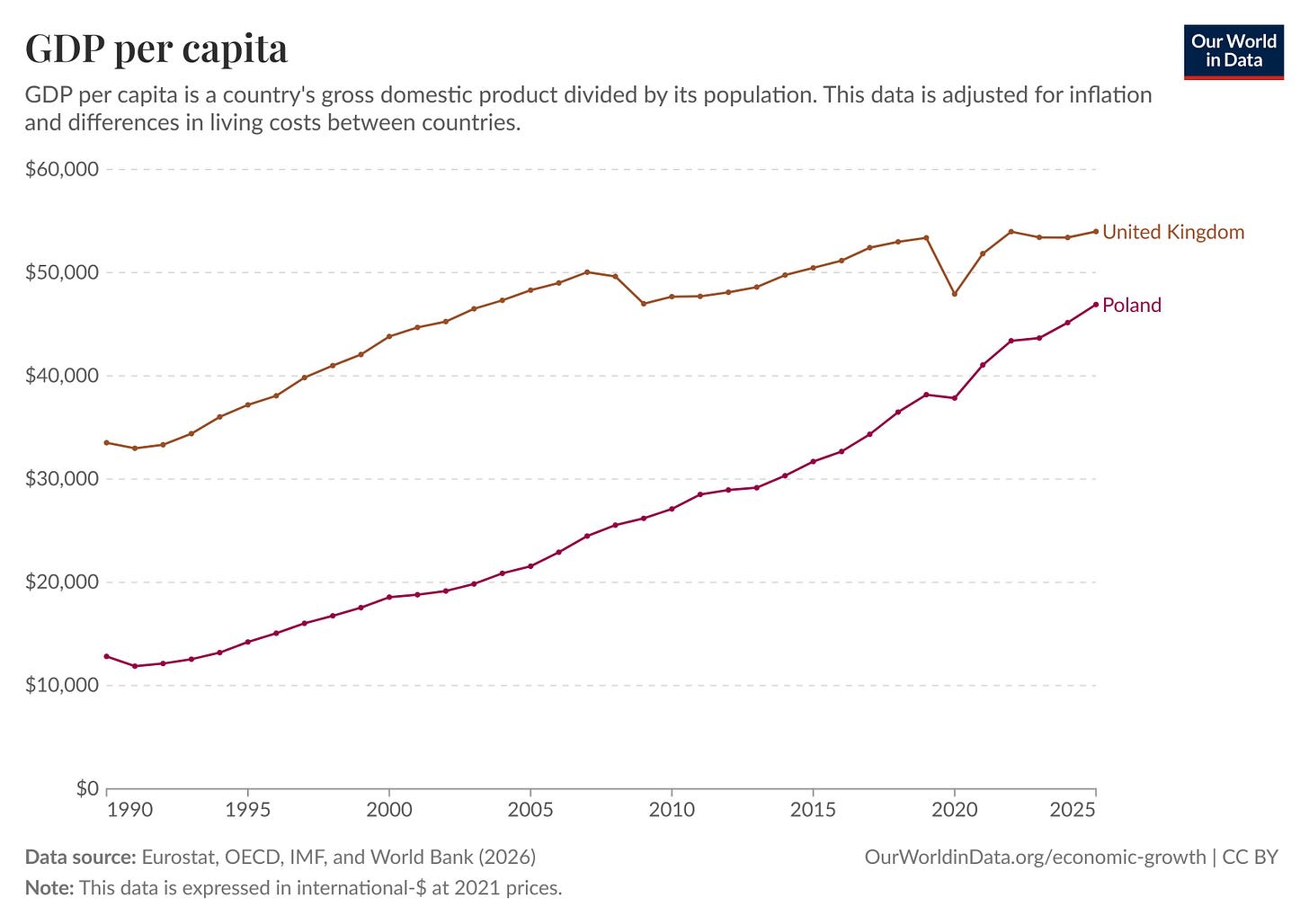
But counterexamples quickly pop into mind. South Korea and Japan do not have significant natural resources (in terms of oil or minerals) but are very rich. Lots of countries with significant natural resources (e.g., Venezuela or the Democratic Republic of the Congo) are poor. South Korea and Iceland did not have colonial empires—indeed, both were ruled by others—but are quite prosperous. Portugal and Spain had large colonial empires (in fact, they divided up the entire New World between themselves in the 15th century) but are nowhere near the top of the GDP per capita list. And Poland is catching up fast with the U.K., the former seat of the British Empire. If trends continue, Poland will overtake it within a decade or two. Ethiopia was never colonized but remains poor. And so on.
So what explains prosperity? The economists Daron Acemoglu and James Robinson, winners of the 2024 Nobel Prize in Economics, explain in their 2012 book Why Nations Fail:
Nations fail today because their extractive economic institutions do not create the incentives needed for people to save, invest, and innovate… [I]n Argentina, Colombia, and Egypt this failure takes the form of lack of sufficient economic activity, because the politicians are just too happy to extract resources or quash any type of independent economic activity that threatens themselves and the economic elites. In some extreme cases, as in Zimbabwe and Sierra Leone, extractive institutions pave the way for complete state failure, destroying not only law and order but also even the most basic economic incentives. (p. 372)
As Acemoglu and Robinson explain, productive economic activity presupposes good institutions. To illustrate, consider investment. Suppose you want to start a construction business. Now, construction requires large outlays of capital and labor. It requires large investments, in other words. But such investment only makes sense if you live in a system where contracts are reliably fulfilled and enforced. In a system with low trust and poor rule of law, such ventures will not be undertaken.
Adam Smith famously argued that modern standards of living rely on the division of labor. But division of labor presupposes trade. And trade that requires long-term investments presupposes trust and rule of law.
If the movement of people can affect institutions, though, this must be factored into the EA calculus. As the Nobel Prize-winning economist James Buchanan once noted:
The entry of an immigrant into an ongoing social-political-legal-economic order, with a defined membership, an experienced history, and a set of informal conventions, necessarily modifies the structure of “the game itself”… Membership involves more than a joining of the economic exchange network. Membership carries with it the power and authority, even if small, to modify the political-legal-constitutional parameters within which the economic game is played. (Buchanan 2010, p. 64)
3. (How) Does Migration Impact Institutions?
The above discussion raises two questions:
Does migration influence institutions (especially over the long run)?
If so, howdoes migration impact institutions?
In the interest of keeping this post short, I will only gesture at the answers suggested by Jones’s work. Interested readers should pick up his (highly readable and engaging) book for further details. (And as a philosopher by training, I am mainly trying to draw out the normative implications of Jones’s research here.)
On the first question, we can look at historical movements of people and whether and how institutions changed in response. Jones gives several case studies of this, across the globe. One interesting case comes from the domestic (U.S.) context. A recent paper by Bazzi et al. in the Quarterly Journal of Economics finds that as Southern whites moved across the country, they influenced politics in the receiving areas, moving them in a conservative direction. As the authors put it:
More than just augmenting the conservative voter base outside the South, [Southern whites] influenced non-Southerners by building evangelical churches, diffusing right-wing media, and mixing through intermarriage and residential integration. Tracking non-Southern households, we show that exposure to Southern white neighbors increased adoption of conservative religious norms.
From the Jonesian perspective, this is indicative of a general pattern brought out by the data: as people move, they bring their culture with them. To simplify: if you move the median person in sufficiently large numbers from A to B, then the culture and institutions of B will increasingly come to resemble the institutions of A. Culture in this sense involves not just surface manifestations like food, dress, or festivals, but also deeper social norms as well as economic and political attitudes.
On the second question, a range of findings is relevant. Below, I note two:
Corruption migrates. A paper from Dimant et al. looks at data from receiving OECD countries and 207 origin countries from 1984 to 2008. They find that “Independent of the econometric methodology, we consistently find that while general migration has an insignificant effect on the destination country’s corruption level, immigration from corruption-ridden origin countries boosts corruption in the destination country.”
Trust migrates. A paper from Algan and Cahuc in the American Economic Review notes that trust is (at least partially) passed on generationally and affects economic growth. They find that “[i]nherited trust turns out to explain a significant share of the economic backwardness of developing countries and an important share of economic differences between developed countries over the twentieth century” (p. 2086). Building on such results, Jones contends that “about 40 percent of the attitude toward trust from an immigrant’s home country is passed on to second-generation immigrants—and about the same 40 percent persists for at least four generations—to the migrant’s great-grandchildren” (p. 17). Why is trust important? The economist Kenneth Arrow noted that “virtually every commercial transaction has within itself an element of trust, certainly any transaction conducted over a period of time. It can be plausibly argued that much of the economic backwardness in the world can be explained by the lack of mutual confidence” (p. 357). Well-functioning markets require trust, and interpersonal trust correlates strongly with GDP per capita.
4. The I-7 and the Precautionary Principle
Jones notes that much of the scientific, technological, and medical development that the world relies on comes from a handful of countries he calls the I-7 (the innovative seven): South Korea, Japan, China, Germany, France, the U.K., and the U.S. Whether it is vaccines, transportation, medical instruments, solutions to climate change, or new agricultural techniques, these are highly likely to originate—in terms of research and development—in the I-7.
Norman Borlaug (pictured below) made the discoveries behind the “Green Revolution,” developing high-yield, disease-resistant grain varieties. His work is often credited with having saved hundreds of millions of human lives across Latin America, South Asia, and Africa. He worked in the United States.
Presumably, Borlaug’s work would not have been possible without well-functioning institutions to facilitate his research. From an EA perspective, then, it is especially important to ensure that the institutions of the I-7 remain robust.
Now, you might not immediately accept Jones’s conclusions. There is a lively debate to be had. But even if we give some significant credence (say, 25%) to the core idea of The Culture Transplant, the precautionary principle applies. That is, even if we do not know the exact cause-and-effect relationships behind the migration of institutions, or if we are uncertain about the effects, it still behooves us to be cautious about proposing open borders, given what is at stake. If it turns out that open borders mean the I-7 can no longer innovate at previous rates, that would be bad not just for the I-7, but for the rest of the world as well. Even cosmopolitan utilitarians should thus be wary of proposing open borders.
Disclaimer: None of this entails a policy of closed borders. (At any rate, as an immigrant myself, it would be hypocritical of me to defend such a policy!) Neither does it justify current migration policies in the U.S. and elsewhere as they stand.
5. The Epistemic Preconditions of Effective Altruism
The EA movement prides itself on a kind of hyper-rationality. We should do our epistemic due diligence, using the best available evidence to take the most effective means to making the world a better place. So far, so good.
But having access to the best evidence requires having our epistemic house in order. As it stands, immigration is a very hotly debated topic. Academics, who largely fall on one side of the political spectrum, are hesitant to defend conclusions in favor of immigration restrictions—lest they begin to sound like modernpopulists. Jones is an outlier here.
In order to make the most effective interventions in the world, we need to have a good sense of what the world is like in the first place. And this requires allowing open discussion, where a range of researchers can bring a diversity of evidence to the table. If immigration researchers are hesitant to discuss or publish work that goes against the grain, chances are we will have a distorted view of reality.
Given how important the issue of immigration continues to be around the world, and how crucial it is to get it right, it is of paramount importance that we go in with the best evidence. This is something EAs in particular should be on board with.




Thought it worth recommending Bryan Caplan’s “Open Borders: The Science and Ethics of Immigration”, which I’ve read and found to give a good overview of the argument in favour of increasing levels of immigration and making borders more open.