This blog has been co-authored by Prerna Choudhury, Lant Pritchett, and Rebekah Smith.
We’ve been intrigued by the EA income-doubling models because we work in an intervention area (cross-border labor mobility) that targets 3 to 4 income doublings (8-16x) for people from low-income countries. Looking into it, we found ourselves on this forum via an anonymous blog quoting Lant Pritchett’s work on how immigration could, ‘from a longtermist point of view…be one of the most important mega-trends in the coming decades.’
The reality is that this is a mega-trend that is ‘medium-termist’ at best and it is happening now. The first comment on the blog, in fact, cites a paper claiming that all of Japan’s poor economic performance relative to other developed nations since the 1990s can be explained by its demographic shift—specifically the decline in the population share of working-age adults.
The comment goes on to say that Japan has not ‘drastically liberalized its immigration’ — which was once true but may no longer be. Japan now runs one of the more sophisticated systems for international labor migration, across three pathways: the Technical Intern Training Program (TITP), the Specified Skilled Worker (SSW) program, and the High-Skilled Professional Visa (Gijinkoku). Together they allow foreign workers to fill roles in shortage sectors like auto repair, construction, agriculture, care work, hospitality, and IT.
For context: We represent Labor Mobility Partnerships (LaMP), a global organization building the systems architecture for cross-border labor mobility. We're here to learn, explore, and understand how the EA community thinks about systems-level work alongside direct impact. But first, here’s what we’re working on, and what the numbers look like through an EA lens.
The Opportunity: Two Demographics, One Solution
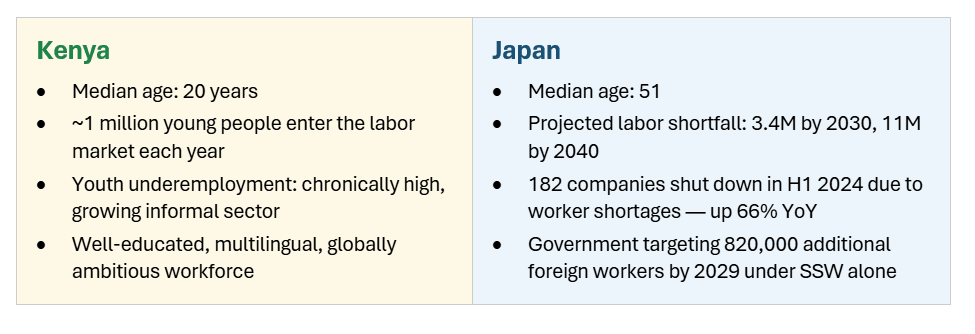
Kenya has one of the youngest populations on earth. Japan has one of the oldest. That gap is the defining economic challenge facing both countries over the next few decades.
Japan is already moving: the number of foreign workers surged by 250,000 last year — the largest increase since records began in 2008 — reaching 2.3 million total. Its B2B recruitment model, which harnesses private-sector networks, has let it scale labor mobility faster than most other OECD countries. To roughly size that impact conservatively: if the average migrant earns 4x more in Japan than at home — call it $1,600 a month — and remits a third of that, or about $530, last year's 250,000 additional workers alone represent something like $300M in income gains and $133M in added remittances.
The Japanese government isn’t stopping there. In 2027 it will replace TITP with a new Training & Employment Program offering clearer career paths, stronger worker protection, and more visa flexibility.
Kenya—or broadly, Africa—isn’t yet part of this story in any meaningful way. If you care about labor mobility as a tool to reduce poverty, you have to focus on origin countries in Sub-Saharan Africa. In the long run, we think the biggest opportunities for Africans will be in Europe (which also offers higher income multiples), but Japan’s developed mobility systems created an immediate demonstration opportunity. We seized it and have now supported Kenyans to work in Japan through these channels for the first time. Now we’re building the systems architecture needed to make these income-multiplying opportunities available at a much larger scale.
The Numbers: Why Migration Is Hard to Beat
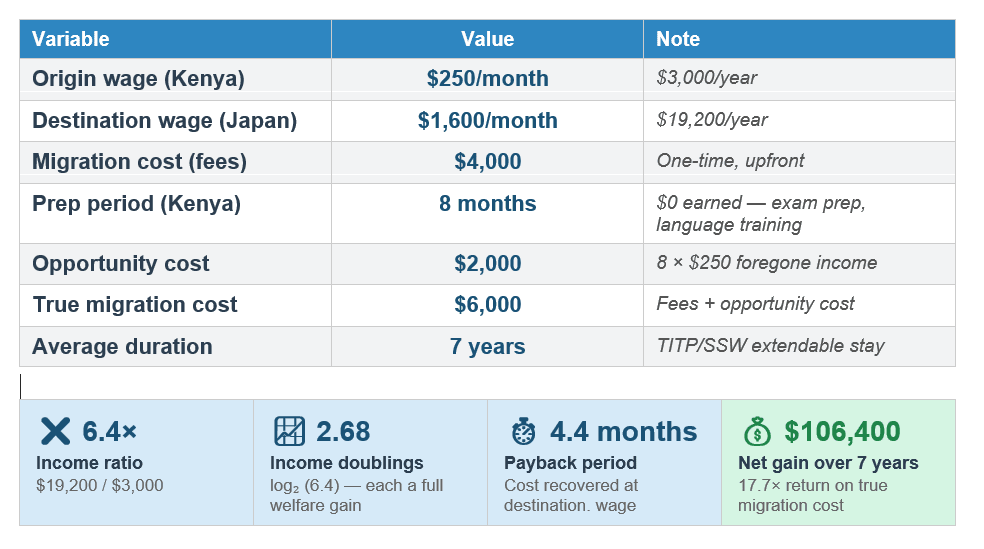
We ran the EA income-doubling framework on the Kenya–Japan corridor. With real numbers from our pilot, and conservatively assuming no raises and capping income gains after just 7 years, the results are striking. Here are the inputs:
The Kenya–Japan corridor, as modelled here, delivers $106,400 in net gains over seven years, with opportunity and preparation costs matched by earnings in 4.4 months, and driven by 2.68 income doublings that compound across the full duration of stay. The $7,000 true migration cost — including preparatory time — looks large relative to origin income, but is tiny relative to even medium-term gains.
Project Yasuke: What We've Already Built
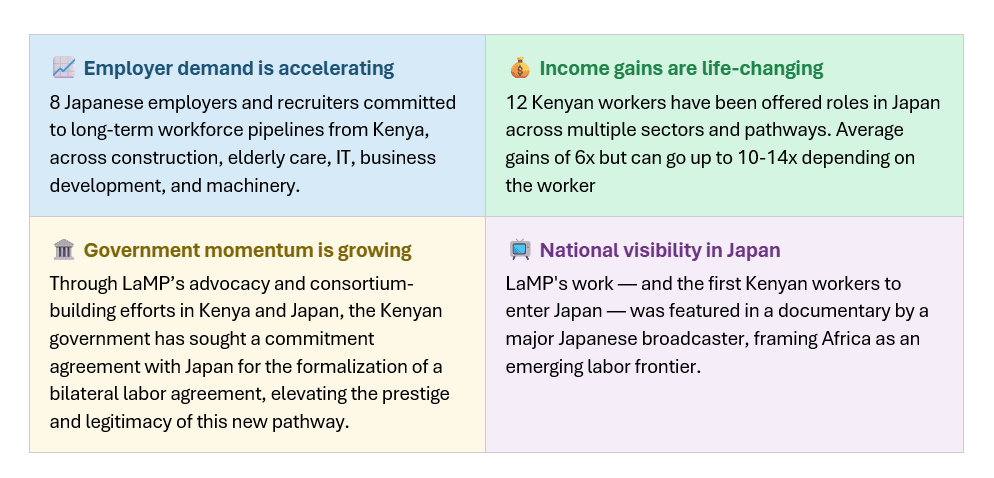
For the past two years, LaMP has been constructing the Kenya–Japan labor corridor — connecting Kenyan workers with Japanese employers through a safe, rights-respecting pathway. Our focus is less on placement than on building the early architecture of a new labor partnership between two nations, especially as there is no established migration corridor between the two countries. This approach to building architecture is what makes this a medium-term rather than a short-term play.
From Pilot to Pathway: The Case for Systems Building
A challenge we share with others building in labor mobility: impact is slow at first. Most of the early effort goes into building the system and proving initial placements before anything can scale.
Labor corridors don’t emerge spontaneously. They require first movers — organizations willing to blaze a trail before the road can be built. You have to prove a corridor works, and that there’s interest in scaling it, before public and private actors will commit to sustaining and growing it. Malengo did this for Uganda-to-Germany educational migration: they took the first students through, built the legal and operational infrastructure, and demonstrated the model before private concessional capital followed a previously fully grant-funded model.
LaMP now has enough momentum in the Kenya–Japan corridor to move past early experimentation. Our role is to build infrastructure, coordinate stakeholders, and absorb the early risk until governments and markets can sustain the pathway on their own.
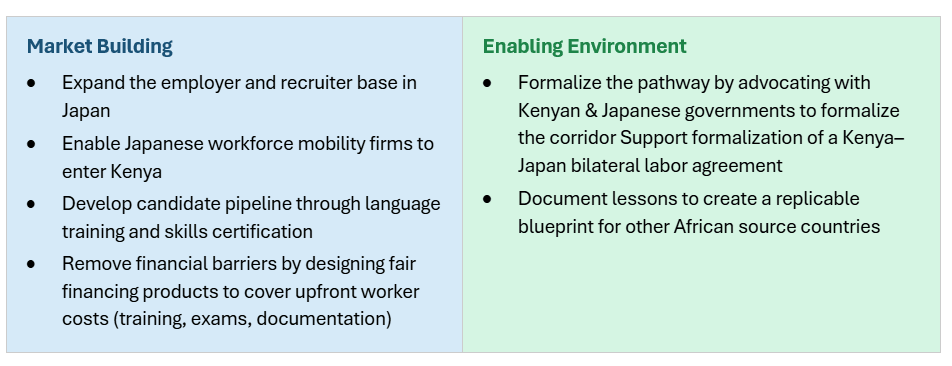
From early placements, we’re now focused on securing public-sector buy-in to formalize the corridor through a memorandum of understanding (MoU) between the governments of Kenya and Japan. Without an MoU, our work won’t progress beyond the initial placements — which is why this phase means balancing demonstration (proving this is possible) with the harder task of making it durable.
The work ahead spans two interconnected dimensions:
As the infrastructure matures, cost per worker placed should fall and placements should accelerate without more philanthropic funding. The migration cost modelled above reflects an early-stage corridor; as language schools, recruitment firms, and policy frameworks solidify, future workers move through a system that already exists, making each placement cheaper and faster. That’s the return on infrastructure investment: it compounds across every worker who uses it.
It's important to note that the Kenya to Japan corridor does not meet the definition of "low-hanging fruit" for labor mobility. It's quite far in distance and perception from the usual source countries that send workers to Japan e.g. Philippines, Vietnam, etc. The lack of local testing centers in Africa adds to the costs, and there are some limits to what we can do to catalyze the signing of a critical bilateral labor agreement by the end of 2027.
On the other hand, by breaking completely new ground, it is very easy to see the causal chain between our interventions and transformative income gains - attribution is clear. And by working on a corridor that seems unlikely on its surface, we are able to address some of the common questions raised about the labor mobility overall theory of change: we can show that employers and host communities do recognize value, and that worker can thrive, even in places without a rich history of welcoming foreign workers.
None of this is fast, though — this is the tension we grapple with every day. LaMP isn’t a direct service-delivery organization, and the path from systems investment to lives changed is longer and harder to measure than a placement count. How does the EA community think about that tradeoff: is expected-value reasoning enough to justify systems-level work, or does the difficulty of attribution make it hard to evaluate seriously? What would make this kind of work legible to EA frameworks?
A closing thought: the name Project Yasuke comes from the first recorded African to reach Japan — a man named Yasuke, who arrived in 1579 and served as a retainer to the warlord Oda Nobunaga. It’s a reminder that this connection between Africa and Japan isn’t as new or improbable as it might seem. What’s changed is that today there’s a structural economic logic behind it, and the beginnings of a corridor that can make it accessible to more than one person.
LaMP is still early on this journey. We’d love to hear reactions from this community: where do you see the model breaking down, what risks are we underweighting, and how do you think about the value of this kind of infrastructure work relative to more direct interventions?
Headline finding: I audited 17 AI Safety Talent programmes. Zero of 17 have published any comparison group, rejected-applicant follow-up, matched control or randomisation. Not one. Every programme that mentions a counterfactual does it by asking participants to self-report.
Background
At least $70 million...
I want to start by noting that I am amazed and somewhat in awe of what's been accomplished by the EA animal welfare movement. I am enthusiastically supportive of all campaigns that make living and dying conditions less bad for farmed animals.
I worked on such campaigns for almost 20 years, and I'm proud of that work.
That said, I do think it's a strategic error that the EA animal movement has so thoroughly moved on from advocacy for animal liberation and diet change.&n...
Author: Grace Ryba (she/her), Executive Director
TL;DR:
* BluePerch is a new animal welfare grantmaker.
* Grant applications aren't open yet - we're aiming to open applications in roughly mid-2027.
* We welcome early expressions of interest from potential grantseekers so we can notify you when applications open - express your interest here or see further details below.
* We're also seeking boa...