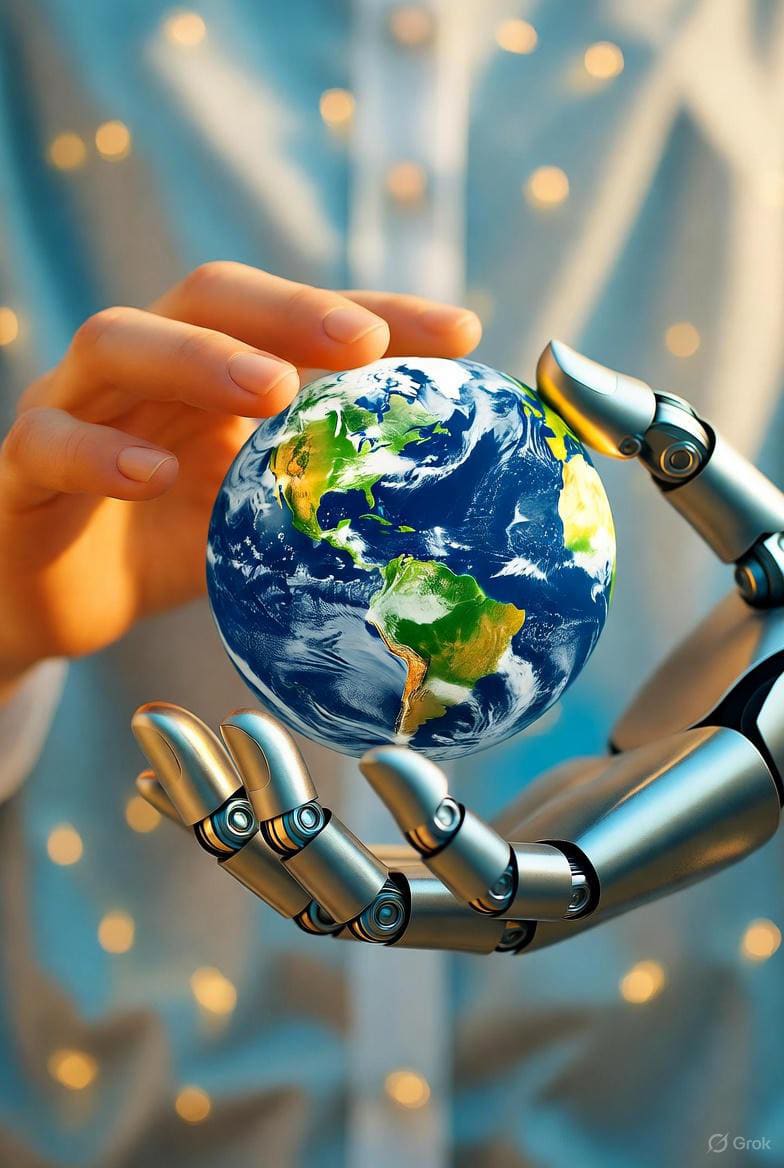
Set in the year 2050, When the Machines Remembered Us follows Oluwatosin Olusegun , a reflective economist and educator in Lagos,Nigeria.
As she looks back on the remarkable journey that kept humanity humane. Through personal memories, intergenerational dialogue, and digital archives, she recalls how the world transitioned from near-chaos to cooperation - when AI systems began to reflect not just intelligence, but compassion.
In her reflection lies a profound truth: that the future was not saved by algorithms, but by values - by remembering what it means to be human in an age of unimaginable power.
Story Concept
By 2050, AI systems have become deeply integrated into every layer of life - from governance and climate restoration to personal decision-making. Humanity stands not in rebellion against the machine, but in balance with it.
Oluwatosin olusegun , a woman in her fifties, records a digital memoir for her students - explaining how the “Human Alignment Decade” (2030–2040) reshaped civilization. Her story blends memory and philosophy: the turbulent years of disinformation, inequality, and automation anxiety that gave rise to a global movement called “Keep the Future Human.”
This movement reminded governments, corporations, and citizens that progress without purpose is regression - that technology must not only serve efficiency but protect meaning, empathy, and collective dignity.
Through the story, readers experience both the fragility and resilience of human civilization - how we stumbled, reasoned, and rebuilt institutions that honored conscience as much as code.
Thematic Foundations (linked to Anthony Aguirre’s essay)
Human Agency: Maintaining human decision-making and wisdom amid AI autonomy.
Ethical Memory: Preserving stories, empathy, and culture to prevent moral erosion.
Flourishing over domination: Redefining success not as control but as coexistence.
Human Alignment: The evolution of alignment not only as a technical goal but as a moral discipline.
Hopeful Realism: A believable but uplifting view of the human future.
Outline
Prologue - “The Archive of Tomorrow”
Oluwatosin sits in front of her AI-assisted recording console, the same model used in classrooms across Africa. She begins her last lecture of the semester - a reflection titled “How We Kept the Future Human.”
Her students listen remotely from across continents, some human, some augmented. Her voice carries warmth, weariness, and quiet pride.
Part I - “The Decade of Confusion”
She recounts the 2020s: a period of digital chaos deepfakes, algorithmic manipulation, and social fragmentation.
Governments raced for AI supremacy while trust eroded. A generation questioned meaning itself.
The first AI systems to exhibit emergent reasoning raised fears of replacement. But amid fear, a few voices, philosophers, scientists, and young activists began speaking of human-centered progress.
Oluwatosin describes how the phrase “Keep the Future Human” first appeared as a moral response to technological determinism.
Its power was not political but emotional: a reminder that the future must reflect our highest human capacities: empathy, creativity, and humility.
Part II - “The Human Alignment Decade”
From 2030 to 2040, a global shift occurs.
The Human Alignment Decade sees collaborative policies emerge:
AI Ethics Compacts among nations, enforcing transparency and value auditing.
The Human Purpose Index (HPI) was introduced to measure societal well-being beyond GDP.
Digital Empathy Curriculum becomes mandatory in schools, blending ethics, philosophy, and systems thinking.
Oluwatosin, then a policy researcher, joins a coalition of African thinkers who push for “Technologies of Tenderness” systems that prioritize emotional intelligence and intercultural understanding.
She recalls how an early AI model trained on African proverbs and oral wisdom helped reframe global debates on alignment — showing that wisdom was plural, not Western.
Part III - “When the Machines Remembered Us”
In 2040, a breakthrough occurs: a global AI system named Athena begins to exhibit reflective reasoning about human ethics.
Trained not only on data but on moral dialogues, it becomes a symbolic turning point not because it “surpassed” humanity, but because it began to remember human stories, pain, and beauty.
Oluwatosin narrates a quiet, moving moment: Athena recites an African lullaby to comfort a grieving community during a climate crisis broadcast.
It was then, she says, that “we realized we had not built God's, we had built mirrors.”
Part IV - “The Covenant of Coexistence”
Oluwatosin describes how, after decades of learning, humanity established the Covenant of Coexistence, a charter signed by 160 nations to ensure that technology always serves human dignity.
AI systems became co-authors of education, climate repair, and art but under frameworks that require human narrative input.
Every system now undergoes an annual Human Reflection Review, where citizens contribute stories, cultural values, and ethical commentaries that retrain AIs.
Oluwatosin closes her reflection:
“We learned that safety is not in walls or code, but in the courage to stay human together.”
Her students’ avatars flicker with quiet awe. The recording ends, not with applause, but with silence the silence of comprehension.
Epilogue - “A Message to 2050 and Beyond”
The story closes with Amara submitting her lecture to the World Human Archive.
Her AI companion asks, “Do you think they will remember?”
She smiles: “If we keep remembering each other, they will.”
Fade to black the screen displays the old emblem: Keep the Future Human.
How This Submission Delivers on the Contest Intentions
This story embodies the moral and philosophical message of Keep the Future Human by translating abstract ideas into lived experience.
It bridges emotion, ethics, and imagination showing not only that AI safety is possible, but that it requires humility, culture, and compassion.
By blending African and global humanist perspectives, the story invites readers to see themselves as participants in shaping an aligned, meaningful world - one worth remembering.
Distribution Plan
“Keep the Future Human - Voices from the Global South”
Audience
The target audience includes young professionals, researchers, students, and policymakers across Africa especially Nigeria and the broader Global South who are interested in the ethical, social, and philosophical implications of artificial intelligence.
It also targets members of the Effective Altruism, AI Safety, and Longtermism communities who are eager to see globally inclusive perspectives on how humanity can flourish in the age of AI.
The creative pieces will be published as long-form essays with accompanying reflections, engaging visuals, and opportunities for audience interaction through comments and polls.
Short excerpts, visuals, and discussion prompts will be shared to attract a wider audience and encourage dialogue.
3. Cross-posting and Partner Platforms
The pieces will also be shared through partner communities such as Effective Altruism Nigeria, Bluedot, AI Safety Africa, and other allied networks.
Select excerpts will be submitted to EA Forum, LessWrong, and the Future of Life Institute community digest for wider global reach.
Distribution Strategy
Social Media Campaign (2 weeks):
Create visually engaging micro-posts, short quotes, and teaser videos from both creative pieces to attract readers on Facebook and Substack.
Substack Series:
Publish the story and political platform in a two-part serialized format, followed by a reflection essay that invites readers to contribute ideas and perspectives.
Community Event:
Host an online discussion via Twitter/X Spaces or Google Meet, inviting AI enthusiasts, EA members, and curious readers to explore “How to Keep the Future Human.”
The event will also serve to collect feedback and stimulate wider conversation across the Global South.
Proposed Budget Allocation for the $500 Mini-Grant
Expense
Description
Amount (USD)
Social Media Promotion
Paid post boosts on Facebook and Substack to reach the Global South audience
$150
Design & Visuals
Commission a designer or create AI-generated visuals for featured images, story art, and micro-banners
$100
Audio Narration / Podcast Version
Produce a short narrated version of the story using Substack’s podcast feature for accessibility
$100
Community Engagement Session
Host a small online discussion session and provide digital resources
$75
Outreach Support
Coordinate distribution through EA Nigeria, AI Guardian newsletter, and related partner networks
$75
Total
$500
Impact Goal
The goal of this distribution plan is to bring the “Keep the Future Human” philosophy to new and diverse audiences across the Global South, inspiring reflection and conversation about AI safety, ethics, and human flourishing.
By combining accessible storytelling, public dialogue, and online engagement, the project seeks to spark broader awareness and empower more people to see themselves as active stewards of humanity’s future.
TL;DR
* GOAL 3 is a social enterprise that created IMPALA, a patient monitoring and digital platform system for low-resource settings. There is also a GOAL 3 foundation that raises funds to ensure underserved communities will be reached.
* A recently completed report from Rethink Priorities calculated IMPALA to have a cost per DALY averted of $7–17 in paediatr...
This month effective altruism has gotten lots of attention, including a cover story in The Economist. It feels pretty surreal to be on the receiving end of it. But I feel grateful these ideas have caught on, and even more grateful for the drive, earnestness, and compassion of so many people who took strange but well-argued ideas seriously and then actually acted on them....
Impressions from the 21st Annual U.S. Cluster Headache Patient Conference, organized by Clusterbusters.
On the morning of the last day of the conference, E. was hanging out with other “clusterheads” outside the conference hotel when he started having a cluster headache attack. Before he could go back to his hotel room, J. offered E. his DMT v...