Meta comment - is it only me or is there something off with the references (the numbers don't match and links don't work) and with the ToC (here 'This' and 'short post' got their sub points). But only the references are an issue worth fixing imo if others have the same.
As for the content - very interesting, I'm surprised I haven't heard about that before. I think this can be very good place for discussion that attracts people willing to do good and caring about their own causes whom we might convince to start thinking about effectiveness and expanding their moral circle. And would make EA more democratic.
[partly in bullet points but I will not spend more time on this]. This short post describes existing donation parliaments as a suggestion - not a strong recommendation - mostly a FYI.
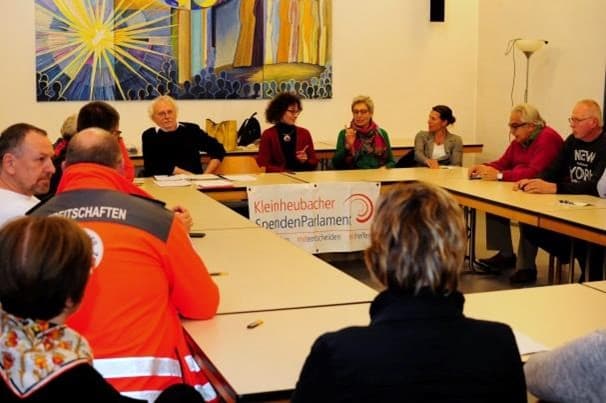
In German and Swiss donation parliaments (“Spendenparlamente”), citizens give money into a common pot and collectively decide (everyone has one vote) in parliamentary meetings how that money is distributed to (local) charities.
This makes charitable giving a public activity and encourages more deliberation about donation decisions (than the default with almost zero deliberation). It is similar to the Life You Can Save’s Giving game, but the stakes are higher and intended to be a repeated exercise, not a “game”.
I provide three very tentative reasons for why one would want to establish donation parliaments:
1. Outreach and Learning Value
Running yearly donation parliaments to encourage giving and public discussions and incentivise learning more about important cause areas and EA thinking.
The structure is similar to giving games, but donation parliament would be a repeated exercise, and the money comes from the participants.
2. Epistemic Reasons = Donation parliaments for medium-involved EAs can improve decision-making.
First, people learn more about EA and can make better decisions in the future.
Second, people spend more time deliberating and have to listen to the people they disagree with.
3. Donation parliaments advertise EA norms, cause areas and thinking
Making effective giving a public and more common activity might be one of EA's aims.
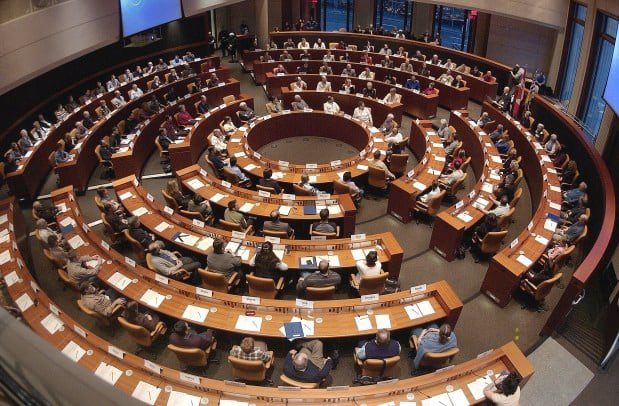
[very speculative shower thought:] Like the big (Irish) citizen assemblies, one could book an actual parliament building for a weekend and then stream these discussions, e.g. about the most effective donation decisions to improve the far future. One can invite experts, etc.
Personal anecdote: My mother told me about the donation parliament she joined in Cologne in the 1990s (after I told her about EA donation lotteries and the LYCS giving games). She talked very positively about the atmosphere and how these donation parliaments made charitable giving a public activity and encouraged donations.
The German donation parliaments provide funding for local charities. I am impressed by the public version of charitable giving (which I think has many advantages over more private versions) and by the reflection and time which goes into the decision where the money should go (which is, I would argue, not the case for most charitable donations).
Germany and Switzerland have a few donation parliaments, e.g. in Hamburg (best website if you want to check it out), Bonn, Zurich, and Reutlingen[1]. In a quick google search, I have not found any such parliaments in other countries. You can enter these German donation parliaments with ~60 pounds per year. An EA donation parliament (e.g. for Giving What We Can members) could require a minimum of something between 100-5,000 Dollars or 0.5% of someone’s income.
Basel’s Donation parliament: “[translated] This not only promotes a more social Basel but also puts it into practice. Thus, a charity system is created in which donations discuss and ultimately vote on the use of their donations directly among themselves and with the project leaders.”[2]
Picture of German Donation Parliaments
Picture of German Donation Parliaments
EA Donation Parliaments?
Everyone contributes to a pot of money. Everyone who contributes a sufficient amount has a vote. The group votes together on how the money is distributed. There could also be different subcommittees for relevant cause areas. A president or a team of co-president is elected or randomly chosen. They prepare the agenda and input material and invite relevant experts.
The discussion could be live-streamed, in person or can happen under Chatham house rule. Which of these formats is preferred depends on the aim of the EA donation parliament. Are they used to achieve (1) better results or to (2) teach the skill of prioritisation of doing the most good with one’s money?
Advantages, Disadvantages and Aims
Donation parliaments are ~large-scale giving games and can develop cause prioritisation skills and epistemic abilities in the community
If an EA local group runs such a donation parliament, compared to just encouraging everyone to give individually, I would assume that this improves outcomes.
First, I would assume that, in total, more money is given to charity – because it is a collaborative project.
Second, I would assume that some people will feel very strongly about where the money should or should not go; they are now actually incentivised to convince other people and to find the strongest arguments and counterarguments (compared to the average EA meeting in which there is no donation decision at the end).
Third, people learn more about EA by participating in the parliament.
Donation parliaments might lead to better decisions
Making the right decision is a function of independent characteristics:
Knowledge about effective altruism and the world
Reasoning capacity (e.g. marginal and counterfactual thinking, constructing theories of change)
Willingness to invest time in learning more and research
Whether parliaments can do better depends on the distribution of accuracies of public and private signals and the status quo in the absence of such donation parliaments.
Donation parliament could be the best actual implementation of moral parliaments (as one way of dealing with moral uncertainty)
Donation parliament might have epistemic advantages (see the relevant discussion of citizen assemblies). The book Democratic reason summarises some of the evidence (but I think that book also has a huge motivated reasoning bias).
If one finds this important, donation parliaments might make it easier to achieve demographic diversity and representation (as this is perhaps seen as more normal that some groups of people have the right to speech in each discussion,e g., when we talk about global health x% of the discussion has to be by people from the Global South)
How to mitigate the epistemic concerns about donation parliaments?
One might be concerned that giving everyone one vote leads to very suboptimal outcomes because of different levels of knowledge and strengths of opinions about the specific vote at hand.
One could use two proposals by Glen Weyl to mitigate some of these concerns.
Quadratic voting = each person has X coins. For every vote, they can use y coins and get y^0.5 votes.
One should be able to transfer their vote to someone else whose judgement one trusts more than one’s own.
[Shower thought] Such donation parliaments could be a publicity effort for EA or Giving What We Can
I imagine some donation parliament that looks like the large citizen assemblies, e.g. in Ireland, on abortion or climate change. One could try to get, e.g. an actual parliament building for a weekend and then discusses the yearly donation decision for a couple of million pounds.
In sum, if a donation parliament is a worthwhile institution, it can serve a very different role than e.g. the donation lottery. The donation lottery is optimal for someone who trusts their judgment about how to do the most good (wants to exploit rather than learn) and values their time. The donation parliament could be a possible strategy for making EA thinking more public (like a large-scale and repeated giving game where the participants already know much more, e.g. they all know at least as much as someone who did the intro fellowship). The donation parliament might also help develop the skill of (cause) prioritisation, the prioritisation mindset.
I sometimes miss this norm or practice of open, complex cause prioritisation discussion within effective altruism. That itself is probably not yet a good reason that this institution is worth its opportunity costs.
TL;DR
NOVAH (No Violence At Home) was incubated by Charity Entrepreneurship (now Ambitious Impact) in 2024 to test a promising idea: preventing intimate partner violence through edutainment, in our case a serialised radio drama. Over the past two years we have produced and aired two seasons in Rwanda.
We are currently evaluating our second season through a randomized controlled trial with 2,400 couples in Rwanda in partnership wi...
TL;DR
* The Long-Term Future Fund is closing down, and EA Funds is launching the Transformative AI Fund with a new full-time team.
* The fund's primary focus is technical AI safety and AI governance (including post-AGI governance), as well as supporting fields such as field-building and forecasting. We'll also consider non-GCR implications of transformative AI such as flourishing futures and digital...
The current Long Term Future Fund (LTFF) fund managers and I have decided to step back from our work on the LTFF. Because we believe LTFF donors trusted the fund managers to ensure that the funds would be used in line with the purposes of their donation, we've decided the right move is to close the fund.
While LTFF is closing, note that EA Funds has launched a new fund...



Meta comment - is it only me or is there something off with the references (the numbers don't match and links don't work) and with the ToC (here 'This' and 'short post' got their sub points). But only the references are an issue worth fixing imo if others have the same.
As for the content - very interesting, I'm surprised I haven't heard about that before. I think this can be very good place for discussion that attracts people willing to do good and caring about their own causes whom we might convince to start thinking about effectiveness and expanding their moral circle. And would make EA more democratic.
I'm eager now to try it out in Poland.
Thanks for your comment
. I believe the things are fixed now.