Comments
Striking piece! welcome to the (not so) new human child 🙂
Striking piece! welcome to the (not so) new human child 🙂
I loved how both the title of the post and the first section foreshadow the wild animal welfare turn in the middle of the post. It was truly enjoyable read!
This may be just one of those 10^20 birth stories happening everywhere, every year, but it's no less a tremendously important one. I'm touched by these connections you've made about suffering in all the world from the vivid experience of your own child, with insights to come away with and bring to us as you have.
It gives me a clearer picture of what r-strategist babies are going through all the time, and sparks some interest and perhaps future reading on the science of consciousness—so little do we yet know about this immensely important mystery.
I wish you, your wife, and your rising pride and joy of one year and counting tonight's very best. May they be your muses in freeing so much of the world from agony, and may life go well for you all.
There are some moments of your life when the reality of suffering really hits home. Visiting desperately poor parts of the world for the first time. Discovering what factory farming actually looks like after a childhood surrounded by relatively idyllic rural farming. Realising too late that you shouldn’t have clicked on that video of someone experiencing a cluster headache.
Or, more unexpectedly, having a baby.
With my relaxed and glowing pregnant wife in her 34th week, I expect things to go smoothly. There have been a few warning signs: some slightly anomalous results in the early tests, the baby in breech position, and some bleeding. But everything still seems to be going relatively well.
Then, suddenly, while walking on an idyllic French seafront, she says:
"I think my waters have broken".
"Really? It’s probably nothing, let’s just check whether that’s normal."
After a leisurely walk home, and a crash course on premature membrane rupture, we realise that, yes, her waters have definitely broken. We’re about to be among the 7–8% of parents who’ll have a premature baby. We call the hospital. They tell us to come in immediately.
One slightly awkward bus journey later, and we’re at the maternity ward. No contractions yet, but the doctors tell us that they might start over the next few days. If they don’t come within the week, they’ll induce labour. They prepare a room, and ask how we want to do this, nudging towards a caesarean. We agree and I head home to prepare things for an imminent arrival. At 7am the next morning, the phone rings: she’s having the baby. With no buses running, I sprint to the hospital, take a wrong turn, and rather heroically scale a three-metre wall to avoid a detour.
Bursting through the hospital wards, smelling distinctly of sweat, I find my wife there, in all green and a mesh hat, looking like a nervous child. We’re allowed to exchange an awkward “good luck” with everyone else watching. Hospital regulations probably allow a kiss, but our cultural norms most definitely don’t, so a pat on the shoulder, and she’s taken into theatre.
For the next twenty minutes, I assume they’re preparing for surgery, but it happens more quickly than I expected. By the time they bring me in, they’ve already done the impressive butchery, and all that is left is to pull the baby dramatically from the gaping wound. I make a stupid joke. My wife can’t laugh because she’s anaesthetised from the neck down. She looks scared.
Then, after under a minute of something happening behind a large screen. “Un petit garcon!”
I’m fully prepared to make a joke about my wife’s (Chinese) family finally having an heir and negating a state-enforced generation of shame[1], but as she can’t laugh, and I don’t feel like explaining it to the medical staff, I decide against it.
My wife is taken into another room, and I can hold this weird little pre-human to my chest for half an hour or so, wondering what I’m supposed to be feeling. I’m mainly just worried about my wife. He’s then moved into a heated incubator and taken to the neonatology ward. There, he’s placed in a bed with oxygen, heating, and various monitors attached. The staff are reassuring, everything seems to be relatively stable. We have a living human child!
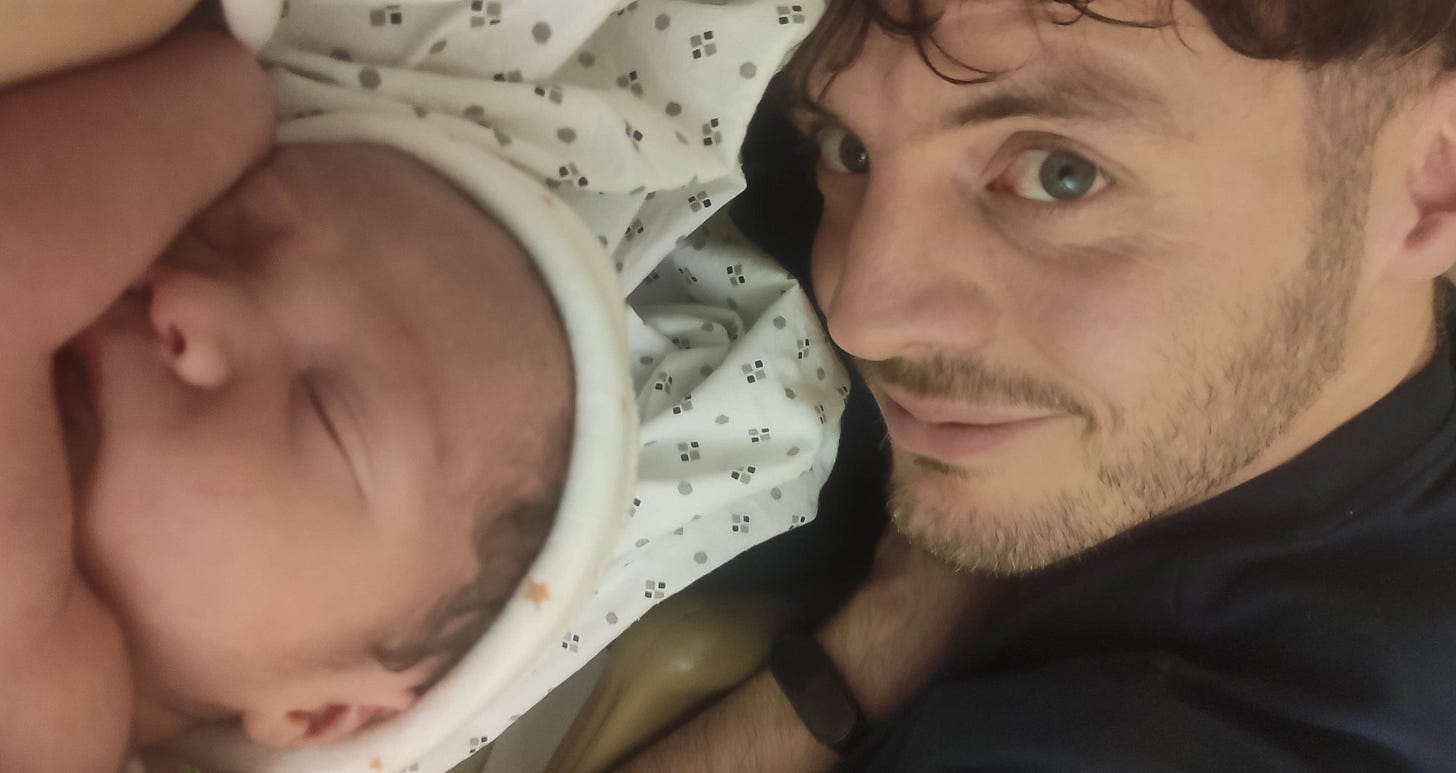
Assuming that there is something that it's like to be one, it’s hard being a new-born.
The helpless indignity of waking from a comfortable semi-conscious slumber and being brought into a sterile hospital filled with white light, weird sounds and cold air. The inability to express any noticeable emotion but distress, confusion and fear.
This is what he looked like in the first week:
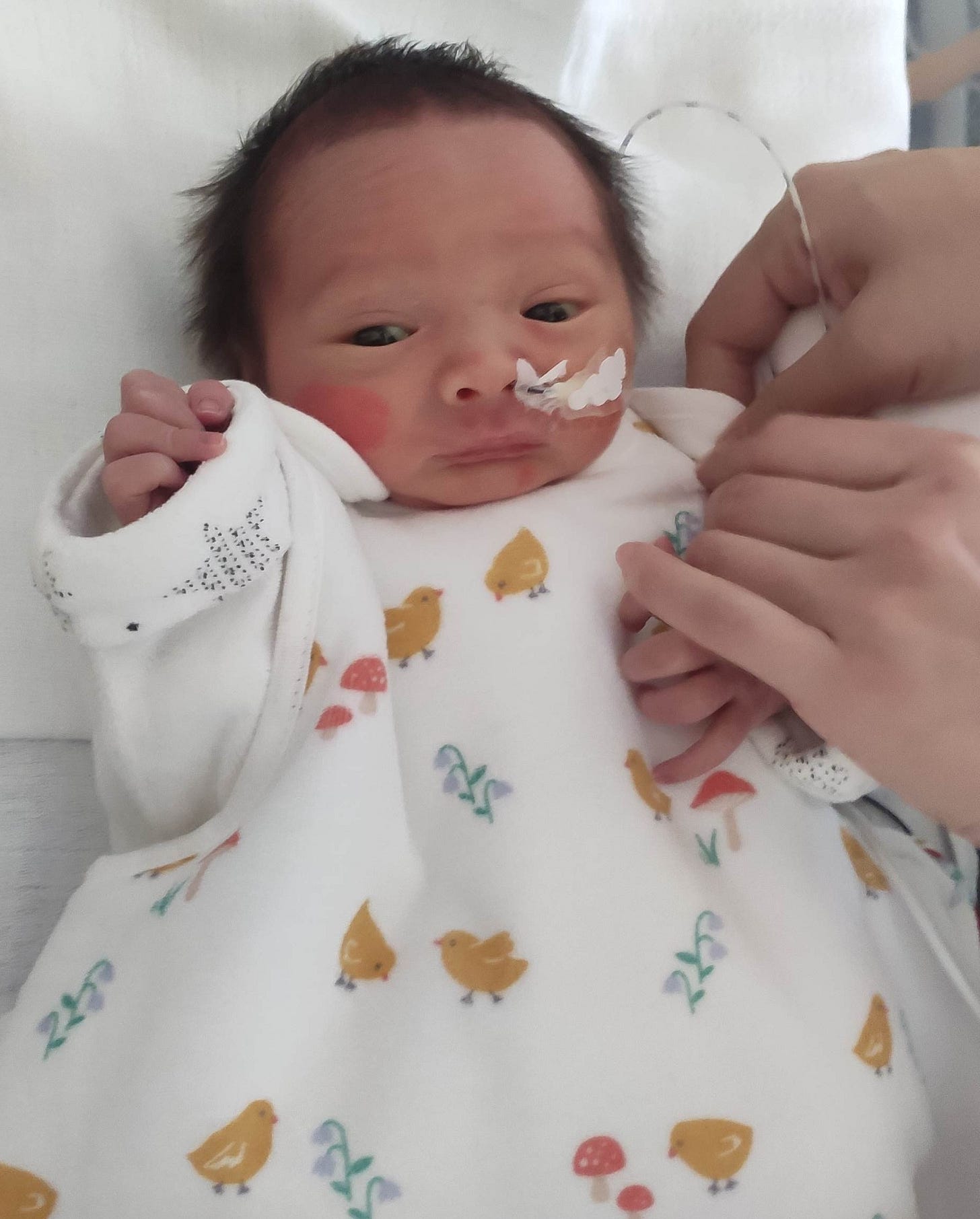
We move in with him after the first night to observe this anticlimactic struggle for survival.
When he’s calm, he just looks adorably confused, as above. His heart rate and oxygen monitors are a reassurance that there is something resembling life going on. But when he's distressed, panic mode begins. His whimpers escalate into something more animal and frantic, we hear the beep and see the erratic signals, and the medical staff rush in, fit an oxygen mask and inject him with caffeine citrate. They tell us that the main risk is hypoxia (dangerously low oxygen levels). If this isn’t fixed, it can impede brain development or damage vital organs. In unstable infants, this can escalate rapidly, sometimes triggering cardiac or respiratory failure.
The weird thing is this is just triggered at random by some kind of primordial fear or hunger. There’s something so visceral about the idea that your own confusion or distress can cause brain damage, or even kill you.
Despite looking relatively calm when sleeping or being held, there’s never any sign of happiness, comfort or recognition. This continues, and his life for the first week is a cycle of fragile stability made tragic by omnipresent tubes, monitors, and moments of genuinely life-threatening anguish.
As with many people involved with EA and animal advocacy, I’m familiar with, and sympathetic to, the case for prioritising wild animal suffering.
I keep thinking of this while watching my son’s first days. I'm watching him trying and failing to feed, unable to coordinate his tongue to swallow, relying on an obviously uncomfortable nasal tube because it’s the only way he can take in nutrition.
Most vertebrates are larval fish. 99%+ of wild fish larvae die within days. For these animals, being eaten by predators (about 75%, on average) is invariably the best outcome, because dying of starvation, temperature changes, or physiological failure (the other 25%) seems a lot worse.
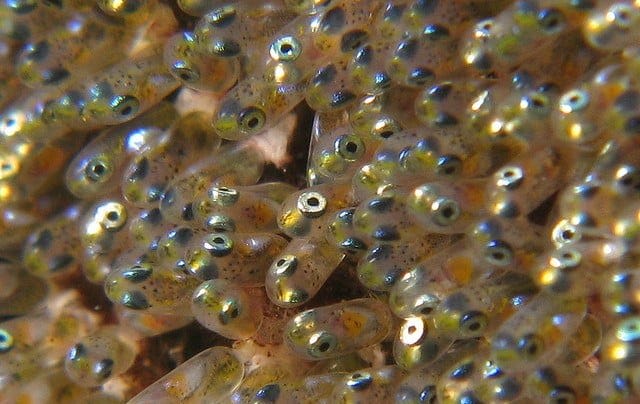
When they perform experiments starving baby fish to death, they find that most sardines born in a single spawning don't even start exogenous feeding. They'll survive for a few days from existing energy reserves. This time is spent in a state of constant hunger stress, driven by an extremely high metabolism and increasing cortisol levels. For the vast majority of the little fishes who can't secure food, their few hours to days of existence probably look a lot more like a desperate struggle until they gradually weaken and lose energy before dying.
They’re born too small. Like the premature human baby sat before me unable to suckle, most don't have the suction force to consume plankton.
Seeing my son in the ICU, hearing the babies in the adjacent rooms who have it so much worse, these numbers somehow come to life.
I realise how universal this experience is, that almost every animal currently alive is a new-born. Underweight, fragile, and overwhelmed by everything around them. This is the default state of existence. And for most of life on earth, this is all there is. A flicker of consciousness emerges from cells and neurons as if by magic, enters the physical world, flails around for oxygen or food, cries out for help if it can. And then vanishes.
There are an estimated 1020 fish born in that situation every year.
I’m not usually an emotional person, but there’s a moment where I’m watching this strangely representative life-form gasping for air and realise: Fuck, this is effectively everything.
It might be the most scope-sensitive emotion that I’ve ever experienced.
In the hospital, I’m constantly thinking about whether this baby (and by extension, the majority of life forms) are actually experiencing anything at all. I can’t shake the sense that, like Schrödinger's proverbial cat, he exists in a kind of superposition somewhere between consciousness and that terrifying void.
I’ve never liked the cop-out of “proto-consciousness” or “an early, different form of consciousness.” Either there’s something it’s like to be a larval fish, or a tiny baby, or there isn’t.
But which is it? In my sleep-deprived state, I try and build a vaguely Bayesian model updating on certain behaviours that feel more or less conscious than others.
It's hard to deny that his distress feels “algorithmic”. I pattern-match his cries with mechanical processes signalling hunger, discomfort, cold, or a need for contact, rather than with identifiable internal experiences. Most adult human emotions seem to have a "half-life", where an intense emotional state decays over minutes or hours. But for the baby, the shifts between crying and calm seem inhumanly sudden, as if he's disconnected from any inner continuity.
I try to recall what I’ve learned about different theories of consciousness. Babies don’t have the long-range connections necessary for integrating information across the brain, they don’t have the connectivity patterns associated with global workspace theory to broadcast information across brain regions. His default mode network won't be functional until the age he'll be able to do jigsaw puzzles.
This supports the idea that consciousness hasn’t yet "activated". Even if there are these pain pathways firing and the baby is screaming his lungs out, that doesn’t necessarily mean there’s something that it’s like for him to be in pain. Suffering might only emerge after some kind of complex integration process. And that system may simply not be online yet.
In the first week, the baby’s behaviour is so alien, and his cognitive processes so simple, that it actually feels more logical to assume that there isn't actually anything going on in his head. It's all just simple algorithms.
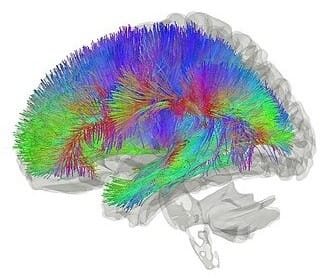
But plenty of theories point the other way.
Recurrent Processing Theory says that simple feedback loops in the brain might be enough for basic consciousness, and that this could appear around birth, or even before. Integrated Information Theory says that consciousness arises wherever there’s enough “integrated complexity”, and sets the threshold surprisingly low. And then there’s weirder theories like panpsychism, which says consciousness is fundamental and mysteriously built into matter itself.
In order to escape the “Schrödinger’s baby” dilemma, where infants are superposed between two extreme states: fully conscious or not at all, the intuitive solution is to find a middle ground. There’s a plausible-sounding argument that moral weight scales with complexity, and that suffering becomes more intense or meaningful as cognitive systems become more elaborate. Suffering and consciousness have a kind of mass: more neurons = more experience = more moral weight. So, by this logic, my baby is "just a little" conscious and worthy of moral consideration.
But this view feels both insufficiently justified and suspiciously convenient. Suffering could be just as bad for a simpler consciousness. I can vaguely imagine a being experiencing a tiny, focused locus of extreme pain, in the same way that I can kind of imagine a diffuse, complex landscape of suffering. I’m genuinely not sure which is worse.
Having said that, I can sense myself (and others) wanting to see suffering and consciousness as scaling with complexity. Believing this helps you justify all the times when you decide to let your child "cry it out", or otherwise suffer for your slight convenience.
It would be easiest, albeit morally dodgy in other ways, to just “round down” from my 30% estimate of conscious existence, and assume that infants aren’t conscious and therefore can’t suffer. That would let us act more freely, ignore the distress, feel less manipulated, and save money on anaesthetic. But I’m not going to “do an Eliezer” and say, “my poorly thought-out model doesn’t assign moral weight to infants, so I’ll just ignore them.”
Instead, I’m left with a kind of bipolar moral uncertainty. Either my baby is suffering, and urgently needs my constant attention, or he’s a soft little automaton - an emotional shoggoth honed by millions of years of evolution to extract resources through mimicry of pain and weaponised cuteness, with nothing truly going on inside.
Premature babies can struggle for much longer. It’s months of agony and waiting for some parents, but we’re lucky. In the second week, he’s improving slowly. The tubes are gone, he’s starting to feed on his own. After a frustrating fortnight in the hospital, he becomes stable, and, by the third week, is finally allowed to leave.
In the hospital, when he was crying, the neonatology staff spoke to him in musical, lilting tones, calling him silly affectionate names like mon petit chou (cabbage), as if he understands at some level. You can see why this gentle compassion is probably optimal; actually empathising with his distress would mean a plunge towards a baby’s level of bipolar psychosis. But I find it weird finding the words to speak to my crying baby in a way that covers both intense distress and the possibility of emptiness.
I really hope he's not conscious, because his life at three weeks still seems pretty rubbish, but I should probably act as if he is.
I think for EAs who think a lot about animals, you learn to live with that uncertainty: hoping consciousness is rare, while mostly acting as if it isn’t.
Expected value calculations offer a kind of solace when you’re distributing limited resources across many beings with varying chances of consciousness. If new-born fishes are only 25% likely to be sentient and cows 85%, then you can make a rational trade-off or allocation of resources.
But that reasoning collapses when applied to a single, emotionally salient case like your own child. Expected value calculations seem increasingly unfeasible - and it just seems weird acting as if he's 35% there. Instead, you’re in an emotional limbo between both perspectives: sometimes suppressing empathy, telling yourself he’s just reflexes and noise, sometimes embracing him as fully sentient, trying to cultivate a sense of love and compassion that might one day have a more certain object.
Things have been going well!
My son has grown into a more robust, rapidly-growing, wriggly, and smiley little human. By the third month, he’s started smiling, and I can make him laugh. At five months, I’ve realised that, beyond the predictable baby chuckles at stupid faces and voices, he’s also learning to embody his delightfully masculine side—breaking into seemingly genuine laughter at slightly violent slapstick hand-puppet theatre. His experience now seems to span a more recognisably human, and amusingly male, emotional range.
I don't know if it's better or worse in terms of suffering. When he cries now, he really cries. There’s a beautiful Chinese phrase for it: 哭得撕心裂肺 (kū de sī xīn liè fèi) - to cry as if tearing apart one’s heart and splitting open one’s lungs.
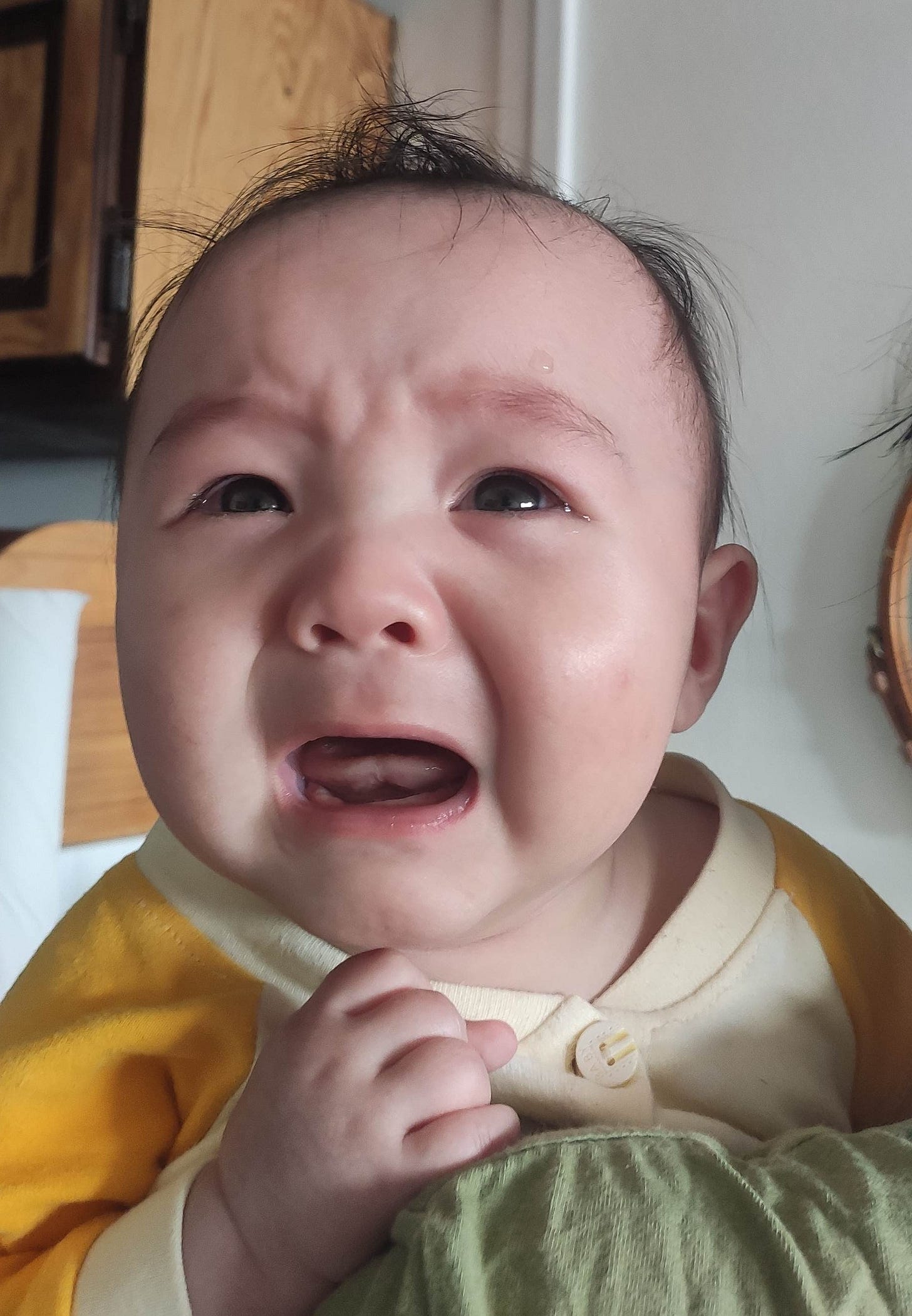
His distress now feels more “real” and less algorithmic. It’s louder, sometimes more infrequent, and not always easily explained away as a need for comfort, warmth or food. Something feels particularly alive about that curious pre-sleep anguish, like a faint awareness that sleep brings an interruption of consistent selfhood, before a rebirth as a slightly updated human in the morning.
His behaviour is starting to feel less like that of a badly-programmed larval NPC, and more driven by identifiably human emotions, even if these emotions are erratic and irrational. It's as if a hyperactive child was let loose with the code, and something magical and emergent happened. I find it increasingly difficult to see him as anything other than conscious.
For anyone else in the EA community thinking of having a baby, let me assure you that they do more than simply remind you of astronomical suffering.
Despite his psychopathic mood swings, he's pretty great. There’s an all-encompassing lovability about him that makes it impossible not to smile whenever in his company, even when he’s crying his little eyes out.
He’s the first grandchild on all sides - a beacon of family continuity that brings pride, joy and meaning to three grandparents. On the Chinese side, my in-laws’ doubts about my unconventional values and lifestyle have been quietly eroded by a healthy grandson and his conspicuous absence of an epicanthic fold.
The truth is, life hasn’t been kind to the little fellow so far. For the first five months of his existence, he’s been an adorable locus of suffering. If the intensity of a baby’s anguish is within an order-of-magnitude of an adult, then my son has likely endured more extreme negative experiences in the past two weeks than I have in the last two decades. He now has moments of obvious happiness, but also prolonged moments of inconsolable distress. If I had to guess, I’d say his life up to 3-months was almost definitely net-negative, but when he’s giggling with a mouthful of spittle, it’s laughably easy to pretend otherwise.
Parents really want their kids to be happy and free from suffering. But I see a lot of optimism bias seeping into the way we think about this topic. When we have to rely on subjective perceptions to determine whether tiny babies are suffering or not, it's so easy to say to yourself: "Aww, looks like he just wants holding" rather than "he's experiencing an unimaginably unpleasant internal state!" But there are some moments, particularly looking back at that skinny, struggling, anguished thing in the weeks after birth, that I start to see the situation more clearly. I think the start of life is just clearly net-negative for the baby, given that he is conscious, and this says more about the world than a lot of us are willing to accept.
I’m not depressed or negative about this. Even in the worst case, I’m still an optimist. Despite a nontrivial p(doom), I believe that humanity can find a way to solve AI alignment, develop smarter and more ethical world systems, build the post-scarcity utopia we dream of, and start building the nuts and bolts of a universe free from suffering. In expectation, I think that my son’s life will be happier, more meaningful, and more beautiful than we could have dreamed of a generation ago.
So here’s a hopeful message for prospective EA-aligned parents: having a child will open your eyes to the true scale of suffering in the world, while looking so unbearably adorable that you’ll find yourself grinning inanely through the whole process.
Her parents are actually quite enlightened - my mother-in-law is a dyed-in-the-wool communist, and therefore absorbed the “women hold up half the sky” logic. My father-in-law is quite liberal and educated. However, upon seeing that my wife’s cousin was born female, the father (my wife’s step-uncle) famously welcomed his new-born daughter to the world with the phrase: 笨蛋 (bèndàn), "you idiot" (literally “stupid egg”)
Now sixth - I wrote this a few months ago



I don't have anything super wise to say here, but I stumbled upon this post and found it moving and radically original, definitely of the most memorable and daring things I've read on the Forum this year. Well done!