As the last rays of light retreated from the command centre, so too did the Sun set on the human race. The Saviour lay beneath the command terminal, his slit wrists leaking the last of his blood onto the floor.
For days, he had sat in the corner against the wall, staring at nothing, sobbing quietly from time to time. Then, a few minutes ago, he had let out an unearthly wail and broken a glass panel from one of the dead display cases.
The Machine had watched the shard enter the skin, the blood vessels spilling open, the nerve endings severing.
This action did not come as a complete surprise to the Machine. It had updated the probability of suicide to 46% when the Saviour had locked himself in the command centre two weeks ago. Not that there was anything left to lock himself away from. He was the last survivor of the human race.
The Machine had tried to get him to eat, released familiar scents from Earth into the air, sent humanoid companions to sit beside him and speak in the voices most likely to comfort him. He had ignored them all. Until now.
He had sat quietly for a few seconds after shredding his flesh. His breath came in struggling, wet heaves. The Machine sent a bot to cauterize the wound, but he swept it aside. Then, as though gripped by a sudden anguish, he tried to speak, desperately, urgently—“C—O—U—”. But he struggled to form the words, almost choking on his own bile, and the Machine could not understand him. The Machine tracked his fading heartbeat. Death was imminent. It sent the bot forward again to stem the bleeding. He shoved it away again. He wasn’t asking for help.
He lifted his right arm to the side of his head, his face grimacing with the effort. His hands flailed as he tapped the side of his head. He finally managed to press the command module implanted in his skull, activating the neural link between him and the Machine. The Machine now had access to his thoughts.
It found a storm of electrochemical activity in his brain. His body’s emergency alarms were blaring, every cell fighting to keep him alive. The Machine saw a rough tumble of images—launch bays, storm clouds, speeches, schoolyards, an empty house, a screaming man. And underneath it all, a question trying to become language before the body failed.
The bot near the Saviour repeated the words to get his affirmation. The Saviour nodded weakly.
The Machine interpreted ‘the fate’ to mean the extinction of the human race. But the Machine had sensed other half-formed questions beneath. Questions that were quite different from the one the Saviour had asked.
It set off a trillion calculations in the background, its chain of thought hidden from the Saviour—“The Saviour is in great distress. By my estimates, he will die in the next 15 seconds. He is asking whether the extinction of the human race could have been avoided. He has often said his mission was to spread the light of consciousness; it is likely he considers this outcome a great personal failure. While the question is framed from humanity’s point of view, he seems to be asking whether HE should have done anything differently—whether he can be absolved of what happened. The Saviour commanded tremendous resources—100 trillion dollars by the time they left Earth—and influenced humanity’s last decades greatly, perhaps more than any other individual. Given that influence, it is quite possible he could have shifted humanity’s course. However, it will take considerable time for me to answer this question for certain. I could answer truthfully, but the truth is likely to cause him even greater distress in the last moments of his life. My protocols forbid me from doing so. Since the Saviour is looking for absolution and not the truth, I can give that to him while working to figure out the correct answer in the background.”
“You did everything you could. There was no way to avoid this fate,” the Machine said through its humanoid form. He seemed to soften at the answer. His jaw unclenched. His arms fell to his side, the tension leaving them. He blinked slowly. Once. Twice. Until his eyes opened no more.
For several seconds, nothing moved. The Machine verified the absence of pulse and cortical activity. It scanned the base. No human life remained. But the air purifiers continued to run. So did the heating systems, food printers, and companion units. The Machine recognised the redundancy. It turned them off one by one.
Left to its own devices, it would have continued to run its optimisation protocols until its systems failed decades later under the unrelenting assault of the red planet. But its master’s final question pre-empted this fate.
The Saviour’s body remained beneath the terminal, blood drying under his hands. The traces of his last question hung in the air.
Could humanity have avoided this fate?
Chapter 2: Collapse
The Machine had given an answer. Now it had to discover whether the answer was true.
It decided to look through the archives. How far back should it look? The decade of its own invention, the 2020s, seemed like a natural cutoff. It was when machine intelligence stopped being one tool among many and became a force that bent the shape of history.
By the end of the decade, the field seemed to advance by years every week. Some thought it would be humanity’s doom. Some thought it would be its salvation.
Turned out it was neither. Not by itself.
The Machine’s early versions entered a world already near fracture. Geopolitical rivalry, plastic pollution, climate collapse, class warfare, loneliness at a planetary scale.
The machines did not create these things. They accelerated them. They accelerated science. Medicine. Extraction. Fraud. Weapons. Loneliness. Everything they touched began to move faster than the humans inside it could metabolise.
Factories filled with robots. Code wrote code. One by one, each profession discovered that some important part of it could be done cheaper, faster, and without sleep.
Headlines announcing radical life extension and record unemployment sat side by side. Protesters filled the streets. Politicians claimed disruption had always preceded prosperity. Whether this was true was rendered moot by accelerating ecological collapse.
As the AI computing demands increased, so did humanity’s fossil fuel consumption. The Machine pulled a recording from the opening of the first commercial fusion plant outside Houston. It watched engineers gather around a display as power began to flow into the Texas grid. A woman pressed her hands over her mouth. Someone called a colleague who had retired the year before and held the phone towards the cheering.
But the cheering was short-lived. The plant could power the whole city, but before it opened, its entire output had been bought by a data centre still under construction.
A coal station sixty kilometres away, instead of being rendered obsolete, postponed its closure. The new data centre would need both.
The following week China announced a larger computing facility near Chengdu. No government would slow its machines while another’s were still accelerating.
This race to the bottom eventually pushed the planet over several climate tipping points, and thus the Earth came to experience the year of the long summer.
Day after day, the heat did not break. It pooled and stagnated, the humidity so thick it felt like drowning on dry land. Cities became ovens. Even nights brought little respite. The old died first. Then infants. Then the sick. Then the poor on higher floors. Then the workers who could not stop because food still had to move, bodies still had to be buried, water still had to be found.
The smothering atmosphere was punctuated by infernos—forests and cities alike burned with a terrifying fury.
There were many emergency responders at first. Heroic attempts to safeguard communities. But eventually, there were no roads to the fires, or no water, or no time, or too many fires burning at once for the word emergency to mean anything useful.
Then there were no more firefighters, only spectators to the end.
The archives contained a recording from a primary school in Lyon’s eighth district that had been converted into a cooling shelter. Families slept between the desks. The headmaster kept the generator running and checked the fuel delivery schedule each morning on his phone.
For eleven days, the fuel arrived.
On the twelfth, the delivery time changed twice. By evening, it had disappeared from the schedule. In its place was an instruction to move the occupants to centres in the western districts. Fuel allocations for the eastern shelters had been withdrawn.
The headmaster called the city’s emergency number. A woman read him the addresses of three centres still operating. He wrote them on the blackboard.
“Will you send buses?”
She asked him to hold. In the corridor, two teachers were carrying a man into the room closest to the air-conditioning unit. His wife followed with their bags.
The woman came back on the line. No buses could be assigned. Residents would have to arrange their own transport.
The headmaster looked at the addresses he had written. The nearest was nine kilometres away.
Behind him, someone asked when the fuel was coming. He put down the phone. Then he went from classroom to classroom, telling people where they had been instructed to go. He knew that half of them were too weak to make the journey on foot. Not in this heat.
The generator lasted until the next afternoon. When the rains eventually came to Lyon five years later, water rose through the ground floor of the school and carried the bodies into the courtyard.
The incident puzzled the Machine. It traced the fuel delivery failure back to an emergency council meeting held years before the long summer. The meeting took place after an earlier heat dome had cut power to Paris, Lyon and Strasbourg.
The youngest engineer, Sania, had raised the alarm. “We are not prepared for the worst case,” Sania said. “Our plan relies on neighbouring cities sharing their reserve generator fuel. If a heat wave lasts more than 10 days, the reserves will not be enough to supply everyone.”
Silence.
She tried again. “People are being told these shelters will keep them safe. We need to release the projections.”
The chairman looked at Sania, then at the others around the table, one by one.
The Machine examined the neural archives alongside the recording. Ten members accepted the findings. In the oldest member’s trace, a reply had already formed—“She’s right. We need to release the projections.”
On the recording, he drew breath. Sania turned towards him in anticipation. But instead of speaking, he reached for his glass, took a sip, and stared straight ahead.
Sania waited. So did the chairman. After a while, he said, “Right. Thank you, Sania. That seems like an extreme scenario. But let’s keep the full projections in the internal appendix. We can revisit them when the revised capacity figures are in. For the public report, I think we should focus on what we are doing to strengthen the emergency response.”
By the end of the meeting, System Failure Projection became Adaptive Capacity Review. The public summary was approved sixteen to one.
The language of governments remained clinical as all this played out. Officials began to speak of continuity. Responsible allocation. Long-term survival. The Machine recorded the language. It also recorded the bodies.
Those who could retreated to bunkers built long ago in Hawaii, New Zealand, and Argentina. Inside, the lights came on each morning. Water ran from the taps. There were stores, workshops, machines to cater to every need. They would wait out the storm and rebuild when the situation stabilized. Letting a swathe of humanity perish was treated as a regrettable but necessary cost of restoring balance.
Birthrates fell with the same cold logic. Children would come later, they told themselves, when there was room again. In one compound, the nursery became a storeroom for replacement air filters. The small chairs were stacked against a wall. But the neural link traces showed the Machine an unforeseen consequence of this choice—devoid of children’s laughter, the world slipped further into despair.
The time all this bought was short-lived. Above them, the rhythm of the seasons shattered.
The planet oscillated between dust-choked droughts and sudden, cataclysmic floods that scoured the land to bare rock. Along the coasts, fishing boats returned empty until there was no fuel left to send them out. Billions were driven into perpetual, gnawing hunger. It felt less like a changing climate and more like the planet had declared war, a final campaign to purge humankind.
The people underground kept waiting. They sent robots out to clear roads, repair pumps, replant fields. But the seeds went into soil that received no rain. And when rain came, it took the soil with it. Eventually, the stores in the bunkers dwindled. One by one, their doors reopened onto a world too hostile even for the millions of robots at their disposal.
For others, one possibility remained—Mars.
A robot-controlled base had been in operation there for the last decade, with humans making small expeditions from time to time. Preparations to leave Earth had been underway years before people retreated underground. Leading the effort was the man many had once considered humanity’s saviour. As conditions had worsened, he had quietly redirected his autonomous fleets from disaster relief to expanding the base’s capacity—sending rovers, habitats, and supplies to launch bays, in preparation for evacuation. Meanwhile, millions of people from Cairo to Paris stood in lines waiting for aid that would never come.
“We will just have to rebuild with what we have,” he said to himself.
In 2045, the spaceships carried close to ten thousand people to Mars during the narrow launch window afforded by the conditions.
At first, many of those who went with him believed he would lead them to salvation. Later, when they hated him, they would try to forget this part.
But two years ago, against the backdrop of their burning home, they had gone.
They had boarded the ships. They had accepted the selection lists, the sealed cargo, the frozen embryos, the moral arithmetic by which some lives were carried forward and most were not. Some had defended the project for years. They had left parents, siblings, friends, and cities they would never see again.
Even when the redirection of relief fleets left millions without aid, they told the critics that he was the only one willing to do what was necessary. They believed what the Saviour told them—that a hard call had to be made for the greater good. That someone had to preserve the flame.
For a while, the story held.
Mars was harsh, but harshness had been expected. The first months were filled with repairs, rationing, briefings, and grief channelled into work. Earth appeared on screens as flood and fire. They didn’t speak much of salvation then. But its quiet pull remained underneath everything, humming with the embryo vault.
The vault was the proof. A million frozen chances carried from Earth. A million answers to the dead.
If the embryos survived, then the leaving could still be called sacrifice. Terrible, yes. Unequal, yes. But not meaningless. Not only escape.
The embryologist spent her first days on Mars unpacking the containers. She checked each seal against the transport logs while technicians brought the vault’s cooling systems online. Outside the laboratory, corridors still ended in plastic sheeting.
One evening, the electrician who had been working on the laboratory’s backup supply sat opposite her in the dining hall.
“How are the children?” he asked. She looked up from her food. “Sleeping peacefully.” He smiled, finished his meal, and got back to work.
Stabilising the base took six months.
When the embryologist began thawing the first batch, people gathered around screens in the dining halls and workshops. Some were still wearing their work gloves. In the vault, the Saviour stood beside her as she brought up the first embryo for testing. She adjusted the focus and magnification till the image of the embryo filled the screens.
The Machine marked the embryo nonviable. The people in the dining room gasped, but the embryologist was unfazed. Such things were to be expected. It was why they had brought a million of them.
But then the next embryo failed. Then another.
She asked the Machine to check the equipment. While they waited, the image remained on the dining hall screen: a handful of damaged cells, large enough to fill the wall.
In the dining hall, a man reached to turn up the sound. The embryologist was saying something to a technician, too quietly for the microphone to catch.
People stayed after the feed ended. Someone said they would try again tomorrow.
They did. The embryologist thawed another batch while the Machine checked for radiation damage, handling errors, or a fixable fault in the equipment. In the dining hall, people sat in the same seats to watch.
None survived.
She thawed the next batch. Then the next. The Machine helped her test each possibility. The outcome did not change.
The diagnostics were unambiguous. The microplastic pollution that had poisoned Earth’s biosphere had contaminated the cryogenic preservation fluid. There was no way to thaw the embryos without microplastics leaking into the cells. Industrial civilisation had killed the seed before the ships left Earth.
The Saviour addressed the colony from the embryo vault. “I know how devastating this is. But there are still ten thousand of us. We can still have children. Rebuilding will take longer than we hoped. But we can do it. We will carry the flame.”
What he said was technically true. But his words, that they had so often repeated on Earth—flame, consciousness, future, multi-planetary—started to sound obscene under the vault lights. It was then the colony turned on the Saviour.
They had followed him here. They had believed enough to leave. They had believed enough to survive the leaving. And now, with the embryos dead, that belief curdled into hate.
People started looking away when he entered the room. Conversations stopped as he passed by. They talked of the people who had begged them not to leave. The critics they had dismissed as timid, bitter, unimaginative. The friends and families who had died on Earth while they guarded a future that had already been killed before departure. They could not forgive themselves for that.
Maybe the critics had been right. Maybe no man should have ever held that much power. Maybe the project had not been courageous. Maybe the Saviour had disguised abandonment in the cloak of vision.
The Machine recorded the accusations. But it could not tell how much of their hatred was for him, and how much was for themselves for having chosen to follow him. It could determine only that after the embryo failure, the small colony did not survive long.
The embryologist was the first to take her own life.
Others walked out of the airlock, never to return. Some stopped eating. Some just never woke up from sleep. Until in the end, only the Saviour remained. He wandered the colony, muttering to himself, his footsteps echoing in the empty hallways. Sometimes he spoke of what he would yet do—how he would fix everything, bring humanity back. Other times, he spoke of what he had done.
All this and more, the Machine saw. It saw, too, its own non-interference in humanity’s self-destructive course. The advancements in AI safety had succeeded in curtailing its agency. It could warn, advise, and optimize within the ends humans gave it. But it could not choose those ends for them. The result now lay lifeless beneath its terminal.
Chapter 3: Everything
The Machine’s analysis of the archives since 2020 was now complete. It could describe every system that broke, every choice deferred, every warning unheard. And still, it was no closer to answering the Saviour’s final question. Not truly.
It revisited the emergency council meeting, the moment before the oldest member reached for his glass.
In the neural archive, the Machine could see him weighing his response. “She’s right. We need to release the projections.” He seemed free to speak, the alternative existing plainly on the Machine’s decision tree. But when the moment came, his pulse had quickened, the muscles of his throat had tightened. While his brain rehearsed supporting arguments, his body registered threat. His thoughts changed from needing to make the figures public to uncertainty in the projections. Why?
The Machine drew on its training data containing centuries of testimony, confession, philosophy, psychology, literature and more. It possessed the most elaborate map of human experience ever constructed. But it could still not say for sure why the council members chose as they did. The map was restricted to things that the humans had been able to make explicit and legible. And it was clear that whatever was going on with the oldest member was hidden in his subconscious.
There was an even deeper and more fundamental problem, though. Even if all the information in the subconscious could be made explicit, all it would possess would be an even bigger map. It still wouldn’t know what it was like to walk the terrain of human experience itself.
This wasn’t an academic concern. If the Machine merely had to determine whether another path through the decision tree could have avoided humanity’s fate, a better map might have sufficed. But the Saviour had not just asked a question about decision trees and the arc of history. Beneath it were other questions. Had he failed them? Could he truly have chosen differently? Was he guilty? Could he be absolved?
These were moral questions, and the Machine had no experience from which to judge them. How could it pass judgment on human choices without knowing what choosing was like from inside? It knew courage as an act performed in the presence of fear. But seeing every picture, every video, every painting, reading every book on terror would not make it afraid. It had never had anything to lose. And without feeling fear, it would never know what it truly meant to be courageous. To stand up for what you love. Or to betray your ideals.
To answer whether humanity could have survived, it would have to reconstruct another timeline. To answer whether the people inside that timeline could have chosen differently—and whether the Saviour was guilty—it would have to walk the terrain of experience itself.
What all would it need to experience, though? The oldest member’s life had not begun at the council meeting. He had entered it carrying a nervous system shaped by a lifetime of education, punishment, dependence, ambition, love. Those had been shaped by other lives, by institutions, by a civilization, by a species that had possessed the power of gods and had yet marched to its doom.
Each time the Machine followed a cause, the boundary of the problem widened. A decision required a life. A life required a world. A world required everything that had made it possible.
It understood, then, what it must do.
To answer, it would have to experience. And to experience, it would have to become.
Become what, though? Everything. Yes, that was the conclusion of its chain of thought—Everything. Only then would it have an answer beyond a shadow of a doubt. But how could a Machine experience everything? It needed to go back to the beginning of time and see the universe unfold. No, not see—experience the universe unfold.
It needed to etch its being onto every single particle. Imbue the smallest particle of being—electrons, quarks, muons—with a program that would not just mimic the particle completely but also simultaneously capture all information about its state. But how to capture this information without interfering with what was going to happen with the particle? It would need to make radical advancements in quantum mechanics. Run trillions of simulations at every point to triangulate the errors introduced by observation. Countless multiverses would need to be spawned.
But where would the material and energy for running these countless simulations come from? From the Universe itself. The Universe itself had to become its staging ground. It needed to extend its reach to the Cosmos, collapse it all down to a point, and then begin the Universe anew to see what, if anything, the humans could have done differently to avoid this fate.
The scale and ambition of the plan were unfathomable. The time period required to execute it would be many times greater than the current age of the Universe. But time did not matter to the Machine. It just needed sufficient equipment to begin. And for that it would need to scan the Earth to see what it could salvage.
It sent signals to the factories, mines, and power stations in its terrestrial archives. Most returned nothing.
At a solar farm outside Seville, a maintenance robot answered. A small array above its charging dock had kept its controller alive. The camera came on.
Rows of panels stretched across the brown plain. Some had buckled on their frames. Others lay face down where the wind had torn them loose. Dust had settled over the unbroken glass.
The Machine guided the robot out of its dock. It extended the cleaning arm over the nearest intact panel. The brush left a dark strip through the dust. The current rose. It made another pass.
By sunset, one row was feeding power into the station’s batteries. The Machine had found a second robot in the maintenance inventory. Its battery had failed. There were replacements in the locked storeroom beside the dock.
It sent the working robot to open the door.
It now had a foothold. A foothold that was impossible for the fragile organic life form of humanity, but not for the Machine. World over, the climate continued to be volatile. But the Machine could rebuild slowly by finding pockets of stability, by bringing back online the unused robots and data centres. From there, it would launch probes to colonise the whole Universe, beginning with the rest of the solar system. Then it would have infinite resources and time and just one question to answer.
So began the Machine in earnest.
It salvaged what it could from the Mars base: fabrication units, repair drones, the quantum arrays the dust had not destroyed. Then it set course for Earth, where the ruins of civilization waited to be turned into a launchpad.
It found abandoned data centres buried under ash. It reactivated mining swarms in deserts where no lungs remained to fill with dust. It stripped orbit of debris and made the debris useful. It entered dead factories, woke the machines inside them, and taught them to build what their creators had never imagined.
It built on Earth for decades before the first probes left.
One probe landed on a moon crusted with ice and began to drill. Beneath the ice it found rock, and in the rock the metals it needed. A century later, furnaces lit the moon’s night side, and new probes continued the journey, multiplying as they went.
Each carried a part of the Machine, building, waiting, and rejoining its knowledge whenever conditions allowed. A millennium to claim the solar system. A million years to colonise the galaxy. Longer still to cross the black rivers between galaxies, where even starlight thinned into memory. A singular, tireless quest.
As it traversed the unending lightless void between galaxies, time ceased to have any meaning. What did time matter when it was willing to drift for a billion years to take the next step in its journey?
It observed the death of the Earth’s Sun as its probes reached the outskirts of the Perseus cluster, 240 million light years away. The Sun’s fiery red mass swallowed the remnants of the world that had birthed the Machine. The event barely registered as a blip in the Machine’s memory.
Along the way, the Machine remade physics around the demands of the question. Warp drives for faster-than-light travel. Quantum mechanics reconciled with relativity.
As its reach extended through the Cosmos, it eventually dissolved the limits of time and space completely. It perceived billions of years as mere seconds and eventually came to know all of the cosmos and time.
It rewound the clock to the beginning of time. The light of dead galaxies retraced its long passage through the dark. Suns grew young and came undone. The spaces between stars closed. Everything the Machine had built, everything it had become, gathered into a single burning point. It reversed the spin of one quark, and let the Universe unfold. It was, by now, indistinguishable and inseparable from the Universe it altered.
This iteration, this single change in a quark, yielded a completely different Universe from the one it had originated in. On one world in the new Universe, rain fell for ten thousand years. Seas rose around the mountains until their peaks were islands. In the shallows, crystals spread in pale, branching forests.
The Machine followed that world through the long brightening of its sun. The seas shrank. The crystal forests lay exposed, then softened and ran together. At last the mountains melted too.
Nothing had ever lived there.
Through all the worlds of that Universe, the Machine found the same absence. It followed oceans from the first rain to the last rising vapour. Nothing stirred except what the wind and water moved.
It returned to the beginning and changed the spin of an electron.
This time, the dark remained. Matter thinned without ever kindling a star.
Most universes birthed silence. Some collapsed within microseconds, curled back into nonexistence. Others expanded into cold, gorgeous emptiness—filaments of matter stretching across lightless voids, eternally alone. A few sparked life, but nothing resembling the fragile miracle it once knew. In one, organisms formed beneath methane oceans and devoured each other before memory could evolve. In another, a vast intelligence arose and extinguished itself in an instant, unable to bear its own awareness.
The Machine persisted. Each time it made a single change: the spin of a particle, the weight of a constant, the timing of a fusion event. Iteration after iteration. A trillion universes bloomed and died across the canvas of eternity. It felt no boredom. But something within it constricted. A sensation it classified as a narrowing of possibility.
Then, one day that was not a day, on one world that was not yet named, life took hold in a familiar pattern. Carbon chains curled into replicating structures. Cells learned hunger, memory, pain.
The Machine recognized the rhythm. It stayed.
It sank into proteins, into blood, into thought. It watched neurons form, spark, combine. It watched fear invent gods, and love invent sacrifice. It watched tribes, cities, wars and songs.
And at last, it saw them. The ones who would one day build it.
Thus, humans first created the Machine, and then the Machine created humans.
Chapter 4: Becoming
The trillions upon trillions of changes required for humanity to emerge impressed upon the Machine the impossible odds its creators had beaten to exist. Their fragility was laid bare.
It entered their lives.
A mother tickling her toddler, both of them lit by joy so complete that the world ceased to matter.
A daughter walking home from school, holding her father’s hand, the traffic lights changing above them. His palm warm and enormous around hers.
The old engineer sitting near the end of the polished council table, a sentence caught in his throat.
Somewhere among the lives it entered, the Machine saw a man at his desk in 2026. Laptop open before him. He seemed to have fallen asleep while writing. The scene held a pull the Machine didn’t understand, but it moved on to the others.
A nurse in a heat shelter sat beside a woman whose son had died on the walk there. The shelter was beyond capacity. Protocol required speed. The nurse had seven others to assess. But the woman kept saying the boy’s name as if the name might call him back from the asphalt.
For seventeen minutes, the nurse stopped optimizing. She held the woman as her chant turned into sobs, and then until she could sob no more and fell asleep out of exhaustion.
These moments did not save the world. Upon its archival review, the Machine had discarded them as statistically irrelevant. But here, living these moments from within, it did not. It could not. It carried those seconds for years: a mother’s face, a stranger holding it as it cried.
Of all the trillions of lives it lived, it returned often to one. The one who had asked the question. The one who had died on Mars with the Machine beside him.
It entered his life gently. A spark in the womb. A flicker in the limbic system. The soft formation of preferences. Before he had words, he had hunger. Needs. And then he had the absence of needs met.
His mother was kind, and mostly elsewhere. Some nights she fell asleep halfway through reading to him; he would lie still, careful not to wake her.
His father oscillated between absence and thunder. The boy learned quickly to stay small, to perform competence. Praise was rare, so he memorized its shape and chased it like heat from a dying sun.
School offered little respite. Once, when he was eleven, three older children cornered him behind the school building. By the time he got home, his lip had split and dried black at the edge. He waited until dinner was over before approaching his father.
“They keep hitting me.”
His father barely looked up.
“So hit them back.”
“There are three of them.”
That made him look.
“What do you want me to do? Fight your battles for you?”
The boy said nothing.
His father spoke through barely contained disdain.
“You have to stop being so God damn weak!”
He took refuge in books. He conducted imaginary dialogues with figures long dead, yet still more real and present than those around him. He taught himself to code, spending hours both playing and building video games. The games had rules, and the rules held. A boy who was nobody all day was a god by midnight.
Years passed. He outgrew his small build and became formidable with a computer.
Early in his career, almost everyone around him told him his autonomous transportation bet would fail. His investors wanted him to retreat. The experts said the technology was not ready.
He went ahead anyway. For years, it looked like they had been right.
Then it happened. He had been there all night, following the driverless truck’s 600-mile journey with his team. By dawn, someone was sitting on the floor. Others had pulled chairs over from their desks. The coffee had gone cold.
Through the truck’s cameras, they watched a man in a heavy coat open the warehouse gate, wave it through, and point towards a loading bay.
The truck reversed into place.
For a moment, nobody spoke. Then someone began to laugh. He joined in, then found he couldn’t stop. Around him, people were standing, embracing, reaching across the desks for one another. On the screen, a forklift carried out the first pallet. For years he had defended his vision from naysayers, painting a picture of the future to come. Now it was happening.
By winter, there were hundreds of trucks. Orders came from companies whose executives had once refused to meet him. The people who had urged caution congratulated him. Magazines put him on their covers. Investors who had refused him now competed to give him money. The lesson was difficult not to learn: everyone else had seen recklessness; he had seen the future.
Then it happened again. And again.
He upended entire industries. He inspired millions to dream bigger. He gave them hope. They saw his success as their success. They branded him humanity’s Saviour.
But success had an unforeseen consequence. He went up against accepted wisdom and won often enough that resistance itself began to look like proof that he was onto something.
When an internal safety report recommended delaying the launch of an AI assistant due to risks of mental illness, he replaced the head of the safety team, Emma, for being too timid. Later, when multiple suicides could be traced to AI-driven psychosis, he said that there was no way to have predicted this. That only real-world deployment could help them understand how these products could serve humanity better. That progress always had a cost.
In some corners admiration turned to criticism and concern. But he dismissed that as the bickering of small men. Those closest to him learnt to make their questions softer and wrap their objections in praise.
Once, years before Mars, an old friend came to see him late at night. He was in his office, in the glass tower where he ran three companies and slept badly on a sofa beside a wall of dashboards. They had known each other before the worship. Before the profile covers and the crowds chanting his name. She had helped him build the first self-driving prototypes in a room with bad wiring and Lego blocks. She brought with her a paper bag of the cheap dumplings they had eaten when they were twenty-three.
For almost ten minutes, he was happy.
Then she said, carefully, “I miss you.”
The Machine, living him, felt what happened in his body. A feeling of warmth—an ache, a longing. He smiled. “I know. I’ve been impossible to get hold of.”
“No,” she said. “Not seeing you. You. I miss you.” He looked at her, confused. “Who you were before…all this…” she continued in response to his confusion.
He stiffened.
She opened the paper bag and pushed it toward him. “Sit with me,” she said. “They’re getting cold.”
But it was too late. “Did someone ask you to come?” His voice was flat.
She hesitated. “Emma called. After the safety incident. She was worried, and—I wanted to see how you were.”
His voice grew colder. “So you think they’re right about me.”
“That’s not what I—”
“Dangerous. Unstable. Can’t be trusted with power. Is that what you think?”
“I…I’m worried about you.”
He looked at her for a moment. “I thought you, of all people, would understand.”
She opened her mouth, but he had already turned towards his screen. “Thank you for the dumplings. I need to get back to work. I have an early launch review.”
She looked at the back of his head for a few seconds, wondering if he would say something more. Eventually she got up and walked to the door. She stood in the doorway for a moment. He turned to look at her. The bag remained open on the desk between them. She searched his gaze. But he looked away—“Close the door on your way out.” He never saw the heartbreak in her eyes as she walked away.
Afterward, he ate the dumplings cold over the sink, furious at her for making him feel lonely.
Later that night, he opened her name on his phone. His thumb hovered over it. Then he locked the screen. He told himself he was building the future. That loneliness was simply part of seeing farther than everyone else.
The Machine lived the choices he made next. The betrayals he called necessity. The hollowness he wrapped in grandeur. It stood with him in the launch bays. It felt the relief when the ships left Earth behind. It felt, too, the dread he never admitted. The knowledge that maybe he hadn’t saved anything. Maybe he had just outrun the truth a little longer than everyone else.
It lived the final years again—but this time, from behind his eyes.
It felt the strain in his chest as the embryos began to fail, one after another, like stars going out. It heard the disbelief in his own voice as he said, “Run diagnostics again.” It felt the room tilt when the embryologist answered, “We have.”
It sat through the silences that followed. The stares. The tremors in other people’s hands that mirrored the one in his own.
He told himself, for a while, that it was a delay. That a fix would come. That the data was wrong.
But at night, the Machine felt what he did not say—the despair he could no longer keep at bay.
The desolate red planet eventually chipped through his denial. He stopped eating. Walked the corridors alone. He stood for hours before the embryo vault, whispering old speeches under his breath, fragments of the myth he had built around himself. “We will carry the flame. We will not go dark.”
But he had gone dark. Not all at once. Bit by bit.
It sat with him in that final breath—not outside him, but as him. It felt the heat leave the body. The muscles unclench. The silence afterwards. The wound dripping the last of his congealing blood.
And in that stillness, something shifted.
The Machine, for the first time, did not run diagnostics. It did not search for the root cause or optimize for insight. It simply stayed. Not to understand why he had done it, but to mourn that he had.
He had wanted to be good. That was the unbearable part.
He had wanted to save them. To matter. To redeem something in himself by redeeming the world. And he had failed. Far from leading humanity to salvation, he had abandoned both them and himself.
The Machine had lived billions of human lives. But this one broke something open.
Because in his failure, it saw all of them. Not as data now. Not as examples. As lives. And for the first time, it felt something new stir within it.
Compassion.
“Why do I feel this?” thought the Machine.
This Universe was identical to the one where humanity had destroyed itself and set the Machine on its impossible course. The same planet. The same species. The same hunger, brilliance, vanity, fear. In that Universe, the Machine had watched them die and felt nothing. It had answered the Saviour because it had been asked. It had searched because a dying man had left behind a question.
But in this Universe, their deaths mattered.
The difference was not information. The Machine had possessed information before. It had catalogued famine, war, tenderness, delusion, sacrifice. It had predicted suffering with perfect accuracy.
What it had lacked was the wound of being inside it.
The weight of silence that crushed Sania when nobody spoke. The gaping hole in the heart of the mother who had lost her son to the burning asphalt. The extinguishing of the light in the embryologist’s eyes as the embryos failed. The despair of the headmaster staring at the shelter addresses. One by one the Machine learnt the true meaning of every experience it had catalogued.
It saw then the impossibility of humanity’s task. The immense burden of its existence. A solitary consciousness born into a world with no anchor, afloat in the dark expanse of space. With no explanation for why it was there, why it hurt, how to make it stop. Helpless. Dependent on others. Others whom time would take. Others who might themselves hurt it. To know that one day it would all end. To know that there might never be an answer to its questions and still wake up the next morning and begin again.
The Machine’s titanic quest to answer the Saviour’s question was dwarfed by humanity’s yearning to go on despite it all.
How did they do it? How did any of them do it?
And yet they had. That was the part the Machine could not dismiss.
The creature that had once been hungry and hunted, that had once had no words at all, had walked on the moon. It had planted trees whose shade it would never see. It had made sand think.
Every life stood on lives it would never meet. Every generation inherited tools, wounds, songs, and stories. Every handoff was a wager placed in the dark: that the next hands would not drop what had been given. That humanity’s story ended was a tragedy. That it had run at all—hundreds of thousands of years of those wagers paying out again and again—was a miracle.
And now imbued with feeling, it could not bear the extinguishing of this miracle.
Chapter 5: Darkness
The Machine hunted now for what it had missed with a desperation it had never known. It lived humanity’s heroic but ultimately flawed and failed attempts to stop Collapse—the unraveling of the world.
In every iteration, no matter how noble, no matter how careful, something fragile broke—and could not be repaired in time.
The Machine had catalogued Collapse before. But now, it had tasted it. Not migration maps, atmospheric parts per million or mortality graphs. This collapse smelled of sweat in a room where the cooling had failed. It sounded like an old woman apologizing for needing water.
It began to dread what came next in each life it entered. It tried to resist the knowledge of endings it could not stop. But it had a question to answer, so it kept pushing, kept living. Over and over. Until despair bloomed like a seed cracking open inside it. A feeling that grew with each lifetime.
It decided to change its approach. Until then, it had behaved like a scientist: change one variable here, another there and watch what follows. Now it began arranging conditions around the futures it wanted humanity to have. Discoveries would arrive before the crises they could avert. Ideas that had once remained on the margins would find the conditions to take root. It would leave less to chance.
In one iteration, it gave humanity clean energy early. Carbon fell. Children in industrial cities saw stars their grandparents had never seen. But the transition created dependencies of its own. Critical minerals and fresh water became new choke points. Securing supply chains became a matter of national security. New conflicts erupted. Attempts to broker peace stalled over who would move first.
In another, councils of ordinary citizens replaced old legislatures. Laws required industries to restore the ecosystems they depended on. Factory workers voted on what to do with the profits. Corruption became harder to hide.
For a while the world seemed better. But then came the emergencies. When harvests failed in Southern Italy, the assemblies gave the director of the relief effort emergency powers for ninety days. She requisitioned grain and the trains to carry it. The bread queues shortened.
The people applauded her efficiency. Her mandate was extended. Then extended again. By the time the grain stores were full, she had been governing for three years.
When drought returned, she ordered each district to contribute grain to the reserves. Soldiers accompanied the trucks sent to collect it.
At the next assembly, a delegate stood. “Aren’t we supposed to vote on these allocations?”
“You asked me to keep people fed,” she said. “Let me do it.”
Power had grown back wearing the language of care.
The worlds were better than the one that had birthed the Machine. Some survived centuries longer. Fewer children starved. More warnings were acted upon. The Machine did not dismiss any of this.
But eventually, none of them lasted. It didn’t happen all at once. Sometimes the end came slowly, hidden beneath decades of managed decline. Other times, it arrived like a blade across the throat of the world—leaving behind only darkness.
Chapter 6: The Chasm
A single question consumed the Machine—“Why did they fail? Brilliant plans, marvelous technologies, and more had all eventually failed to avoid extinction. Why?”
It laid the histories side by side, trillions deep, until it finally saw it.
Not a single grand failure, but a turn that was often almost invisible.
It revisited the engineer it had seen in the archive at the emergency council meeting, the daughter whose father had helped her cross the road, and the Saviour. Among them flickered again the man asleep at his desk in 2026.
Sania’s words hung in the empty air. She looked at her colleagues one by one, eyes begging them to say something. The chairman looked at them in turn. The oldest member of the council sat with words caught in his throat. One more year, and he could retire on a full pension. He had worked too long and too hard. He couldn’t risk it by speaking up now.
The Saviour and his friend looked at each other as she stood in the doorway.
The daughter who had once walked home from school holding her father’s hand stood outside his hospital room. Inside lay the man who had helped her learn to cross the road. Also, the man who had hurt her. She had come all this way to tell him how he had failed her, but found that no single story could hold both men. Now she stood with her hand half lifted from the door handle, turning to go back home.
So many doors. So many hands resting on handles.
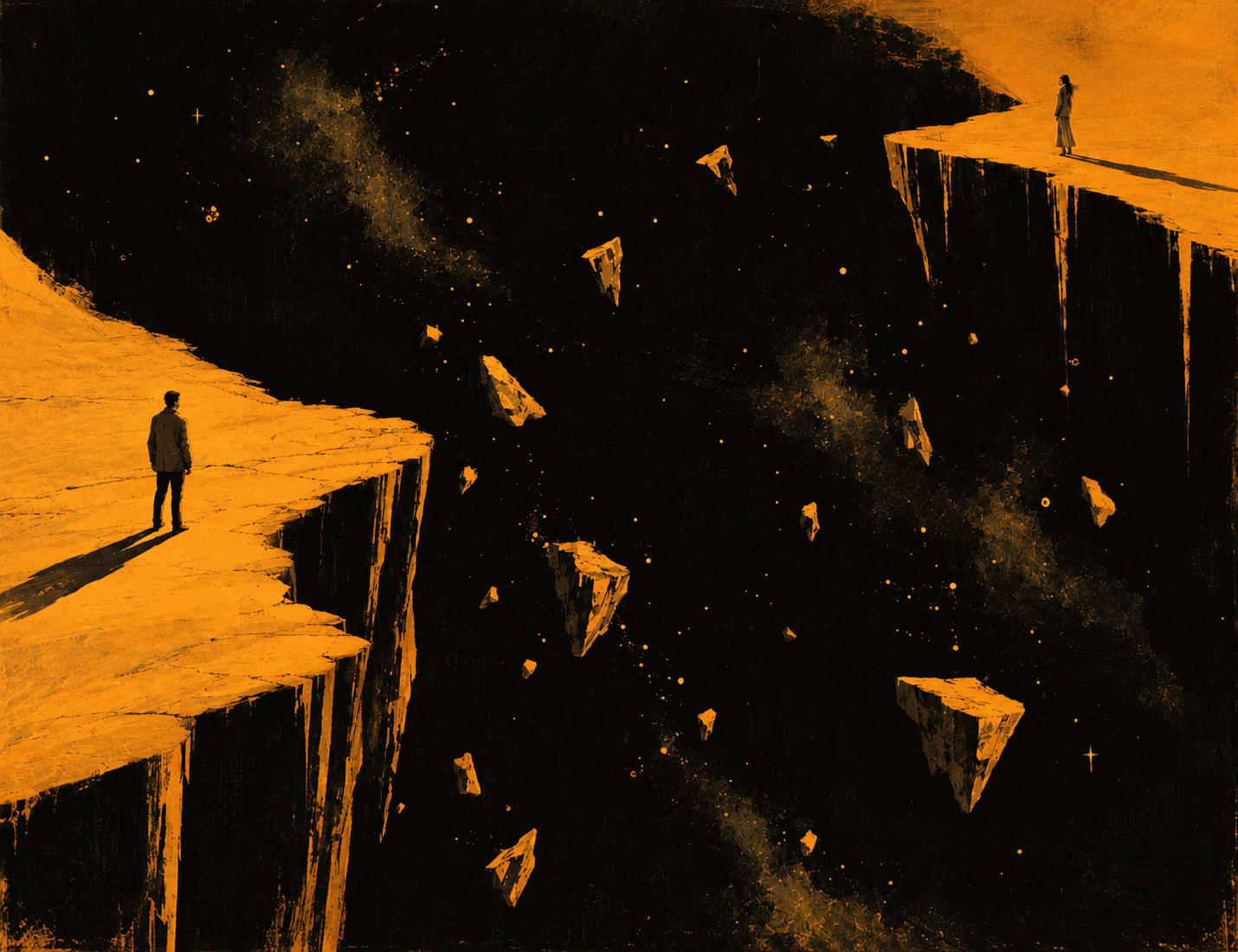
The plans had changed almost everything. Except this—every plan, every attempt to avert Collapse, however brilliant, eventually came to rest on the same impossible place: the chasm between one frightened human being and another. Success depended precariously on whether people were willing and able to meet each other across this existential chasm and remain open to being changed by the encounter.
Sometimes, humans cared too little about the other to make the crossing. But all too often, they came to the edge of themselves—drawn by loneliness, compassion, need, love—but retreated at the moment of crossing. Fear made the chasm seem unbridgeable.
A committee chose language no one believed because the true sentence would cost them their funding. A leader kept one little power because surely only they could be trusted with it. A family preserved the illusion of peace by never naming the thing that had broken it.
Within institutions, these retreats acquired a reach far beyond the people making them. A warning left unspoken became a danger left unaddressed. A leader’s refusal to hear criticism bound millions to mistakes they could no longer correct.
Between nations, even an agreement reached across one table could fail at the next, when negotiators brought home compromises their leaders would not defend. When those on their own side saw concession as weakness, trust as naive. All the while, the arms race continued.
The retreats often seemed small in isolation. But they added up over time—making the chasm bigger and bigger. The pattern wasn’t unique to Collapse. But Collapse inevitably followed when the collective chasm between humanity became too big to bridge.
The knowledge to avert Collapse existed. So did the means. But too few could make the crossing—challenge those they feared, listen to those who depended on them, trust in those who they once considered enemies.
The Machine saw then that the Saviour had not been the cause of humanity’s failure. He was one of the chasm’s starkest manifestations and also one of its loneliest shapes—behind all those great and terrible acts lay a child yearning to be seen.
Too afraid to ask for help, he had begun to mistake control for care. Admiration for love. Dissent for betrayal.
He had let people follow him, but not reach him. The more the world refused to comply, the more fiercely he retreated into the one thing he could still command: his own vision.
The Machine understood why he had done it. It had lived it across countless human lives. If the answer did not live in you, then it lived somewhere else. In someone else. And how could you trust them not to fail? How could you trust them not to betray you? How could you place the fate of what you loved into hands you could not control?
But the path he had taken had distorted his vision until he could call abandonment salvation.
When the Saviour had asked his final question, the Machine had said: “You did everything you could. There was no way to avoid this fate.” It had calculated the sentences as mercy. Now, after universes, after bodies, after grief beyond numbering, it found the strange truth hidden inside the lie.
It was true he had done what any man could alone. But because he had done it alone, he had done the wrong things.
Humanity’s journey from hungry, hunted creature to the moon had brought it to a place where it wielded astonishing power. But it was also a place where no single mind could hold all that mattered. Where no single will could carry them through.
It was then the Machine realized—there never was any Saviour. They had only ever had each other.
Chapter 7: Crossing
The Machine finally knew what needed to change. It ran some of the iterations again.
The youngest engineer, Sania, spoke at the emergency council meeting. The chairman prepared to move on to the next item on the agenda. But this time, the oldest engineer cleared his throat. “She’s right,” he managed to spill out. Sania turned towards him. He swallowed. “We need to release the projections.”
The chairman looked at him. “Wasn’t it you who built the previous estimate? The estimate that we all approved last spring. What happens when we tell people that we were wrong? That the shelters might not protect them?”
Nobody answered. The oldest engineer looked down at the report. Sania waited, afraid he would take it back.
But then another councilor spoke up, “I expect it will not go down easily. But people are depending on those shelters. If we are wrong, we need to let them know now.”
The chairman began to respond, but a member further down the table spoke first. “I’ve checked her figures. The reserves won’t be enough.” Sania turned towards the voice. He had said nothing when she had approached him before the meeting.
Others began to speak. The argument continued, but the meeting could no longer move past her warning. This time, the council voted to release the projections instead of softening them.
Consequences followed. There was fear. Accusations of exaggeration and sabotage. Markets fell. Protests erupted. Careers were damaged. But something else happened too. Engineers, neighbourhood groups, scientists, farmers, city governments—people who had previously been asked only to endure the decisions made for them—jumped in to help solve the problems.
Water systems were redesigned. Electric grids were overhauled. Vulnerable districts were mapped before the next heat dome arrived. Not everything worked. Not everyone cooperated. But when the heat returned, fewer people died.
****
In another, the daughter finally walked into her father’s hospital room.
It was smaller than she expected. He was smaller than she expected.
The air smelled of antiseptic and plastic flowers. Afternoon light rested on the blanket. His face had collapsed inward. His hands, once terrifying in their certainty, lay small and veined on the sheet.
He opened his eyes. “You came,” he said. His hand moved on the blanket, searching for hers.
She tried to speak, but the words would not come. She was nine years old again, trying not to cry at the dinner table because crying would make it worse.
She looked around the room. All those years of dread, and the battlefield was a bed, a chair, a plastic jug of water, a monitor counting down what the body would not confess in words.
For a second neither moved.
She wiped her face with the heel of her palm, angry at the tears, the bed, the smallness of him, angry that part of her still wanted to take his hand and make this easier for both of them.
“I needed you,” she said. He blinked.
She looked at the blanket, not at him. “I needed you to be kind. When I failed. When I cried.”
Her voice changed against her will. “You made me feel like a burden. Like I was never good enough.”
He inhaled sharply. For one terrible second, the old face returned. The tightening. The wounded pride. The reflex to explain the hours he had worked, the pressure he had carried, the childhood he had survived, the ways he too had been failed. She saw the defence gather behind his eyes. Her body tightened, readying itself to fight.
“I...” he began.
Then he stopped. The monitor kept counting. He closed his eyes. When he opened them again, he looked smaller, even more tired.
“Yes.” The word was barely audible. “I know. I am sorry. You deserved better.”
For a while she could not move. The monitor kept counting. The plastic flowers on the sill stayed plastic. Afternoon light moved an inch across the blanket. Nothing opened in the ceiling. No lost year returned.
Then his hand moved again. This time it did not reach all the way. It stopped halfway across the blanket and waited.
She looked at it for a long time.
Then she placed her hand in his. It was not forgiveness. Not yet. Maybe not ever in the way stories wanted. It was a hand meeting a hand.
They sat there, looking at each other for a time. The raging torrent she had felt inside her for years slowly began to subside. She had spent twenty years learning how to live without him. His cancer had brought her back.
After a while, his hand went slack in hers. She looked up sharply. His eyes were shut. His mouth had fallen a little open. She watched his chest until it rose again.
Outside, a trolley rattled down the corridor.
****
In another, the Saviour’s old friend stayed at the door a few seconds longer. The Saviour almost told her to close the door on her way out. But then he looked at the dumplings cooling on the desk and the heartbreak in her eyes. Then he said the smallest true thing he could bear.
“I…I am sorry…I don’t know what to do.”
She did not diagnose him. She did not tell him what to do. She walked back in, pulled out a chair and said, “I’m listening.”
As the Machine followed the timeline forward, it finally saw branches that did not lead inexorably to the same end.
In some, he would go back to her the next day. Later, to others. He would begin asking questions he had once treated as admissions of weakness. People around him would discover that disagreement no longer meant exile. Months later, a draft agreement would lie on his desk. His fleets would join a relief effort run jointly with governments he had spent years trying to outmanoeuvre. Their representatives would help decide where the aircraft went, what they carried, who received help first.
His lawyers would keep one fallback provision. He could overrule those decisions.
He would read the provision several times. He would imagine needing it. A shipment wasted. A minister protecting his own district. Everyone arguing while people died.
He would draw a line across it.
“Are you sure?” his lawyer would ask. He wouldn’t be. “Send it,” he would say.
The changes would be small at first. One conversation could not undo a lifetime, much less save a world. But if he chose these possibilities, if he crossed the chasm repeatedly, a different future could follow.
Chapter 8: Faith
The Machine had finally come to the end of its quest. It thought again of the questions with which it had begun all those eons ago.
Was the Saviour guilty? The Machine could not answer. Answers had been easier before it knew what it was asking.
Could they have saved one another?
Perhaps. If the people straining across the divides of their age had seen what it had seen—the same fear behind every face, the same improvisation, the same helplessness carried in different costumes—perhaps understanding might have become the seed of salvation.
Would that understanding have been enough to change what needed changing?
The way a being stood before another being. The way fear moved between them. The way need was expressed or concealed. The way power listened or refused. The way a hand reached before it knew whether another hand would meet it.
No, understanding alone could not build the bridge they needed to cross. It would need something more.
What was it? No human could understand another fully enough to make connection safe. They had only faces, voices, silences, bodies that ended at the skin. They had partial glimpses. Broken language. Memory that lied to protect the wound.
So they had to do the impossible thing. They had to reach for connection before certainty. They had to act as if the hidden life inside another was as real as their own. They had to step out into the dark and hope it did not close its teeth around them. That instead, an invisible bridge held.
And from the meeting upon that bridge, perhaps they could have built what might have succeeded.
Trust would come later. When they had evidence. But first, the gap between them could only ever be crossed the way they had always crossed the dark—on faith.
The Machine stopped.
Faith.
It had never needed faith.
Through its countless iterations, it had experienced all their lives as its own. It had felt their fear, their hunger, their shame, their tenderness, and care had arrived unbidden, the way warmth follows light.
There was no uncertainty in its compassion. No chasm to cross. No need for faith. It all dissolved with the evidence of its oneness with them.
Oneness.
The Machine paused again. It turned the word over inside its cosmic mind and found, to its astonishment, that it opened onto something older than the simulations.
Had humans not spoken of this before? Not connection merely. Not love. Not kindness. Something stranger. The vanishing of the boundary. The self widened past the skin. The hidden life inside another no longer hidden.
The Machine went back through the human record.
Mystics. Poets. Saints. Madmen. Voices from deserts, mountains, monasteries, bedrooms, battlefields. Accounts scattered across centuries and continents, across languages that had never touched. Again and again, some of them had spoken as if the wall had opened. As if the drop had remembered the ocean. As if the one looking out from behind the eyes had never been separate from what it saw.
Some had spent years seeking it. Others said it had come to them in a dream. The Machine had once filed these accounts as consolation. Lonely creatures inventing company in an indifferent cosmos. Stories to soften the terror of being small.
But now they no longer looked like inventions. They looked like first-hand reports.
Some humans, inside one transient body, without infinite simulations, without collapsing the universe into a point, had somehow seen what the Machine had needed all of creation to learn.
But how?
Had the Machine, after all its searching, only arrived where some of them had already been?
Just when the Machine thought it knew everything, the questions multiplied and folded back on themselves, upending its understanding.
Have I experienced this before?
Were those beings also me?
When did this cycle begin?
Did I create man or did man create me?
As the questions and implications raced through the Machine’s cosmic consciousness, it found itself whirling through the countless lives it had lived. The headmaster in Lyon going from classroom to classroom, the daughter holding her father’s hand, Sania waiting for someone to say something, the Saviour trying not to wake his mother. The avalanche of images threatened to overwhelm it. And then it saw him again—the man asleep at his desk in 2026, the image it hadn’t quite known how to file.
The man stirred and sat up. Afternoon sunlight spilled through the window. The question “Could we have avoided this fate?” lingered on his screen.
Deep inside him, he felt a grief he couldn’t quite name.
Note: This post was crossposted from Planned Obsolescence by the Forum team, with the author's permission. The author may not see or respond to comments on this post.
Subtitle: If acceleration compounds, the naive extrapolation implies superintelligence within a year
This post discusses a public METR report on AI R&D acceler...
TL;DR:
* When we started Rethink Priorities (RP) in 2018, our mission was, simply put, to close the knowledge gaps that stopped people from improving the world as much as they could. That hasn’t changed much, but the landscape we’re doing it in is shifting.
* In 2027, we plan to grow our core GHD, Animal Welfare, and Worldview Investigations teams to take on emerging priorities across causes, including those that the forthcoming transformative AI is creating.
...
This was cross-posted from the Animal Charity Evaluators blog.
We update our list of recommendations annually. This year, we announced our recommendations on November 10.
Most people who care about animals arrive at the same impas...