I write to raise what I think is a fundamental flaw in a Center for Global Development (CGD) article about immigration. I posted here only after receiving what I considered inadequate feedback from the authors over the last 3 months.
The major argument of the article “UK recruitment of nurses can be a win-win” is that the current situation where Nigeria exports an ever-increasing number of nurses to the UK could be good for both countries. For Nigeria, the benefits come through both the classic economic benefits of remittances, and stimulating increased nurse training in Nigeria to compensate for the losses of nurses.
A Misleading Datapoint
The central datapoint on which their argument rests seems misleading. The authors cite the number of nurses who leave Nigeria each year for the UK alone and claim that increased nurse training in Nigeria is enough to replace these nurses. “Between late 2021 and 2022, the number of successful national nursing exam candidates increased by 2,982—that is, more than enough to replace those who had left for the UK.” Technically, they are correct that the number trained replaces those who leave only for the UK, but they don’t consider the majority of nurses who left to other countries.
Emigration to the UK constitutes under 25% of the total nurse emigration from Nigeria. A more meaningful data point would have been the total number of nurses that leave Nigeria for all countries. Based on this Guardian article (and others), about 29,000 new nurses were registered in Nigeria over the last 3 years, while 42,000 left. The total number of nurses in Nigeria is reducing, not increasing as they claim.
To express this situation graphically, the best graph to illustrate whether or not nurse Migration is a "Win-Win" for both Nigeria and England might have looked more like this (forgive the poor formatting!)
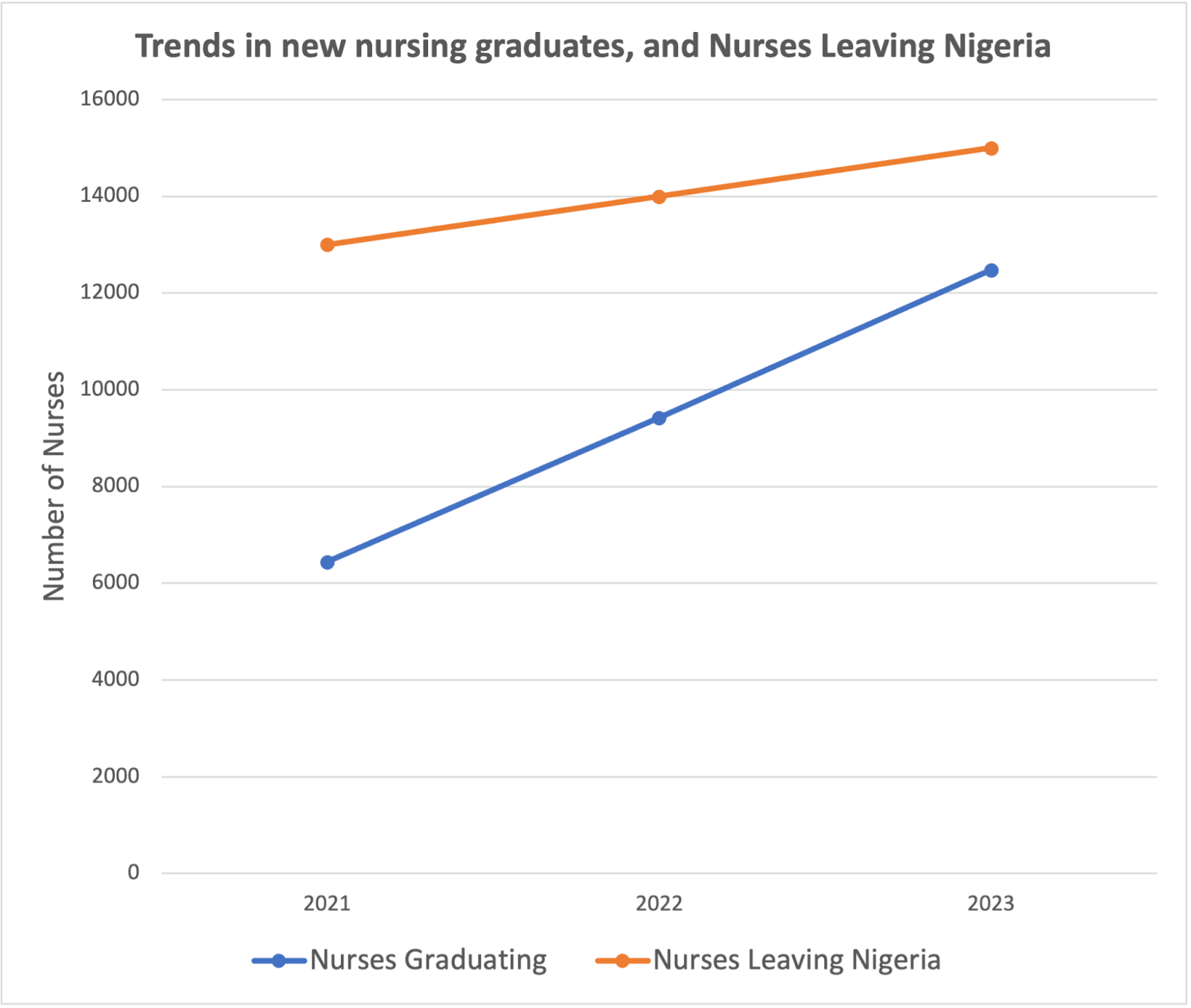
Over the last 3 years Nigeria has lost a net 13,500 nurses. This is a loss of about 1% of their nurse workforce a year, while Nigeria needs an increase of around 2.5% nurses yearly just to keep up with population growth. This assumes that no nurses left or joined the Nigerian workforce for other reasons. Nurses may leave the Nigerian workforce due to retirement or for other work, while nurses could also be entering Nigeria from other countries to work - I doubt these adjustments would make a big difference to the overall analysis.
Based on this data, it looks like England will win and Nigeria will lose. My main claim is that it is incorrect to claim a win-win scenario for two countries when emigration from Nigeria includes a majority of nurses leaving for many other countries – not just the UK. I’m very happy to be shown where I’ve gone wrong here and welcome any comments!
An Author's response
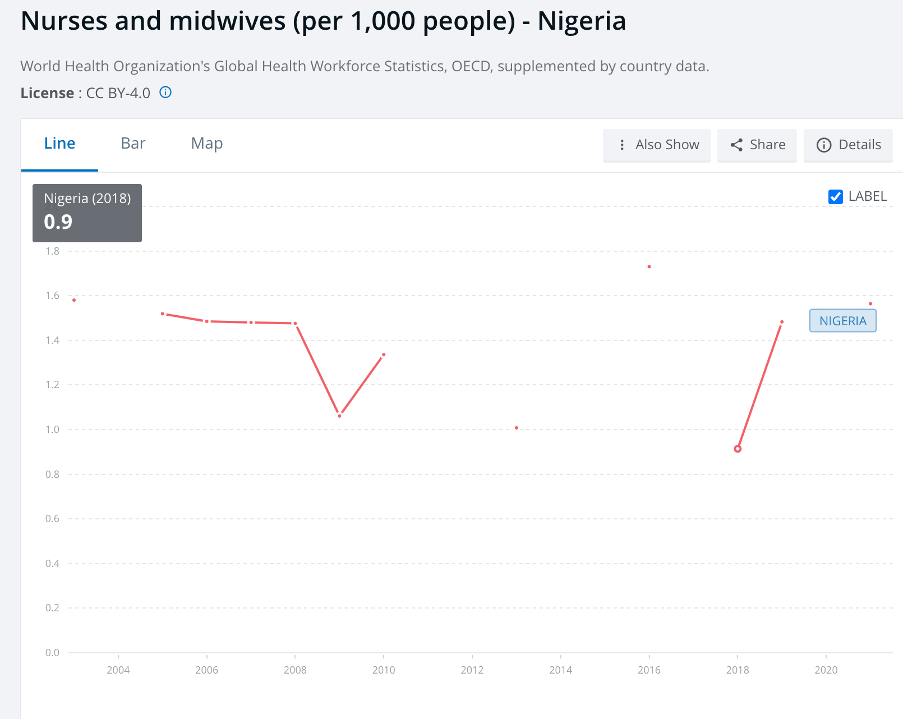
Privately, one of the authors briefly responded that their argument is based on the change in trainees and migrants over time. This still avoided my concern: you cannot look at migration outflows and inflows between two countries in a vacuum. The author also noted WHO data that shows a flat trend in the number of nurses per 1,000 people. I agree that tracking “nurses per capita” over time would be the best way to measure whether the nurse situation in Nigeria is improving or deteriorating. However the world bank data appears grossly inaccurate. Their “nurses per 1,000 population” number fluctuates implausibly between 1.75 per 1,000 in 2016, to almost half that 0.9 per 1,000 in 2018 then back up 1.5 per 1,000 the next year. Unless 100,000 nurses left Nigeria over 2 years then flooded back in the next year (not the case), the data is absurd and not to be trusted. The most proximate data we have to understand trends in nursing numbers is probably the data above - total number of nurses trained each year vs, those leaving he country (as displayed above). I don't think we have a reliable data source for nurses per capita in Nigeria.
An Implausible WHO Data Set
Also, (a side point) the authors' argument that Nigerian nursing institutions could be increasing their trainee numbers as a direct response to the UK policy doesn’t make much sense either. There would be a long lag time (3-5 years of training) before we would see any response to a new policy which took in more nurses from another country. Instead nurse training increases rapidly 1-2 years after UK immigration increases. I think you could make a decent argument that Nigeria is increasing nursing training in response to a general overall trend in nurse emigration, but not just from the UK policy.
In summary looking at trends and number of nurse emigration (what I think the article tries to do), the data appears to show net harm to the Nigerian Health System, not a “win-win” at all.
If I’m right, then I think the premise for the article is invalid – i t should probably be retracted or rewritten. I don’t love being that guy who brings the criticism and would rather have resolved this without posting here, but I think truth-seeking is important, especially when addressing Open Philanthropy funded think tanks. I also think when you chase a potential inaccuracy in good faith, it's usually best to continue until the loop is closed.
I recognize there’s more than a chance I’m wrong here, so I’m very open to being rebuffed in part or in full. I'll edit or retract the post based on convincing responses. I would especially appreciate a response from CGD authors or staff.


TLDR: The immediate drop in Nigerian nursing workforce isn't indicative of the long-run effect of rich country nursing visas. Prior evidence suggests that the increasing in nursing supply will be lagged, but big enough swamp the effect of outmigration.
Hi Nick, thanks for this! Point well taken on the misleading numbers in the CGDev article. I share your skepticism that the UK policy could have caused an uptick in the Nigerian nurse population within 2 years of its introduction. In the first couple of years of the policy, the outmigration is plausibly a net-loss for Nigeria before we consider the effects of remittances.
That said, the crux of the cost-benefit calculation (bracketing remittances for now) is the effect of UK nurse recruitment on the Nigerian nurse workforce over the longer run. In particular, we have evidence (open access) from the Philippines[1] showing that expansions in US nursing visas caused an additonal 9 non-migrant nurses to be licensed for each nurse who migrated to the US. We can think of the big surge in nursing supply as being driven by the hopes of winning the "migration lottery" to the US, with most lottery entrants losing.
Crucially, the increase in nurse licensing only showed up after at least a 4-year lag (the time it took to complete a nursing degree). This increase involved both increasing enrollment at existing institutions, but also an increase in the number of nurse-training programs, which would show up with even further lags. If the Nigerian case mirrors that of the Philippines, we wouldn't have expected the increase to be visible yet. I think you made a similar point when you said :
The Philippines nursing example is the closest analog we have in the research, but we see a similar mechanism at work in the boom in engineering/CS skills in India in response to changes in the US H1-B cap (Khanna and Morales, 2021).[2]
Now, there may be institutional differences between the Filipino/Indian and Nigerian cases that cause there not to be similar effects. For example, there could be bottlenecks to expanding existing nursing colleges or setting up new ones. Alternatively, all the increase in nursing supply could be absorbed by other countries. I'm not familiar enough with the country to have a view on this, so I'd be curious if you think the Nigeria is particularly well or badly suited to expand nursing supply.
The CGDev authors cite this research, and I'm guessing this drives their views more than the spotty WB/WHO data.
And here's another paper with similar findings in the context of Fiji.
Nice one lots of important points there thank you.
First I want to stress I'm not an expert or even that well versed in this area, I just saw an article that I thought was deeply flawed and tried to correct the situation (still waiting for CGD response). Its great that this has triggered good commentary about the actual issue though and I'll engage as best I can, I find it fascinating and I think its an important issue.
My take is that the Phillipines situation seems so different from the situation here in Sub-Sarahan African that it has limited applicability here. Even just looking at the "Brain drain vs brain gain" simplistic framing (bracketing remittances and other benefits/harms), the Phillipines situation mostly doesn't translate. Like you say we will see over the next few years whether increased nurse training will soon compensate for both those that leave every year and the deficit of tens of thousands which has already happened but I'm skeptical. My very low confidence take would be that within 2-3 years based on current trends the yearly no. trained might creep just past the number who leave, but will not replace the current deficit, nor keep up with the still rapidly increasing population.
To state the obvious, the current Nigeria situation provides evidence in the opposite direction the Phillipines article
"Our research provides evidence against the idea that skilled migration necessarily depletes origin countries of health professionals or college graduates more broadly."
So far from the limited data we have (See Nigeria above, and other West African countries like Ghana and Liberia are similar), skilled migration is depleting some origin countries of health workers.
Looking more deeply though, I think the "brain-gain vs brain drain" framing isn't super useful as there are so many other factors at play. Rather the EA style framing of "overall net positive vs. net negative" is better as we can include a range of factors in our analysis, even if they are hard to quantify. Just looking at the Phillipines situation, here's a top-of-the mind list of i potential positives and negatives from the Phillipines mass training/migrations. Far from exhaustive
Potential Positives
- Remittances from the nurses that managed to emigrate (Massive in this case)
- Increase in overall skilled worker training
- No shortage of trained nurses in Phillipines
Potential Negatives (often harder to quantify)
- Dissatisfaction within the Phillipines Health system. How can nurses be satisfied with a local wage in the Phillipines, when so many of their colleagues have orders of magnitude higher wages abroad? This is a neglected downside in these mass migration situations. In the Phillipines there are so many registered nurses now unwilling to work there that the government is changing the rules so that they can employ unregistered nurses who haven't yet passed the board exam...
https://newsinfo.inquirer.net/1912359/nurses-group-hits-band-aid-solution-to-shortage-problem
- Gutting of senior staff/talent/leaders - senior and better nurses emigrate easier, leaving more junion/less talented nurses at home
- "Brain drain" from other skilled work The article points out that most of the new nursing stock was people who would have done another post-grad qualification if not nursing. This means other fields which needed workers (engineering, law etc.) may have suffered some brain drain. Important to note though that overall skillled graduation increased.
- The training glut left thousands of trainees without a meaningful qualification. Only 38% percent of the new glut of nurses passed the registration exam vs. 58% before. So on finishing training almost 2 out of 3 nurses wasn't able to work at all.
I would lean towards the overall situation in the Phillipines being net positive, but I'm not sure its a complete slam-dunk.
To follow up on your Nigerian Question, as we can see from the increasing number of graduates in the CGD article, Nigeria is already doing a pretty good job at expanding nursing supply. Based on current evidence though, I doubt they can do it quick enough to keep up with emigration. I don't know the Nigerian situation, but here in Uganda most private nursing schools have spare capacity. Once that has filled though it will become a lot harder to open new schools.
Like the Phillipines article said "Such a response may not be possible in all contexts, for example in sub-Saharan Africa, where the postsecondary education system may not expand as readily in response to increased demand"
Agreed that we should consider the broader set of costs/benefits you list! The top talent loss cost could be an especially a big deal in Nigeria, where I'd expect a weaker "bench" of substitute human capital than the Philippines (both for new potential nurses and for those who would train the new nurses/found new private colleges).
My (unquantified) view is that the CBA still looks pretty one-sided in the Philippines context, but I'd love to see what a formal modeling exercise produces (and if the conclusions are different for Nigeria or other Sub Saharan African countries).
I think there's strong evidence that there is in fact a far weaker "bench" of substitute capital in the Phillipines. Pre nurse-glut, 58% of nurses passed the registration exam, whereas post nurse-glut that dropped to 38%.
I agree that top talent loss is likely far less of a big deal in the Phillipines but for very different reasons - mainly because only 1 in 8 (or similar) new staff left, which should mean enough strong staff remain, even with the clear drop in average nurse quality.
Phillipines and Nigerian CBAs are likely be wildly different, even just based off the one datapoint that Nigeria has lost tens of thousands of net nurses through emigration while Phillipines gained.
Not sure if we disagree here. Of course I'd expect the average nurse quality to go down as the workforce increases by 9x. Rather, the claim about weaker substitutes in Nigeria was about explaining why Philippines nursing supply might be more price elastic than Nigerian supply. Specifically, since literacy, numeracy and high school graduation rates are likely significantly higher in Philippines than Nigeria, there's a larger share of the population that could plausibly respond to the migration demand shock by acquiring the relevant training.[1]
Agreed if we conducted the CBA today. However, as stated in the original comment, we want to be careful about lags here. Even in the Philippines, the migration increase started in 2000 when the US policy changed (Figure 3) and peaked in ~2006. While the enrollment rate in nursing programs did start increasing in 2000 itself (Figure 4, Panel A), the increase in the nurse graduation rate (i.e., the trained workforce) only started in 2004 (Figure 4, Panel B), and only hit it's peak in 2010, 10 years after the migration began. If we were looking at the change in Philippines' nurse workforce from 2000-2004, I think we might've concluded that they'd lost nurses and that the migration was a net-loss for them. Now, as we've discussed, there are reasons to believe that Nigerian nursing supply may not be as elastic as Philippines nursing supply, but I just wanted to emphasize that the current net-loss of nurses in Nigeria doesn't yet give us strong evidence that the CBAs will be wildly different.
Implicit here is that basic numeracy, literacy and high school graduation are pre-requisites for acquiring nurse training.
Yep agree with all of that. Nigeria has been losing quite a large number of nurses for 5 years now, but maybe the compensation will happen like in the Philippines like you say
Shall we check in here again in 5 years and see what happens ;).