Comments
I worked as a Summer Research Fellow at the Happier Lives Institute (HLI). The last two months, I researched how individuals can improve their wellbeing (report coming).
Here are 11 lessons I learned, from the first interview to the last meeting 🙌
(Note: this is based on feedback my bosses gave after they hired me)
#1 - Just apply.
Employees at HLI usually have PhDs or Masters degrees in psychology, economics, or philosophy. Seems reasonable when you're trying to find ways to make people happy.
I'm going to start my computer engineering undergrad in a week. 😮
That's not to say I hadn't explored psychology, economics, or philosophy informally. Past projects like hackathons let me find unique insights to bring - ex: how people in LMICs need self-care 100x more than care from specialist psychologists.
Still, the imposter syndrome was real. From the very moment I filled out the application form.
And yet, filling out a simple application form led to the best first job I could dream of.
So key takeaway? Nix the doubtful thoughts. Just apply. 😉
#2 - Don't Do All the Talking.
During the interview, I got to meet my (future) boss Sam Dupret. I gave him the trademark: "EA-aligned psychologist who knows how to code"
It was my first time being interviewed by a scientist. Suffice it to say, I did quite a lot of hyperventilating beforehand. 😁 But also, I searched up past webinars from my boss to get to know his personality.
Sam's a pretty casual guy. That's why it surprised me that he read off a formal script at the start of the interview. Maybe because he was also learning to run interviews while I was learning to give interviews. 😅
Still, I was prepared. I'd read How to Win Friends and Influence People by Dale Carnegie (the best or second best book I've ever read). It describes exactly how to be social. I'd recommend it to everyone!
In this case, a lot of the book's tips helped me turn the interview from a formal interrogation to a casual, two-sided conversation.
#3 - Mention Specific Challenges Overcome.
As the interview progressed, Sam and I talked more about my pre-interview 'test' task. I analysed a report on which factors influence wellbeing.
Again, I'm about to start an undergrad in computer engineering. Reading an economics research paper was like a J.K. Rowling novel full of fantastical words. 😵
However, after a lot of Googling, I started to understand the jargon. It connected to other areas I'd researched. (Ex: I'd learned lots of maths from AI courses that helped me understand the maths in social sciences.)
So, I just told Sam that. Being open about the challenges I faced/fixed in past work/test tasks showed my boss that I could figure things out on my own. As he told me later, this was one of the factors that helped HLI decide to hire me.
#4 - Show Specific Curiosity.
At the end of the interview, Sam gave me some time to just ask questions. I chose to ask him about questions/topics I'd want to learn more about on the job. Specifically, we went on some intellectual rabbit holes on how early childhood experiences could influence mental health in later life.
Afterwards, Sam told me how he noticed I was engaged with this area of work. Because I showed him my curiosity to learn more 🤓
Now, after I'd gotten hired, a few things immediately went well 😊
#1 - Meet as Many People as Possible.
The most impactful work happens A) in groups and B) in the long-run. That's why making long-term relationships was a bigger goal for me than my short-term individual project.
So I told my colleagues at HLI this, I reached out to set up 1-on-1 meetings before the job officially started, I used Dale Carnegie's lessons on how to be sociable, I set up an unofficial games day, etc.
Overall, we could say I was throwing spaghetti on a wall 😅 Some things really worked and other times, I was waiting alone in a Google Meets Room.
Still, the regret of not trying to make relationships would be worse than the occasional rejection. Also, some of the upsides were great! For example, I met Ulf Johansson, a past volunteer at HLI. His suggestions directly (and unexpectedly) helped me plan 10% of my project! 😮
#2 - Ask Unique, Memorable, Personal Questions.
When I had meetings, I did my best to be vulnerable + personal + human. Ex: I had weekly meetings with my boss, Joel. Each sync, we made a deal to not start with boring: "How are you"s. Instead, I'd come up with a unique, interesting question:
At the end, Joel told me how he could always look forward to something new in our meetings. 😊
#3 - Ask for feedback.
Especially in a small team like at HLI, everyone's busy wearing mutiple hats all the time. My bosses might not always have time to note little things I should change.
But, if I don't change, then I can't grow. So... I just had to take things into my own hands! 😁 Ex: Every few weeks, I'd ask them for what I should keep doing and what I should change. Ex: At the end, I scheduled a retrospective to understand what went well and what to change.
In a small busy team, these things aren't easy to make time for. But they help everyone. So I shouldn't just wait passively for my boss to take care of this for me.
#4 - Be an Owner.
Ownership is very specific for me. Being an owner means I see my work as an improvable opportunity, instead of a task to get over with.
Example: my bosses wrote a report separate from my project. Being 'fresh' to science, some jargon still confused me. So I went out of my way to create a simple infographic to summarise the report.
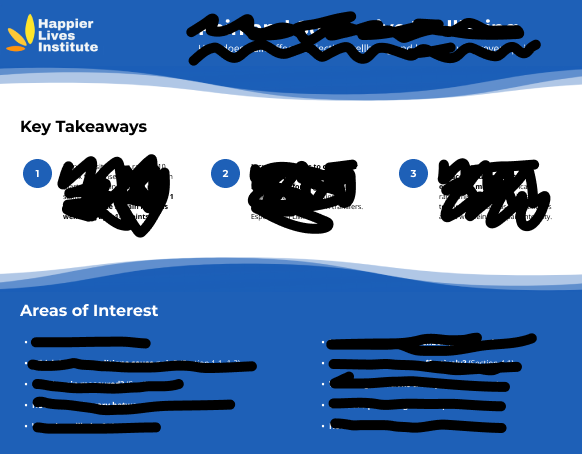
In the end, my bosses told me how they valued my independence in planning / delivering projects myself.
Still, I'm not sure that HLI will use this specific infographic. But again, the regrets of not trying to do it are worse than this one infographic not being used. So I'm glad I tried!
After some time on the job, I noticed some group successes... and some failures too 😢
#1 - Overcommunicate for Transparency.
This was a natural habit of mine. I can't stand being disorganised, so I just had to create structure in everything. 👉👈
This made me more slow in the beginning. But it saved time later. Ex: If my bosses needed to check my work and I could just send a spreadsheet link. Versus lots of extra meetings to clarify information. It also helped my bosses know early when I was going in the wrong direction, so they could help me fix mistakes.
#2 - Proactively Mention Working Habits.
This is something I didn't do well. And I didn't find out until the end of the internship. When I was writing up the final report, my bosses and I disagreed on conclusions. In the end, my bosses typed up a 4 page document to explain things to me 😮
That might seem excessive, but it was exactly what I needed! Personally, written feedback is much better conversations. Since I can review the feedback several times. I hadn't told Sam + Joel that. But luckily, they noticed I worked better with written feedback anyways. 😁
That got us wondering - why not just have noted my working preferences at the start? I shouldn't just have waited for my bosses to ask. I should've taken initiative to tell my bosses what kind of communication works best, what I'm motivated by, past practices I liked in teams I've worked on, etc.
#3 - Ask: "How could I be wrong?".
In that same problem of conclusion disagreements, I was also being wayyyy too confident in my beliefs. 😣 Without going on a rant, let's just say I was being a militant nihilist about how credible psychology is 👀
I know... seems a bit much for a student about to start a computer engineering degree, right?
Luckily, my bosses (Sam + Joel) walked me back to more reasonable positions. Still, it would've been more efficient if I'd been more cautious in challenging others' beliefs.
Specifically, I should've asked: "How could I be wrong?" before challenging others' viewpoints. And asked more questions instead of jumping to conclusive statements.
With all those lessons mentioned, I wanted to finally thank my colleagues at HLI for giving me the opportunity to learn them!

Thanks for sharing, and doing so in the most friendly manner, Madhav!
GREAT advice, relevant for everyone who enters a running organization.
I appreciate you taking the time to read and encourage :-)