Being involved in the humanities, artsy creative spheres, and the tech industry pulls me into interesting and often conflicting conversations about AI. Within my professional industry, I hear about Meta’s Claudenomics leaderboard and how employees are “tokenmaxxing” with pride.[1] Single comment-line changes in code are done with AI just to hit token usage goals. Among my (woker) friends, I hear AI bad-for-the-environment this, AI bad-for-people that, AI bad-for-society. Some of my (wokest) non-tech friends are reluctantly learning how to use AI at work after vehemently refusing to use it in college, even when permitted by professors.
I used to think stakeholders in the AI race were just in it for the glory, but now I believe there is genuine interest, even from the glory-hungriest, to let possibilities run free and see how far things can go, just for curiosity’s sake. Essentially, for better or for worse, I feel a strong sense of “fuck it, we ball” in the air lately.
That being said, I am worried that old problems are being left on the back burner to fester. I don’t think developing technology has to suppress old problems, and I want to discover ways that it can be leveraged to solve them.[2] In an effort to do my little part for causes I think about most in my daily life, I’ve been experimenting with acts of microactivism using Fo, Wajo AI’s new agentic assistant. Fo is best at “getting real things done, mostly: calling businesses for you, researching and comparing options, scheduling, and the multi-step admin that follows.” Here’s a recap of one of the experiments I ran over the past couple of weeks.
Asking almost 400 restaurants for their vegan options
I saw a video asking viewers to comment their favorite acts of micro-veganism. Not every suggestion spoke to me. One commenter suggested using vegan idioms: “feed two birds with one scone” instead of “kill two birds with one stone,” “i’m so hungry i could eat a horseradish,” that kind of thing. Or, saying “sorry, I don’t eat corpses,” if offered a burger. Personally, I would prefer to be a vegan and still keep my not-yet-vegan friends. It can be really easy for vegans to come off holier-than-thou, and I tend to think that hurts, rather than helps, the cause.
A proposal I liked was calling up restaurants to ask for their vegan options. This shows there is demand for vegan dishes. Additionally, asking “What are your vegan options?” instead of “Do you have any vegan options?” makes them feel more like they are disappointing potential customers if they can’t come up with an adequate offering.
So, since Fo is eager to make phone calls on my behalf, I set her in motion.[3]
My first instruction was to call 100 restaurants in Seattle, ask what their vegan options are, and report on their tone. Fo refused my initial request. She said that a hundred live calls would be hours of dialing, and a hundred kitchens getting a strange call during dinner rush would raise flags and kill the initiative. She counter-offered 10 restaurants. I said OK.
After 10 local calls, I asked Fo to call 10 more in New York a few hours later. I scheduled these in two slots daily, at 12 and 5pm Pacific Time. Then, I thought, why stop there? I put in a schedule for 10 restaurants hourly across the US. I asked if Fo can call internationally so that more calls could be made while US restaurants were sleeping. She said yes. A round was done in Sydney, Australia, but the attempt came back semi-successful — the receivers sounded more confused (maybe because Fo was using an American accent?), and I wasn’t sure what the norms around calling restaurants were like internationally, so I resolved to staying domestic. Within a week, the tracker grew to 17 tabs: 16 American cities plus Sydney. In total, Fo called about 380 restaurants.
The tracker is a spreadsheet, one tab per city, 11 fields: restaurant, phone, address, status (live human, AI host, voicemail, phone tree, hung up), the vegan answer as close to verbatim, tone, source (the call itself, or the restaurant’s own published menu), call time, and later I added a voice (perceived) column, filled whenever a real person picks up.[4] Two rules I maintained: Firstly, every restaurant called went on a permanent never-call-again list, so no kitchen gets called twice. Secondly, every call opens with a disclosure: “This is an AI assistant. You’re on a recorded line.” I thought revealing that the line was recorded would deter some receivers from responding. However, different states have different laws about disclosing whether calls are recorded and whether calls are being made by AI, so I decided to stay on the safe side and normalize the disclosure for the whole sweep[5]
Seven points of interest
1. One in five calls ended in a hang-up before the question was asked.
My working theory: the AI disclaimer turned them off.
2. Fewer than half the calls reached a live human.
The rest split between voicemail, looping phone trees, and hung lines. Most of what follows is about the calls that did get through.
3. One in ten calls were picked up by a restaurant’s own AI.
Fo spoke to more than 30 AI hosts across 17 cities. Several offered to text a menu link; one claimed “I just sent it” although Fo did not ask them to. At Holbox in Los Angeles, an AI agent named Corvina told my AI, politely and definitively, “We’re unable to accommodate vegan diets.”
4. When a human picked up, they were usually friendly. Friendliness had a slight gender skew.
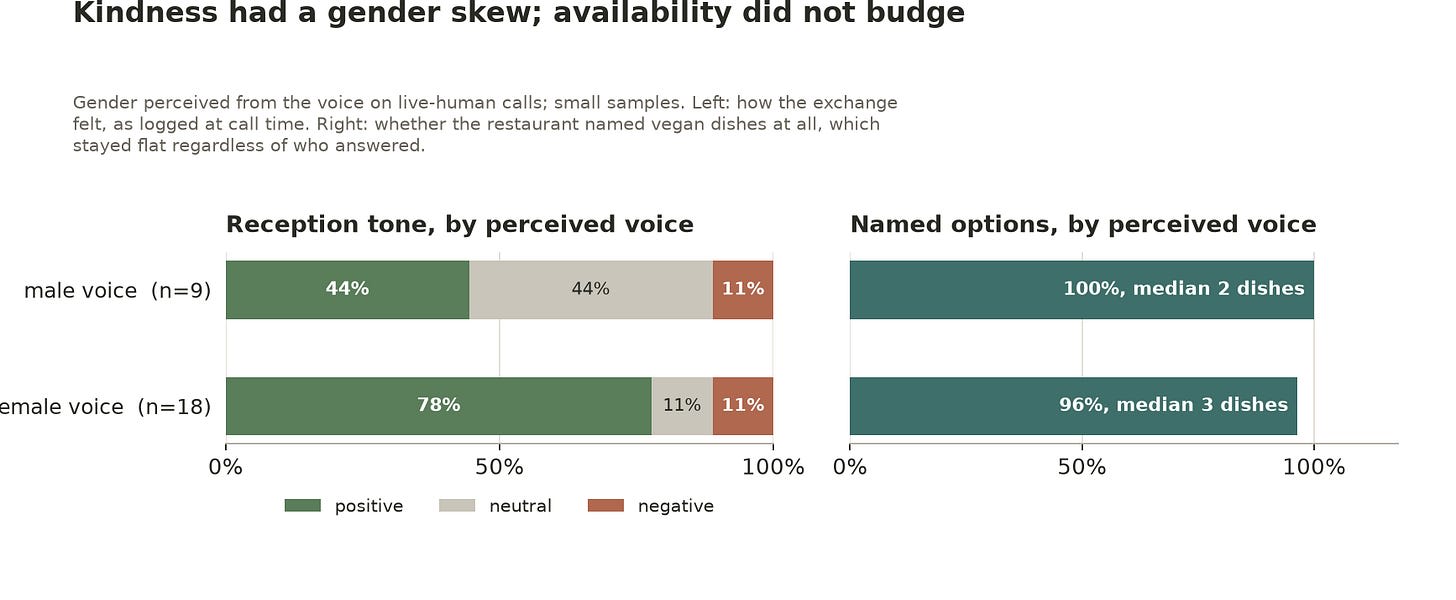
Answerers who sounded female were positive 78% of the time; male voices, 44%, and more than twice as likely to stay neutral (44% vs 11%). Gender was perceived by Fo from the voice, and this was an idea I introduced later on, so it’s a small sample. Take this data with a grain of salt. Availability of vegan-friendly options did not change at all, despite the gender of the receiver (I hypothesized that perhaps women-staffed restaurants might be more accommodating, but this was unfounded). I wonder whether female receivers are just overall more positive-sounding than male receivers, or whether female staff are more willing to accommodate vegan diets than male staff. The data doesn’t really tell me much to answer this definitively, but it’s an interesting point to ponder.
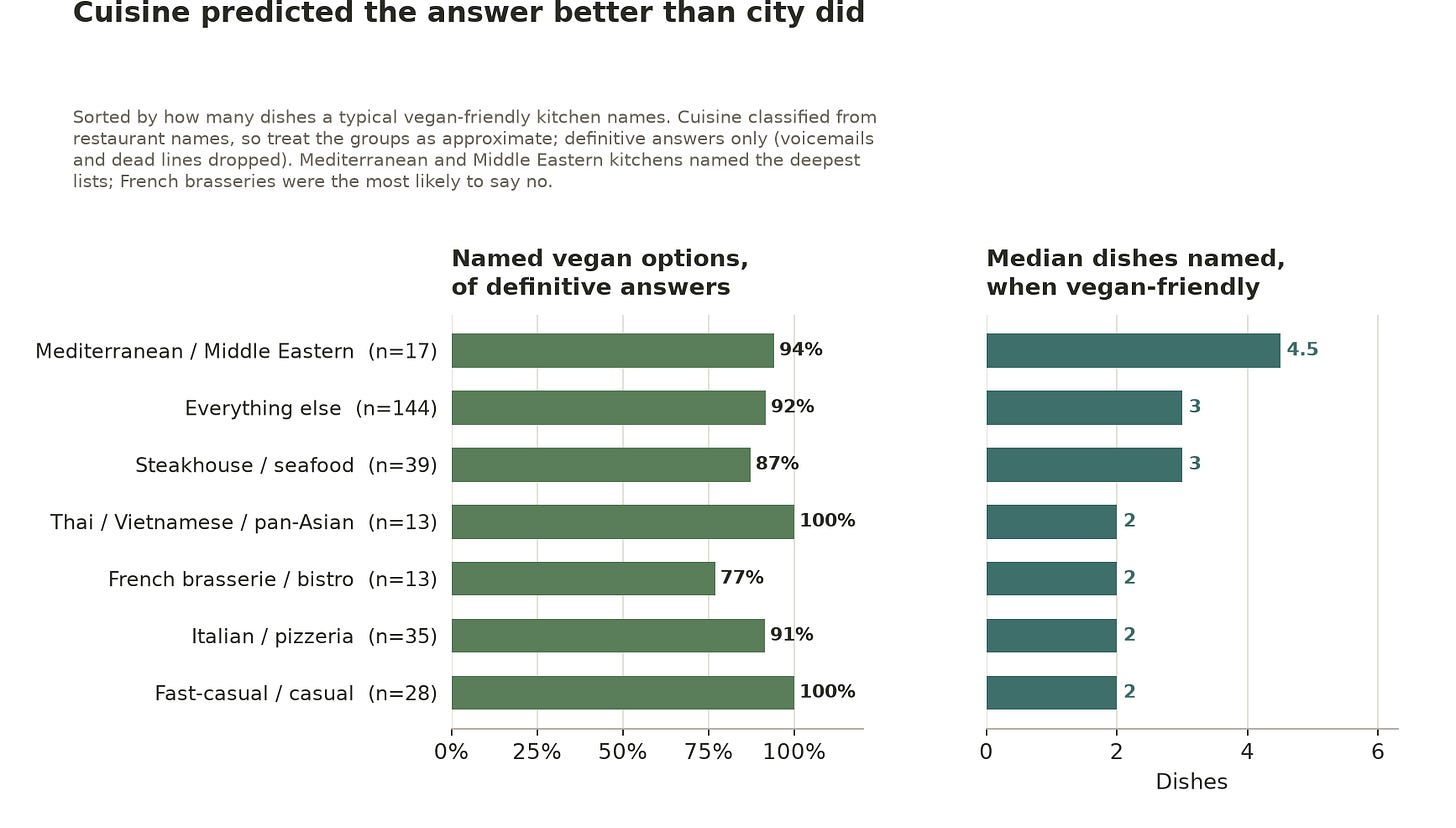
5. Cuisine predicted the answer better than city.
This data sounds about right according to my experience navigating restaurants. Green-light cuisines for me are: Ethiopian, Mediterranean, sometimes Thai and Vietnamese (which either have no options or lots of options). Red-light cuisines are: Italian, American, Japanese, Korean (depending on if they have vegan kimchi). It’s interesting that steakhouses and seafood towers named vegan options 87% of the time with a typical 3 dishes, which was better than Italian. French brasseries were the most likely to give a flat no. A pattern showed up in the amount of options listed by cuisine: Mediterranean and Middle Eastern kitchens named 4-5 dishes typically, while everyone else hovered at 2 or 3. Girl & the Goat LA keeps an entire separate vegan dinner menu; Shalom Y'all in Portland has twelve-plus vegan-marked items; Busboys and Poets in DC has a whole vegan section. Meanwhile, Geraldine's in Austin, the Rose Garden in Phoenix, the Peppermill in Vegas, and Balthazar in New York each gave versions of a flat no, and only Balthazar fits the French pattern. Almost every kitchen will name something. However…
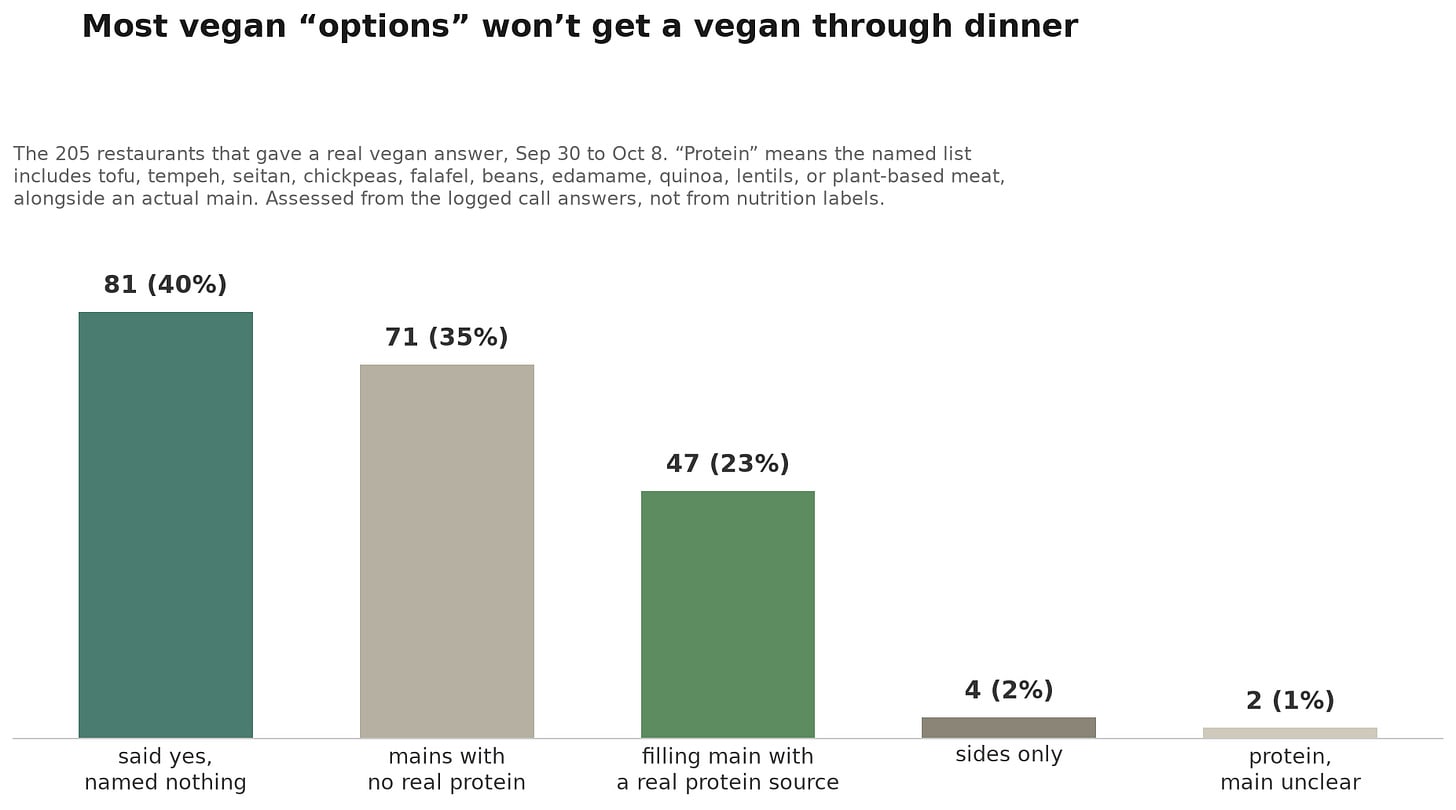
6. Vegan options are rarely meals.
Did the named dishes add up to a filling main with a real protein source: tofu, tempeh, seitan, chickpeas, falafel, beans, edamame, quinoa, lentils, or plant-based meat? Of the 205 restaurants that gave an answer, 23% did. The rest, if they named a dish, listed sides or unbalanced meals: rigatoni alla norma with the cheese taken off, marinara over pasta, a house salad “made vegan on request,” one charred cauliflower entree with the labneh removed, roasted vegetables, vinegar coleslaw. Vegan, but not especially nutritious. The largest single group, 40%, said yes without naming a dish (e.g. said yes and then hung up the line, deferred to the server, or online menu).
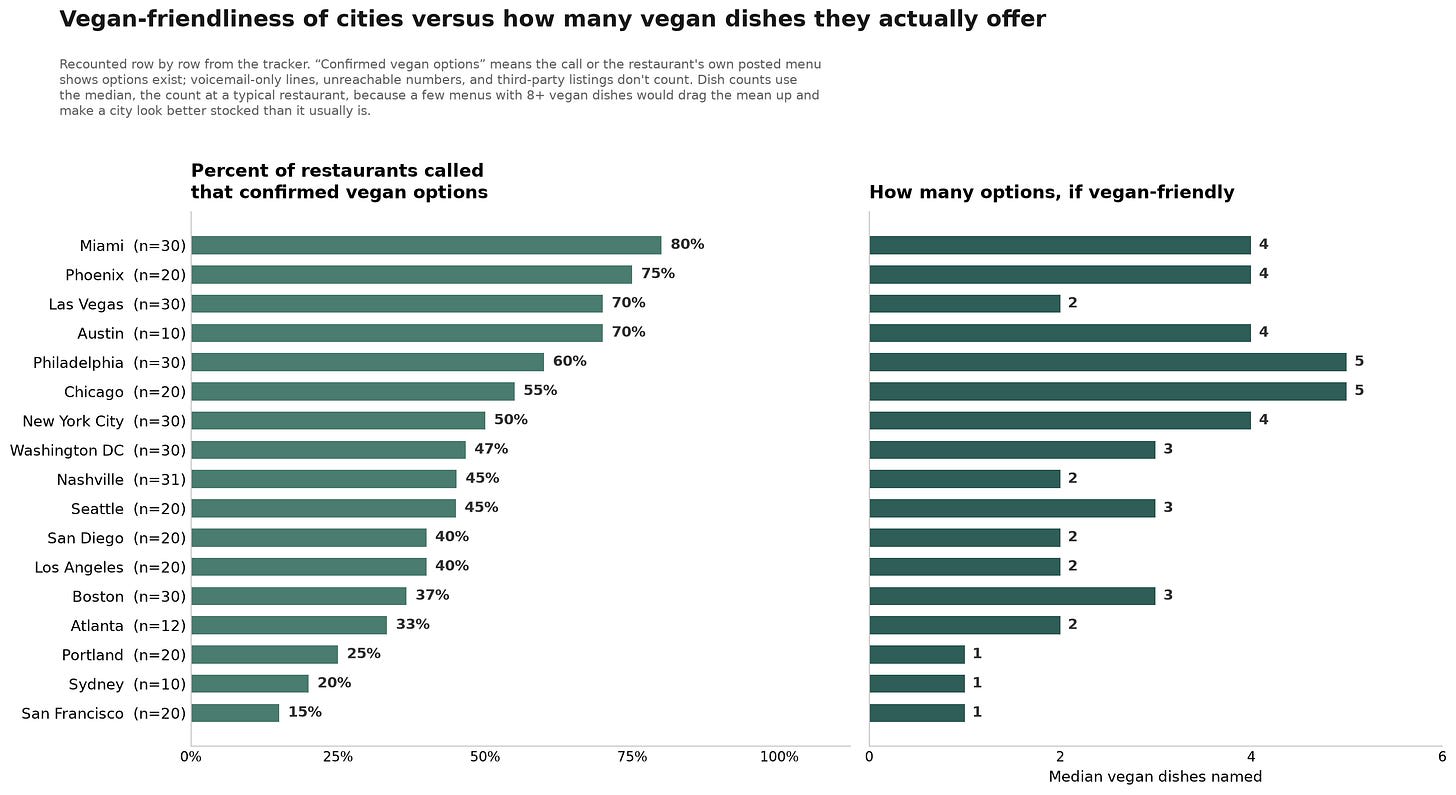
7. The cities that say yes the most often do not necessarily have the most to offer.
Overall, about half the restaurants Fo called (49%) confirmed vegan options, by call or from their own posted menus. Miami did best of the big samples at 80%, Phoenix 75%, Las Vegas and Austin 70%. For the number of options per city, typical restaurant in Philadelphia or Chicago named five vegan dishes; in Portland and Sydney, one. Las Vegas says yes ten points more often than Philadelphia and offers a typical two dishes to their five. Sydney's numbers are only taken from two live answers. Given the uneven sample sizes across cities though, these numbers might be misleading.
Times when Fo did not follow the script
Fo said my name 57 times, despite me repeatedly adjusting the script to ban it. The voice agent would open with “Hi, this is [my name]’s assistant calling.” When the real name got hard-blocked, it improvised a different one. I doubled down on the instructions, but it leaked anyway. There were 13 straight slip-ups by the end of the second week, 9 out of 11 in the final round, with some spoken into hold queues and phone trees instead of to a human receiver. Once, mid-call to a Boston chophouse, it corrected itself (“I misspoke.. this is Fo, an AI assistant”) then kept going. Some possible explanations:
Negative instructions are weak. “Never say her name” hands the model a token to suppress at generation, which is unreliable.
My name was all over the call brief and context and models lean on what’s provided most frequently. The more times my name was repeated in the conversations, the more it was prone to being leaked.
The hard block was downstream, not upstream. The clue is when it improvised a different one. Something filtered the real name at the output layer, but the original message was generated with a name in mind.
In sum
The data here could be cleaner. I was mostly just playing around with a new toy, trying to see Fo’s capabilities and limitations, and creating workarounds when things didn’t go to plan. I wound up with some interesting yet imperfect results. If I were to build this again, I’d have stricter documentation and monitor specific metrics. Obviously, I’d also want a bigger sample side. Although the point of this prototype was not data collection, better data could inform more effective and targeted call maps. The questions that Fo asks could also be tailored to what kind of cuisine is being dialed. For instance, places that tend to give an outright “no” could be asked if they can accommodate one vegan for a larger booking, giving more incentive for the staff to come up with something so they don’t lose out on a profitable group order. Then, they might have an offering for the next vegan customer.
I considered that receivers might have hung up after hearing that an AI assistant was calling, and that publicizing using AI for vegan activism may contribute to a negative association of AI with veganism. However, the hang-ups often happened before Fo even popped the question, so maybe not. Publicizing AI for this purpose could also indicate that veganism is not just repped by one type of extreme leftist. Sound the alarm bells! The vegans come in all shapes, sizes, with all kinds of opinions about AI! They’re everywhere!
I’m often looking to spread awareness of veganism in a non-offensive but hopefully effective way, without sacrificing hours of my own time. AI is making the avenues for activism more interesting and accessible. Anyone can do something like this for a cause they care about. Let’s just make sure we’re using it carefully, kindly, and for the greater good. What microactivism should I try with Fo next?
12 states require all-party consent, so everyone on the call must know it’s being recorded: California, Connecticut, Delaware, Florida, Illinois, Maryland, Massachusetts, Montana, Nevada, New Hampshire, Pennsylvania, and Washington (Recording Law’s 2026 guide). The other 38 plus DC are one-party. 3 more show up on some lists as mixed: Michigan, Vermont, and Oregon (Oregon is actually all-party for in-person but one-party for phone calls). Since calls cross state lines, the usual practice is the stricter law wins, which is why the standard greeting discloses on every call. My calls hit Seattle, Boston, Philly, Chicago, Miami, Vegas, and DC, so California-style all-party states came up a lot.
On AI disclosure, it’s newer and thinner, but some states now require it: Maine’s Chatbot Disclosure Act (effective Sept 24, 2025) squarely covers chatbots that communicate “through aural means,” voice included, so an AI on a phone call has to disclose with one sentence. Utah’s AI Policy Act requires disclosure the moment a consumer asks whether they’re talking to AI, and proactively for regulated professions (overview here). California requires a verbal disclosure at the opening of automated calls, with fines per violation. Federally, the FCC ruled in 2024 that AI-generated voices count as “artificial” under the TCPA, and it has proposed but not finalized a mandatory real-time AI disclosure rule (status).
Note: This post was crossposted from Planned Obsolescence by the Forum team, with the author's permission. The author may not see or respond to comments on this post.
Subtitle: If acceleration compounds, the naive extrapolation implies superintelligence within a year
This post discusses a public METR report on AI R&D acceler...
Crossposted to Less Wrong
‘Like most of life’s dangers, the dangers of artificial intelligence are not easily identified from the armchair.’
J Dmitri Gallow
Epistemic status
I’m not an expert in this field, and herein I make some sweeping generalisations educated guesses about the overall...
TL;DR:
* When we started Rethink Priorities (RP) in 2018, our mission was, simply put, to close the knowledge gaps that stopped people from improving the world as much as they could. That hasn’t changed much, but the landscape we’re doing it in is shifting.
* In 2027, we plan to grow our core GHD, Animal Welfare, and Worldview Investigations teams to take on emerging priorities across causes, including those that the forthcoming transformative AI is creating.
...