“I” refers to Zach, the Centre for Effective Altruism's CEO. Oscar is CEA’s Chief of Staff. We are grateful to all the CEA staff and community members who have contributed to the development and implementation of our strategy. Mistakes are of course our own.
Executive summary
One year into our 2025-26 strategy, we have reversed our programs’ negative growth trajectory from 2023-24 and will sustain that momentum in 2026 while preparing to hit much more ambitious goals from 2027 onwards:
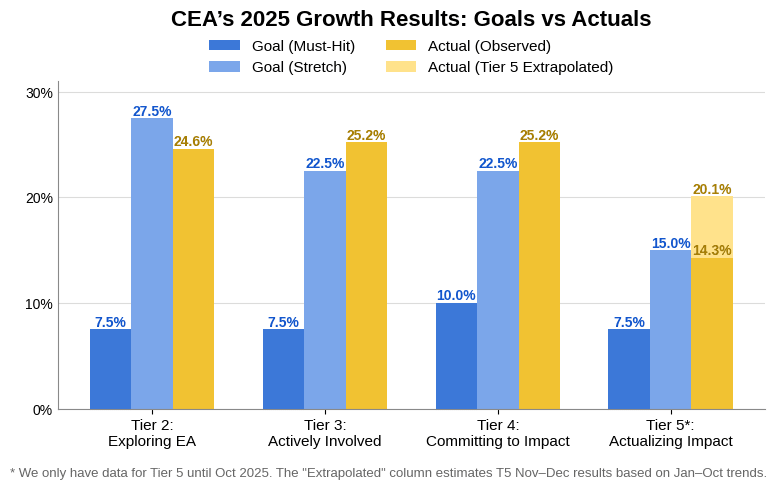
- CEA grew the number of people engaging with our programs by 20–25% year-over-year across each tier of our engagement funnel, beating our targets of 7.5–10% without increasing spending, and reversing the moderate decreases in engagement with our programs throughout 2023–24.
- We laid the foundations for furthering our contribution to EA funding diversification by merging with EA Funds and hiring an accomplished new Director (Loic Watine).
- And we strengthened CEA’s own foundations, establishing our in-house Operations Team and growing our headcount from 42 to 66 while increasing talent density, including another experienced Director for our new Strategy and M&E function (Rory Fenton).
We also faced some challenges:
- Beyond the impact of EA growth on the perception of the movement’s health, our efforts to improve the EA brand beyond the EA community have not yet translated into impactful outcomes (although there are signs the brand has stabilized independent of our efforts); we have struggled to grow our Marketing and Communications Team.
- Despite our success increasing headcount across the board, staffing and recruitment capacity have still been our biggest bottlenecks (we recently increased the size of our Recruitment Team from 2 staff to 4).
- We are still part of Effective Ventures, with our spinout process having taken longer than planned.
In 2026, we will sustain our momentum with goals of 10-15% growth across each tier of our engagement funnel. We are intentionally setting growth goals for 2026 lower than our realized growth from 2025 because we plan to invest much of our time and effort this year laying further foundations to facilitate a step-change in EA’s growth trajectory from 2027 onwards.
Investing in a strong CEA that can deliver movement growth, an improved brand and diversified funding is a major undertaking. We believe this continues to be an investment worth making, because EA principles remain the best answer to the question ‘How can I do the most good with my time and money?’, and the movement putting those principles into practice is gaining sustainable momentum.
Stewardship and sustainable momentum
Our stewardship strategy for 2025 and 2026 is focused on building sustainable momentum for EA:
- Stewardship
- Taking more responsibility for enabling EA to live up to its potential by playing a leading role setting and steering towards common goals, providing public goods, and facilitating coordination
- Sustainable momentum
This strategy was created in response to the need to turn around the EA movement’s momentum post-FTX, where downward spirals posed a potentially existential risk to EA’s future. You can read our full strategy post here.
Recommitting to a principles-first approach to EA was the first major strategic decision of my tenure (in light of the fact that during the search for a new CEO, the board and search committee were open to alternative strategic directions), which we wrote about on the Forum in August 2024.
There are several reasons why we are prioritizing growth: most directly, there’s the impact people have through their careers or donations when they put EA principles into practice. And more indirectly, achieving growth would be among the clearest possible signals to the community and the wider world that EA is worth listening to, committing to, and investing in.
Anecdotally at least, it seems that we have already been largely successful in moving beyond narratives about the “death” of EA. I had a journalist tell me at the beginning of 2025 that they wanted to write a piece about how EA isn’t dead, but they couldn’t because they didn’t have the data to back it up; now we have receipts.
2025
- In our first year of executing this strategy, we grew by 20–25% year-over-year across each tier of our engagement funnel, beating our targets of 7.5–10% YoY growth, and reversing the moderate decreases in engagement with our programs throughout 2023-2024. Our results include:
- Our 2025 growth strategy has centered around building sustainable momentum in EA growth, while not leaving behind our focus on program quality, cost-effectiveness, or a consideration of marginal returns.
- We achieved our growth without disproportionately increasing costs. Overall CEA spending increased by 0.4% on a like-for-like basis in 2025 (more below), whereas our tiers have grown 20–25%. When we looked at cost growth for each of the tiers, we broadly found that we did not disproportionately increase our spending.
- Our growth came from many sources, for instance:
- Expanding existing program offerings (e.g. expanding from 3 → 9 EA Summits)
- Launching new ones (e.g. our new career bootcamp course)
- Investing in outreach (e.g. ramping up our email marketing for EA Global)
- Improving the quality of programming (e.g. improving the onboarding emails for the EA Newsletter increased our click rate from 10.6% → 17.5%)
- Picking up programs that otherwise wouldn’t exist (e.g. the EA Opportunities Board).
- We also maintained focus on quality. We deliberately held back on scaling programs we judged unready; these results don’t reflect us maximally pushing. In some areas, we prioritized high talent density programs (like Pilot Unis) even when they contributed a relatively low number of users to our headline metrics.
- This was likely the pillar of our strategy that received the most attention from CEA as a whole (in part because it was what the pillar most of our existing programs were already most closely targeting).
2026
- In 2026, we will (1) set the foundations to deliver an ambitious step-change in EA’s growth trajectory in 2027+ and (2) continue delivering YoY growth for CEA programs.
- We plan to set more ambitious growth goals from 2027 onwards. Our primary focus is on growing the number of people in the later stages of the funnel, as that best reflects realized impact (as opposed to growth earlier in the funnel, which represents potential impact).
- In 2026, our primary focus will be on substantially improving the foundations of our programming, both to improve the scale-readiness of our existing programs, and to launch new scalable programs.
- While our primary focus will be on building foundations with urgency, we still want to maintain a steady pace of sustainable growth across CEA programs. Our 2026 goal is to continue growing each tier of engagement by at least 10–15%.
- This is purposefully less than the growth rates we achieved in 2025 as we want to reemphasize the need to build foundations for a step-change in our growth trajectory (and we will again have stretch goals).
You can read a more detailed report on our work growing the EA community here.
Improving the EA brand
Prioritizing improving the EA brand is motivated partly by growth (increasing awareness and understanding of EA among potential recruits) and partly by sustainability (making EA's reputation more stable over time, which underpins EA's value as a way of reaching donors and talent, the ability of EAs to do high-impact work outside EA settings, and community morale).
2025
Our 2025 strategic goals for this pillar were:
- Highest priority
- Improve sentiment and understanding of the EA brand among key external audiences
- Build and support a network of EA spokespeople who publicly represent the brand and its values
- Establish a strong owned media presence
- Build necessary communications capacity and team infrastructure at CEA
- Lower priority
- Improve perceptions of the EA brand and willingness to associate with it among the EA community
- Improve public discourse about EA in social media and other public media
- Build positive and productive media relations
- Improve the communications infrastructure of EA-aligned organizations
Building up our own capacity has been our main focus and biggest challenge. We started the year with only 1 full-time staff member and were aiming for 7 by the end of the year, and we ended it with 3 (the net increase of 2 includes 5 hires and 3 departures).
There are multiple factors that make hiring for communications-related roles unusually challenging. The first affects not only CEA but also many other organizations throughout the EA ecosystem: the pool of people with sufficient context, values alignment, and skills is relatively small and is being fiercely competed for (and points to the importance of ecosystem growth and reaching new audiences). Some other factors are more CEA-specific: the perception of damage sustained by the EA brand (real and imagined) makes some prospective hires nervous about the combination of hard-mode and high-stakes; and some experienced professionals are put off by the distinctively entrepreneurial demands of building up a new function that has relatively little existing infrastructure. We’ve made strides by investing in recruitment, increasing our compensation for senior roles, and demonstrating through our growth initiatives that EA is not a sinking ship - but this is still a hard problem it will take time for us to solve.
Given our own severe capacity constraints, we endorse having deprioritized trying to systematically improve comms infrastructure at other orgs. We did, however, provide some opportunistic assistance to other organizations, such as advising the Shrimp Welfare Project on their Daily Show appearance.
Brand perception among general audiences seems to have at least stabilized, though we do not want to claim CEA deserves primary counterfactual credit. Research conducted by Rethink Priorities in Feb-April 2025 suggests that among people familiar with EA, sentiment is largely positive and similar to the previous year. It seems unlikely that our efforts so far since then will have made a measurable difference to brand awareness or sentiment among the public (although more time having passed post-FTX might have), but we do now have stronger foundations to build from. We also expect our successful growth efforts will make it more difficult to use EA as a punching bag (because it’s harder to claim that EA is dead when it’s growing).
We've made initial progress on owned media, social media and spokespeople. We grew our social media followers by 15%: we value followers more than one-off engagement as a quality metric because they indicate sustained interest. We redesigned and relaunched effectivealtruism.org, and grew visitors viewing 3 or more pages by 30%. We launched the EA Stories campaign to humanize EA, which was well-received and demonstrated increasing willingness from community members to publicly associate with and advocate for EA.
While we’ve been able to do some work with other organizations and individuals, we decided to limit the amount of spokespeople work we did, as we quickly learned that spokespeople frequently imposed significant coordination costs on our end that our limited capacity couldn’t handle.
Community sentiment seems to have meaningfully improved. Anecdotally, community morale is significantly higher than in 2023 and 2024, in part evidenced by demand to partner with us on communications initiatives now exceeding our capacity to manage partnerships effectively. The collective action problem - where people benefit from the brand but don't contribute to it - appears to be diminishing.
We are seeing the results of myself and others at CEA publicly advocating for EA and creating a permission structure for others to do the same. Some of our most notable comms with the community this year include:
- Publishing our stewardship strategy, which was well received on the Forum and in other interactions I and others have had with leaders in and members of the community
- My opening talk at EAG London, which got the 2nd highest number of positive feedback survey mentions of any EAG content in the last 2 years (tied with my 2024 opening), which seems to reflect sustained demand for more vocal leadership of EA
- Anna’s April fools Forum post satirizing EA adjacency, which has one of the highest karma ratings of all time
- A candidate told Anna she had been reluctant to apply to anything that would put EA on her resume, and after reading this post, felt embarrassed and decided they were wrong about not owning their EA affiliation, and applied for a role at CEA
2026
Our immediate priority is continuing to build team capacity, and then we will begin transitioning from foundation-building to scalable execution. By far the most important determinant of our future impact will be whether we can build a team with the expertise and bandwidth to execute on our strategy.
After spending much of 2025 doing smaller projects and setting up business as usual systems (e.g. social media), we want to build towards creating content that can have deeper penetration and wider reach. We are exploring how best to pursue thought leadership initiatives (combining spokesperson development with proactive media pitching and greater investment in owned media, e.g. socials, podcasts) and how to achieve breakthrough media moments.
We may have significant reactive communications opportunities in 2026. In particular, the Netflix series The Altruists (about FTX) is expected to be released in 2026, and while we are unsure about the tone and scope of the show, we want to make sure we are as prepared as possible.
Diversifying EA funding
Prioritizing fundraising at the ecosystem level is motivated partly by growth (alleviating funding constraints in the near-term) and partly by sustainability (addressing the risks associated with overdependence on a single funder and increasing resilience in the longer-term).
2025
Our 2025 strategic goals for this pillar were:
- Highest priority
- Merge with EA Funds, or make a final decision not to merge
- Hire a senior leader for a new Development/Partnerships function
- Lower priority
- Make effective giving a more prominent part of EA culture
- Develop M&E to better understand and influence the state of effective giving and EA funding sources
The decision for CEA to merge with EA Funds was finalized early in the year, and was announced on the Forum in April. Our original plan was for the merger to coincide with leaving Effective Ventures, spinning out together as a single organization, and the spinout delay meant that instead we merged to become one organization within EV on 1 July (spinout still pending, more below).
Loic Watine joined us in January 2026 as Director of EA Funds. Loic was previously Chief Research and Policy Officer at Innovations for Poverty Action and has significant experience in quantitative research and senior leadership. He’ll be responsible for developing a strategy for EA Funds and building a team to implement it, and I’m very excited about his potential to alter the trajectory of EA Funds and strengthen the EA funding ecosystem.
The Animal Welfare Fund, led by Karolina Sarek as full-time Fund Chair, has had an impressive year, and serves as proof of concept for the potential of our EA Infrastructure and Global Health and Development Funds, as well as the Long Term Future Fund (which we expect to relaunch with an updated scope and name) once they have full-time Fund Chairs; they have been in maintenance mode pending leadership hires. AWF published their 3-year grantmaking strategy, launched active grantmaking, and raised $9.9M in 2025 (almost as much as the previous 3 years combined).
The redesign of the EA Funds website was a collaboration with our Online Team which has reduced the bounce rate from 46% to 38% and increased average time on the site by 7%, though we haven’t yet seen a change in donation conversion (although the numbers are low and we have been doing minimal public fundraising).
Investing in a broader cultural norm of effective giving was a lower priority, but we had some small wins. Our collaboration with Giving What We Can has produced 171.5 weighted pledges at EAG and EAGx events so far this year (up 76% from 97.7 in 2024), including a record breaking 41 10% and 37 trial pledges at EAG NYC (8% of attendees pledged during the event). I was quoted in the NYT advocating for donating to GiveWell as an effective strategy to counteract the effect of USAID cuts, which GiveWell reported produced a small uptick in traffic to their website. This year’s Giving Season event on the Forum was record breaking for the number of posts (113) and the number of orgs taking part in Marginal Funding Week (54). You can read the best Giving Season posts here.
2026
Our goal is to grow EA Funds fundraising in 2026, but we have yet to settle on firm targets. We expect our provisional approach of linking funding growth targets to community growth targets (i.e. 10-15% in 2026) is likely to be insufficiently ambitious based on the success of the Animal Welfare Fund. We are planning for AWF to scale significantly again this year, and we are in the process of hiring for multiple new roles on the team: apply here!
We expect to rescope specifics once we have our Directors of EA Funds, Strategy/M&E (more below), and Partnerships in place and onboarded, but we have a few key milestones we’re working towards beyond increasing fundraising and continuing to scale AWF:
- Hiring a Director of Partnerships and more donor development/fundraising capacity. Fundraising for the EA ecosystem via EA Funds will be a key part of their roles (as opposed to fundraising for CEA’s own operational costs).
- Hiring full-time Fund Chairs for the EA Infrastructure Fund, a new version of the Long Term Future Fund, and possibly the Global Health and Development Fund.
- Developing and publishing grantmaking strategies for each Fund. As well as the impact of our grantmaking, counterfactual fundraising will be a key evaluation metric for our efforts.
Strengthening CEA
If we want to achieve sustainable momentum for the EA community, and the EA community’s trajectory is dependent on CEA, then as responsible stewards we must continue to invest in the sustainable growth of CEA.
Operations Team
Our Ops Team grew to 16 staff by the end of 2025 (having begun the year with 5 staff), and is now responsible for all of our in-house operational functions:
- Business Operations, including grantmaking, systems, and Salesforce
- Finance
- Legal
- People Operations, including HR and recruitment
- Property, including office management
Staffing
Two things are true at the same time: we have substantially increased our headcount while increasing talent density, and capacity is still our biggest bottleneck.
We ended 2025 with 66 core staff, compared to 42 at the end of 2024: the net 24 increase (57%) was comprised of 38 new hires (including 9 transfers from EV Ops and 4 from EA Funds) and 14 departures. While some churn naturally occurred because staff felt like they had better opportunities elsewhere, overall we believe it is a sign of strengthening CEA (most of these departures were endorsed because of mismatches between existing roles and new strategies or under-performance). We have also increased our senior leadership capacity, with new Directors of EA Funds (Loic Watine, more above) and Strategy (Rory Fenton, more below).
Having established an in-house Recruitment Team for the first time in late 2024, we’ve increased the quantity and quality of hiring rounds while recruitment capacity has remained a bottleneck. We’ve recently recruited 2 new recruiters to increase the pace of hiring (taking our Recruitment Team from 2 staff to 4).
We plan to increase our headcount significantly again this year, so if you’re excited about stewarding EA with us, you can find open roles on our website: we’ll be adding new roles on an ongoing basis throughout the year.
Spending
Our spending on CEA-wide operational costs in 2025 was $21.8M, a 7% increase compared to 2024.
Our 2025 operational costs include the costs of operating Trajan House and EA Funds (and exclude EA Funds grantmaking), which were not part of CEA previously. Excluding Trajan and EA Funds, we spent $20.5M, a like-for-like increase of 0.4%.
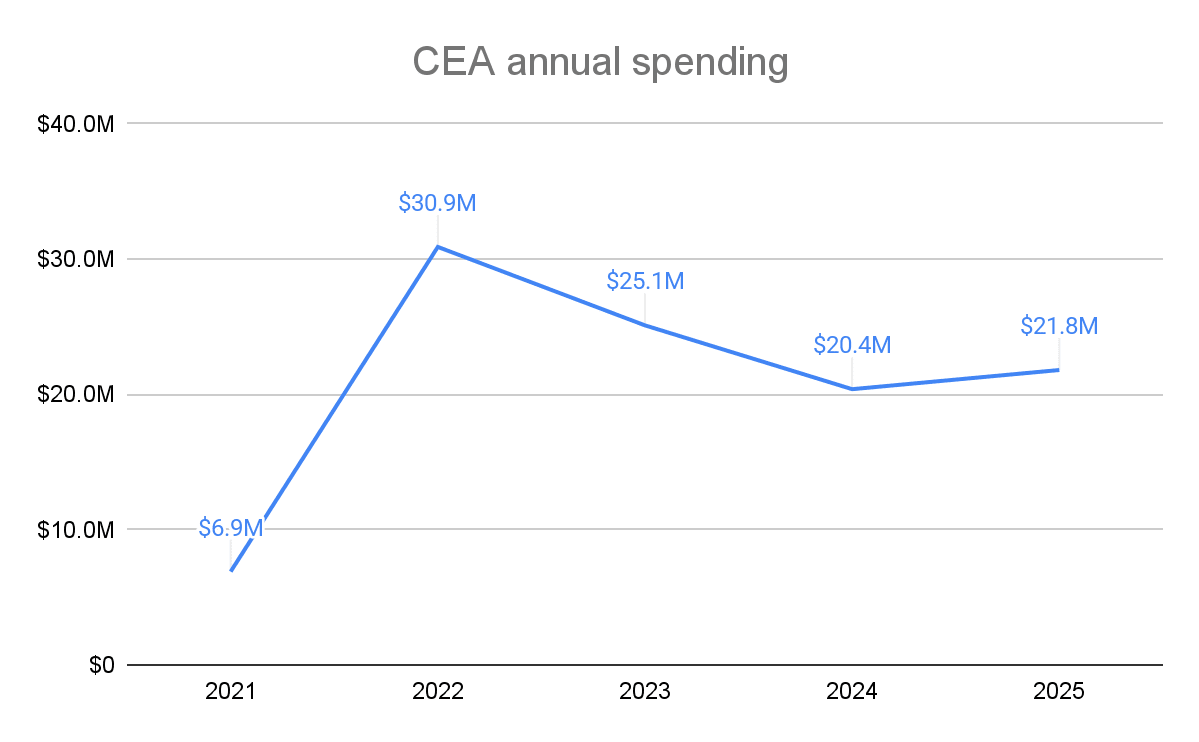
Our increase in staff costs was counteracted by lower spending on non-staff costs, and the combination of increased capacity, greater efficiency, and our first concerted effort to grow the EA community post-FTX produced metric growth higher than spending growth (which is discussed in more detail in the growth section above). Our best guess is that this means CEA’s overall cost-effectiveness increased substantially in 2025.
Monitoring & evaluation
We still need improved M&E to better assess our overall cost-effectiveness and marginal return on investment, and to enhance our ability to identify, invest in and communicate about our most cost-effective projects. Our main CEA-wide M&E initiative this year has been developing our growth model, which is discussed in more detail in the growth section above.
Rory Fenton joined in January 2026 as our new Director of Strategy. Rory was previously a Program Director at Innovate Animal Ag and has significant experience in strategy and M&E in previous roles at the Prevail Fund and One Acre Fund, among others. He’ll be responsible for leading our M&E function and developing new infrastructure, which is a critical aspect of our strategy moving forward, and I’m excited by his potential to lead thoughtful growth initiatives at CEA.
EV, still
We are still a project of Effective Ventures. Our spinout project has taken longer than planned, and we are now aiming to spinout and become an independent organization in early- to mid-2026.
If you see what we see when you look at EA today - principles that remain the best answer to the question ‘How can I do the most good with my time and money?’ and the movement putting those principles into practice gaining sustainable momentum - then please consider joining our growing team!
We’re hiring now and we’ll be hiring all year, for new roles across all our existing functions, while also adding new ones: you can find and keep finding open roles at centreforeffectivealtruism.org/careers.



Thanks for the post! It seems like CEA and EA Funds are the only entities left housed under EV (per the EV website); if that's the case, why bother spinning out at all?
You’re right that CEA (including EA Funds) is the last project remaining within EV.
We are spinning out to build an entity structure optimized for an independent CEA. Among the lessons we learned from the EV experience were that entity structures and associated regulatory requirements can be complex, especially when operating in multiple jurisdictions, and that getting our structure right matters in many ways. To take one example: the EV structure requires two CEOs (in the US and the UK), whereas our new CEA structure will require only one.