Animal welfare is an important cause area within effective altruism. Every year, billions of animals suffer, both in factory farms and in the wild. The scale of that suffering means interventions have the potential to measurably improve billions of lives. Yet the organizations most motivated to address these problems have limited resources, so heuristics are required to direct those resources toward the most impactful interventions. One way to measure an intervention’s impact is by how much suffering it reduces, and a critical part of that calculation is an animal’s capacity to feel subjective pain. This is difficult to assess: animals cannot describe their experiences to us, and precise, generalizable neural correlates of subjective pain remain elusive. We are therefore left to rely on heuristics. An obvious heuristic is the number of nociceptors. Nociceptors are sensory neurons that respond to damaging or potentially damaging stimuli. They are distributed throughout the skin, muscles, joints, bones, and viscera, and they form the basis of the sensation of pain. It seems reasonable, then, to expect the number, density, or quality of an animal’s nociceptors to track how much pain it subjectively experiences. So what does research say? I focus on studies in humans, the only animal that can describe its experience of pain.
Nolano et al. (1999) applied capsaicin (the compound that makes chili peppers hot) cream to the forearms of healthy volunteers for three weeks. This reduced sensitivity to painful heat and coincided with the loss of about 80% of the nerve fibers in the outer layer of the skin, fibers that act as nociceptors. After the treatment was stopped, the fibers gradually grew back, and within six weeks both nerve density and pain sensitivity had returned to near-normal levels. Simone et al. (1998) found the same pattern when capsaicin was injected into the skin: pain sensitivity fell as the nociceptors degenerated. Ochoa and Torebjörk (1989) electrically stimulated C-fibers (a type of nociceptor) in volunteers’ nerves, causing a dull or burning pain that grew stronger as stimulation frequency increased. Mouraux et al. (2012) found that the probability of detecting noxious stimuli is a function of the number of nociceptors activated.
Natural variation in nociceptors corroborates this evidence. Perini et al. (2016) studied carriers of a rare genetic mutation that reduces C-fiber density to varying degrees, and asked them to rate how painful a series of described situations would be. Carriers with lower C-fiber density tended to underestimate the pain of these situations more than those with higher density. This suggests a link between nociceptor density and estimated pain intensity, a totally subjective phenomenon. Cox et al. (2006) studied humans with congenital absence of pain and found that each carried a mutation disabling an ion channel in nociceptors.
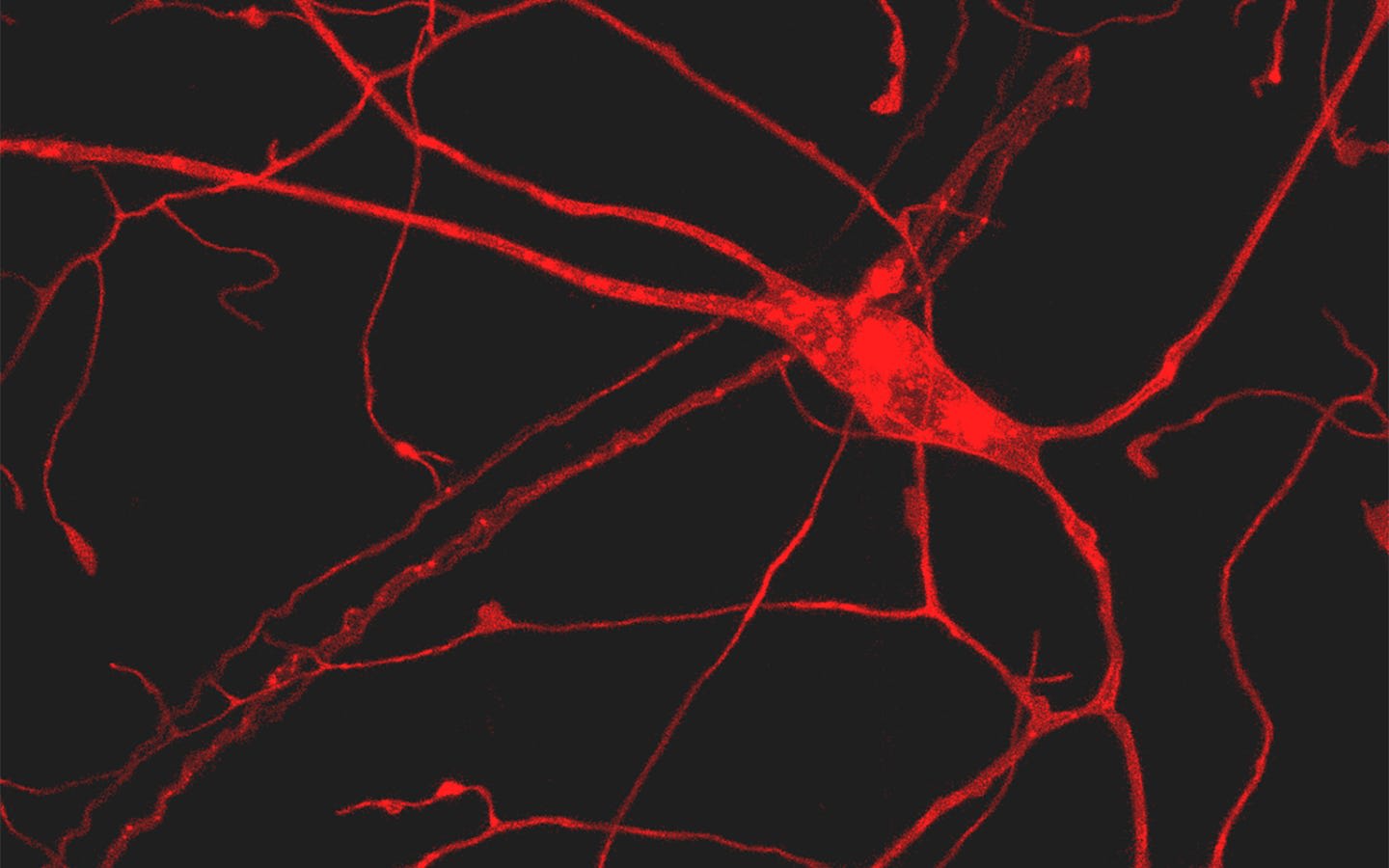
A fruit fly nociceptor
The research surveyed here suggests a strong causal relationship between nociceptors and the subjective experience of pain. However, it is important to note that nociception is not by itself sufficient, although it appears necessary. Researchers studying subjective experiences of pain in animals treat nociception as only the first of many pieces of evidence. Gibbons et al. (2022), for example, assess insects’ capacity to suffer against eight criteria: (i) nociceptors, (ii) integrative brain regions, (iii) connections between the two, (iv) responses modulated by analgesics or anesthetics, (v) motivational trade-offs, (vi) flexible self-protective behavior, (vii) associative learning, and (viii) a preference for analgesics when injured. The more criteria an animal meets, the stronger the case that it can feel pain. Criteria (ii) and (iii) point to a key limitation of relying on nociceptors alone. Nociceptors only detect damage. The signal must then be carried to, and processed by, brain regions capable of integrating it, and these regions are likely where the subjective experience of pain arises. Even so, nociceptors need not be treated as a simple yes/no criterion; the studies above suggest that they can serve as a graded estimate of pain intensity.
Crossposted to Less Wrong
‘Like most of life’s dangers, the dangers of artificial intelligence are not easily identified from the armchair.’
J Dmitri Gallow
Epistemic status
I’m not an expert in this field, and herein I make some sweeping generalisations educated guesses about the overall...
Cross-posted from my Substack.
Epistemic status: I’ve puzzled over this for a long time but I’m not sure I came to the right answers. I'm sharing this partly because it might help others work on resource allocation, but mostly because some smarter reader might tell me how to do it better.
TL;DR:
* I he...
A few weeks ago, an open letter appeared calling on Effective Altruists to go beyond the cage-free campaigns and shift the focus from "welfare reforms" to promoting animal-free diets, especially in the wake of potentially very large amounts of funding flowing towards animal causes.
The original letter is here: https://beyondcagefree.org/ and an EA forum blog post by one of the organisers (...