Comments
165
Epistemic status: I've been an academic, climate activist and research lead in Extinction Rebellion UK's Data Analysis and Insights Circle. I co-authored most of the studies below. I am writing in a personal capacity, drawing on extensive research into climate activism.
Summary
Most people in the UK accept that climate change is real, and most are worried about it. The majority (66%) even support nonviolent direct action to protect the UK's nature (Guardian). Yet very few take part in collective action. In 2023, five years after it was founded, only about 0.25% of the UK population (roughly 170,000 people) had joined Extinction Rebellion, a major climate activism group.
That gap between sympathy and participation is where a lot of arguments about whether protest "works" go wrong. Someone points to a poll showing the public dislikes a tactic, or a hostile headline the morning after, and concludes the action failed.
Since 2020, I have spent a lot of time studying climate activism. The work includes a review of 50 studies, national surveys, a field experiment with around 350,000 Facebook users, a media analysis and a survey of over 1,000 activists. My conclusion is that we often judge activism by the wrong measures. We poll the wrong audience, at the wrong time, using the wrong kind of data, and we generalise from the wrong people.
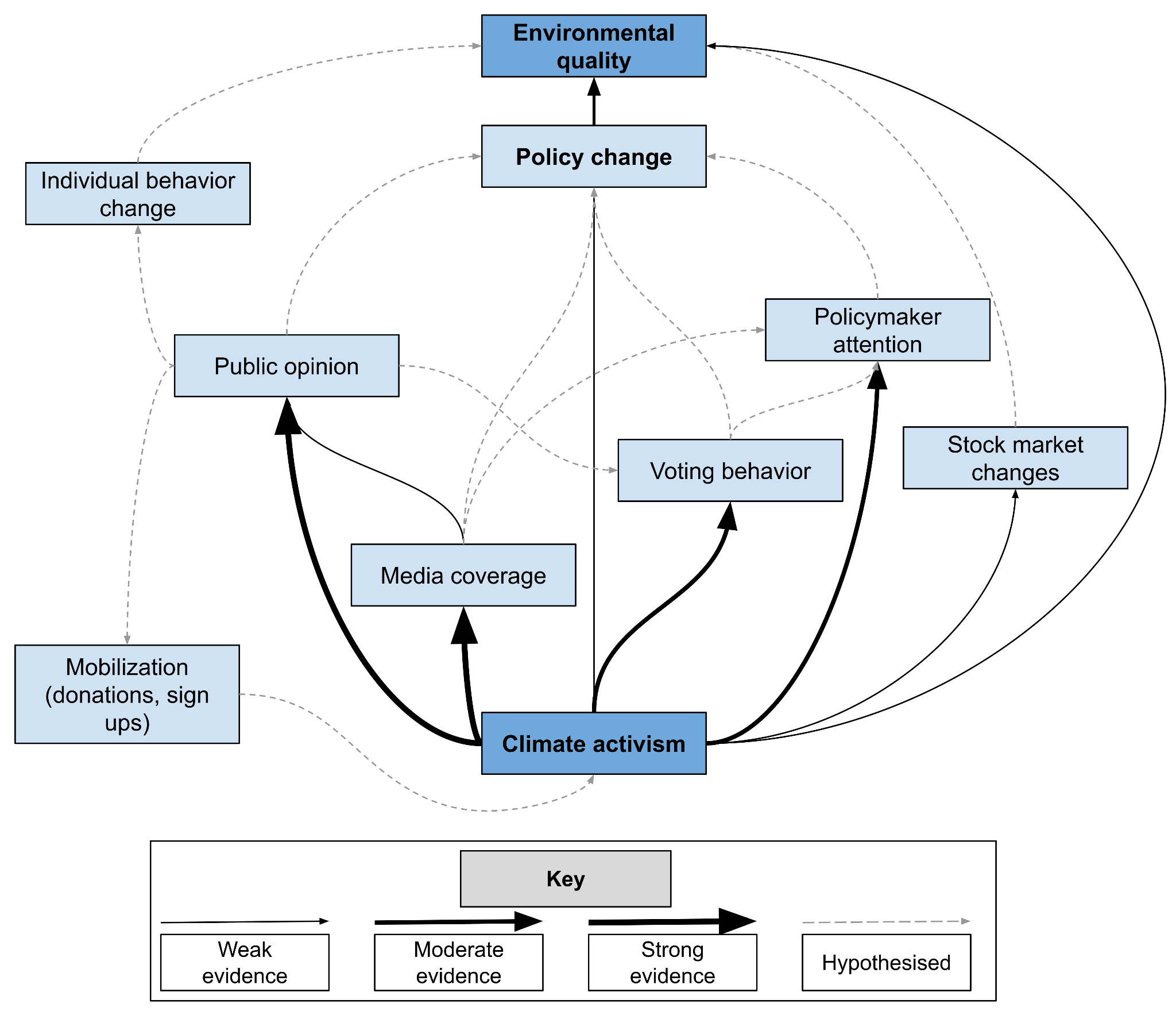
With colleagues at Yale, I reviewed 50 recent, rigorous studies of collective climate action (open preprint). They covered protests, marches and divestment campaigns, drawn from sociology, psychology, political science and other fields. We sorted the findings by how strong the evidence was:
The pattern is the problem. The evidence is strongest for outcomes close to the protest and weakest for the outcomes we care most about. That is not necessarily because activism fails at the distal end. Policy and emissions take years to move and have many causes, so they are hard to attribute. We also found little evidence that disruptive action reduced overall support for climate action, despite how often backlash is predicted. Social Change Lab's polling found the same for UK climate protests: disruptive actions didn't lead to a loss of public support for climate policies.
The review has two big gaps. Most studies come from the US and Western Europe, and most measure short-term outcomes. So when someone says "the evidence shows protest works" or "the evidence shows it backfires", usually the evidence shows effects on attention and opinion, measured soon after, in rich democracies.
The most common test of a tactic is whether the public approves of it. With historian Kevin Young, I argued that majority support is the wrong metric. What matters more is whether a tactic imposes costs on the elite decision-makers who can concede.
Take the case of the 1963 Birmingham civil rights campaign. It did not win by persuading the white public. Boycotts and sit-ins cost downtown businesses millions in sales, and those businesses pressed politicians to accept desegregation. From this, we argued that disruption should impose direct costs on elites, it must be sustained so they cannot wait it out, and it can take many forms, including boycotts, litigation and financial pressure. For climate, that points towards the banks, insurers and investors that fund fossil fuels. This is an argument from history and theory rather than an empirical test, and one case is not proof.
The same applies to media coverage, the other thing activists check the morning after. With colleagues at Yale, Penn State and LSE, I analysed 412 articles about Extinction Rebellion and other groups. They came from the BBC and the 15 most-read UK papers, November 2022 to May 2023. We found:
The practical point: a hostile headline tells you a lot about the outlet and something about the tactic. On its own it is not a good guide to whether the tactic worked.
With colleagues at Social Change Lab, I co-authored a study that surveyed a nationally representative UK panel three times: before the protest (n = 1,986), days after (n = 1,657) and six months later (n = 1,356). We also surveyed a fresh representative sample at six months (n = 1,441) to compare the population as a whole against the baseline. There is also a longer report.
In the fresh sample, attitudes towards animals were more positive at six months than before the protest. Without a comparison group we can’t credit that shift to the protest, but we can say that the short-term backlash did not last, while the boost to the group's own mobilisation was large.
This is just one protest, in one country, on one issue, but it shows how much the timing of a measurement can drive the verdict. A poll taken the next day would have reached the opposite conclusion to one taken six months later, and most commentary is written the next day.
Movements often design outreach around what people say they want. My research suggests that can mislead.
For Extinction Rebellion, I ran four focus groups with people who were sympathetic to climate action but not involved: grandparents, healthcare workers, religious people and scientists (summary). They were clear that they wanted to be asked politely and humbly. Even soft demands such as "do your bit" put them off, as did any hint of disruption.
We then tested this in a field experiment with around 354,000 Facebook users in Birmingham, Oxford and Cardiff. Ads invited people to a local climate talk. They used either a polite request or an urgent exhortation, with a protest, a diverse crowd or a flooded UK street as the image.
The outcome was clicks, not attendance, so this is one step along the path to action. But it is real behaviour, and it reversed what people told us.
A nationally representative survey of 1,100 UK adults found the same gap between saying and doing. At the end of the survey we asked people whether they would give up extra time, unpaid, to answer five more questions for XR. 32% did. Of those who had said they intended to donate money to climate action, fewer than half gave their time. A quarter of those who said they did not intend to donate gave it anyway.
The biggest difference was identity. 57% of people who identified with XR gave their time, 29 percentage points more than those who did not. That gap was about twice the size of the next largest: how much people prioritised climate, whether they thought XR was effective, and whether they intended to donate (each about 14 points).
The studies above point in different directions on disruption. The focus groups found that disruption put off newcomers. The Grand National protest brought a surge of new supporters. Both can be true, because they describe different people. I think disruption acts as a filter. It repels some people (e.g., those meeting a movement for the first time) but activates others (e.g., people who are already sympathetic).
Who is on the sympathetic side of that filter? In an online experiment with 5,996 UK adults that I ran for XR (unpublished), we showed people one of 11 climate narratives and asked how willing they were to join a large protest at Parliament. About 8% said they were very or extremely willing, and that group skewed strongly to the political left. Narratives about government corruption, the effectiveness of non-violent direct action and health impacts did best, and "green jobs" did worst. I don't think that makes green jobs a weak frame in general. My guess is that it appeals to the wrong audience: the people most moved by economic arguments are not the ones likely to turn up to a climate protest.
The same split shows up among activists themselves. With colleagues, I surveyed 1,375 people on Extinction Rebellion UK's mailing list between December 2024 and January 2025. We asked how expecting repression (arrest, fines, surveillance) and having experienced it related to their intentions to take part in rule-following and rule-breaking action. 37.5% had experienced at least one form of repression.
The sample was older, whiter and better-off than the population, and many were retired, so the costs of repression may be heavier for others. Still, the pattern fits the filter idea. A response that deters the public at large may harden the committed core.
So a measure taken on one group tells you little about another. Public reaction to a disruptive action says little about its effect on existing supporters, and the reverse.
These are my suggestions, drawn from the studies above rather than tested directly.
None of this is specific to climate. I've focused on it because it's what I've studied, but most of these lessons apply to any movement that uses public protest.
My research (with co-authors):