TL;DR
- In an online experiment with 4,761 Americans, short presentations built from 14 message modules increased the relative value people placed on a plant-based gift basket by $10.05, about 26% of its original value, compared with a placebo video.
- Content mattered much more than quantity. Describing celebrities' plant-based diets and framing meat reduction as being on the right side of history produced the largest gains.
- More modules, captive viewing, and asking people to eliminate meat (rather than reduce it) made no significant difference.
- This is a real-stakes choice, which is better than stated intentions, but it is a single choice measured immediately after exposure. It says nothing about what people ate the following week.
Why I'm posting this now
There has been a lot of discussion lately about whether EA has given up on diet change. Seth Ariel Green argues it hasn't: funders deprioritised it because the evidence was weak, and they would back new approaches that come with better evidence. He also asked more of us to post rather than polish.
Here's my quick contribution! Note, the meta-analysis by Green, Mathur and colleagues found that meaningfully reducing meat consumption remains an unsolved problem, and a single online experiment does not change that. However, it does offer a direct comparison of many message types against the same real-stakes outcome, which the literature mostly lacks.
What we did
With Jacy Anthis and Joshua Tasoff, I ran a large online experiment with 4,761 Americans, recruited through Prolific in September 2023.
- Treatment: each participant in the treatment group saw a presentation of either 5 or 9 modules, drawn at random from 14. (Full scripts and videos are on OSF.) Each module was one to two minutes of narrated slides. Half of the participants were required to watch the full presentation, while the other half had the ability to skip modules. The 14 modules were:
- Identity (being on the right side of history)
- Animal suffering
- An animal rescue story
- Environment
- Pandemic risk
- Blaming the industry rather than consumers
- Health
- Whether individual choices make a difference
- Celebrities
- Plant-based eating as a growing trend
- Convenience
- Nutrition tips
- Willpower
- New food technology
- Control: a placebo video.
- Outcome: real-stakes willingness to pay for a meat-based versus a plant-based gift basket, measured before and after exposure. Both baskets had a $100 retail value. For each, people chose between the basket and a cash bonus rising from $0 to $100 in $5 steps, and we told them 20 participants would be picked at random to have one of their choices carried out for real, receiving either the cash or the basket.
Because modules were combined at random, we could estimate the effect of each module, as well as features such as the number of modules, whether captive vs free audiences, and whether the closing ask was to reduce or to eliminate meat. The study was pre-registered and funded by the Food Systems Research Fund and the Sentience Institute. One secondary outcome asked people how much of a possible bonus they would donate to ProVeg. (However, we ran the study in 2023, before I joined ProVeg, and this is my own academic work rather than ProVeg's).
What we found
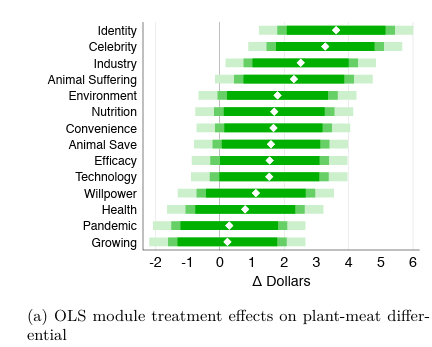
On average, the treatment increased the relative valuation of the plant-based basket by $10.05 compared with the control group, about 26% of its original value.
The effects varied widely by content:
- Largest gains: describing celebrities' plant-based diets, and framing meat reduction as being on the right side of history. The identity module added $3.61 to the plant-meat gap (95% CI 1.79 to 5.43), and celebrities $3.27 (1.45 to 5.09). Industry ($2.51) and animal suffering ($2.30) were the only other modules that were significant on their own.
- No significant effect: adding more modules, captive viewing, and asking people to eliminate rather than reduce meat.
- Weakest: the growing-trend ($0.24) and pandemic ($0.29) modules. Every module's estimate was positive, so nothing backfired.
The two strongest modules have something in common. One shows people others admire already eating this way, and the other asks how future generations will judge us. Neither gives new facts about meat. The next two strongest, blaming the industry and showing animal suffering, are standard advocacy content, though. Most differences between modules aren't statistically significant.
People who already wanted to cut down on meat (24% of the sample) moved the most: their effect was $5.35 larger. Effects were also larger for women (by $3.53) and for people over 45 (by $3.80).
![]()
What this can and can't tell us
What it can: the outcome is a choice with money at stake, which is a step up from stated intentions. Randomising modules lets us compare message types against each other on the same outcome, instead of testing one campaign against nothing.
What it can't:
- Persistence. The choice was made straight after the presentation, in the same session. We don't know whether anyone ate differently afterwards.
- One product, one decision. Valuing a gift basket is narrower than changing a diet.
- Setting. An online US sample, paid to take part, watching a presentation they were asked to watch. Real-world reach and attention will be lower. Even when people could skip modules, they skipped only about 14% of them, so we learnt little about captive versus skippable viewing.
So I'd read this as evidence about which messages are worth taking into a field trial, rather than evidence that messaging reduces meat consumption.


Thanks for conducting and sharing this interesting study. Did participants know they had a <0.05% chance of actually receiving a basket? If so, the outcome seems much closer to a pure hypothetical than to real stakes.
No, they were told 20 people would be selected to receive their choice for real, but not how many people were in the study overall.
Thanks for clarifying. Did you probe whether participants thought they had a meaningful chance of winning, or some other proxy for how much they viewed the stakes as real?