Comments

This post is part of the Cross-Cause Fund (CCF) series by Rethink Priorities — a sequence of articles dedicated to effective giving across philanthropic areas.
TL;DR: A lot of new money is about to enter effective giving. When that happens, the question "Where does a dollar do the most good?" gets harder to answer, not easier. It depends on how much money each area already has, and that amount keeps changing as the money arrives. This is why the model behind the Rethink Priorities Cross-Cause Fund doesn't just rank funds once and stop. It tracks how each fund's cost-effectiveness changes as it receives more funding, and re-ranks as it goes. Below, we explain why anyone giving at scale should use similar reasoning.
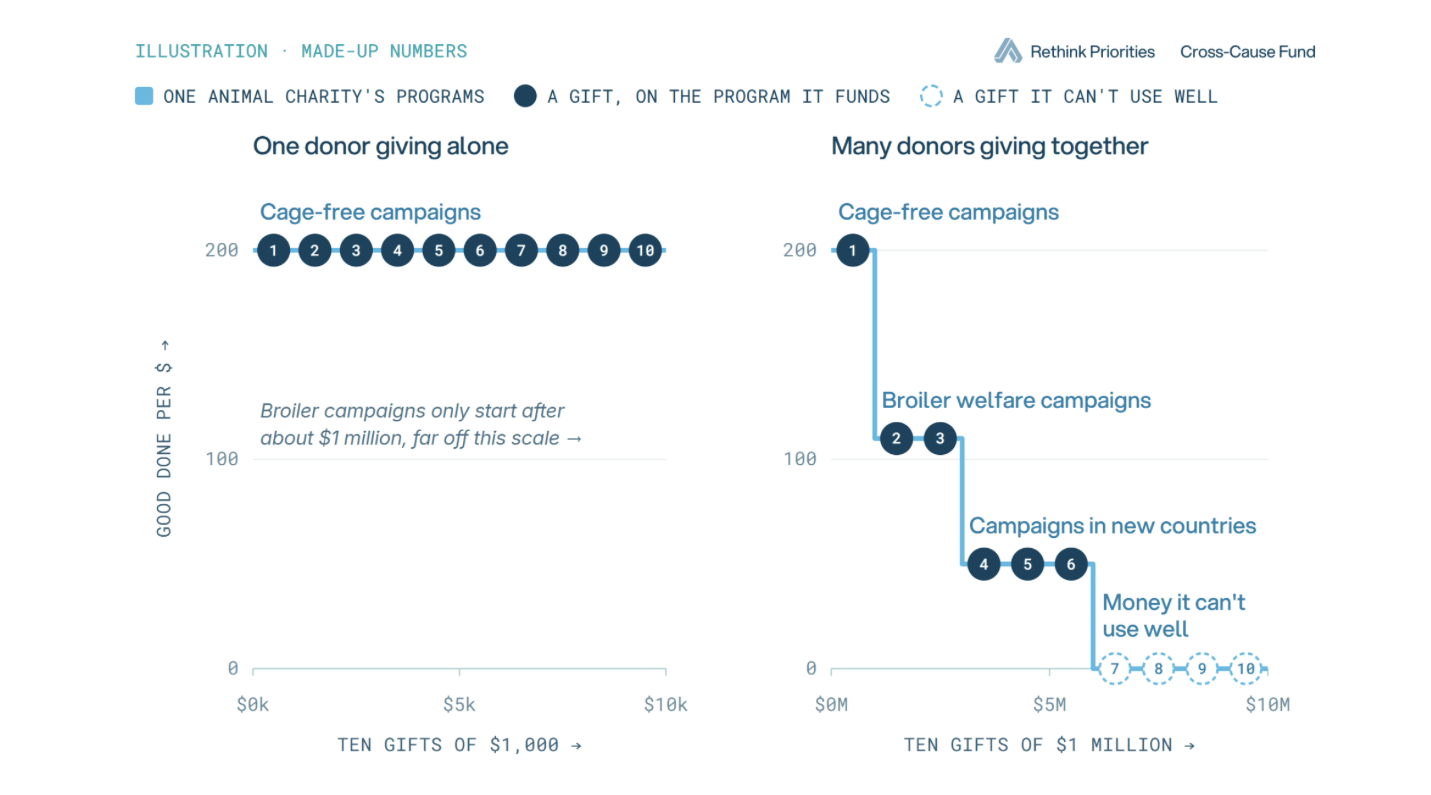
If you’re a small or mid-sized donor who makes giving decisions independently, it’s relatively easy to figure out what your money is doing. For example, when you give your first $1000 to a charity that runs corporate cage-free egg campaigns, your donation will go on to fund corporate cage-free egg campaigns. When you give your second $1000 to the same charity, it will fund…corporate cage-free egg campaigns. And you will never guess what your tenth $1000 goes to.
If you’re a major donor, or a mid-sized donor whose decisions are influenced by many other mid-sized donors, your cost-effectiveness estimates are suddenly much more complicated. The first $1 million you and your friends give might go to corporate cage-free egg campaigns, but the second $1 million might go to, say, campaigns to improve the welfare of broiler chickens (an intervention for which there is much thinner evidence). Go further, and your favorite charity might not even be able to use your tenth $1 million productively at all.
A lot of money is going to enter philanthropy soon. So we can’t keep assuming that the next dollar to a given charity funds basically the same sort of thing that the last dollar did. Instead, we need to have a principled approach to address these questions, and that’s one of the aims of Rethink Priorities’ Cross-Cause Fund.
Modeling diminishing marginal returns
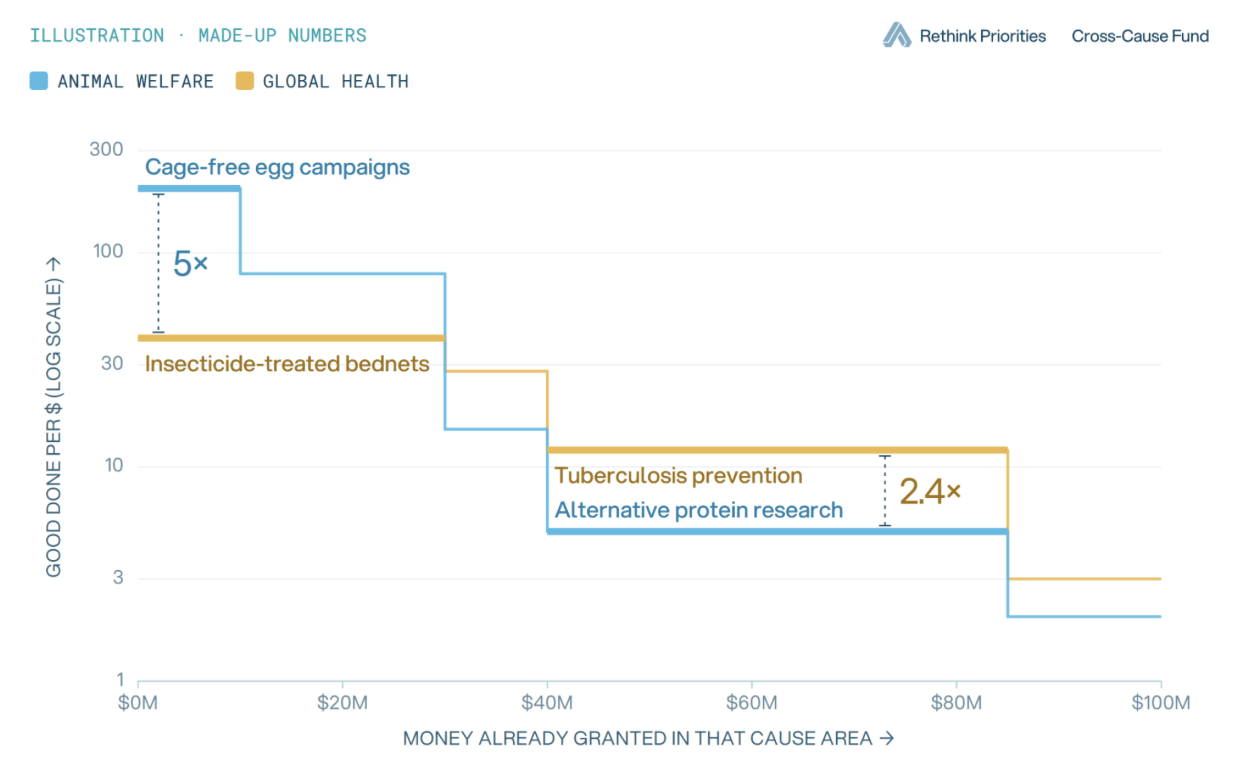
Why do we need a model? First, cost-effectiveness tends to change as a field becomes better funded. It’s a mistake to think of increasing the amount of money in a cause area as funding the same thing but at a higher cost. What you end up funding changes too. For example:
- As GiveWell started to move more money, it expanded beyond its Top Charities to more speculative areas such as tuberculosis prevention, mobile health, and funding randomized controlled trials for potential new interventions.
- If funding for animal advocacy increases, interventions with a strong track record, such as corporate cage-free egg campaigns, become saturated. So you can then expand corporate campaigns to other species or new countries, or try more speculative interventions like alternative protein research or vegan advocacy.
- If funding for technical AI safety research increases, the well-specified, highly promising research agendas from established organizations and researchers all get funded. What remains is more exploratory, less promising, or comes from newer organizations or researchers without as much of a track record.
Of course, if you’re funding entirely different programs, the relative cost-effectiveness of cause areas will change too. If, for example, cage-free egg campaigns are more cost-effective than insecticide-treated bednet distribution, that is no reason to believe that alternative protein research is more cost-effective than tuberculosis prevention.
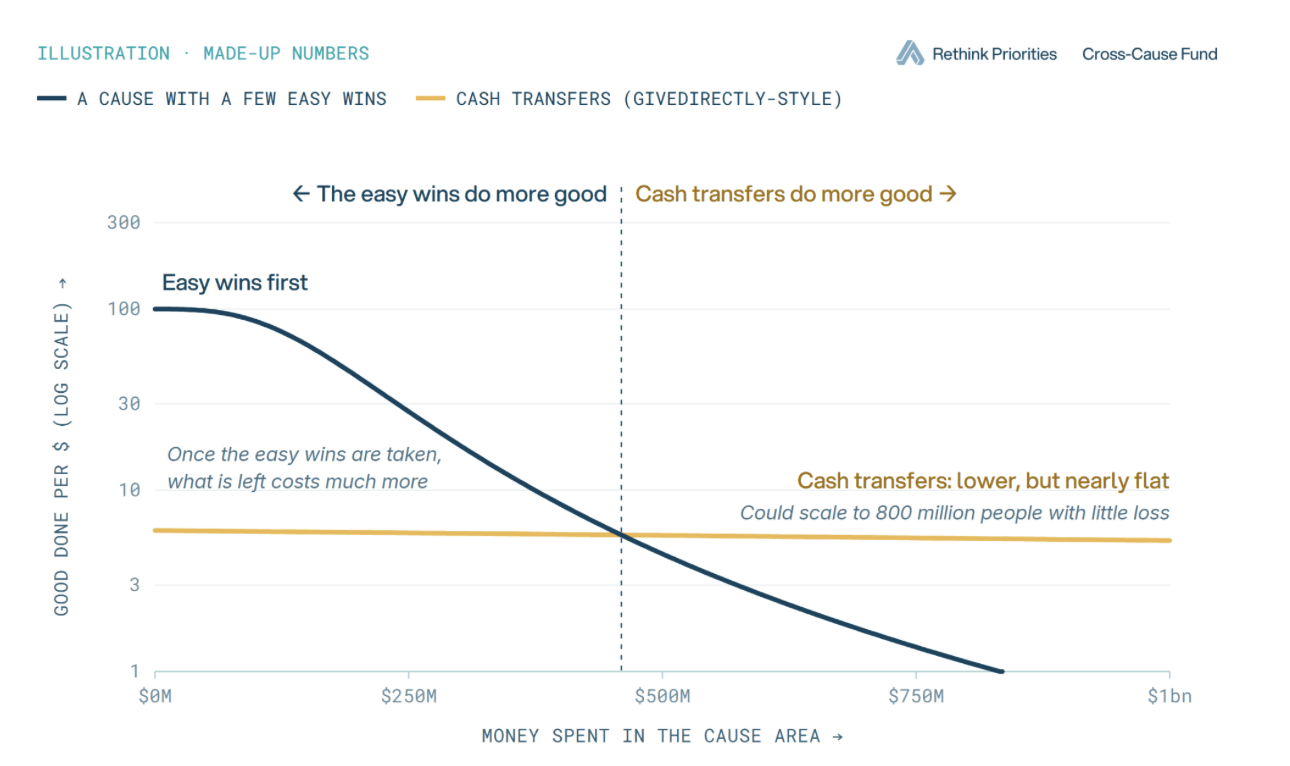
Second, cause areas absorb money at very different rates. A charity’s or cause area’s room for more funding isn’t static over time. Organizations can hire more staff and scale up existing programs, and founders can create entirely new charities and interventions.
But different interventions and cause areas have different abilities to scale up. For example, mature cause areas tend to have more established organizations, which may have an easier time scaling up quickly than a new one. The Against Malaria Foundation has a lot of experience expanding bednet distribution to new areas, but a small animal advocacy charity may have far less experience switching which species it advocates for.
Some cause areas may also run out of cost-effective interventions more quickly than others. For example, you can imagine that one cause area has many easy wins, but once the easy wins have been taken, the remaining opportunities are costly. On the other hand, another cause area might be relatively cost-ineffective but able to expand almost indefinitely without losing much cost-effectiveness. (The extreme example of this dynamic would be GiveDirectly, which gives unconditional cash transfers to the poor. GiveDirectly is consistently less cost-effective than the best opportunities in global health and development, but it could also be in principle scaled up to all 800 million people living in extreme poverty without much loss of cost-effectiveness.)
Finally, you have to consider marginal cost-effectiveness in the context of everything else you believe about cause prioritization. For example, if you believe a minute of human suffering is a thousand times more important than a minute of chicken suffering, you’ll stop giving to charities that help chickens at a much lower level of funding than someone else who thinks a minute of human suffering is only twice as important as a minute of chicken suffering.
Or suppose the most cost-effective interventions in Cause A are less risky than the most cost-effective interventions in Cause B, but at some level of funding they switch, and Cause B’s interventions are less risky. If you have a relatively low appetite for risk, you may have exactly opposite giving behavior at different levels of funding than someone with a high appetite for risk.
As we’ve written about before, “just do whatever has the highest marginal cost-effectiveness” doesn’t work. You need to handle your moral uncertainty in a reasonable, thoughtful way, and that doesn’t change when you’re dealing with cost-effectiveness. Depending on how you choose to act between different worldviews, your reaction to changing cost-effectiveness will look different.
Acting as part of a group
In general, impact-focused donors’ views are correlated with the views of other impact-focused donors. They tend to read the same reports and blog posts, receive pitches from the same nonprofits, and go to the same parties. They talk with each other about their donation decisions and end up influencing one another.
This means you aren’t making decisions as an individual; you’re making decisions as part of a movement.
Imagine that every impact-focused donor agrees that AI safety is the most important cause area, but animal advocacy is also important and should get some funding. If they all act as individuals, they all donate to AI safety causes, because AI safety is the most important. So AI safety winds up overfunded, well beyond the point where any individual donor thinks the movement should be funding animal advocacy instead.
Or imagine that every impact-focused donor agrees that 80% of donations should be spent now, and 20% should be saved for the future. Since they all think most donations should be spent now, they all end up spending their entire donation budget now—and 100% of donations are spent now.
Obviously, these are toy models. (Imagine getting every impact-focused donor to agree on the same thing.) But in the more complex, real world, it’s even more important to think clearly about how other people’s behavior should affect yours. You need:
- An understanding (even if rough) of other people’s giving behavior.
- A model of your giving, so you can plug other people’s behavior into your model and understand how it should affect your giving behavior.
How the Cross-Cause Fund works
For each fund, we estimate how cost-effective it is at the margin today. With input from the funds and outside experts, we also build a diminishing-returns curve: for each extra $2 million, how much impact that increment achieves relative to the first $2 million. The model then allocates money in $2 million steps, adjusting the score for every fund after each step based on what it has already received. A fund that tops the list at the start can drop down once it has absorbed enough.
The Cross-Cause Fund incorporates diminishing marginal returns into its model. We model diminishing marginal returns for each fund we include using a power law (that is, we expect an X% increase in funding to decrease cost-effectiveness by Y%, regardless of how much funding there is). We treat each fund’s marginal returns individually. For example, we’ve provisionally assumed that each doubling of GiveWell’s annual budget would only reduce its cost-effectiveness by about 10%, because GiveWell is a flexible organization with a long track record of finding new interventions. On the other hand, based on advice from external experts and our internal judgment, we assumed that each doubling of a global catastrophic risk fund’s budget would reduce its cost-effectiveness by about 46%, although the fund managers themselves believe they can use more money than that well.
In a previous version of the model, we assumed (for simplicity and efficiency) that each fund was unable to effectively spend more than five times its budget because they would have to hire more staff and otherwise scale up to regrant more money. However, in the latest (soon-to-be released) version of the model, we no longer assume there’s a fixed cap. Similarly, our estimates for the rates at which marginal returns decay before hitting this cap are provisional, and we think there’s room for improvement here as well.
Why you can't just follow the highest marginal number
A (seemingly) obvious fix would be to always give to whichever area is most cost-effective at the margin, updating as you go. But, as mentioned before, "most cost-effective" depends on questions people disagree about:
- Moral weights: How much does a year of suffering for a chicken or a shrimp count, compared with a year of human life?
- Time: How much do impacts 100 or 500 years from now matter, compared with impacts this decade? And how much should you trust predictions that far out?
- Risk: Should you back a long shot at enormous impact, or prefer smaller, more reliable gains? Should possible harms count extra?
Different answers produce different rankings, and each ranking shifts in its own way as money comes in.
Most of us aren't certain about these questions, so the real problem is how to act across several views at once. One option is to let each view direct a share of the budget in proportion to how much you believe it. For example, a view you give 30% credence to then steers about 30% of each funding step. Another option is to average the views' scores and fund whatever comes out on top, in which case a view's favorite area can get far more or far less than its credence share.
These methods can recommend very different portfolios, and diminishing returns play out differently under each. There are several funds and views, different ways of combining them, and curves that bend at different rates, which is a lot to weigh. Anyone deciding where to give is already relying on some model of these trade-offs, even if it's an implicit one. Making it explicit lets you interrogate it better and see how the answer shifts as assumptions change. And this is exactly why we created the model behind the Cross-Cause Fund, to make these trade-offs transparent for donors.
As more money enters philanthropy, these questions will only become more pressing. We’ll keep refining how the Cross-Cause Fund models diminishing returns and room for more funding. If you’re a donor thinking about how to give at scale, or you have views on how fast different causes can absorb money, we’d like to hear from you. Email us at [email protected].
Acknowledgements
Thank you to Ozy Brennan for helping write this post; to David Moss, Laura Muresianu, and Carmen van Schoubroeck for reviewing it; to Ula Zarosa and Shane Coburn for copyediting; and to David again for generating the graphs.
Parts of this content were prepared with the assistance of AI tools (such as Claude and Gemini), which we use to improve efficiency and readability. All outputs are supervised, reviewed, and fact-checked by RP staff, who remain responsible for the final content.
24
