In a world of vast and ever-expanding knowledge, one might assume expectationally justifying one altruistic action over another to be increasingly straightforward. Yet our models of the future are and remain incomplete. If that is the case, is such justification ever possible?
In his essay collection Anthony DiGiovanni addresses just that topic: As unknown unknowns exist, human understanding is incomplete. This limits the possible futures our predictive models can take into account, leading to coarse models.
The premise of this sentiment is one I must agree with. However, in this essay, I propose a more dynamic evolutionary framework that leads to a different set of questions. Unknown unknowns exist, yet they are not merely obstacles, but an evolutionary pressure that gave rise to the favoring of adaptive epistemic mechanisms that support exploration, learning and continual refinement of predictive models. Ultimately giving opportunity to what humans are known to be good at: Using the resources we have. To achieve this, I propose the central question should be, given unawareness, how do we become better choosers?
We have to choose where to allocate the resources. However, the decision itself is far from straightforward. Whilst I agree that in some (rather rarer) cases suspending one's preference may be the best action, I argue in this essay that the decision to do so should be a last resort, as there is a vastness of possible actions that go beyond the first layer one might think of.
This essay begins with showcasing what unknown unknowns are out of an evolutionary epistemology perspective. Beginning with explaining prediction as a fundamental part of life. Followed by an examination of how this led to evolution favoring predictive mechanisms. For this focus is put on curiosity, feedback, heuristics and cumulative culture, ultimately explaining the repetitive cycle they create. Lastly, I bring the evolutionary epistemic framework into perspective with the central question, as well as its sub-questions, of this essay:
“Given unawareness, how do we become better choosers?”
How do we increase humanity's ability to discover unknown unknowns?
How can humanity most effectively transform unknown unknowns into known unknowns?
How can we better cultivate the adaptive mechanism evolution has already provided us?
How should civilization organize themselves to become better learning systems?
How should societies allocate resources between solving today's known problems and exploring tomorrow's unknown ones?
Unknown unknowns: An evolutionary epistemology perspective
To discuss unknown unknowns, it must first be defined what unknown unknowns are, as well as distinguish how they differ from known unknowns.
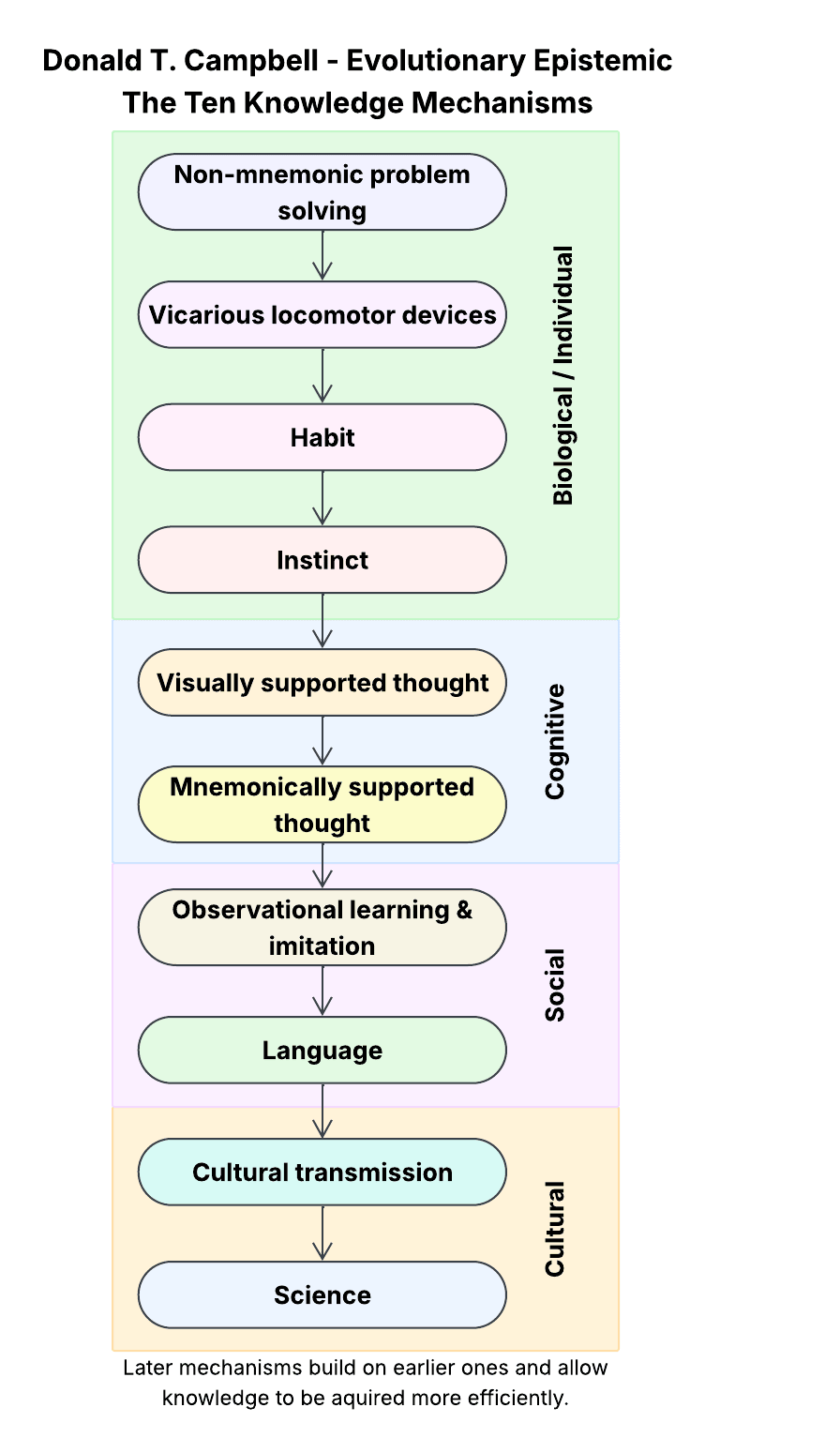
The main lens out of which this will be done is an evolutionary epistemology one, a term coined by Donald T. Campbell[1] in 1978 when establishing a ‘science of science’, to be compatible with evolutionary biology and social evolution. It is based on ten levels of biological and social evolution:
This principle is much argued, and Campbell himself distanced himself from the adaption-focused aspects. However, it beautifully illustrates how knowledge mechanisms scale. As the conversion of unknown unknowns to known unknowns and then knowledge depends on knowledge expansion, Campbell is where this essay starts. His framework inspired the further introduced idea on unknown unknowns that will assist in making better choosers, as well as create a more complex and dynamic lens.
Prediction as a Fundamental Requirement of Life
Several million years ago our distant primate ancestors were still hunters and foragers. Let’s imagine one of them. She is out foraging, picking up mushrooms from the forest floor, as she hears a rustling of leaves. She immediately gets up and looks around. Not seeing anything but also not feeling any wind, she decides to retreat.
This section is a fictional example and not based on facts.
Her response to this situation is one that may seem like a complete waste of energy. Why retreat if there is no imminent danger? The answer lies in prediction.
Prediction precedes action. The moment the leaves rustle the brain becomes a predictive machine. The sound can be caused by nature or by others. If it's other, it may be a peaceful being or a predator. The sound indicates therefore a possibility for danger. Then follows action: ensuring survival is the highest priority, so she retreats.
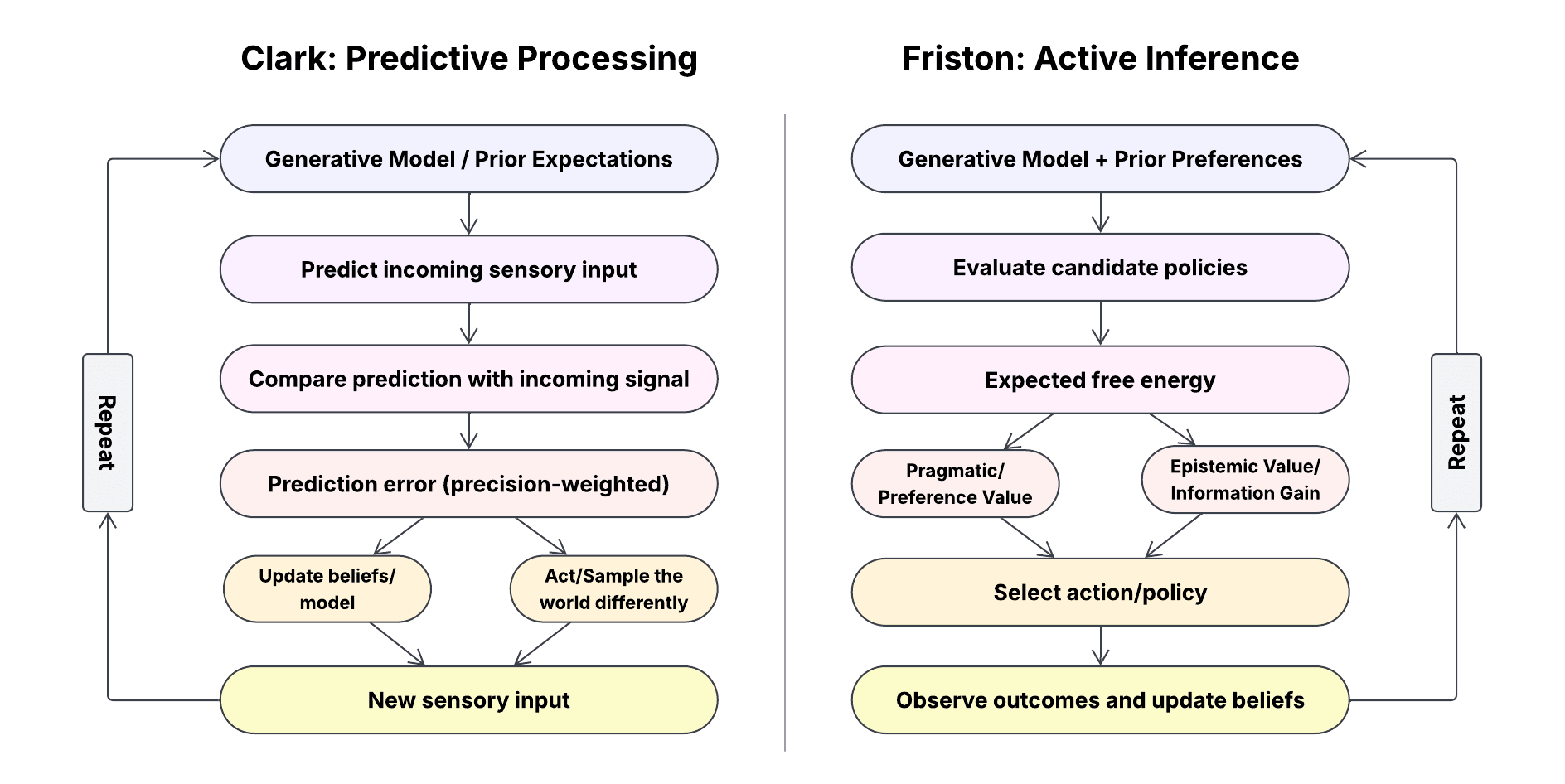
It is not merely a useful tool, but an essential mechanism of life. For those who predict more accurately, have a better chance of survival. Anticipation allows adaptation. The theoretical base this is originating from is the work of Karl Friston[2], as well as Andy Clark[3], who have, separately, worked on an active-inference/ predictive-processing framework. They do slightly differ, but overall follow a similar idea:
Our perception is based on a generative model. A mental model, that is how we expect the world to be. We behave based on that model, and should we be confronted with a different reality, a so-called predictive error, we update our mental model to be in accordance with what we now expect from reality. A wrong prediction here is an encounter from unknown unknowns.
Trying to predict the impact of one's actions - altruistic or not, is a form of optimizing survival. It has done enough that predictive mechanisms play a role in evolution itself.
Evolution Favors Predictive Mechanisms
A few years after we last saw the primate flee, she has now given birth to two healthy offspring. Lovely and playful children. Hearing a rustling she tenses and is immediately about to set out to grab her younger child, who is gathering berries a few meters away. As she sees the culprit she can relax: her older child sneaking up to scare their sibling. The young child keeps picking berries, ignorant to what is happening behind their back. Until the older jumps her, resulting in a scared scream followed by squealing as a result of their now ongoing wrestling. The mother shakes her head in disbelief but moves over to tear them apart, with a promise: she will play a game with them, a sound based hide-and-seek.
This section is a fictional example and not based on facts.
Two children playing, just like nowadays. Thinking back, we tend to call these times ‘careless’ and ‘fun’. To some degree they were. But what one often forgets is that they are actively preparing for their adulthood. Play teaches the children valuable skills. Here, such skills as anticipating a predator by sound.
Such are called predictive mechanisms: Instinct, memory, planning. These mechanisms can serve the deepening of knowns, but also exploration of unknown unknowns. Their mother teaches them a game about rustling noises in the forest? That is one too: social learning.
Curiosity and Feedback: The Evolution of Knowledge
While playing hide and seek with her sibling, the younger girl has claimed a berry bush as her new territory. She is certain this lushous bush will keep her safe. Maybe a little too safe, as she hears her brother move farther away. Now having time to take in her surroundings, for the first time she notices these unknown berries. She has never seen them before, and that even though she went on many foraging trips with her mother before. Curiosity overcomes her and she picks one of the berries and smells it. Funny. Different. It makes her hesitate to bite into it. But she does, just to spit this awfully tasting berry out again and for her brother and mother to find her curled up with a hurting stomach in the bush a while later.
This section is a fictional example and not based on facts.
Curiosity killed the cat is a quite popular saying. And it is fair, it can be a real killer. But in itself, curiosity is not a mechanism that wants to actively harm us. On the contrary. It is about recognizing gaps in our knowledge. Here, a gap in the form of an unknown berry. It motivates the child to seek more information: what is this berry? It may be able to provide them a new source of food - or poison. Finding out the answer is a confrontation with reality. In Friston's work[2] this would be considered ‘information gain’, as reality helps refinding and deepening our world models. Which then in turn are the basis of predicting the future more accurately. In this case, the child learned that the berry is not one that can be consumed. So, when she goes gathering with her mother, she will not be collecting this specific berry and may even warn and protect her sibling. That all thanks to curiosity, which helped her accumulate knowledge and then in turn allowed her to predict the future of a dangerous-berry-eater.
This also applies to unknown unknowns. As Kidd & Hayden[4] say, curiosity motivates information seeking and learning. A wish to gain knowledge. Exploration of unknown unknowns caused by curiosity is what sets up the feedback loop. Therefore, curiosity supports improvement. This specific mechanism is the heart of science nowadays: finding information gaps and filling them. Science is thereby closely related to unknown unknowns.
However, there is only so much that one single person can learn within their lifetime. Luckily, this limitation is one that humans have been conquering as well.
Civilization as an Evolutionary Engine
Time passes. Far away ancestors from those primates live a vastly different life. One of them walks on the newly laid stone street of her city, along the flow of the bustling citizens getting around. Dodging her way through the crowd she leaves the main street to enter the apothecary she works in. After getting settled in the back of the shop, she gets all ingredients ready to make today's batch of medicine. As she grabs the batch of berries that arrived yesterday, she hesitates. Something seems off. She moves over to the bookshelf and grabs one of the books. Going back to the berries she scours through the pages until she finds the page about the berry. Or the berry it is supposed to be. In the caution section of the page she finds a reference to another similar berry: a poisonous one.
This section is a fictional example and not based on facts.
Her model of the world has a slightly different memory of the berries she was supposed to have. This is one show of prediction. One that may have saved some patients. Her previous throughout experience making this medicine have let her be aware of what to expect. The slight difference between the two berries however, let her doubt. Then comes what civilization offers to the limitation problem: Cumulative learning. Thanks to the indepth notes that her previous generations have taken, the knowledge has been preserved. She does not need to go through the learning process herself again.
The collective brain about whose importance Joseph Henrich’s work[5] stresses, comes at play in this. Language, and in its extended form writing, have allowed us to teach acquired knowledge over generations. We move away from a one-person brilliance and rather function as a shared one, allowing a broader capacity of knowledge. Much knowledge stems nowadays from scientific institutions which work as a collective feedback mechanism. Heuristic ideas get tested, feedback gets provided and it then leads to cumulative updated world models that now not only one person possesses, but a whole civilization. Heuristics itself is therefore deeply intertwined with curiosity, learning and cumulative culture. But also underwent an indepth evolution and change. It is now handled very differently in such society, and further also impacts the handling of unknown unknowns.
The Evolution of Heuristics
A few hundred years later, the woman's ancestor finds herself in a laboratory. Yawning, she grabs the newest sample which she had left to process overnight. It is a rare berry that tribes in the past almost fully burned and eradicated, causing its extinction to prevent their children eating them. Or so it was believed as there were only tellings about this berry in ancient texts. Only recently a few bushes have been discovered and her team had the chance to research it. To her surprise, while the berry definitely is not the nicest in taste, the sample does not find any toxins. On the contrary. After much research the team finds its possible usage for medicine.
This section is a fictional example and not based on facts.
Gigerenzer[6] defines heuristics as a simple decision strategy, which uses limited amounts of information. Optimization may at times not be feasible given genuine uncertainty, which leads to this approach being capable to even outperform more information hungry approaches at times. This does not mean that simple is better, the performance depends on the structure of the environment. Nor does it imply that incomplete information has to be followed by paralysis. If exhaustive optimization can’t be performed, sometimes heuristic approaches are the most rational option to decision-making.
A heuristic idea can not be considered a final formalized model. They are not set in stone. But they are also not irrational, rather they are adaptable. Seeing that heuristics as adaptable ideas has already been argued in 1960 by Donald Campbell[7]. According to him, ideas compete, get researched and successful explanations will survive. Problems in old ideas can be rejected, refined and newly formalized to create new models. Some may turn into better heuristic models, some even may turn into proven scientific models.
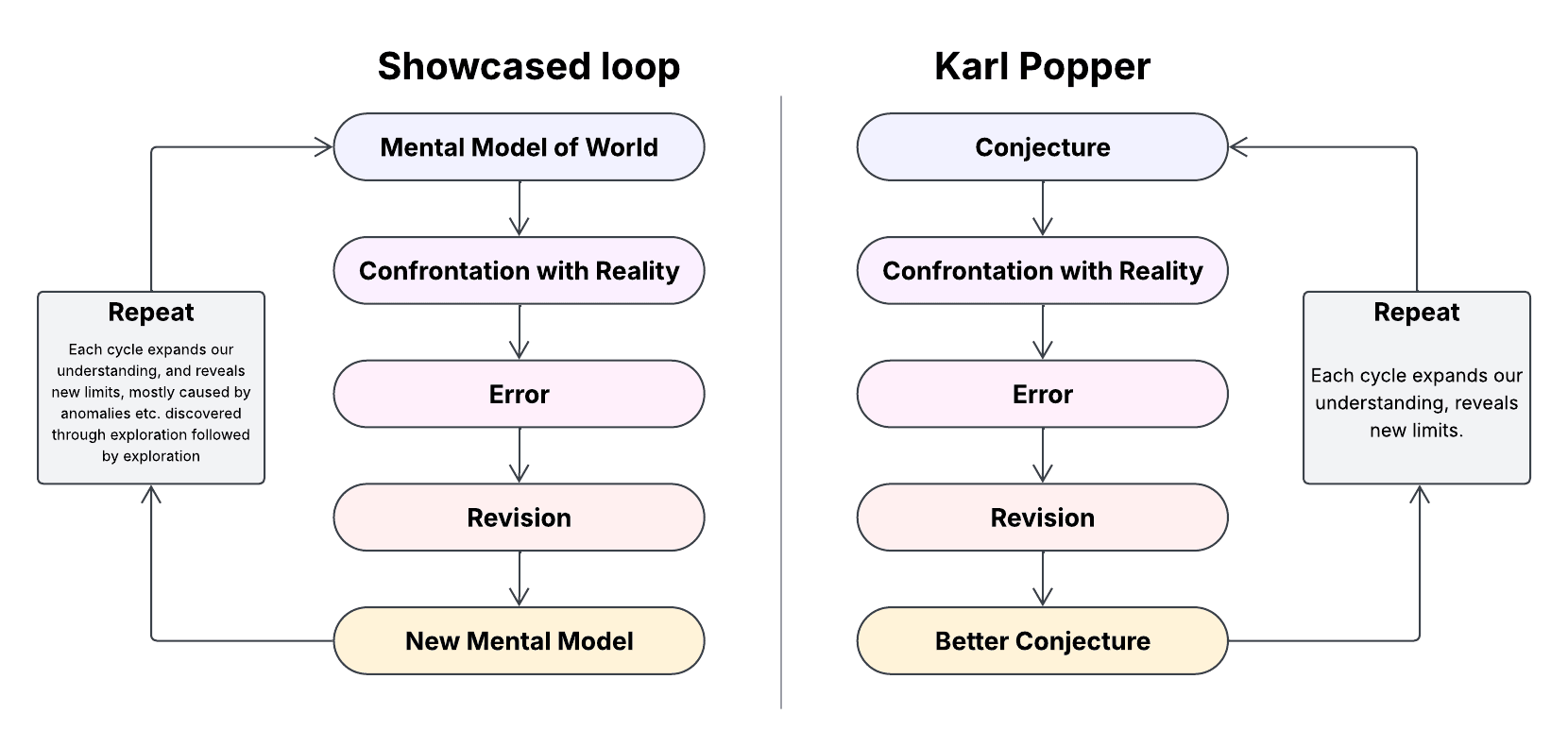
Though even a fully ‘proven’ framework is one Popper[8] would most likely object, as even proven science has to be open to confrontation with new realities. According to him, surviving a test and thus being proven in scientific terms, does not turn it into a certain knowledge. Instead he supports the idea of an endless loop of:
Taking Popper's framework seriously into account, this would further suggest that science can never reach absolute certainty. Even currently ‘proven’ models, may be confronted and in need of revision given new evidence. Would that lead to an immediate suspension of preference to an impartial altruist?
Would that not be immoral in itself? If heuristics are such an interwoven aspect of science, then inaction may further delay scientific progress. Heuristics are almost impossible to avoid in a decision-making process given uncertainty. Therefore, I propose refining the decision-making process, to ultimately make us better choosers.
In fact, this discussion is taking part in the described process itself. How to act under radical unawareness is a known problem without a certain answer - a known unknown, that once was an unknown unknown as well. With his essay DiGiovanni is aiming for feedback, for refinement of the current ideas or even for novel approaches. The competition is taking part in a small-scale version of the broader process I have described: variation in ideas → confrontation with feedback → refinement.
A way to improve this feedback loop. Isn’t that where we should look for answers as well then?
Modern Epistemic Adaptation
The discovery of the berry did not only leave the primates' ancestors curious. No. It grappled through the curiosity of the entire world. From breeders trying to make it ideal for their local environments, to research in its unique DNA and history. Society amplified curiosity. It made it scale and become a collective.
This section is a fictional example and not based on facts.
With society functioning more and more as a collective and globalization further supporting this, our relationship to curiosity and learning has drastically changed. The previous two ideas have been further amplified. Science itself behaves more evolutionary, its communities constantly changing. Ideas compete, get researched and successful explanations survive, whilst others are worked on and improved thanks to feedback. (David Hull [9])
In our modern world knowledge is an (mostly) open resource that goes hand in hand with university. But most importantly, science gets constantly worked on. Outdated models get updated, any new idea gets peer reviewed and new models appear, both in their own discipline but also interdisciplinary, allowing even more in-depth knowledge through collaboration. A wildly complex setup that we have created, but one that has proven to be a significant support in our scientific endeavours, yet may still need some fine tuning.
This ultimately leads to a more goal oriented question. We can’t with certainty give Anthony an answer whether unknown unknowns can be eliminated - but we can question our way of approaching them: How do we create systems that support them? How do we expand our knowledge? How do we efficiently turn unknown unknowns into knowledge? Rather than looking at unknown unknowns as one static evil, I believe that we need to look at them as part of an elaborate system, which further has to be considered in decisions. The question should ultimately be how to become a better chooser. This question leads to vastly different approaches and answers.
Curiosity → Feedback → Evolution: A Dynamic Alternative
Unknown unknowns exist. And I also agree that in some situations the best answer to it may be suspended preferences. However, I believe this approach should only be taken once the entirety of the feedback loop has been given consideration.
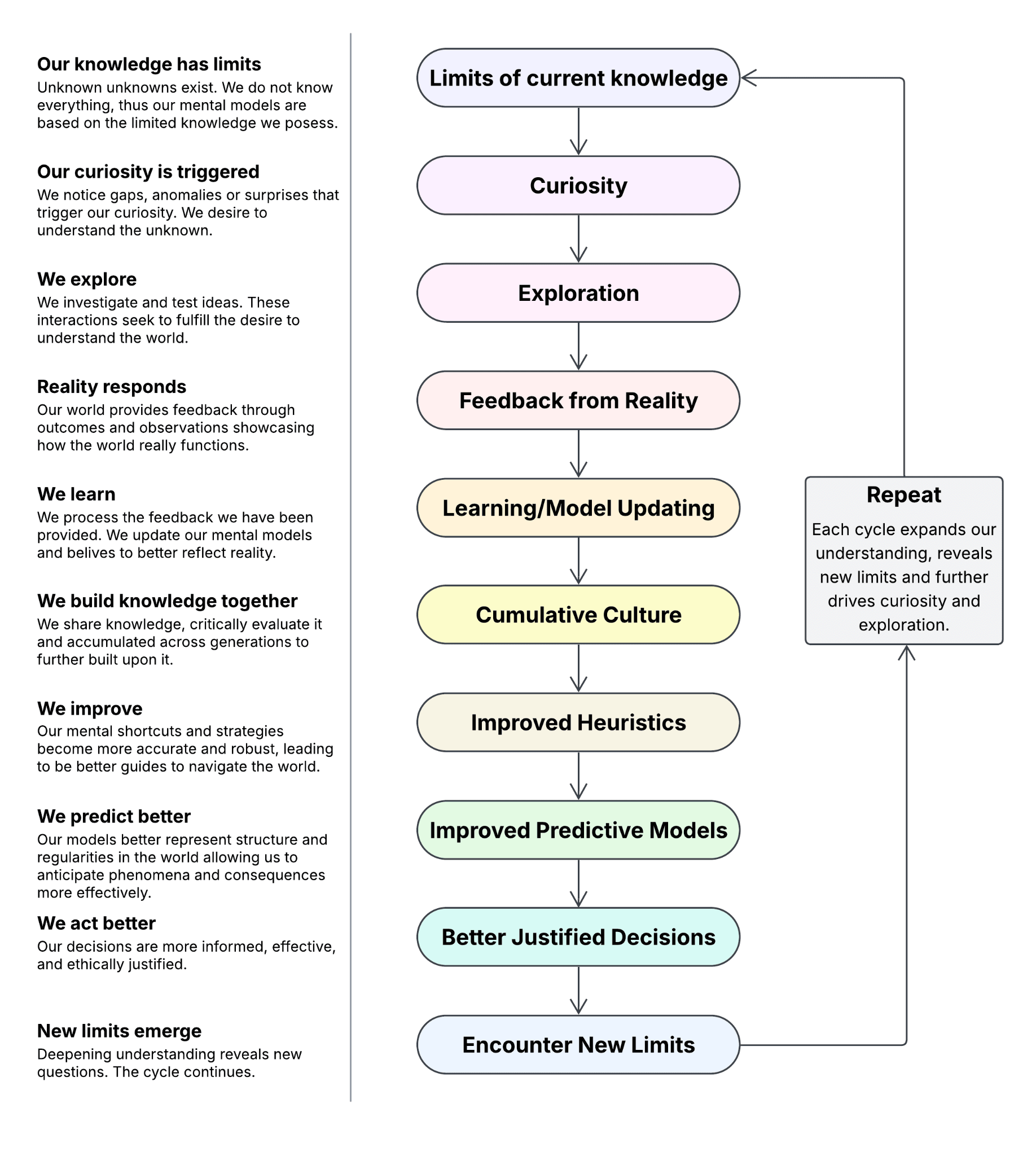
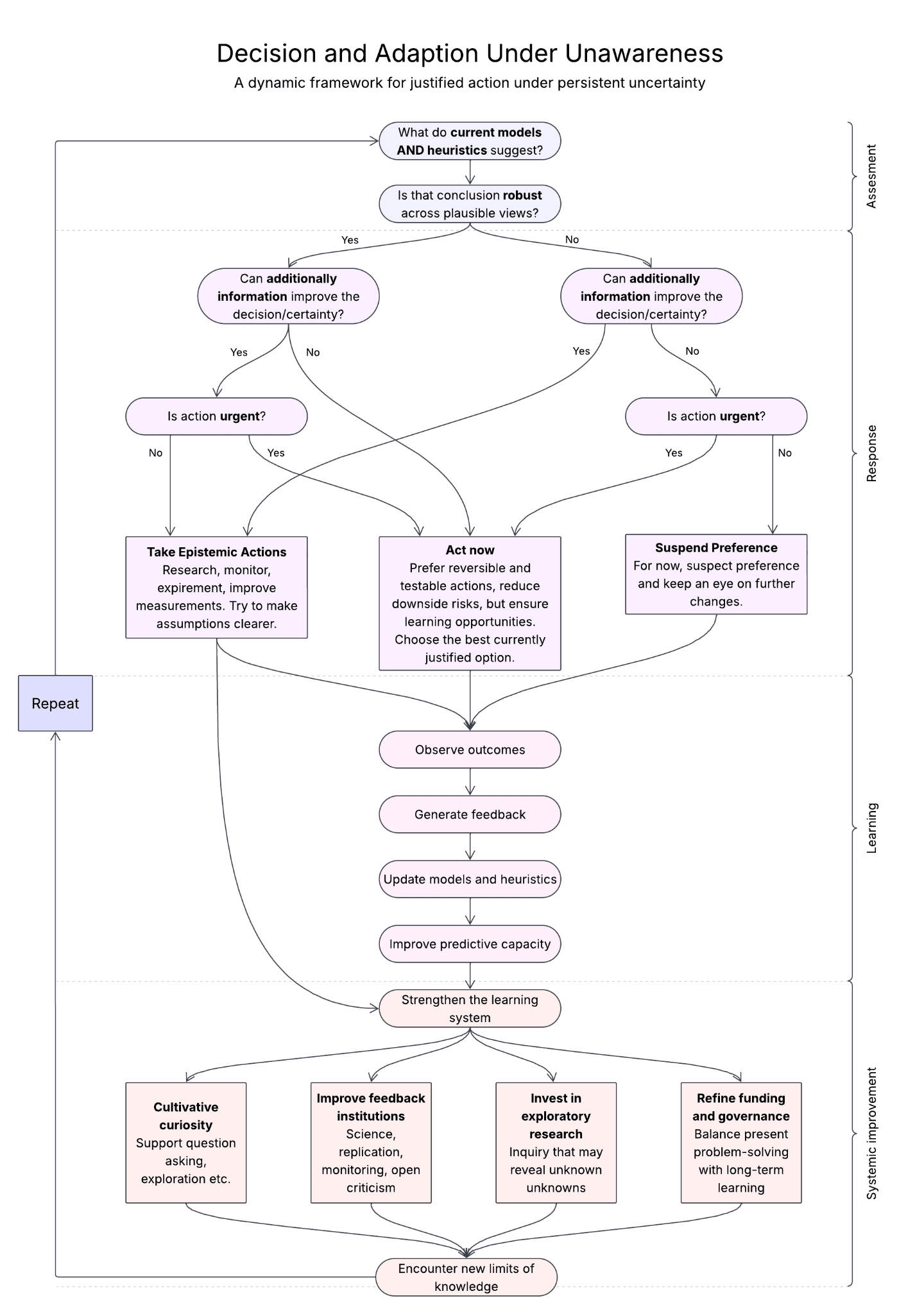
Rather than a static framework, I propose a dynamic framework based on the previous parts of this essay:
Unknown unknowns are a major contributor to humanity having evolved into the adaptive epistemic system itself. Their existence is what makes us much of what we are: curious beings that explore. We have finetuned our curiosity with institutions, cumulative culture and continually updating models. All this makes unknown unknowns far from static, and they should not be treated as such.This framework allows us to rephrase the question to: “Given unawareness, how should we become better choosers?”. To tackle this question, there are multiple subjects to be addressed:
How do we increase humanity's ability to discover unknown unknowns?
How can humanity most effectively transform unknown unknowns into known unknowns?
How can we better cultivate the adaptive mechanism evolution has already provided us?
How should civilization organize themselves to become better learning systems?
How should societies allocate resources between solving today's known problems and exploring tomorrow's unknown ones?
Increasing humanity's ability to discover unknown unknowns
It is tempting to answer the question of what to do with the unknown unknowns with: “just find them”. In the previous parts I have already explained that this is not easy. An uncovered unknown (turned known) creates a broader reality of possible unknown unknowns. An endless cycle. Furthermore, it is not possible to search for something that is unknown to us directly. We stumble upon it through observation of reality. Therefore the best we can do to uncover more unknown unknowns, and thus make our predictions better, is expanding the range of reality we are capable of observing, which then leads to a higher chance of anomalies caused by unknown unknowns to appear.
This is something we are very much capable of doing and in fact are already doing so in some fields. For example, CERN’s Large Hadron Collider (LHC), which will potentially be joined by a larger version the Future Circular Collider (FCC). The LHC is a tool with the goal of discovering physics beyond the Standard Model. Meaning: Unknown unknowns.
What does this mean for a chooser? It means that choices go beyond the first layer. To make a choice between action and inaction based on current partially-heuristic models is not the only option. The assumptions in the models can be fine-tuned and researched as well.
This is what continuously happens in pharmaceutical companies, trials before decisions. But it is not limited to such industries, in many other industries, such as tech, it is argued to be more beneficial to the public for decision makers to make second-layer decisions, before committing to the first layer. In tech the first layer example would be a release of products/software, whilst the second layer choice would rather focus on further understanding of the consequences and/or any unknown factors in the product itself.
This can be applied to other fields as well. An altruist who wishes to work in a field may decide to rather work on the broad understanding and open assumptions of their cause, rather than directly working on it.
Transforming unknown unknowns into known unknown effectively
Encountering anomalies is one subject, responding is a wholly different one. A discovered unknown unknown turns into a known unknown. Yet, it is not worth anything if we don’t follow up with action. After detecting one it is imperative to turn it into a defined research problem. This only allows us to turn it finally into a known. To do this efficiently, a system should be in place.
This, too, already has its application in some fields, one of them being The International Pathogen Surveillance Network (IPSN). It links laboratories and genomic-surveillance actors internationally, which allows a collective investigation of unusual pathogens and mutations. The setup of the system ensures that unknown unknowns, upon detection through an anomaly, get turned into known unknowns quickly. This does not only accelerate the progress, but also the public health decision-making.
Such systems are unfortunately not present in every field that may benefit from it. Therefore, this creates another second layer option for the chooser. Working on or even on the creation of a system such as the IPSN in their cause area. Again, this increases the variety of options and helps create an active impact without suspending preference.
Cultivating evolutionary adaptive mechanisms
Curiosity has been a driving force for millions of years, so why not lever the mechanisms evolution has provided? As a civilization we have built vast curiosity-promoting institutions. From universities, libraries, open-source communities to even the internet itself: The haven of a curious individual. But it did not come without the price of possible exploitation. Standardized assessments, publication pressure, commercial incentives, engagement algorithms and even false information are the unwanted second edge of the sword.
Education is a foundational part of life, and it should be used to rather promote the good side of the double edged sword. Creating a curious society is essential. The more people there are that ask questions AND that are explicitly aware of how to handle them (question 2), the higher is the chance to uncover new unknown unknowns.
With education being such a broad field there are many different ways that this can be addressed. One attempt of this being the International Baccalaureate’s (IB) Primary Years Programme (PYP), which is aimed to achieve inquiry-based learning in the classroom. Inquiring about what you learn is the very premise of curiosity itself. Of course there are many other ways that this question can target. This program would solely help with creating an inquisitive mindset in the children. It promotes general curiosity. However, this can also be more tailored towards a specific topic and used to direct more research/conversation etc. on it.
Curiosity is in many places, another one being the internet. With it social media , a vast playing field for the curious. Leaving its obvious problems aside for a moment it is essentially a gigantic communication network with (unfortunately only partly correct) amazing learning material at its hands. In fact, I have first read about this topic on a social media platform. Curiosity combined with communication can be a vast driving force towards discovering more unknown unknowns. While working on the obvious issues it brings with it, the potential should be leveraged.
Et voilà, we have more second layer options. If the lack of knowledge is an issue, then for curious minds to uncover said knowledge is a possible answer. So, instead of disliking a heuristic assumption in a model, why not stir the curiosity of others and find solutions together? Just like DiGiovanni's essay did. There is a reason why curiosity and exploration has worked well for a long time, and combined with a collective brain we may as well capitalize what we have available as resources. Talking about resources…
Allocating resources accordingly
We live in a world run around resources. Money represents the value of resources, time, water, food, you name it - we allocate it. The main question one might face is what to allocate it to?
Unknown unknowns certainly are not amongst secure investments of resources. Understandably so. Uncertain returns are risky business, and there are plenty urgent issues to fund with predictable outcomes.
This is where we also circle back to the option of suspending impartial preference. However, a world in which everybody would focus on the predictable and certain opportunities, would be a world that slows scientific progress and discovery of unknown unknowns tremendously. Balance of funding is imperative. Sticking to certainty only will not allow steps of the cycle to happen just yet, it will be postponed to an unknown future. And I would argue that the denial of possible life-changing discoveries is not what an altruistic driven individual wishes. In fact, this may be its own debate about the ethical aspect of denying the opportunities of discoveries.
Funding the hunt of unknown unknowns is a gamble. But as with most gambling, it can be cheated. Here by fine-tuning the decision making. CERN once again is a lovely example for this. There is a balance to be found between predictable research and projects such as CERN's FCC.
Unknown unknowns do not tell us which discovery to fund, because by definition we cannot know what that discovery will ultimately be. However, they can give us reason to fund the capacities that make discovery more likely.
This means, the last question for a better chooser makes them wager between the options they have. And I believe this is what we really must work on.
Conclusion: Uncertainty cuts both ways
Once again, unknown unknowns exist. But suspending impartial preference due to the aspect of the ‘unknown’, which does not allow complete certainty is a static and shallow mindset. For millions of years unknown unknowns have existed alongside humans. Step by step we have made bits of uncertainties vastness part of our certain mental model. Evolution and our continuously progressing society has developed a looping mechanism to handle these unknowns.
Looking at radical unawareness as a more dynamic process allows more points of action, which means we go beyond a preference first layer choices. Instead, there are second layer options that allow the chooser to further decide between actions which cause the first layer options to be of less heuristic origins. Options such as building systems or funding the ability to discover unknown unknowns. Suspending preference may, in some cases, really be the correct answer. However, such drastic decisions should not be taken lightly and be the last resort. The closest to a overall guidance I can bring this to is the following:
It is not a one-step road of encountering heuristics followed by suspending preference. Rather, the entirety of the progress should be considered and weighted against each other, for inaction itself can be considered immoral. Epistemic delay comes with moral costs itself. Just as preventing it at times can prevent harm. This is part of taking unknown unknowns seriously. We must not only take in account the consequences of unforeseen discovery, but also of its delay. Therefore, we must weigh all options before choosing a suspension of preference.
I can’t give you a certain answer of how to handle unknown unknowns. Their existence is too broad to give one specific answer. The framework showcased here is also subject to feedback, as there certainly are points that I missed or may not have considered. Different fields may hold different solutions. However, I can with certainty say that they are worth spending time on. Further exploration will help us move closer to an optimized framework. If unknown unknowns deny certainty in funding decisions, then they give us reason to fund the capacities that make discoveries instead. Basic knowledge is the core of progress, as well as better predictive models. But there is a balance to be found.
Further Reading
About Knowledge
[1] Donald T. Campbell
On Donald T. Campbell in Evolutionary Epistemology
TL;DR
* GOAL 3 is a social enterprise that created IMPALA, a patient monitoring and digital platform system for low-resource settings. There is also a GOAL 3 foundation that raises funds to ensure underserved communities will be reached.
* A recently completed report from Rethink Priorities calculated IMPALA to have a cost per DALY averted of $7–17 in paediatr...
This month effective altruism has gotten lots of attention, including a cover story in The Economist. It feels pretty surreal to be on the receiving end of it. But I feel grateful these ideas have caught on, and even more grateful for the drive, earnestness, and compassion of so many people who took strange but well-argued ideas seriously and then actually acted on them....
Note: This post was crossposted from the Coefficient Giving Farm Animal Welfare Research Newsletter by the Forum team, with the author's permission. The author may not see or respond to comments on this post.
Subtitle: On vegan advocacy, effective altruism, and FIFA
I turn 40 today. Here are some hot takes.
On factory farming
1. Our biggest challenge is salience. If factory farming led the evening news, it wouldn’t last lo...