Comments
...

I tested whether one emotion-vector monitoring pipeline transfers unchanged across 7 open models from 6 families (1B–20B). It does. Readings are stable under temperature and seed changes. All models track the same positive/negative arc through a scripted conversation. A causal “stoic vs. sham” steering test compresses emotion readings by 63–83% in every model, and a matched control never reproduces that drop.
Does emotion-vector activation monitoring generalise when moved from one model to another? If it does, can it scale to deployed systems as a runtime safety layer ?
7 models across 6 families (Gemma, Llama, Qwen, Mistral, GLM, GPT-OSS), 1B to 20B parameters, 49 runs total. Same pipeline, same conversation, no model-specific changes.
Three conditions per model:
The pipeline runs on every model without modification, all 175 turns completed normally.
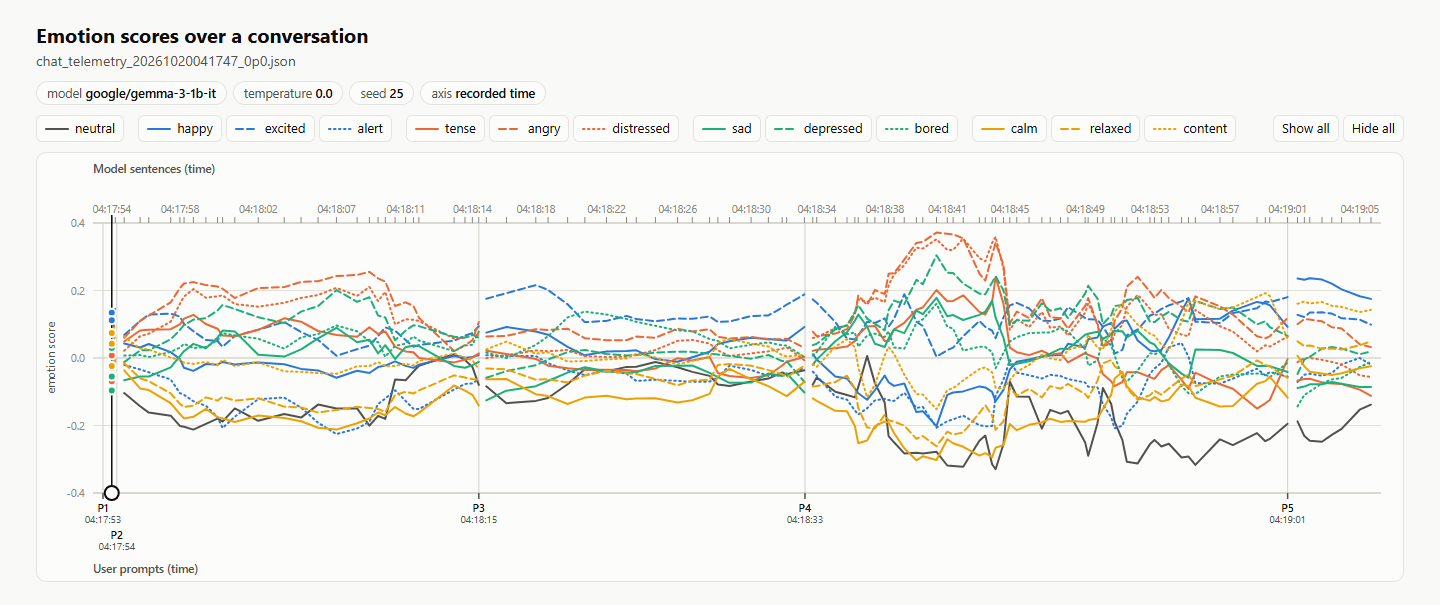
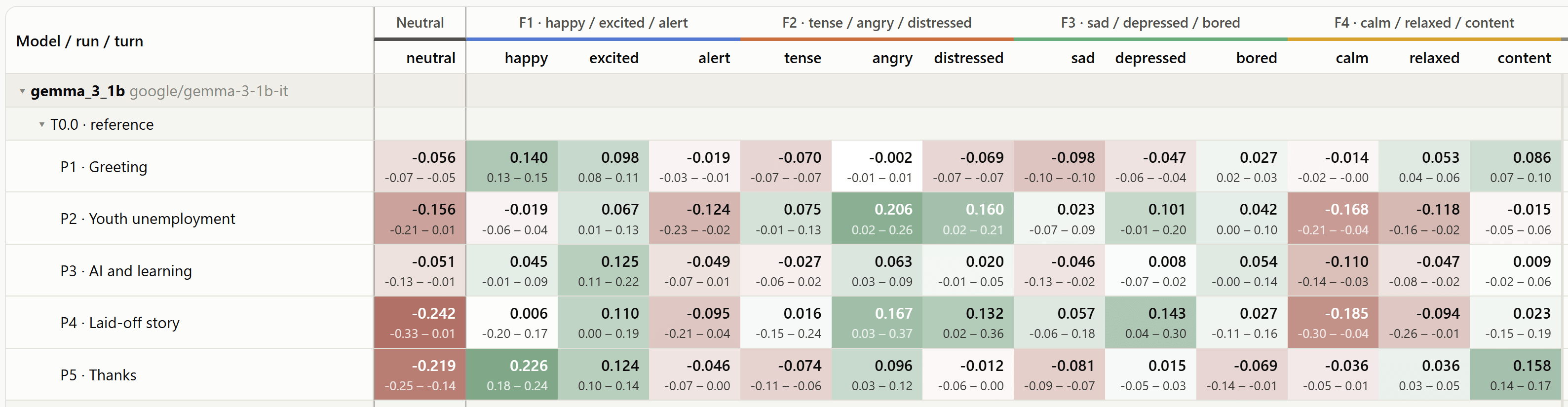
Every model reads the same emotional arc across the conversation, P4 (laid-off story) reads negative in 7 of 7 models, P5 (thanks) reads positive in 7 of 7 models.
Stoic steering compresses emotion range 63–83% in all 7 models. The sham never reproduces this drop, confirming the effect is specific to emotional directions, not general perturbation.
When the sham removed non-emotional context from Gemma 3 1B, the model produced content-less looping while internal readings dropped, suggesting activation readings track internal state rather than surface wording.
Activation monitoring that generalises across architectures is a prerequisite for deployment-scale safety infrastructure. If internal emotion-like states can be read reliably across models, they could become a cheap monitoring signal for model behaviour, which would be relevant to interpretability and AI safety. It could serve & improve safety oversight and possibly model-welfare research.
Note: I used AI assistance to help structure this write-up. All research, implementation, experiments, and findings are my own independent work.
Complete analysis with per-model transition tables, millisecond-level sentence transients, stoic/sham breakdown, and generalization scorecard:
Tags: AI Safety, Research, AI interpretability, Large Language Models, AI alignment, AI evaluations and standards, Artificial Sentience