Hi Axelle! This is really great timing - I've recently been looking into a closely related project.
I don't have access to the Bloomberg article, but keen to hear your thoughts on some of the data Aviagen has published on their welfare selection program, in particular this report. I was (perhaps naively) given the impression that broiler welfare was actually improving quite fast, e.g. the leg defect rate of the Ross 308 halving from 6% to 3% over the past 10 years, according to Fig 10.
If true, that's ~1bn chickens each year no longer suffering from leg defects!
There's also this paper (also published by Aviagen) that suggests about 30% of their selection focus is on health and welfare traits (Fig 3). Is this misleading?
The project I'm looking into would essentially be working with Aviagen/Cobb to speed up their welfare selection programme through better measurement technology / whatever their current bottlenecks turn out to be. The feasibility of that very much depends on their willingness to cooperate though.
🐔 I’m now working on a book about “turbochickens”, the Better/European Chicken Commitment, and the global broiler industry as a symbol of industrial animal agriculture reaching its limits – scheduled for publication in French next spring.
Are you also planning to publish the book in English?
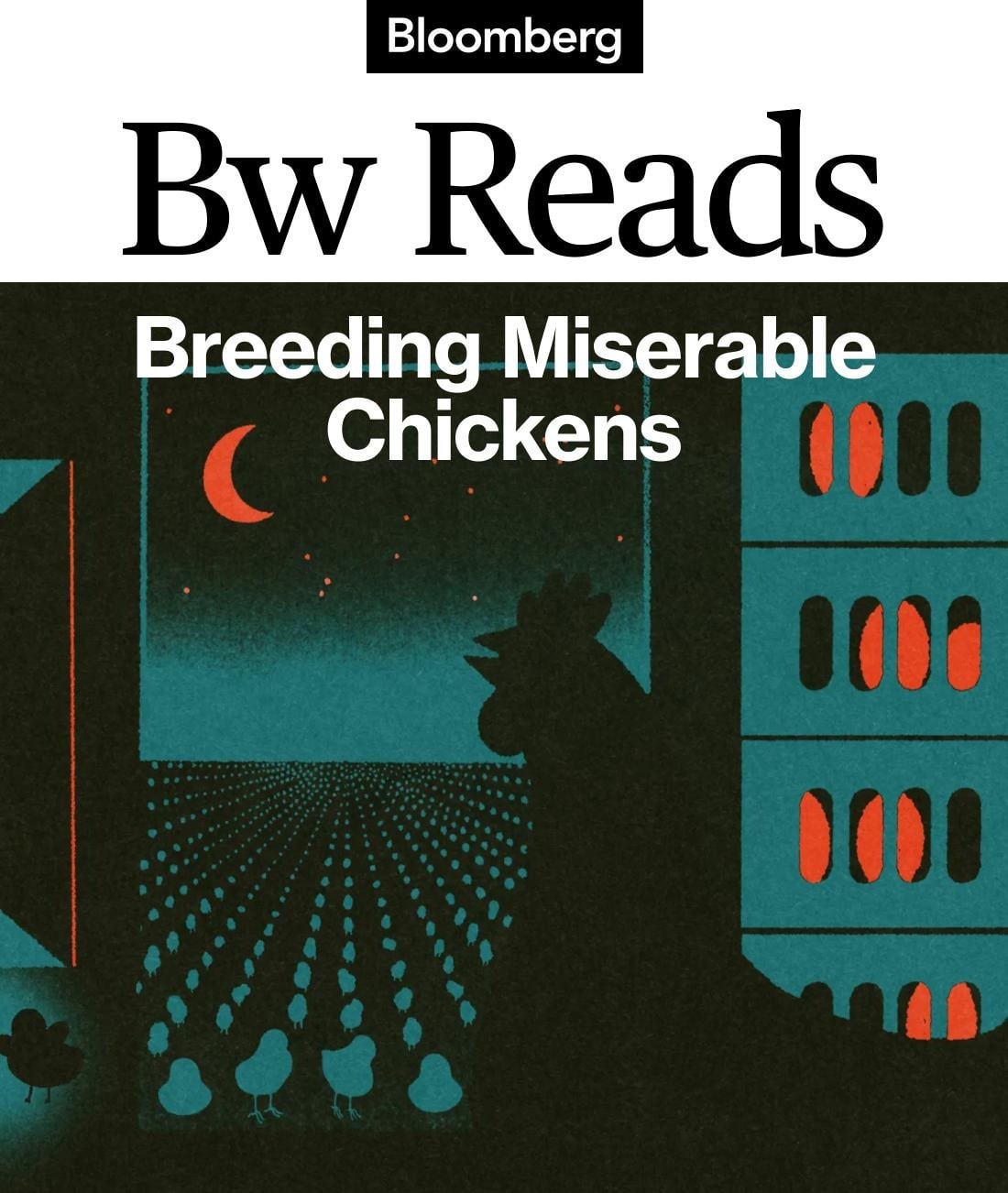
Bloomberg Businessweek: "How Generations of Selective Breeding Created Miserable Chickens"
I’m a journalist covering animal suffering in agriculture.
Yesterday, Bloomberg Businessweek published a story from "Chicks on Speed: Big Chicken's Push for Faster Birds, But Slower Reform", a cross-border investigation I’ve been working on with five other European journalists: Julia Dauksza, Tracy Keeling, Wojciech Oleksiak, Andrei Petre and Paul Tullis. This work was made possible by the support from Journalismfund Europe.
So far, our work has been published in Bloomberg Businessweek, Le Parisien, UFC-Que Choisir, The Bureau of Investigative Journalism and Mindcraft Stories. Two additional articles are expected in the coming months.
Bloomberg Businessweek agreed to produce a short social video about the story. They also released an audio version for Spotify and will use it as their Sunday newsletter this week.
The beautiful illustration is from Becky Mann
Key findings
“Balanced breeding” masks a profit-first reality – The poultry industry markets its genetic selection programs as “responsible and balanced”, but in practice, growth speed and productivity remain top priorities. Breeding companies fix welfare problems caused by rapid growth reactively rather than preventing them, prioritizing profits over animal welfare.
Scientific findings are actively challenged – European industry groups, including the poultry lobby AVEC, have systematically attacked the European Food Safety Authority (EFSA) welfare recommendations, questioning the science and delaying potential regulatory reforms – a strategy reminiscent of the “Merchants of Doubt” approach used by other industries.
Genetic causes of suffering are obscured – Poultry actors, including the genetic selection company Aviagen, deflects responsibility by framing welfare issues as farm management problems rather than the systemic consequences of breeding for rapid growth. This shifts responsibility onto farmers and slows adoption of the European Chicken Commitment (ECC) standards.
Europe-wide lobbying shapes the narrative – Coordinated lobbying and a commissioned study disseminated by AVEC create a pervasive echo chamber emphasizing costs and feasibility challenges of the European Chicken Commitment, while downplaying or ignoring the animal welfare and public health benefits of slower-growing breeds.
US industry actively monitors and counters animal welfare campaigns – In the US, the Animal Agriculture Alliance invests heavily in tracking NGOs and activists, influencing corporate partners, attending conferences undercover, and using PR campaigns to protect intensive poultry farming and maintain the fast-growth model.
The European Chicken Commitment gains traction, but deadlines loom – The NGO initiative promoting slower-growing breeds has secured commitments from over 600 global brands, including Nestlé and Burger King, to phase out fast-growing chickens by as soon as 2026. As these corporate pledges approach their deadlines, scrutiny on compliance and progress is intensifying.
Behind the story
The first step for us was to dig into the scientific literature on the effects of breeding for rapid growth. What struck us most was discovering that scientists had already issued clear warnings, many decades ago, about the health problems and suffering linked to fast-growth genetics.
From a reporter’s perspective, it was also striking for us to see the poultry industry using the same lobbying playbook as Big Pharma and Big Tobacco: casting doubt over science, shifting responsibility onto scapegoats (in this case, farmers), disseminating alarmist impact studies. In Europe, this happened just as the European Commission was announcing plans to modernize animal welfare legislation.
A key moment in the investigation came with the work of the Welfare Footprint Institute. Their evidence shows that adopting the Better/European Chicken Commitment would bring a significant reduction in broiler chicken suffering. This kind of research helps weigh the industry’s economic claims against the costs in animal welfare, adding real value to the reporting. I would encourage other journalists covering food and agriculture to use the Welfare Footprint in their work.
👉 Please feel free to share the findings or the article with anyone working to reduce chicken suffering.
What's next
🐔 I’m now working on a book about “turbochickens”, the Better/European Chicken Commitment, and the global broiler industry as a symbol of industrial animal agriculture reaching its limits – scheduled for publication in French next spring.
I was born at the end of the cold war, unaware of the danger we were emerging from. Duck and cover drills (as if those could protect schoolchildren from a nuclear blast) were a curiosity of the past.
The farmer-poet Wendell Berry, who wrote about the dread of nuclear war, died recently. From his 1968 “The peace of wild things”:
When despair for the world grows in me
and I wake in the night at the least...
Note: This post was crossposted from the Coefficient Giving Farm Animal Welfare Research Newsletter by the Forum team, with the author's permission. The author may not see or respond to comments on this post.
Subtitle: On vegan advocacy, effective altruism, and FIFA
I turn 40 today. Here are some hot takes.
On factory farming
1. Our biggest challenge is salience. If factory farming led the evening news, it wouldn’t last lo...



Hi Axelle! This is really great timing - I've recently been looking into a closely related project.
I don't have access to the Bloomberg article, but keen to hear your thoughts on some of the data Aviagen has published on their welfare selection program, in particular this report. I was (perhaps naively) given the impression that broiler welfare was actually improving quite fast, e.g. the leg defect rate of the Ross 308 halving from 6% to 3% over the past 10 years, according to Fig 10.
If true, that's ~1bn chickens each year no longer suffering from leg defects!
There's also this paper (also published by Aviagen) that suggests about 30% of their selection focus is on health and welfare traits (Fig 3). Is this misleading?
The project I'm looking into would essentially be working with Aviagen/Cobb to speed up their welfare selection programme through better measurement technology / whatever their current bottlenecks turn out to be. The feasibility of that very much depends on their willingness to cooperate though.
Keen to discuss this more!