Comments
I found this very funny! Thanks for the post, Niki.
I determined the Holocaust directly decreased the living time of soil nematodes, mites, and springtails, by 1.83*10^15, 2.24*10^13, and 1.31*10^13 years respectively, with 8.21*10^9, 3.61*10^8, and 3.13*10^8 QALYs respectively, with a total of 8.88*10^9 QALYs. Values for both soil invertebrate densities and QALYs per year of soil invertebrate lives are estimated here. This is due to land change use from infrastructure used to carry out the Holocaust. 1.1*10^7 humans were killed in the holocaust (including Jews, Poles, Roma, Sinti, Soviet POWs, disabled, homosexuals, etc.). I calculate a direct benefit of 807 QALY per Holocaust-affected-person (HAP).
For the case of concentration camps, I only consider those which were counterfactually built and not repurposed from other infrastructure, so specifically I include Auschwitz-Birkenau, Majdanek, Maehthausen, Buchenwald, Sachsenhausen, Dachau, Treblinka, Sobibor, Belzec, Natzweiler-Struthof, and Ravensbrück. I only consider up to the end of 1945 after which they ceased to function as concentration camps and started being used as other functions such as prisons, military bases, and memorials, which are not counterfactual. After considering the time they were operational until 1945, this is 2.72*10^7 m²-years across all camps. This was a repurposing of a mixture of cropland and temperate forest with a density per m² of 4.24*10^6, 5.2*10^4, and 3.04*10^4 respectively for nematodes, mites, and springtails, resulting in 5.59*10^8 QALYs across the camps.
I am excluding ghettos, as this was largely a reusing of already-existing urban infrastructure which likely did not add extra distribution to the soil, and I remain unsure about the effects of infrastructure such as train lines that may have been repurposed from existing train lines.
Considering mass graves, Keenan et al. estimate that decomposing vertebrates, including humans, cause significant disruption to deep soil biochemistry by creating anaerobic zones. 4 years after a human is buried, nematodes are still absent from the site. I am unsure on net due to the potential for decomposition of vertebrate remains adding to soil nutrients in the long term after the anaerobic stage. The paper found very little evidence of decompositional products laterally away from burial sites, it occurs on the vertical plane above and below the grave. I maintain some uncertainty, but it seems that the effect on soil insects from mass grave sites is proportional to their area. Across around 3000 mass burial sites, there was an estimated 1*10^6 m² of gravesite created as a result of the Holocaust. Assuming a conservative estimate of 5 years of disturbance, this results in 5*10^6 m²-years due to Holocaust mass graves, about ⅕ the land use of concentration camps, with 1.03*10^8 QALYs in soil invertebrate life averted. Note that due to grave impact on soil being proportional to area, it would be wise in the future to have many individual graves rather than mass graves. Estimates range between 2-8 people-per-m² in the Holocaust’s mass graves, compared to 0.2-0.5 people-per-m² for individual graves, so are 10-40x less dense, so an order of magnitude more soil invertebrate life could be averted.
I determine that Holocaust memorials make up the largest quantity of direct land use from the Holocaust. The majority of memorial land is repurposed from previous concentration camps. I exclude time where they were used as farms or Soviet military bases. There are two other large memorials, Yad Vashem in Jerusalem and the Memorial to Murdered Jews in Berlin. These contribute 3.99*10^8 m²-years counting from their beginning of operation as a memorial until today. This is likely an underestimate as I am not projecting the impact of land use into the future. These represent 8.22*10^9 soil invertebrate QALYs, or 92.5% of QALYs caused directly by the Holocaust. It is also likely that this is an underestimate due to the majority of mass of Holocaust memorial sites being located in many small sites around the world.
As far as I can tell, the majority of the effect of the Holocaust on soil invertebrates is not from direct land clearing for infrastructure, but from the indirect effect of counterfactual absence of the descendents of HAPs. I estimate that the human years prevented have indirectly caused about -4.89x10^14 QALYs, equating to an overall harm of about -4.45x10^7 QALYs per HAP.
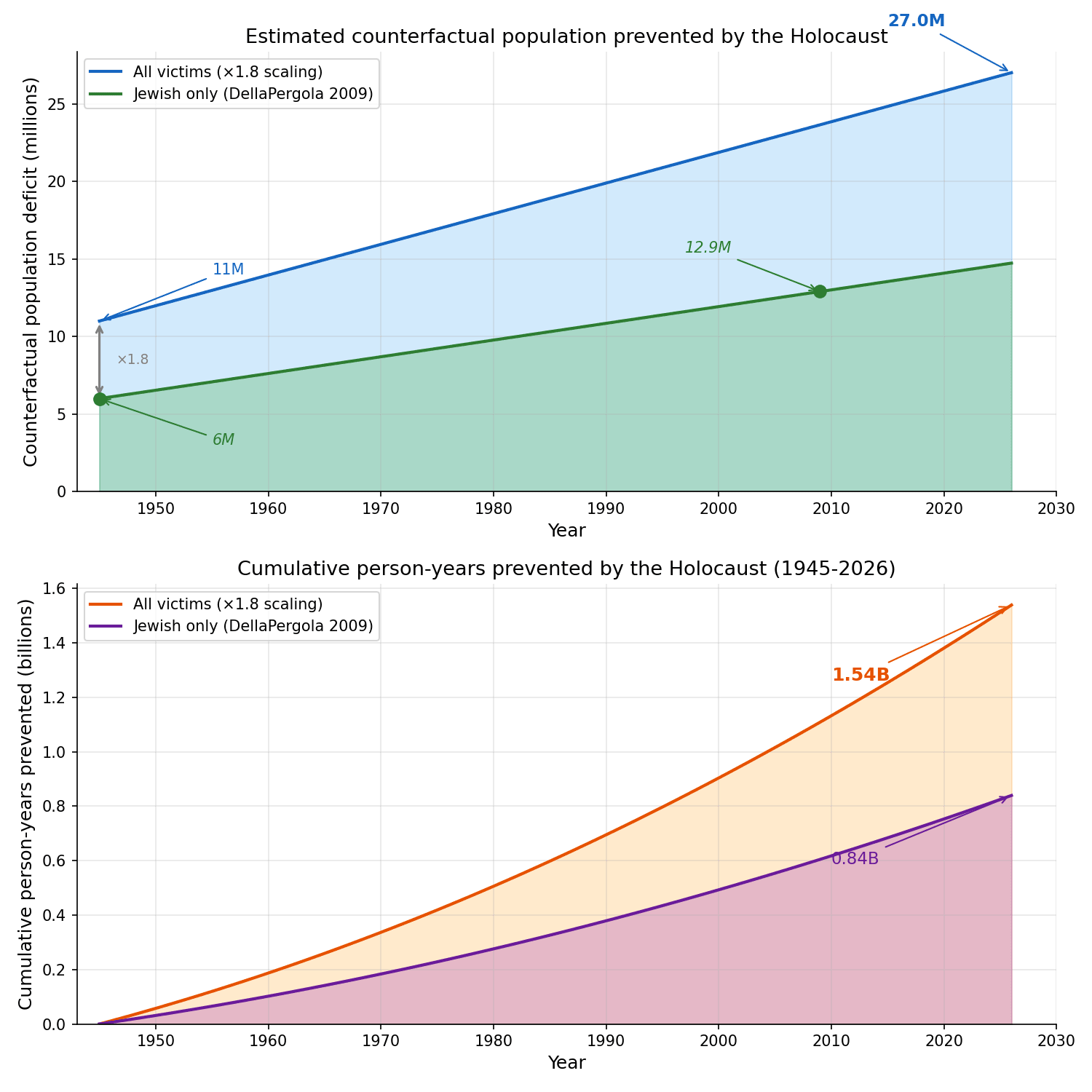
DellaPergola estimates that in 2009 the counterfactual population deficit of Jewish people was 12.9 m, increased from an initial deficit of 6 m killed. I am unsure whether the population in that time would have grown exponentially or logarithmically, likely some in between with an s curve trajectory, so to simplify I assume linear growth, with a 2026 population deficit of 14.7 m. Assuming a 1.83x scaling factor of total HAPs to Jewish people only (a ratio of 11 m HAPs and 6 m Jewish people at the end of the Holocaust), I calculate that the total counterfactual population deficit is 27.0 m, and, assuming linear growth, 1.54 b human years prevented by the Holocaust.
To feed humans, cropland is required, with 8.70*10^03 m²/person-year on average. This cropland is largely converted from temperate forest with large populations of soil invertebrates, resulting in roughly ⅕ the populations of nematodes and mites, and 5% the population of springtails, with most of the reduction in number of soil invertebrates coming from nematodes, which have significantly larger population sizes. This results in -4.89*10^14 soil invertebrate QALYs caused by the increase to their population due to the human population deficit.
Unlike with soil invertebrates, the reduction in human population would have had a positive impact on farmed animals, which I estimate to be 2.39*10^10 QALY, from a prior estimate of -15.5 QALY of farmed animal suffering per human year, caused by meat consumption. This value has significant limitations however due to lower levels of meat consumption in the past, as well as a lack of shrimp consumption due to a Kosher diet. However, for the indirect effects on soil invertebrates to be negligible compared with the direct impact on farmed animals, the cropland per human-year would have to be less than 0.158 m² (= 8.70*10^3 * 2.39*10^10 / (4.89*10^14)), which is 0.00182 % of the global average of 8.70*10^3 m²/human-year. I have a hard time seeing how one could be confident about this.
In the 2022 EA survey, 3.3% of respondents claimed to be Jewish. This is likely an under-representation as many people of Jewish descent would have claimed they were Atheist, which makes up 79.8% of respondents. My estimation is that it is closer to 5%. I calculated that the Jewish deficit is 14.7 m people. Given current populations of Jewish people at 16 m, this means that the Jewish population would have been 91.9% bigger, meaning that EA would have been 4.59% larger.
The sign of this effect is ambiguous, and I think worth flagging as an important source of uncertainty.
A larger EA movement would plausibly save more human lives through global health interventions. Each additional person-year lived requires food production, which reduces soil invertebrate populations via land use change. However, a larger movement would also scale up animal welfare advocacy. Campaigns like Veganuary and School Plates, which reduce farmed animal consumption, are estimated to increase soil invertebrate populations, and thereby reduce their welfare.
Despite the highly speculative nature of these impacts, effects cannot be neglected just because they are uncertain, and so I include them here for completeness.
I think preventing another Holocaust would be strongly beneficial to soil invertebrates, however the cost of preventing future Holocausts is extremely unclear. I estimate that the overwhelming source of harm comes from the reduction in human-years lived, and the indirect impact on agriculture. I took the baseline of 0.189 increased human-year per $ from this estimate based on a donation to HIPF from CEARCH. If the Holocaust prevented 1.54 b human-years, then at a price point of 0.189 human-years per $, preventing a similar sized Holocaust would only be cost effective if it could be done for less that 8.15 B$.
In addition, building more Holocaust memorials would provide a continuous long-term increase to soil-invertebrate welfare. To be cost effective, however, they would need to operate with significantly lower budgets than most existing memorials. For example, Yad Vashem’s operating budget is more than 50 M$ per year. Using The Berlin Memorial for Murdered Jews as a template, my best guess is we should instead build memorials cheaply out of concrete to take up as much of surface area as possible, and thereby displace the maximum number of soil invertebrates.
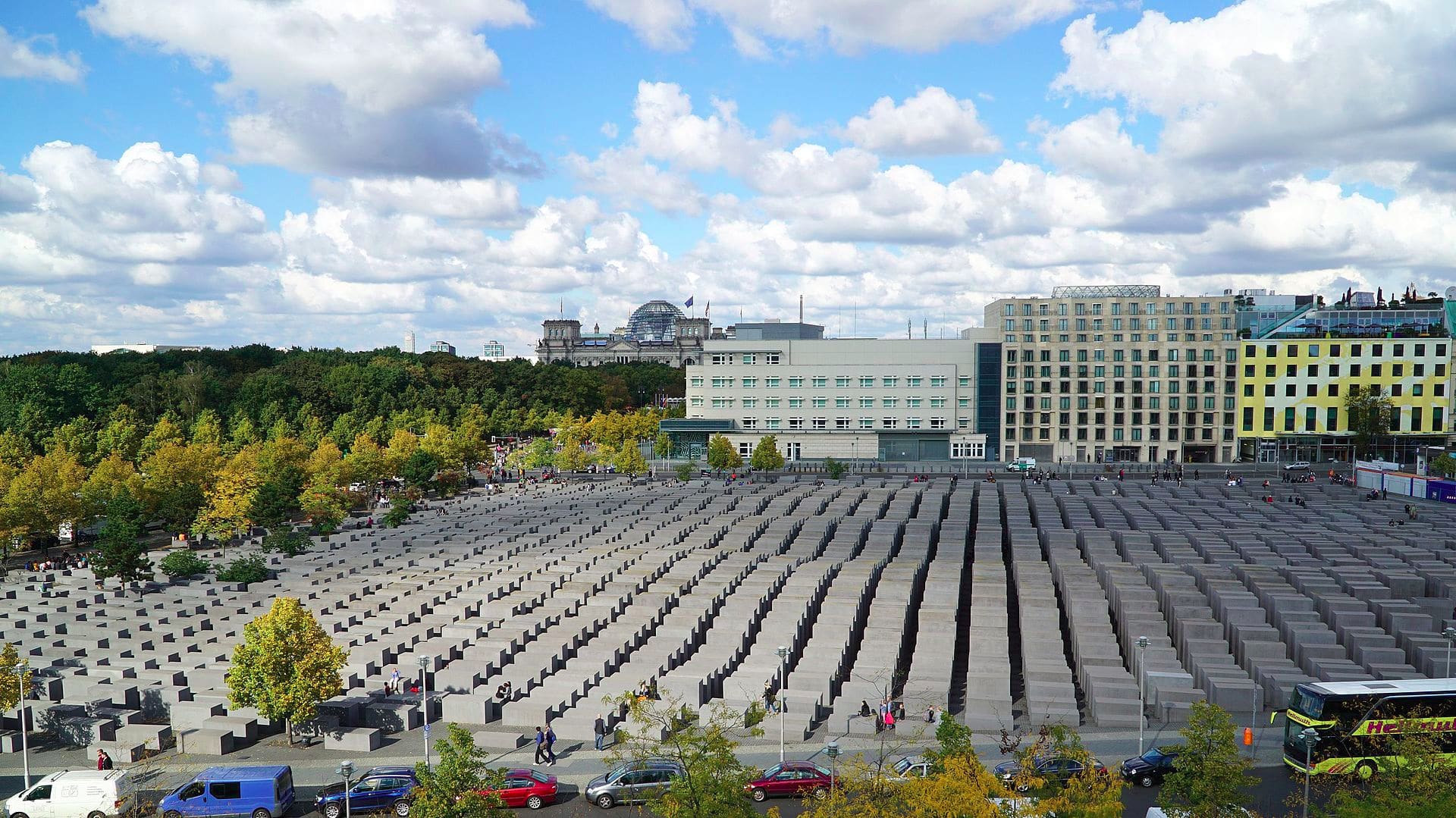
Berlin Memorial for Murdered Jews of Europe
The cost of paving the Earth's surface in Holocaust memorials would initially be quite high. For example, the Berlin Memorial cost about 25M$ for only 19,073 metres squared. However, once we begin building these at scale, I speculate that it would be possible to bring the price down significantly. Furthermore, this would provide a compounding long-term benefit to soil invertebrate welfare by occupying the land for many thousands of years.


This is outright the best April Fool's post we've had this year. Shame it didn't get more views. Seriously, I laughed out loud multiple times.
(I'm Jewish, my grandma was a Holocaust survivor and her father and most of her extended family were killed by the Nazis. My grandfather managed to flee before the war started but some of his family were also killed.)
Thank god we have the April Fool's tag to protect us from Poe's law though.
Strongly disagree.
Edit to add: Good to know that people react to other people's discomfort with jokes about mass murder of their family with downvotes.
Yeah I'm not sure what's with the downvotes.