Comments
55
...

Crossposted from my Substack Future Economist.
After summarizing his research for the AI Economics Brief, I was immediately drawn to attend Chad Jones' lecture in Berkeley, where I currently reside. The lecture was part of an AI Risk Series, with hardly any PhD economists in attendance to listen to the leading growth theorist on AI, in a typical American open-plan office space at Berkeley University. As a well-written blog post summarizing his research exists from a more prodigious German resident of the Bay Area - Leopold Aschenbrenner -, I want to focus on the different perspectives of technologists and economists regarding AI’s economic impact, the Bay Area as the location where these camps interact, and how a growth theorist tries to bridge these gaps.
Presenting at an AI Risk series already makes Professor Jones an outlier in economics. While growth theory has been neglected in economics for decades, this recently changed with Nobel prizes for Romer and Aghion. Their models are closely related to Jones’ semi-endogenous growth models, as both try to explain technological progress. However, the latter exogenous models are still taught in undergrad. Jones’ model uses population to explain growth over time, which, ultimately, is driven by population growth. But AI might speed up the idea discovery process. But this explains why some economists focus on “deep learning and fertility”, as both forces have the potential to affect future innovation dramatically.
As a growth theorist, Jones is already thinking about the long-term. This makes him clearer-eyed about AI’s long-term impact, while labor economists have a more immediate, empirical framing in mind. This has been vindicated historically by the many previous technologies, from the steam engine to electricity and computers, that affected the economy without causing widespread automation. Chad Jones makes the case for the computer: The income share of IT equipment rose a bit in the 1990s. That’s when Nobel laureate and growth theory predecessor Bob Solow was looking for it in the productivity statistics. But then it fell as the rate of price decreases due to Moore’s Law outpaced the growth of computer tasks.
The Bay Area is the place where economists and technologists talk to each other. The closeness to the tech industry and the openness to ideas make this a place where economic theory and AI mingle, for instance, at the Stanford Digital Economy Lab. Both Jones and Brynjolfsson were early converts to AI and have recruited a range of postdocs working on the topic. While in most parts of Europe, AI is used by econ departments to get government funding for new academic positions for traditional labor economists or econometricians, Stanford leads the way in actually researching these topics.
Deric Cheng and I present an AI Economic Roadmap that tries to combine both perspectives. As Chad Jones rightly pointed out during the Q&A, technologists were right about AI’s development over the last few years. This should make us trust them more, but they might overlook some obstacles to the broad deployment of AI, as Chad Jones pointed out in his “weak link” model.
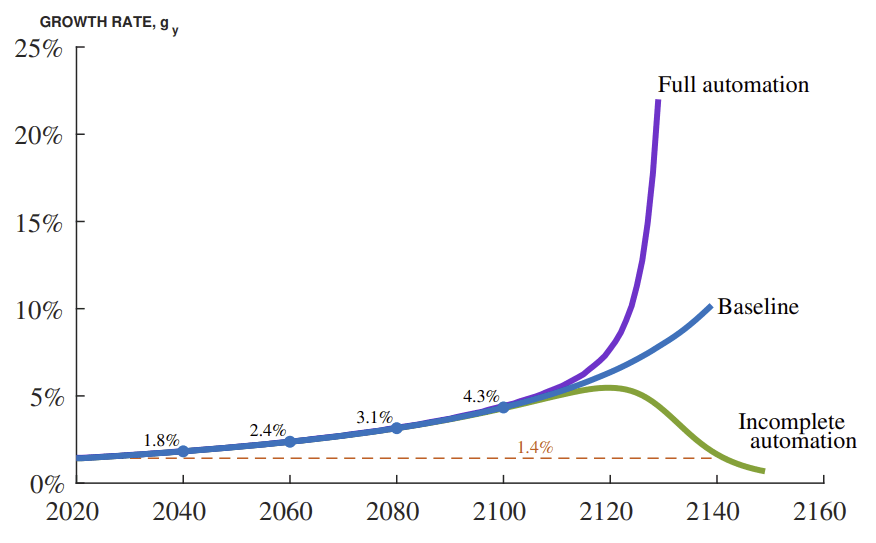
Source: Jones and Tonetti (2026)
Jones's recent weak-link model exposes these differences. It continues to extrapolate past trends, but from automation rather than the constant 2% growth that’s a desideratum so far. As you need to automate every task in a chain to get huge economic impact, the benefits of AI might be delayed. But this doesn’t mean the harms of AI are delayed, as they can already occur with AI’s first deployment. You need to automate all tasks in a chain to reap most of the benefits, while harms can arise from limited deployment in the economy. This temporal difference is another reason for the AI safety investments Jones advocated for in another paper. An economist worried about economic growth advocating spending to curb its excesses is like a vanilla Neo-Keynesian macroeconomist advocating against anticyclical spending. In a way, Chad Jones's “weak link” doesn’t just build a bridge between economists and technologists but also between the two factions of the Bay Area’s AI debate: safetyists and accelerationists. Jones offers both sides a shared framework — delayed benefits, immediate harms — that neither camp's priors alone can generate.
