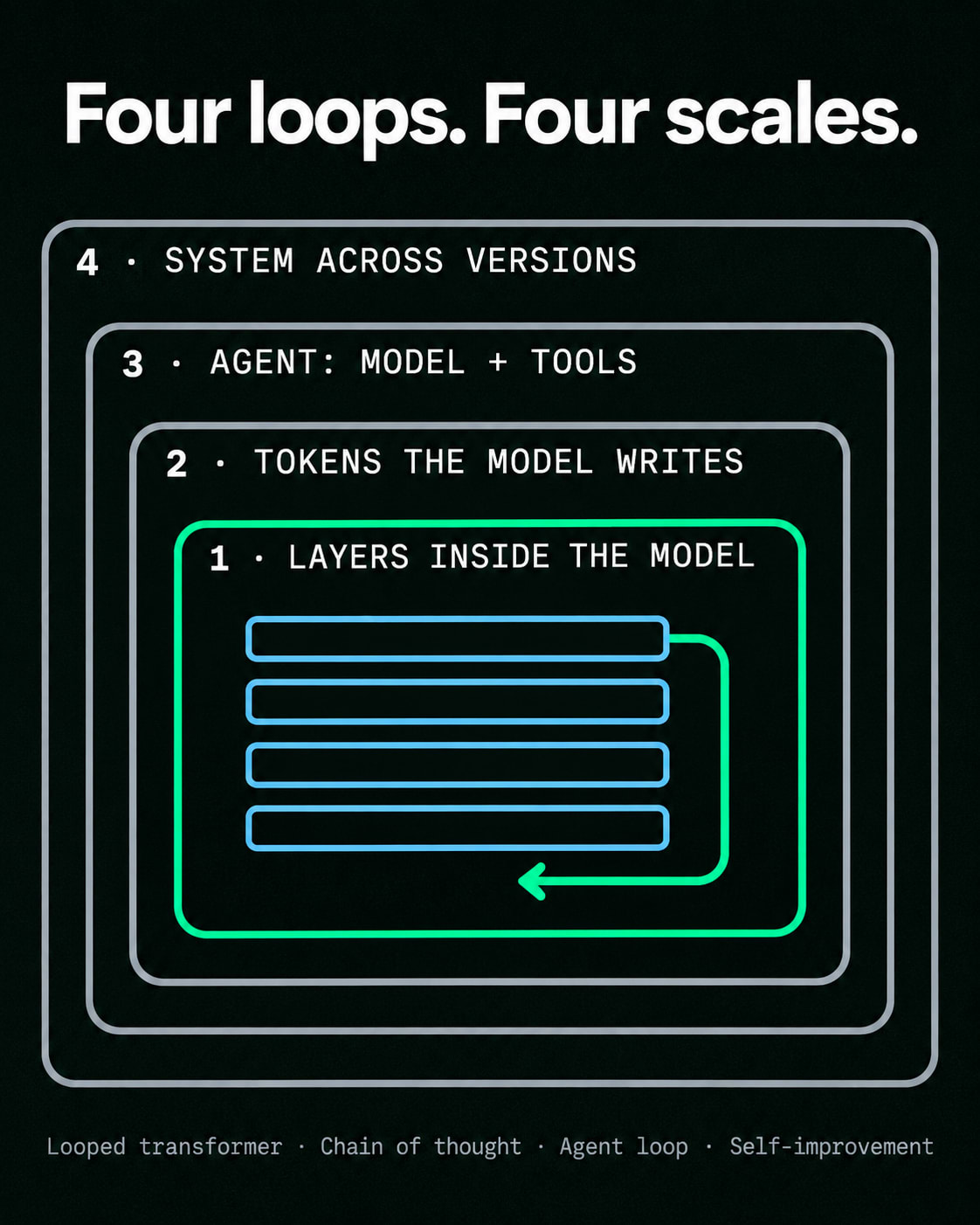
Epistemic status: an explainer plus a modest claim about oversight. The technical facts are from public papers and model cards (linked); the oversight argument is my view, not a result.
What changed this autumn
Looped transformers rerun a shared block of layers several times per token, so a model can compute more deeply without more parameters. The idea is old (Adaptive Computation Time in 2016, Universal Transformers in 2018), but 2025–26 brought it into released language models. NVIDIA's 4B Dory stores 36 layers and executes 96 when its 20-layer core loops four times; with two or more loops its authors report better average results than selected larger models on 12 benchmarks (paper).
The weights stay fixed during these passes. Only the hidden state changes. This is extra computation on the current request, not learning, and not recursive self-improvement: nothing persists to the next request.
Why this matters for oversight
Chain-of-thought reasoning puts intermediate steps into text. That text is imperfect evidence. It isn't guaranteed to match what the model actually computed. But it can be read, logged and audited.
Looping does its intermediate work in activations. There's no transcript. As more capability comes from internal passes rather than written steps, a smaller share of the reasoning is available to read at all.
Two inferences I'd resist:
"No visible reasoning means hidden intent." A hidden state isn't a concealed English paragraph. Its absence isn't evidence of deception, and treating it as a secret transcript leads to the wrong questions.
"Better benchmark scores settle the question." Performance and observability are separate properties and need to be evaluated together.
The claim
My view is that more capable internal computation raises the value of external checks. For code, that means tests and execution traces. For a calculation, an independent recomputation. For a decision, checks proportional to the cost of being wrong. When the reasoning can't be read, the outcome has to be checked.
There's a useful complement: looping adds computation, not information. A model can't loop its way to a fact that isn't in its input or weights. That makes one class of error easier to anticipate: a confident answer to a question whose evidence was never available. That's a place where retrieval with citations, plus verification, does more than any amount of extra internal processing.
Open questions I'd like input on
Which interpretability methods transfer to recurrent-depth models, where the same weights act on a changing state? Does weight sharing make per-pass probing easier or harder?
Adaptive halting decides when to stop looping. Is a learned halting signal itself something we should monitor, given that confidence isn't correctness?
As capability shifts from visible chain of thought to internal passes, should evaluation norms require outcome verification as a default reporting standard?
This post adapts the oversight section of a longer explainer I wrote, Looped Transformers Explained, originally published on piszczek.pl, which covers the architecture, evidence and costs in more detail, with interactive figures.
Disclosure: I drafted this with AI assistance, checked the facts against the linked sources, and the argument and questions are mine.
Note: This post was crossposted from Planned Obsolescence by the Forum team, with the author's permission. The author may not see or respond to comments on this post.
Subtitle: If acceleration compounds, the naive extrapolation implies superintelligence within a year
This post discusses a public METR report on AI R&D acceler...
We’re the co-founders of Better Futures Guide (BFG), a charity evaluator specifically focused on livelihoods. We were founded last year through Ambitious Impact’s Charity Entrepreneurship Incubation Program. We welcome questions, criticism and opportunities for collaboration, in the comments or at info@betterfuturesguide.org.
...
TL;DR
* We recently set out RP’s strategic priorities and the three new bets we’re making in 2027.
* In this post, we outline what we need to make them happen.
* We need more support from individual donors, this year in particular.
* We’ve redirected roughly three-quarters of our 2026 unrestrict...