Comments
58
...


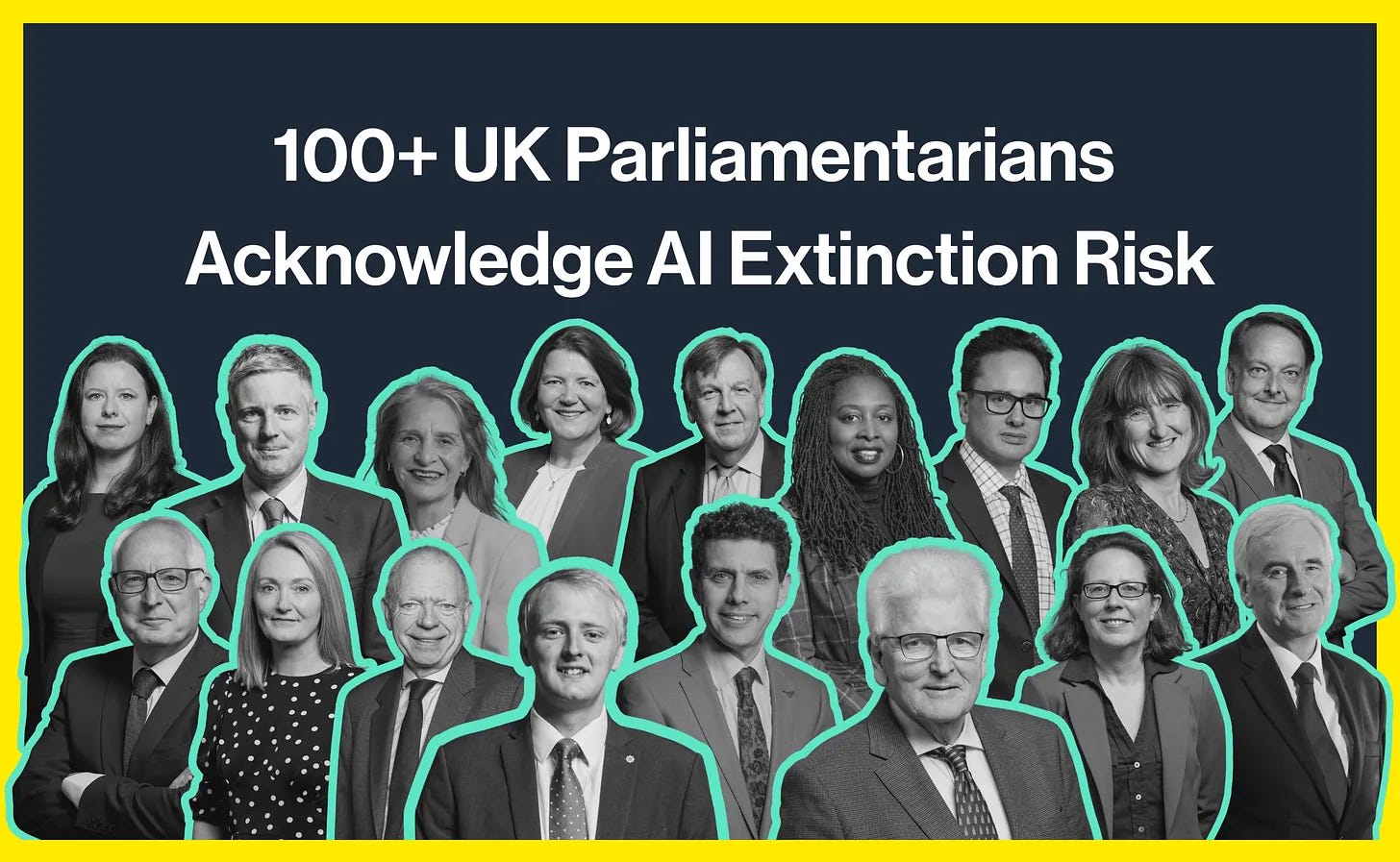
Co-written with lgonza from Torchbearer Community.
This is the first in a series of posts assessing the impact of ControlAI against external comparators. We are members of Torchbearer Community, which collaborates with ControlAI. Some ControlAI staff founded and are members of Torchbearer Community, and ControlAI were given the opportunity to comment on this draft before publication, so we have an obvious potential conflict of interest. We’re publishing the individual components of our assessment openly for critique to mitigate this. We welcome your feedback!
Executive Summary
Summary: ControlAI's UK parliamentary outreach is among the fastest and most resource-efficient advocacy campaigns we found in recent British political history. Starting from zero contacts in December 2024, a team of roughly three full-time UK policy advisors (the staff that brief politicians) has, in sixteen months, secured 125 cross-party signatories on a statement recognising AI extinction risk, identifying superintelligence as a global and national security risk and calling for binding regulation on the most powerful AI systems. They have also spearheaded two House of Lords debates and a cross-party Commons amendment to a Government bill (NC12, March 2026). Based on our analysis, we think further funding for ControlAI's outreach to lawmakers is likely to be among the most cost-effective interventions available to those who take seriously the risk of human extinction from artificial superintelligence.
Methodology: We compared ControlAI's parliamentary recruitment to eight UK advocacy campaigns selected for variety across method, scale, and political context: Zero Hour, the People's Pledge, the Conservative Environment Network, the Net Zero Scrutiny Group, the PSC Councillor Pledge, Greenpeace's Climate Vote, Results UK, and Friends of the Earth's Big Ask. We assembled comparable figures on recruitment rate, staffing, and the structural advantages each campaign held at launch.
Findings:
ControlAI is an advocacy organization working to prevent the development of SuperIntelligent AI. Their work is structured around the Direct Institutional Plan (DIP), a strategy that combines (1) designing concrete policies that target ASI development and precursor technologies, with (2) directly informing every relevant person in the democratic process ( lawmakers, executive branch, civil service, media, and civil society) and asking each to take a public stance on ASI development. In the UK, the most visible activity to date has been one-on-one briefings of individual parliamentarians about extinction risk, paired with an ask that they publicly support binding regulation. It does this through two primary mechanisms: briefings carried out by ControlAI staff members (UK based), and by offering easy tools for common citizens anywhere to contact politicians or journalists (international). This article evaluates that parliamentary-outreach component specifically; we don't assess the executive-branch, civil-society, international, or media components of the DIP here.
Starting in December 2024, ControlAI began the cold-outreach to UK parliamentarians. Sixteen months later (5th May 2026), they report 125 cross-party signatories on a statement calling for binding regulation on the most powerful AI systems, recognising superintelligence as a national and global security threat, as well as an extinction risk. Two House of Lords debates and a cross-party Commons amendment to a Government bill have followed. The statement parliamentarians are asked to sign reads, in full:
Nobel Prize winners, AI scientists, and CEOs of leading AI companies have stated that mitigating the risk of extinction from AI should be a global priority.
Specialised AIs — such as those advancing science and medicine — boost growth, innovation, and public services. Superintelligent AI systems would compromise national and global security.
The UK can secure the benefits and mitigate the risks of AI by delivering on its promise to introduce binding regulation on the most powerful AI systems.
A small organisation getting 125 signatories in less than a year and a half using almost nothing but cold outreach sure sounds impressive...but is it? To find out, we're comparing ControlAI's parliamentary campaign to other UK campaigns that sought individual parliamentarian endorsements. In this article, we are only looking at parliamentary sign-ups.
Our data for the ControlAI campaign comes from their 2025 Impact Report, https://controlai.com/, and personal communication with ControlAI staff.
ControlAI had 125 parliamentarians (93 from Westminster almost equally split across the Commons and Lords, 32 from devolved legislatures) support their campaign and signed the campaign statement by 5th May 2026. These signatories came from 160+ meetings (online or in person), including briefing the Prime Minister's office.
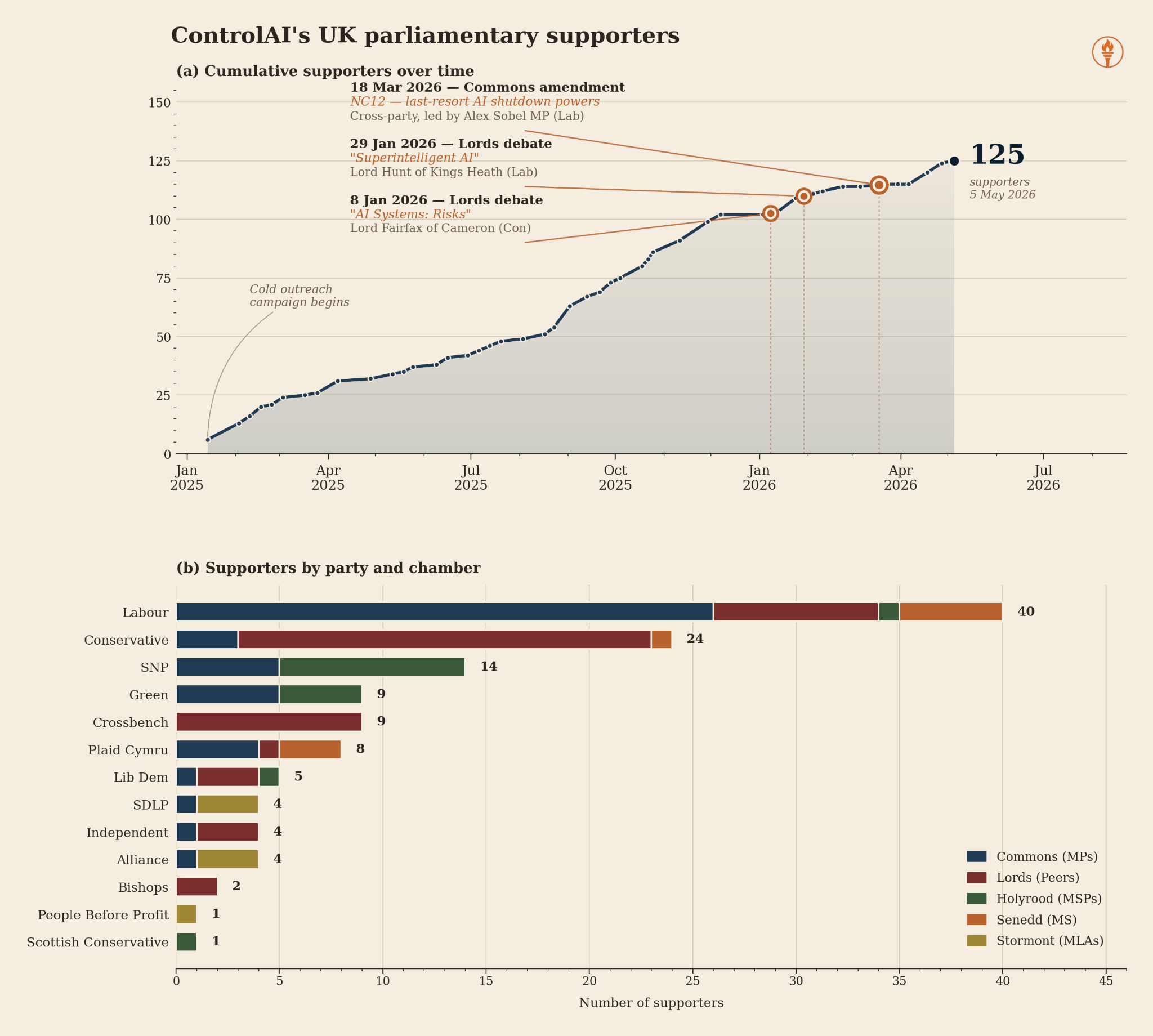
ControlAI have a roughly 1 in 2 (about 48.5%) conversion rate, applied only when politicians previously had not been supporting the cause before a meeting was held. This conversion rate excludes politicians who signed the statement without a meeting (whether it be via email, or in person before the meeting had started).
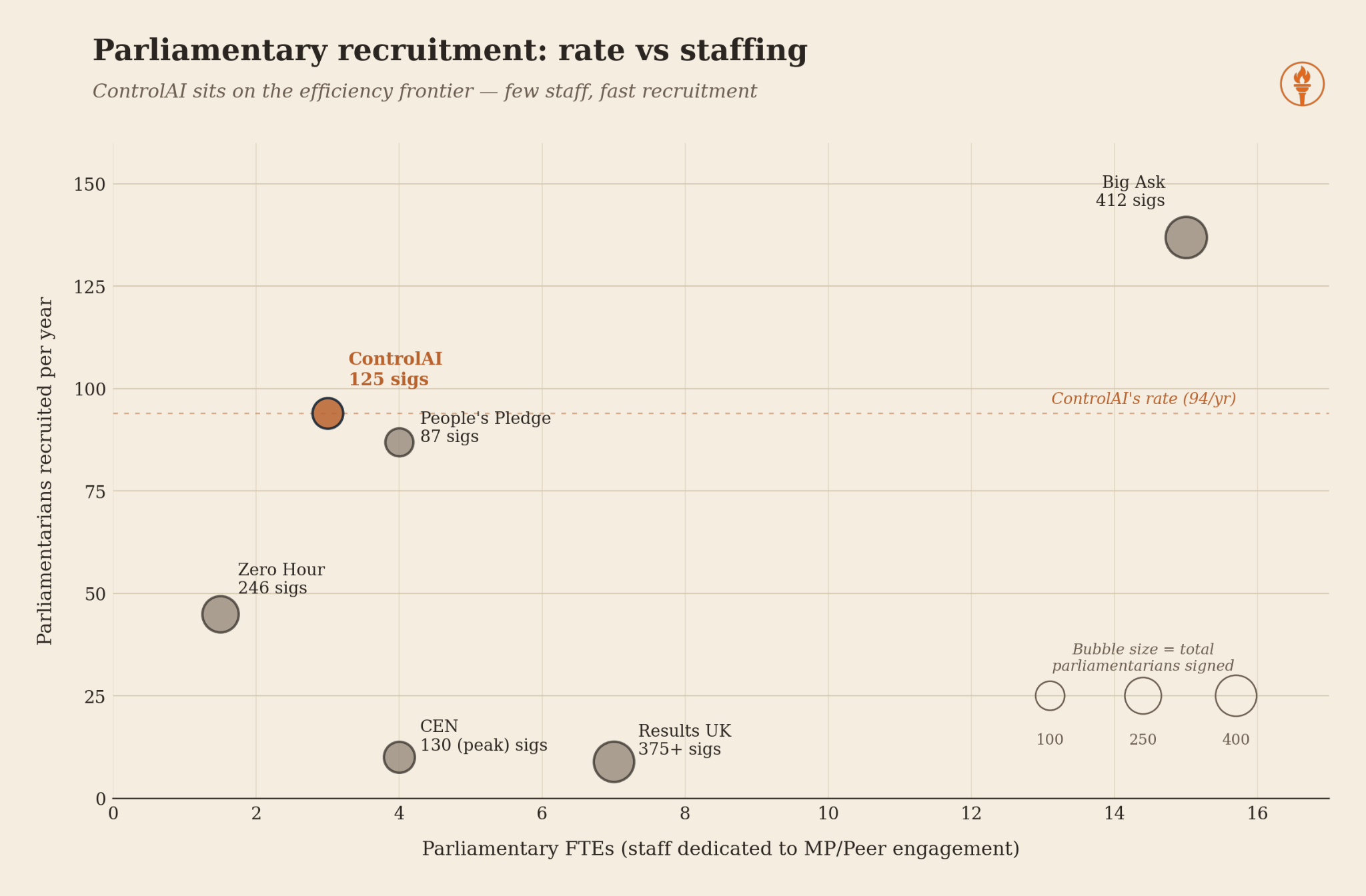
ControlAI had a team of 9 to 15 full-time employees over the course of 2025-early 2026, approximately 3 of them worked directly in parliamentary advocacy focused on the UK. They also started with 0 parliamentary contacts and no insider help whatsoever.
Their approach was described as "funnel based". It contained the following steps:
Two House of Lords debates on Superintelligence and extinction risk have followed. An additional debate on the risks from advanced AI systems has been approved by the Backbench Business Committee, to take place in Westminster Hall. In addition, on 18th March 2026 a cross-party group of MPs tabled amendment NC12 to the Government's Cyber Security and Resilience (Network and Information Systems) Bill. Drafted with ControlAI's input by ControlAI supporter Alex Sobel MP, the amendment ("Last-resort powers in respect of data centres and AI models") would create a statutory route for the Secretary of State to direct the shutdown of data centres or AI systems in an "AI security or operational emergency" ( defined as a situation posing reasonable likelihood of large-scale critical infrastructure disruption, serious national-security degradation, or severe large-scale harm to human life). It would also require the Secretary of State to write a report on the "causes and potential causes of AI security or operational emergencies", which must include consideration of the development of superintelligent AI as one such national security threat. The amendment was co-sponsored by 11 MPs across Labour, Conservative, and Plaid Cymru, including ControlAI signatories John McDonnell MP and Sir Desmond Swayne MP. As of writing, the House has not yet considered the amendment, but its tabling marks the first time the UK Parliament has considered binding statutory powers framed around catastrophic AI risk. The amendment is also the first piece of proposed UK legislation to recognise superintelligence as a national security threat, and was covered in national media.
As mentioned earlier, beyond the direct briefing method by ControlAI's members, there's also a grassroots approach of providing tools for common citizens to contact lawmakers and journalists. ControlAI have a 200 thousand plus mailing list, about 25% is UK based, the rest is US based. The UK subscribers have sent over 10 thousand emails, with estimated direct impact of ~5-10 parliamentarian supporters signing the ControlAI campaign statement from these emails alone. This mailing activity grew mainly in the second half of 2025 and does not explain the bulk of parliamentary recruitment. It should be noted, though, that it's a growing part of the process.
We also note that ControlAI have been actively meeting and briefing parliamentarians in Canada (where one member of staff has met 100 lawmakers in ~9 months, resulting in multiple hearings on superintelligence risks, and a new campaign to prohibit the development of superintelligence that we don't cover here), the US (where ~1.2 FTEs have met and briefed 18 Members of Congress and staff at >90 congressional offices in ~9 months), and in Germany. As ControlAI's work in these countries is at earlier phases we do not gather comparators for this activity in this first report.
The UK has a long history of organised parliamentary advocacy that sought to garner support from elected officials, which we use as comparators for ControlAI's effectiveness. By comparing ControlAI to these historical cases, we can start to establish rough base rates for how fast parliamentary coalitions form.
We selected eight comparators, chosen for variety across several dimensions: method (grassroots vs direct lobbying vs insider organising), scale (from zero-budget MP factions to large NGOs with hundreds of staff), political context (climate, foreign policy, constitutional reform, environment), and the nature of the commitment asked of parliamentarians. All comparators constitute well known and relatively successful campaigns. Taken together, they provide a reasonable picture of what successful parliamentary engagement looks like in the UK.
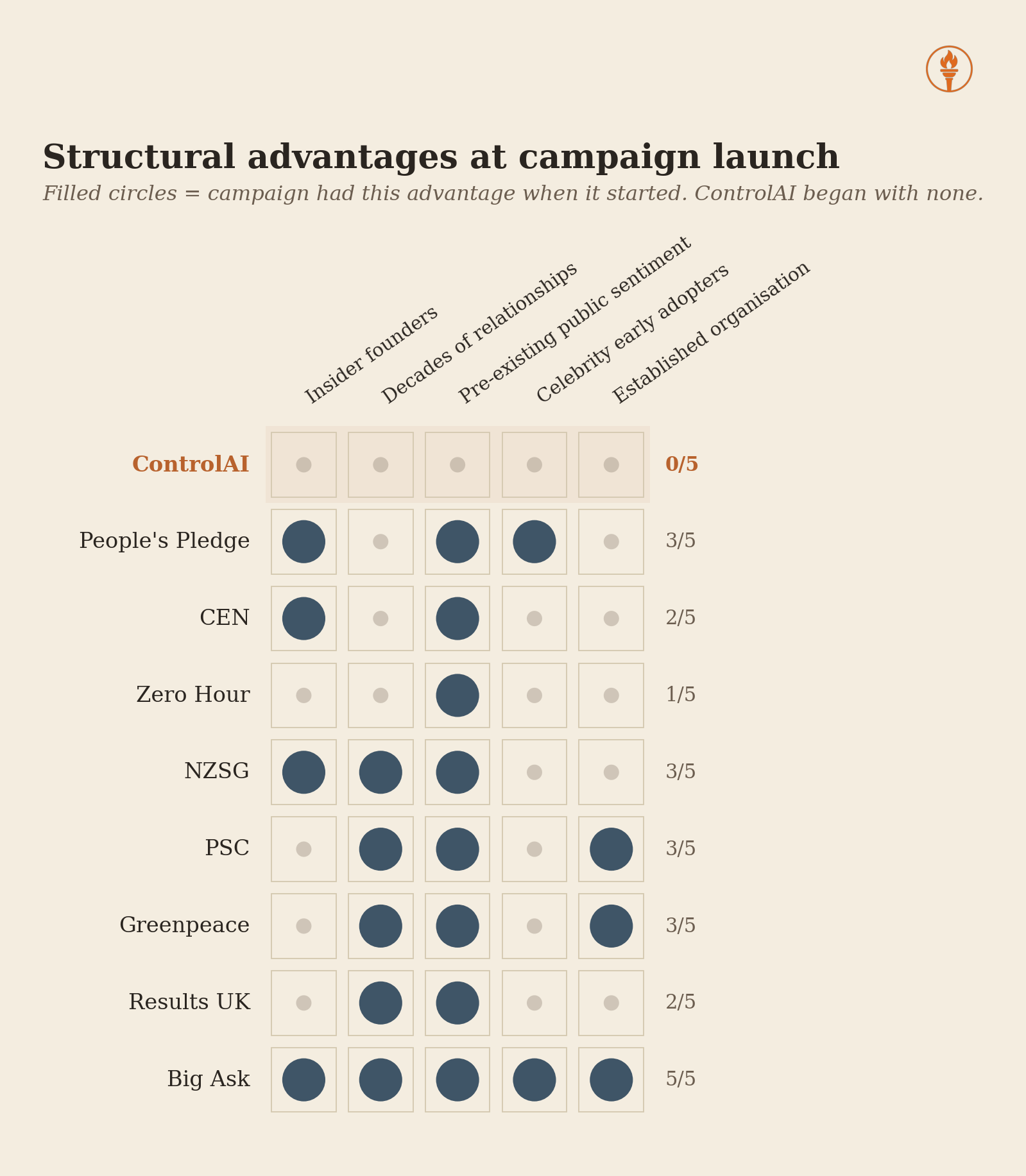
The campaigns span different decades, different political climates, and different levels of public salience. What "counts" as a parliamentary endorsement varies across campaigns, from low commitment asks such as signing an Early Day Motion (EDM: essentially a parliamentary convention) to high commitment asks such as publicly backing specific legislation (potential career risk).
The eight comparators are:
The table below compares these comparators and ControlAI.
| Campaign | Lawmakers signed | Duration | Total staff | Parliamentary FTEs | Method | Ask level | Issue novelty | Specific ask a "first"? |
|---|---|---|---|---|---|---|---|---|
| ControlAI (2024) | 125 parliamentarians | 16 months | 9-15 | ~3 | Direct briefings | High | Very high | Yes |
| Zero Hour (2020) | 246 parliamentarians | ~5.5 years | ~15 (mostly voluntary) | ~1-2 | Constituent pressure | High | Very low | No |
| People's Pledge (2011) | 87 MPs | ~12 months | ~4-6 | ~3-5 | Public pressure + constituency referendums | Moderate | Very low | No |
| Conservative Environment Network (2010) | 80 current (130+ peak) | 15 years | 11 | ~3-5 | MP network-building | Low | Low | Partly |
| Net Zero Scrutiny Group (2022) | ~50 documented | ~3 years | 0 (MPs only) | ~0.5-2 informal | Open letters | Medium | Very low | No |
| PSC Councillor Pledge (2025) | 1,152 councillors | ~2 months | ~12-18 | ~1-3 | Digital sign-up + activist network | High | Very low | No (new tactic, established cause) |
| Greenpeace Climate Vote (2023) | 223,737 voter pledges | ~12 months | 300-500+ | Unknown | Mass door-knocking | Very low | Very low | No |
| Results UK (1986) | 375+ across APPGs | 40 years | 23 | ~6-8 | APPG secretariat + events | Low | Low-moderate | Partly (citizen lobby model) |
| Friends of the Earth Big Ask (2005) | 412 EDM signatures + legislation | 3.5 years | ~120-150 | ~10-20 | Mass letter-writing + coalition | Moderate-High | Low (issue) / High (ask) | Yes - world's first binding national climate law |
For ControlAI specifically, the novelty entry reflects that at launch there was no prior legislation, no parliamentary consensus, little public recognition of the possibility of superintelligent AI, and little public pressure to address extinction risk. Only one sitting legislator anywhere in the world (US Rep. Ted Lieu) had signed a statement on AI extinction risk. Each of the other comparators launched with substantial prior recognition of the issue (see the discussion and appendix for details).
We give more details on the comparators below.
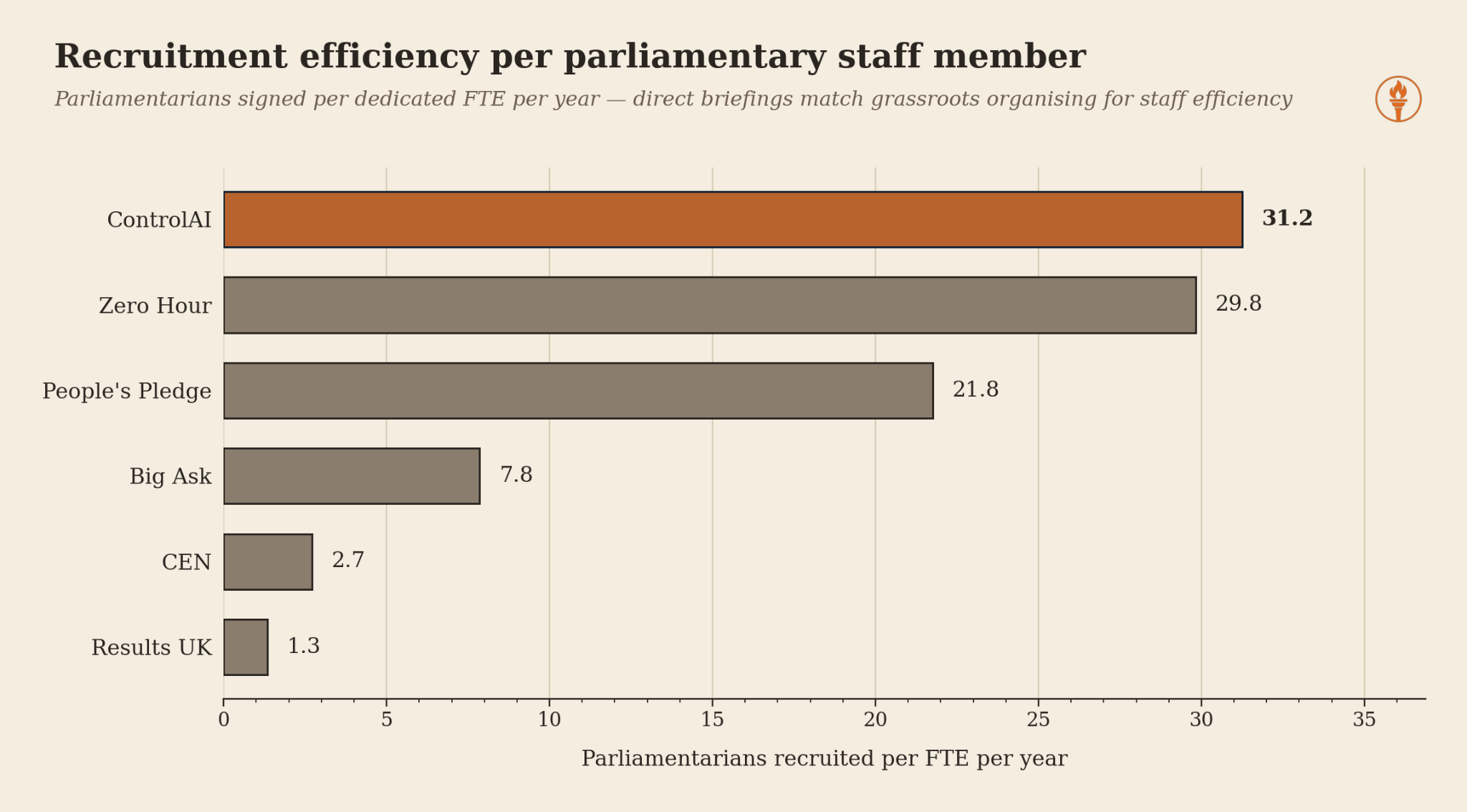
Zero Hour is probably the closest structural analogue to ControlAI's campaign, being a small campaigning organisation getting parliamentarians to publicly back a specific position. Their Climate and Nature Bill campaign won support from 192 MPs and 54 Peers since 2020, backed by 75,523 registered grassroots supporters. This works out to ~45 parliamentarians per year. Zero Hour launched after Parliament had already passed the Climate Change Act, adopted a net zero target, and declared a climate emergency.
Friends of the Earth's Big Ask is widely considered the gold standard for UK advocacy. Launched in May 2005 with Thom Yorke, it mobilised around 200,000 people to write to their MPs, built a coalition of 100+ NGOs under the Stop Climate Chaos banner, and achieved 412 EDM signatures (64% of all MPs). The Climate Change Bill appeared in the Queen's Speech just 18 months after launch, and the Climate Change Act received Royal Assent in November 2008. EDM signing is a low-commitment parliamentary action, essentially adding your name to a list. The Big Ask is, however, the strongest novelty comparator: while climate change was broadly accepted by 2005, binding national climate legislation was a world first. The Big Ask had novelty in its ask even if not in its issue.
The Conservative Environment Network built a caucus that peaked at 130+ Conservative MPs (around 37% of the parliamentary party) after 15 years of work. CEN was founded by Conservative insiders with deep existing relationships and asks only that MPs affiliate with a set of broad environmental principles. It launched two years after the Climate Change Act passed with near-unanimous cross-party support. The proposition that Conservatives should care about the environment was already mainstream. The drop from 130+ to 49 after the 2024 election shows the fragility of single-party organising.
The Net Zero Scrutiny Group took a different approach entirely: beginning in 2021, sitting Conservative MPs organising open letters to The Telegraph opposing net zero policies. They had no external staff, but had a shared media infrastructure from the Global Warming Policy Foundation (which had spent 13 years building the institutional case against climate policy). They gathered around 50 documented signatories over three years.
The People's Pledge was launched in March 2011 to campaign for an EU referendum, it gathered 87 MPs in about 12 months. The People's Pledge was chaired by John Mills, a wealthy Labour donor and businessman. It was directed by Mark Seddon, a former Labour NEC member with deep political networks. Boris Johnson signed within ten days of launch, giving it enormous momentum and media coverage. Pre-existing Eurosceptic sentiment was widespread and the press was sympathetic, with YouGov polling showed 61% public support for a referendum before the campaign even launched and 81 Conservative MPs defying the whip to vote for a referendum in October 2011. However, the People's Pledge did contribute to constitutional change, a much bigger success than ControlAI has achieved to date.
Greenpeace UK's Project Climate Vote shows what massive resources buy in public mobilisation: 50,000 doors knocked, 223,737 pledges, 14,000 phone calls, 2,500 trained volunteers. Yet direct parliamentary engagement was modest (10,315 emails to candidates). Converting broad public engagement into specific parliamentary commitments is difficult. ControlAI's direct parliamentary engagement sidesteps this conversion problem entirely.
Results UK is structurally the most similar to ControlAI: a small professional advocacy charity doing direct parliamentary engagement, with a parliamentary team roughly twice the size of ControlAI's (~6 FTEs vs ~3). After 40 years, they count 375+ parliamentarians across their APPG memberships. ControlAI reached 125 specific statement signatories in 16 months with no insider connections. APPG membership is also a much softer commitment than signing a named policy statement, and Results UK's influence extends well beyond membership headcounts into sustained policy relationships built over decades.
The PSC Councillor Pledge demonstrates what a 40-year-old organisation with a large activist base can achieve under favourable conditions: 1,152 councillors signed in just two months during the Gaza conflict, with approaching elections adding urgency. The PSC could draw on decades of council motions on Palestine, 300,000+ marchers in London, and deep organisational roots across the UK. The mechanism was low-friction (an online form). The engagement rates are surprisingly close: PSC reached ~6.8% of all councillors, ControlAI ~8.9% of all parliamentarians. But ControlAI did this at a harder level of government on an issue with no comparable public mobilisation or institutional history.
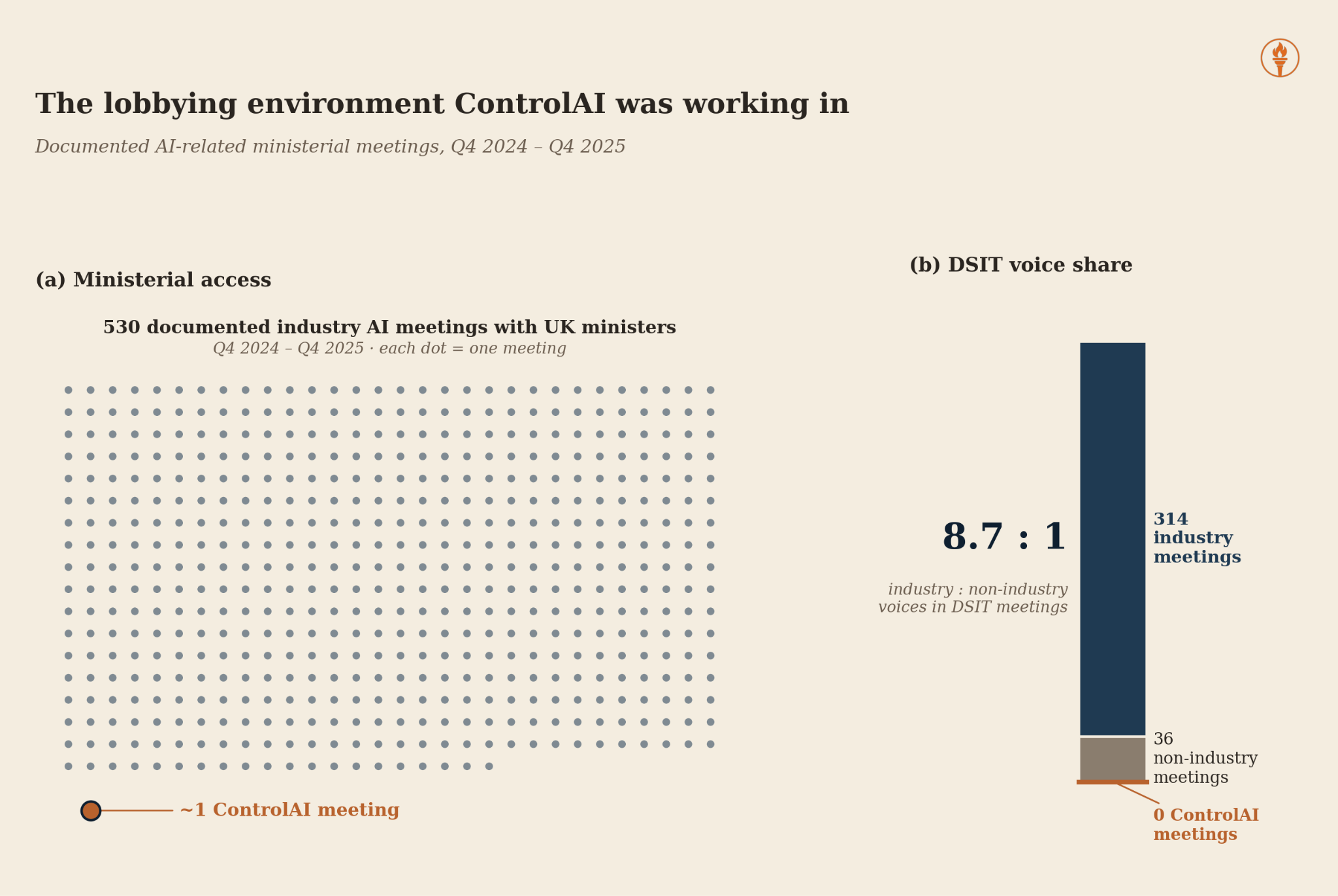
The comparator analysis above considers what other UK campaigns have achieved, but not what ControlAI was working against. Across the same sixteen-month window in which ControlAI was briefing parliamentarians, the AI industry was running an extensive, well-resourced lobbying operation aimed at the executive branch of UK government. UK government ministerial transparency disclosures and the UK Register of Consultant Lobbyists for Q4 2024 through Q4 2025 are in the table below:
| Metric | AI industry / pro-AI | ControlAI |
|---|---|---|
| Documented AI-related ministerial meetings, all departments | 530 (lower bound) | ~1 |
| Documented AI-related ministerial meetings at DSIT alone | 314 (~5 per week) | 0 |
| Industry vs non-industry voices in DSIT AI meetings | 8.7 : 1 | - |
| Google/DeepMind DSIT meetings vs all non-industry voices combined | 37 vs 28 | - |
| Distinct organisations with documented ministerial access | 50+ | 1 |
| Primary targets | Ministers, PM, Chancellor, senior officials | Backbench MPs and Peers |
| Disclosed consultant lobbyist relationships | 12 AI orgs with named lobbyist firms (often multiple per company, e.g. Meta with 3, Microsoft with 3, Google with 2, Amazon with 3); other major labs additionally lobby via in-house teams not captured in the register | 0 (ControlAI lobbies directly) |
| Staff dedicated to UK government engagement | In-house teams across 50+ AI organisations plus external consultant lobbyists | ~3 FTEs |
Note that this compares ministerial access (where industry concentrates) with parliamentary briefings (where ControlAI concentrates), so is not a true like-for-like comparison. The figures are also a lower bound as no data is available for in-house government affairs activity, MPs' meetings (which are not disclosed), special adviser meetings, and informal channels. Ministers meeting AI companies is not, on its own, evidence of undue influence, as meeting stakeholders is part of the job. However, the data give an indication of the balance of voices being heard. The executive-branch conversation about AI policy is running roughly nine industry voices to every one non-industry voice at the lead department, so the political environment ControlAI is trying to shift is actively populated by a substantially better-resourced competing narrative.
Our analysis here has several limitations:
On the narrow question of parliamentary recruitment speed, ControlAI's performance is at or near the top of our comparator set, and they achieved this with fewer resources and fewer advantages than any comparable campaign. The direct briefing model, a core tenet of the Direct Institutional Plan, seems to be genuinely efficient for building parliamentary coalitions across party lines. The funnel ControlAI describes (outreach → briefing → sign-up → public statement → parliamentary action) is also producing its later-stage outputs: two Lords debates and, in March 2026, a cross-party amendment that would create statutory powers for catastrophic-risk shutdown of AI systems. While much remains to be seen about whether this parliamentary support translates into enacted policy, we think that greater funding for ControlAI and the Direct Institutional Plan would provide an excellent return on investment. The success of ControlAI's application of the Direct Institutional Plan in both absolute terms, and relative to our comparator set, and the plans ControlAI has laid out for scaling their current approach with further funding, we think suggest that further funding for ControlAI is among the most cost-effective interventions currently available to those who take seriously the prospect of human extinction from artificial superintelligence.
In future posts we plan to assess other aspects of the Direct Institutional Plan and ControlAI's work, such as their effectiveness in raising public awareness, briefing journalists and content creators, and establishing grassroots movements. We also plan to examine the experience of volunteers and other organisations applying the DIP, including through Torchbearer Community's training programme, as a way of separating the method's intrinsic effectiveness from ControlAI's particular implementation.
We welcome your feedback on our work here so far! Further details on our sources for this article are given in the appendix here.