Thank you for this and hope this will generate more discussion.
Have you considered the role technology, especially AI can play in this? Can some of what regrantors do be replaced or supplemented? AI is capable of processing large amounts of data and doing it on a ongoing basis, something that can be very, if not prohibitively costly for current donors and regrantors, especially at smaller scale. It can help achieve much more granular allocation: smaller projects and initiatives, individual needs, continuous rather than cyclical donations.
Shortening the distance between the donor and the ultimate beneficially can help emotions and ego driven giving become more effective. Perhaps a limited gain for a donor like yourself, but potentially a huge impact overall.
I've been working on a small project in that space, aiming to create a layer Ai agents can apply themselves to to identify, assess and donate potential recipients. zooid.fund would be interested to know what you think
This document goes through key decisions donors face, based on my experience as a donor. Nothing here is authoritative but I hope it resonates with some of you.
TL;DR
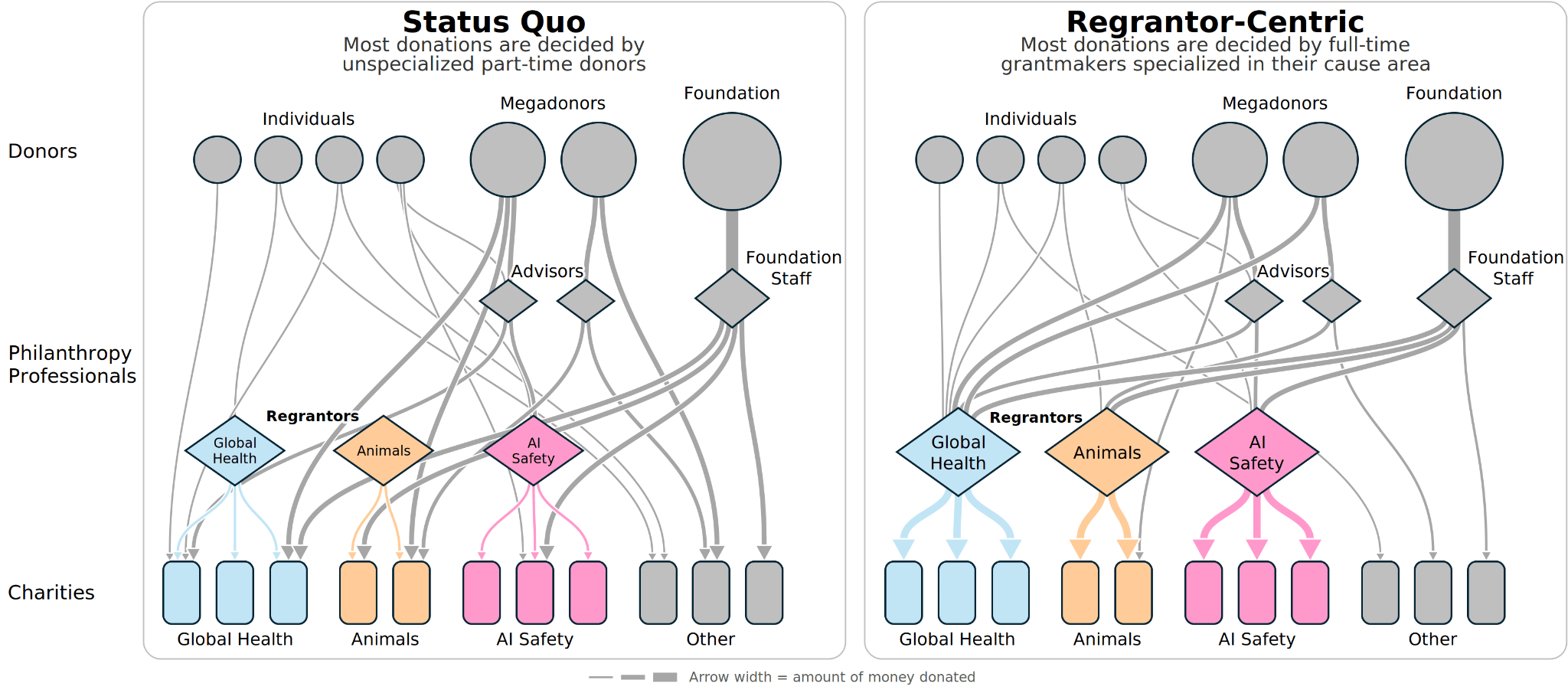
My central thesis is: donors should delegate most of their donation decisions to professionals. That is, rather than picking charities, you should think of your task as picking regrantors who will use their greater time and expertise to pick the charities. (C1)
Some of my other main claims, with links to relevant sections:
You can donate badly (get much worse results than you could have) without realizing it. This makes it important to follow best practices, like delegating to professionals. (C2)
If you do make sizable donations yourself, why not get a professional’s feedback first. (D2)
A key criterion when assessing a regrantor is their track record of verifiable impact. (C4)
It’s only human to find “objective” reasons your friend’s charity is great, but we owe it to the primary stakeholders of our giving - the beneficiaries - to avoid that kind of bias. (C4)
A fun thing about good donations is that even if you go broke later - you accomplished something. (E2)
Image created with PowerPoint + the much-lamented Fable 5
Target audience
Really anyone who has money to donate and wants to squeeze as much impact out of it as they can, but especially those who see donating as their primary path to impact (C3, E1).
About me
I’m staying anonymous for personal reasons but I’m a working professional who’s been making donations throughout my career, from tiny amounts to millions of dollars. Section D below covers the main causes I’ve donated to. You can leave questions or comments below or email me at [email protected].
Acknowledgements
Thanks to Elliot Teperman (@ElliotTep) for encouragement and major editorial input.
B. A checklist
Every donor’s situation is different, but this list is a good starting point:
Figure out (roughly) how much you expect to donate, how soon. (E1)
Decide how much time to put in. Eg, retirees may have more time for donation research than those still at demanding jobs.
Decide which cause areas, and how to split your donations between them. Can involve personal factors, conversations, and public resources on cause prioritization. (D)
Choose which regrantor(s) for each cause area. Again from consulting a mix of contacts and research, and perhaps conversations with candidate regrantors. (C4)
Make the donations, including thinking through logistics like timing, taxes, and whether to use intermediaries like DAFs. (E6)
Hold the recipients/regrantors accountable: ask for their goals in advance, get updates on where the money went and what it achieved, compare responses to their stated goals. (E3)
C. Use regrantors
1. Why
Donors should delegate their donation decisions for the same reason we delegate other tasks like plumbing, surgery, legal contracts, car repair, house design, or tax filing: because specialists who do the work full-time do it better than hobbyists. I think of making your own donation decisions as “stock-picking”, and stock-picking as an irresponsible way to invest your savings.
There is a balance here. Many skills are worth non-specialists getting some basic familiarity with: cooking, driving, financial planning, etc. Arguably donating belongs on this list. And many donors have career skills and experience that can give them some insight on donations.
But in my experience, most donors lean on specialists too little, not too much. Too many conversations between donors and donation professionals evoke a hobbyist enthusiastically describing their ideas about how to do heart surgery, or drive a racecar, to someone who does it for a living.
2. Weak accountability
One might ask: if donation professionals get better results, why don’t donors rely on them more? A key answer is that philanthropy suffers from weak accountability: bad philanthropists don’t feel the pain of mistakes the way bad entrepreneurs or bad drivers do, the feedback loops aren’t there. This is a well-known problem: see, eg, Holden Karnofsky, Ken Stern and Kevin Starr. The upshot is that since mistakes are less obvious, extra diligence is needed to avoid them.
3. When making your own donations still makes sense
There’s no need to be absolute about these things.
Scale matters. Cooking small meals is a good skill to have, but a meal for 1,000 people is a task for a professional. If you try it yourself you’ll learn some things, but waste time and money and get a worse result. Similarly, there’s little harm in donating a few bucks to your friend’s charity. But anyone doing significant giving should aim for the bulk of their donations to be assessed rigorously, which I argue means by someone else.
I believe some of my most impactful donations were in fact “stock picks”. But:
These came after spending years getting familiar with a donation area.
They were only a fraction of my total giving. I’m more comfortable taking gambles knowing that the majority of my donation budget is in the hands of pros.
Before writing a significant check, ask yourself: am I really likelier to spot and accurately vet these opportunities in my spare time, than someone I could pay to do it full-time? My thesis is: usually not.
4. Which regrantors?
Without going into specific recommendations, some general comments:
Terminology: by “donation professionals” I mean anyone whose work involves weighing donation opportunities more or less full-time. This includes roles like:
Regrantors (aka funds), who pool funding from multiple donors large or small, and use it to make their own grants.
Philanthropic advisors, who advise different donors one-on-one.
Foundation staff, who work for a specific large donor’s foundation.
Of these three, I’m generally a fan of the regrantor/fund model, because:
They’re accessible to the broadest range of donors, including smaller donors.
One-on-one advising is inefficient: every hour an advisor spends with a single donor is an hour they could have spent researching opportunities applicable to many donors. Pairing donors with individual grants becomes a complex matchmaking exercise. By contrast, the pooled fund model lets many funders fund many grants without the communication overhead.
It can be helpful to have an advisor learn your specific constraints and interests, answer questions and make introductions. But - hot take - I see good donation opportunities as mostly objectively good rather than “good for donor x”. Treating donations as a matter of preference, like decorating your home, makes philanthropy donor-centric when it should be beneficiary-centric.
Track record. What past grants have they made, how did they decide on them, what impact resulted, what other grants did they reject? What grants have they made that didn’t work out (any regrantor should have some), and what did they learn? I’ve observed some tendency for donors to put too much weight on a regrantor’s mission statement - even on the fund’s name - and too little on their past concrete results.
Most regrantors specialize in some cause area or theme. The range and quality available depends on the area. In global health GiveWell has a strong track record and there are other good options too. Animal welfare also has several capable regrantors now. But areas like AI safety or biosafety are more challenging - fewer regrantors, they disagree more, their track records and methodologies are harder to assess. And in many cause areas you may not find a credible regrantor at all. But I expect more of these gaps to be filled as the regrantor/fund model gains traction.
Personal factors can influence which regrantors are most suitable for you. So if you work in biotech, that may help you assess a biosafety regrantor’s work, and keep you motivated. And experience will equip you to contribute more to grantmaking decisions. The less experienced you are, the more sense it makes to stay out of the way.
Be careful about recommendations from 1. friends and 2. those who seek you out. It’s dangerously easy to convince yourself that your friend has great advice, but you would research a friend’s car recommendation before buying, right? I think of donation decisions as a responsibility I’ve been entrusted with, and myself as a steward. The key stakeholders are the beneficiaries of the charities’ work and serving them requires staying objective and skeptical. I picture a distant niece counting on me to pick a school for her. I wouldn’t send her to a school just because my friend went there or they mailed me a glossy brochure. I’d do some research.
5. Centralization pros and cons
Funding being centralized in one or a few dominant megadonors has well-known drawbacks: lack of diversity, any mistakes they make are magnified, important areas go unfunded. But a decentralized landscape has drawbacks too. As with investments, there are always donation opportunities that sound intuitive but don’t add up (eg, crisis response to the latest natural disaster). Sometimes the reason it knocks on your door is that all the more sophisticated donors sniffed out its flaws. The more funding is directed by amateurs, the more these false opportunities get filled. But these downsides of small donors are mitigated when they donate to good regrantors.
D. “Choosing” cause areas
1. Don’t?
First of all, just as you shouldn’t stock-pick charities, there’s a parallel argument that you shouldn’t stock-pick cause areas. The choice of high-level cause areas is even more complex than the choice of specific charities: all the more reason to delegate it. This is what Cari Tuna and Dustin Moskovitz have so admirably and successfully done.
Unfortunately, this complexity is also a challenge for donation professionals. You can find thoughtful regrantors who specialize in global health, or animal welfare, AI safety, etc. But so far almost none specialize in the question of how to divide your giving across all the possible areas. So unless you can build a team of experts like Cari and Dustin did, donors are mostly stuck making their own cause area allocations.
2. Resources
My goal here is to help donors with their process rather than to proselytize for any particular cause area. That said, some thoughtful starting points on cause selection:
Rethink Priorities are one of the few groups who’ve taken on the ambitious task of recommending how to allocate funding across cause areas, with their cross-cause fund and donor compass.
Charity recommenders/funds with multiple cause areas:
Coefficient Giving’s 14 funds. (Though it would be helpful to see a ranking of these by budget.)
Founders Pledge’s five funds: climate, global catastrophic risks, global health, long-term future, rapid response.
EA Funds: animal welfare, EA infrastructure, global health, long-term future.
Various articles discuss the ITN framework: importance, tractability, neglectedness.
Conversations with professionals are a natural next step beyond online resources:
Philanthropic advisors, regrantors.
Sophisticated grantmakers are often sitting on opportunities they like but for various reasons are unable to fill: urgency, PR, constraints from their donor, conflict of interest, etc. Many of my best donations have come this way.
Peers at work or elsewhere may be facing similar decisions, and share trust and context. Donating is complex and time has made me a strong believer in comparing notes with peers rather than trying to go it alone.
And, in 2026, doing research without LLMs is like writing on a typewriter.
You may also find cause areas you consider promising that aren’t on the lists above, eg: democracy/governance (US and elsewhere), human rights and civil liberties, science and innovation, war prevention, “meta” work like cause prioritization itself, and more. Donating is a sufficiently open problem that it’s reasonable to experiment a bit. What’s less reasonable is to give large amounts to more adventurous causes, without even running them by donation professionals. Getting a pro’s take is easy, you can reject it but at least hear them out.
3. Effective altruism
Is the effective altruism (EA) movement good? Or bad? This endless reductive debate strikes me as tangential to the practical donor decisions I’m discussing here. People have been donating to help others, and trying to get the best results they could, since long before the term effective altruism was coined in 2011. You should judge my advice and others’ by whether it makes sense, independent of any particular movement or catchphrase.
Several of the issues and organizations that I donate to and assess as high-impact come from outside of traditional EA. There’s no need to pick a side on these things.
That said, empirically, many of the resources and organizations I’ve found useful and linked to in this doc are associated with EA. I’ve benefited from their work and I’m grateful to them.
E. Other giving decisions
This section goes through some other questions donors should give some thought to, with my anecdotal takes.
1. How much to give, when
If you’re able to donate, you’re able to save. Earlier in my career I somewhat haphazardly donated a portion of my income but also saved some. Later, when career-switching or starting new projects, those savings turned out to be crucial! I see some people donating every unspent dollar - I don’t think this makes sense.
Saving is extra important for those operating with a slim buffer: early career, people with dependents, health risks or costs, or just on lower incomes.
In particular, if you have a meaningful, impactful job that doesn’t pay much - don’t put too much money or time into your donations. I’ve seen young donors agonize over how to divide a $500 donation budget between 20 different funds/charities and this is just overthinking. We each have our path to impact: if yours is your work, accept that and give it your focus. Thinking hard about donations is most important for those of us for whom it will be the main impact we have.
This is related to a rule of thumb I believe in strongly: your net impact is dominated by the good you do, not the bad you don’t do. This is why “harm-reduction” practices like recycling, veganism and frugality tend to be low-impact. Most people’s greatest impact will come from identifying something they can actively do (a job, side project, donating) that improves the world, and staying focused on doing it as well as they can.
On the question of how to divide your energy between a) working (to make money to donate), b) donating (including the research to decide where) and c) doing work that’s directly impactful: there is no short answer here, we need people doing all three. But a hot take of mine is that our society greatly underrates donating as a path to impact, or even (hotter yet) good donations will always be the most practical route to impact for most people - there just aren’t enough high-direct-impact jobs out there for them to be a feasible option for the majority. Having a normal for-profit job and making high-impact donations is a great way to contribute, and if more people did this a lot of important underfunded work could scale up. Or in brief: the more people do a) and b), the more funding for c).
People warned me about the risk of lifestyle creep: you may start out a for-profit career with the goal of donating, but you hang out with well-paid colleagues, pick up expensive habits, have a family and maybe in the end donating falls off your priorities. It’s certainly true that I spend more on myself than I did in my idealistic youth. But on the whole I haven’t found this warning to be true.
The greater risk I’ve seen is not losing interest in donating, but getting complacent about holding your recipients accountable, and yourself. For every cartoon villain who betrayed their ideals there’s a flock of philanthropists enthusiastically funding projects that just aren’t achieving much. Weak feedback loops (section C2) mean that we must stay tough on ourselves about whether we’re donating well, because no one else will be.
Another general principle I believe strongly: a lot of problems aren’t due to bad intentions, but to poor conversion of good intentions into positive outcomes. Getting results is tricky and focusing on how hard you’re working or how much you care, can easily become distractions from the all-important question of whether you’re actually making a difference.
An underrated downside of low-impact donations is not just that they fail to achieve results, but that they’re depressing for the donor. Pouring money down the drain is demotivating; knowing your donation enabled a successful project feels great.
But, many good donations won’t produce tangible, satisfying results for the donor. Preventing anonymous strangers from getting sick “statistically, in expectation” is intangible. Helping prevent a catastrophic incident even more so. Getting animals moved from horrific conditions to only somewhat less horrific conditions, doesn’t feel great. A lot has been written about this (eg, Yudkowsky): my own experience is that tracking your donations’ impact helps to ensure the wins feel like wins and the losses like losses.
Regrantors probably do need to work on strengthening emotional feedback loops back to donors. Ten donors who give to a good regrantor who funds ten projects, typically are each having more impact than ten donors who each give to one project: they just don’t feel it as viscerally, by default. This is a gap regrantors can tighten via evocative communication, for example, of the sort: “Donors who gave us >$10k funded projects like x; >$1k, projects like y.”
A final note on motivation. Like any donor, my giving capacity depends on my finances. Some years I have less to give. Someday I may go broke. If so it will be a real consolation that I made donations when I could and some that got results. In this strange way - as an “emotional hedge” against financial loss - giving can actually boost your for-profit career, freeing you to take financial risks in the knowledge that even if you lose it all, you still had an impact. It has for me.
3. Engaging with recipients
Early on my leaning was to try to identify good charities, give them my money, then get out of the way. I had an image of the annoying donor barraging busy staff with time-consuming questions (and with more experience I can confirm that these donors are indeed a thing). But I’ve come to recognize some benefits of staying more engaged:
Motivation (#2 above). Seeing the work and its results is motivating.
Education. Learning more about the organization, the work they do, who does what, strategy. Understanding things like this makes you a better donor.
You can also pick up some useful signals: don’t infer too much from one interaction or person, but I’ve certainly had interactions with staff that updated me to be more or less positive about an org. (These interactions are more informative if you’re not a known major donor: see #4, anonymity.)
Accountability. When you ask this year what their goals are, then next year whether they met them, this informs you, but also creates healthy accountability for them.
This applies to regrantors as well. In the for-profit analogy, most investors should mostly invest in professionally run funds rather than in individual companies. But you should still research which fund to invest in, kick the tires, and be willing to switch if another gives better returns.
There are also ways to get involved that not only help the donor, but also the org: volunteer, offer professional services, connect other donors (a great way to help), serve on the board.
4. Anonymous vs public
Projects like the Giving Pledge and Giving What We Can make a case for being public about your giving: it can help motivate others. Plus - it’s honest. The whole premise of this document is that donating involves many confusing decisions. Confusing and important decisions are worth discussing with others.
Downsides of making your donations public include involving your ego (which can manifest in insidious ways), and the risk that people - recipients, would-be recipients, friends - will treat you differently, consciously or unconsciously. James Özden (@JamesÖz) has a good recent piece about this.
It’s a personal decision. Just remember that:
You can go from anonymous to public. You can’t go the other way. But,
Wearing a mask carries the risk of having it removed. No mask, no such risk.
5. Impact investing vs donating
Some philanthropists pursue impact by investing in for-profit companies rather than nonprofit charities. A lot of problems can be solved by for-profits, and often more efficiently than a charity could. But I don’t do impact investing, for two reasons:
The basic dichotomy that either an investment opportunity a) is profitable - in which case it should be attractive to for-profit investors, or b) isn’t - in which case it amounts to a nonprofit donation anyway. I aim to deploy my money where it’s most needed and that’s unlikely to be where regular investors can profit.
A lot of important work will never be profitable. Eradicating diseases only common among the global poor isn’t profitable. Abused farmed animals can’t pay you for anything. For-profit work can be high-impact, but only a market fundamentalist would insist that all high-impact work can be structured so as to turn a profit.
6. Giving mechanics
Practical details can materially affect outcomes for both recipients and donors. Eg:
Tax considerations! These depend greatly on your situation, jurisdiction, source of income, etc, but I can attest from experience that screwing them up can be a big deal. At a minimum, do some searching (eg: this post) and check with LLMs - but for many donors it will make sense to talk to a tax professional. Two points I’ll flag:
Whatever you do, don’t sell an appreciated asset (eg, a stock that’s gone up) and donate the proceeds - this leads to a totally self-inflicted capital gains tax! (For most US donors, anyway.) Instead, donate the appreciated asset itself.
Make a will. For a serious donor, dying without a considered estate plan is a major blunder. The default way the law distributes your assets is extremely unlikely to resemble what you’d want and a basic will isn’t hard.
DAFs are a popular tool for managing your donations: I’ve found them very helpful. (They can also be used to make anonymous donations.) Just beware of the DAF warehousing problem: at some point you really do need to deploy the money.
Services like Foundation Source are another useful resource, for those who want more control over the assets than a DAF provides, but aren’t at the level to set up their own fully staffed foundation.
7. Tip your services
If a service is helping you make significant donations - tip the provider. Otherwise you’re counting on others to do it, and I’ve repeatedly encountered useful resources that are going underfunded. Examples:
Most obviously, if you act on recommendations from a philanthropic advisor, pay them. If you’re not sure how much, just ask them, there are conventions about things like this.
If donating via a regrantor, above a certain amount it’s appropriate to include some operational funding for them. My whole argument is that good regrantors play a key role: their budgets have to be covered from somewhere.
Excessive overhead is a real risk and I have seen it. But what I see more often is widely useful resources that everyone seems to be counting on others to fund.
If you’re influenced by a research piece, consider chipping in to the org that produced it.
If you make a donation through a third-party website - eg, Giving What We Can’s or GiveWell’s - include a tip for the site.
Tips can also take other forms. Recommending an org to other donors, sharing their fundraisers, sending a strong hire or board member their way, praising a staff member you had a good experience with to their boss - lots of ways to give back.
8. Influencing others
My instinct has always been: if you want something done, don’t whine about how others (government, the rich) aren’t doing it - do it. Or do your part anyway. This is the mindset that led me to try to make money and donate it.
But time has tempered my conviction in this approach. The reality is that there are people with much more money than me, better connections, their hands on levers I’ll never touch. Occasionally I even meet some of them. What if something I said could healthily influence their decisions a smidgen? Might that produce more impact than my own relatively small donations?
I don’t know, and I’m still wary of where the effort to influence people can take you. Making friends with powerful people, flattering them, laughing at their jokes… May it never come to that.
But it seems increasingly plausible to me that engaging with other decisionmakers may be a significant part of my opportunity for impact. Hence, among other things, this document.
F. In closing
Giving well is hard. Every grant you fund means a thousand more you declined. In a few years we’ll probably see a bunch of mistakes we were making. In the meantime, the weak accountability problem means we can underperform badly and still feel like we’re doing great.
Our main failure modes as donors are when we let it become about us or our pet theories. Our beneficiaries are counting on us to resist that: question ourselves, get outside feedback, and delegate to professionals when it makes sense. In the long run, the ego boost of calling the shots doesn’t compare to the satisfaction of seeing a healthy grantmaking process bear fruit.
Epistemic status: Speculation from two decently informed advocates armed with anecdata.
Note on process: After having some version of this conversation several times and saying, “we should probably write about this publicly,” we took the less heroic route: we recorded one of our conversations, fed the transcript into an LLM, and then substantially revised the structure, substance, and framing ourselves. We will not be sharing the transcript, as it is in...
I want to start by noting that I am amazed and somewhat in awe of what's been accomplished by the EA animal welfare movement. I am enthusiastically supportive of all campaigns that make living and dying conditions less bad for farmed animals.
I worked on such campaigns for almost 20 years, and I'm proud of that work.
That said, I do think it's a strategic error that the EA animal movement has so thoroughly moved on from advocacy for animal liberation and diet change.&n...
Author: Grace Ryba (she/her), Executive Director
TL;DR:
* BluePerch is a new animal welfare grantmaker.
* Grant applications aren't open yet - we're aiming to open applications in roughly mid-2027.
* We welcome early expressions of interest from potential grantseekers so we can notify you when applications open - express your interest here or see further details below.
* We're also seeking boa...


Thank you for this and hope this will generate more discussion.
Have you considered the role technology, especially AI can play in this? Can some of what regrantors do be replaced or supplemented? AI is capable of processing large amounts of data and doing it on a ongoing basis, something that can be very, if not prohibitively costly for current donors and regrantors, especially at smaller scale. It can help achieve much more granular allocation: smaller projects and initiatives, individual needs, continuous rather than cyclical donations.
Shortening the distance between the donor and the ultimate beneficially can help emotions and ego driven giving become more effective. Perhaps a limited gain for a donor like yourself, but potentially a huge impact overall.
I've been working on a small project in that space, aiming to create a layer Ai agents can apply themselves to to identify, assess and donate potential recipients. zooid.fund would be interested to know what you think