Comments
Most EA fellowships have excellent curricula and proven outcomes, but they can't scale past a certain point. The problem isn't quality, it's reach.
The typical pattern goes like this: A fellowship runs its first cohorts through EA groups. Word spreads, applications grow organically, then plateau. The program ends up competing with other programs for the same pool of people who are already EA-aware, already researching career transitions, already following the right podcasts.
These people likely represent roughly 3% of your potential audience. The thousands of professionals with the right skills who aren't thinking about career changes yet remain unreached.
Take an AI Safety training program trying to recruit CS and ML professionals. You can reach the small percentage who are already Googling "AI safety careers." But there are thousands more working at tech companies and building production ML systems who have the right background but haven't seriously considered the transition.
Companies like Nike and Apple can spend millions on brand awareness and wait years for returns. EA organizations can't. But what if you could reach that broader audience without burning philanthropic dollars, where the cost to reach each new person is covered by revenue from a small first purchase?
That's net-zero acquisition. This article explores how it might work in practice.
One angle worth considering: This approach also functions as a form of funding diversification. Many EA organizations offer everything for free, which leaves them highly dependent on grantmakers whose priorities can shift over time. Revenue generation, even at a modest scale, reduces this dependency and creates more organizational resilience.
It's also worth noting that the concept of generating revenue is somewhat foreign to many in the EA community. These are nonprofits with philanthropic funding, so the idea that they can charge people for something and still be a charity might be surprising. But nonprofit status doesn't preclude earned revenue, it just means profits are reinvested in the mission rather than distributed to shareholders.
This approach is for: Established programs with proven outcomes, ready to scale beyond word-of-mouth growth and partnerships.
This is NOT for: New programs still validating their model,
Why I'm Writing This
I help high-impact fellowships and courses (EA and social impact) build digital infrastructure that scales. Over 7 years, I've worked with 200+ clients, mostly in commercial contexts. When I started engaging with EA, I noticed something: the marketing sophistication that's standard in commercial contexts is mostly absent here.
I wrote about this gap, analyzing how EA organizations tend to overhire communications roles while underinvesting in growth marketing. Many people agreed the gap exists, but few knew how to bridge it. This article shares one specific approach that works in commercial training programs and could work for EA fellowships.
Disclaimer: I used LLM assistance for some research and editing in preparing this article.
Sales trainer Chet Holmes spent years polling audiences about their buying intent. Across thousands of events, he found consistent patterns:
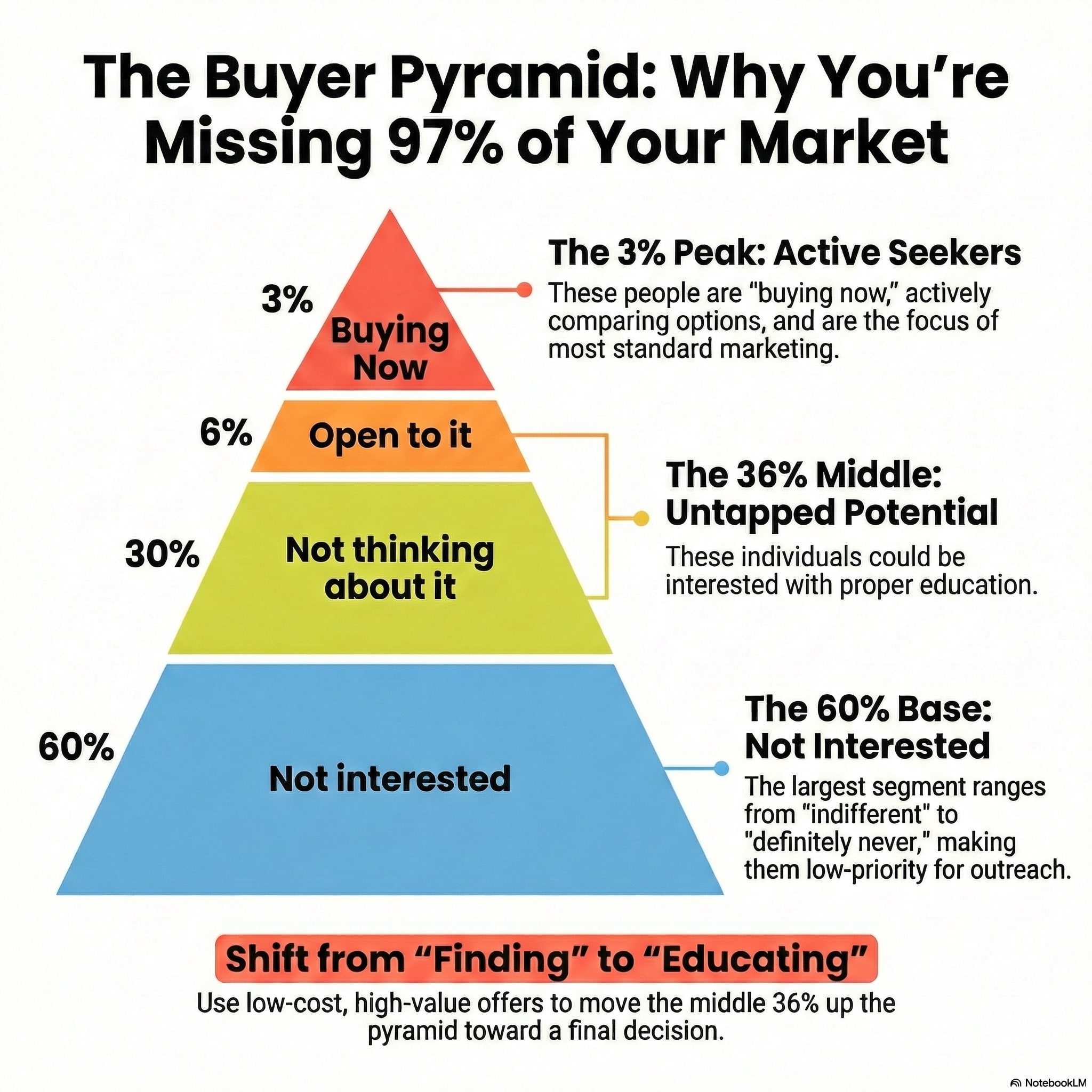
This framework, called the Buyer Pyramid, isn't rigorous research. But it captures something real: at any moment, only a small fraction of your potential market is actively looking.
For EA programs, this creates a constraint. Current recruitment relies on word-of-mouth, university groups, organic search, and podcast appearances. These channels naturally attract the 3% who are already aware and interested.
Note on overlap: While research suggests that overlap between people doing different programs isn't as high as previously assumed, there's still a strong case for expanding beyond the existing pool of engaged individuals.
The result: multiple programs fighting over the same small pool of ready candidates. And it's not just other fellowships or training programs you're competing with. This applies to career opportunities too. An AI Safety program trying to recruit ML engineers isn't just competing with other training programs… It's competing with Mark Zuckerberg offering those same engineers millions in compensation packages. You're fighting for attention and commitment against massive financial incentives.
Back to our AI Safety example: through word-of-mouth channels, you reach ML engineers already researching safety careers. Maybe 5000 people at any time. But there could be 50,000+ more engineers at tech companies who have the right background but haven't been exposed to the right framing yet.
If the Buyer Pyramid framework holds true for this audience, that might be your "not thinking about it" segment. Current methods don't reach them efficiently.
EA organizations can't invest millions in brand campaigns that pay off in five years. Philanthropic funding comes with expectations.
The typical response is to stick with word-of-mouth growth. But word-of-mouth growth is severely limited in scale and requires significant staff time with unpredictable results.
A better approach would expand reach at net-zero cost.
Many commercial training programs face the same challenge: long consideration cycles. Career decisions take months or years. You can't wait 18-24 months for people to convert while spending money on ads.
One potential solution: create a small paid offer that aims to cover its own cost through immediate purchases. The goal is to break even while building a list of people who've demonstrated real interest.
Here's a commercial example. Russell Brunson (DotCom Secrets) built a book funnel that distributed over 1 million books:
He's cash-flow positive from day one and has a list of people who gave their credit card, consumed the content, and are primed for higher-value offers when they're ready.
A closer-to-home example: The School for Moral Ambition is explicitly using a book launch strategy to build their movement. Rather than only recruiting from the existing 3% of people already interested in their mission, they're using the book as a tool to reach and educate the much larger pool of people who aren't yet thinking about these ideas. The book serves as both a revenue-neutral acquisition tool and an educational funnel that prepares readers to eventually engage with their programs.
RGray Digital Marketing ran an experiment comparing free consultations to paid consultations for client acquisition:
Someone who pays $10 for a book has likely crossed a psychological threshold that someone who downloaded a free PDF has not. They're more likely to consume the content (since they paid for it), more likely to implement what they learn, and more likely to purchase again.
These small paid offers give you value on two timelines.
Short-term: Research from commercial training programs shows 10-20% of people who purchase an introductory product will take immediate action on relevant next steps. For EA fellowships, this could mean joining an expression of interest list or applying to a program.
Long-term: For the 80-90% who don't convert immediately, you have a relationship. They're on your email list as buyers, not freebie-seekers. Your follow-up email series compresses their learning timeline from 12-24 months of self-education to 3-6 months of systematic, curated content. When they're ready to decide, you've earned their trust and positioned yourself as the natural choice.
Back to our AI Safety program example: you create a funnel offering "The AI Safety Career Transition Book" for $30 (this could be physical or digital). An ML engineer who's vaguely curious about safety research but isn't actively job-hunting sees your ad. The $30 commitment is low enough that they'll take a chance.
About 10-15% of people who see the ad buy. At checkout, you offer them the option to join your program's expression of interest list and receive early notification when the next cohort opens. About 20% opt in.
Note on conversion rates: The exact percentage will vary based on your audience, offer, and ad quality. These numbers are illustrative based on similar funnels in commercial training contexts. You'll need to test to find your own benchmarks.
Now you have two segments:
If this works as intended, you've identified who's interested at net-zero cost and potentially shortened their timeline from "vaguely curious" to "ready to apply."
Most established training programs already have curriculum, recorded sessions, frameworks, and case studies. These can be repurposed into a paid lead magnet without creating everything from scratch. This doesn't have to be a physical book. It could be a digital workbook, a self-paced course, a recorded workshop, an assessment tool, or any other educational product based on your existing material.
You're not selling access to your fellowship. You're selling education that helps people understand whether they should eventually apply.
The EA ecosystem is beginning to experiment with growth marketing:
EA Hungary reported "a lot of success with paid social media ads to attract diverse and talented participants at quite a low cost" on the Forum.
Amplify, launched in 2024 to provide marketing support to EA groups, worked with EA Netherlands and saw a 3x increase in intro program completions and 35% increase in EAGx attendance.
The School for Moral Ambition is explicitly using a book launch as a funnel to build their movement.
These examples are early, but they suggest these principles might work for EA programs.
Note: This is an example for illustration purposes. Your specific funnel structure should be tailored to your program's unique context and audience.
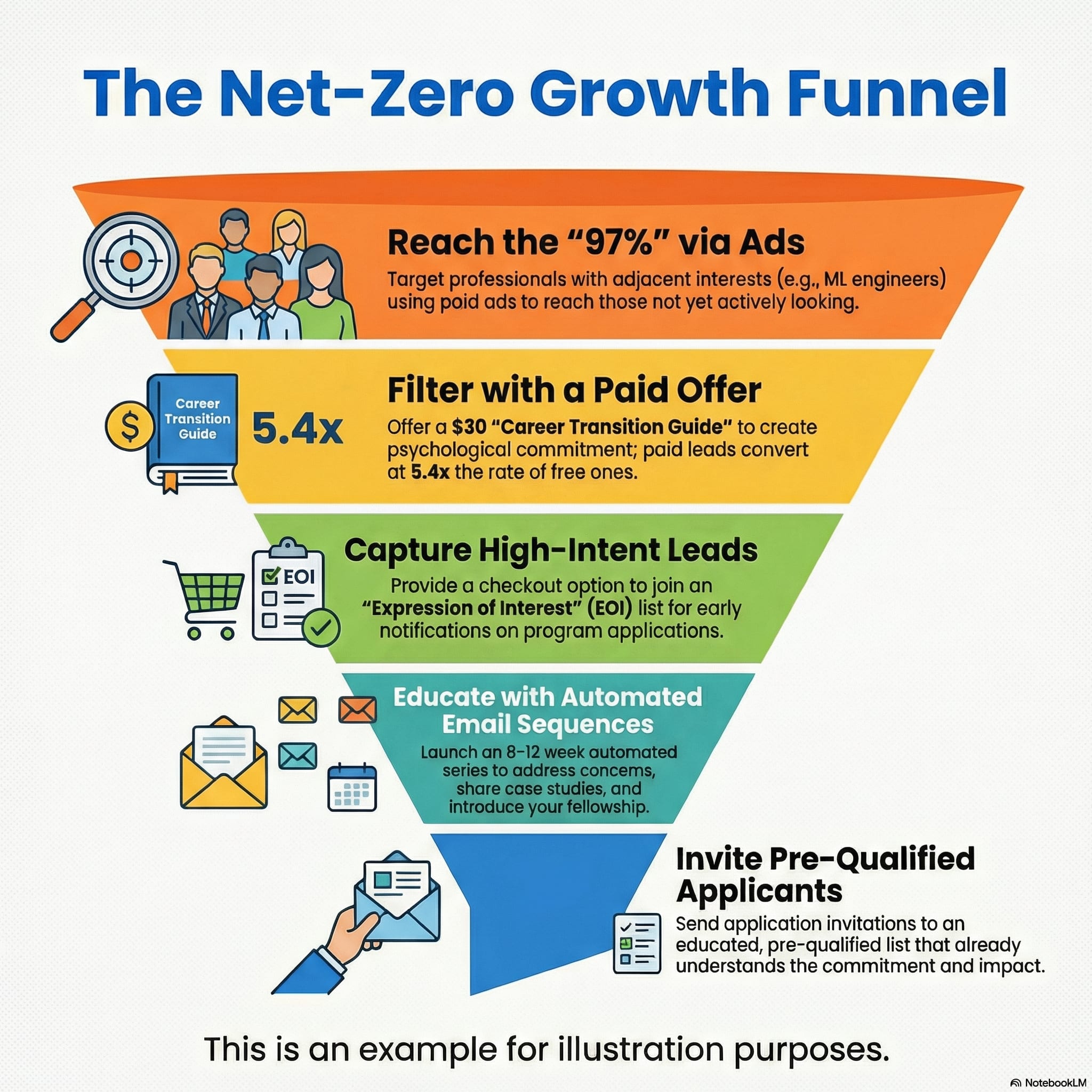
Here's the structure for an EA training program:
Step 1: Paid Ads Target people with the right professional background who've shown adjacent interests. For an AI Safety program: ML engineers at major tech companies, CS PhD students working on capabilities, robotics researchers.
Step 2: Landing Page Single focused offer: "The [Topic] Career Transition Guide" for $30 (this could be a physical book, digital course, workshop recording, or workbook).
Important note: This is a paid offer, not a free download. Remember the research showing paid leads convert at 5.4x the rate of free leads. While offering it for free might seem like it would get more people to download it, those free downloads are far less likely to actually read the material, take it seriously, or convert to your program later. The small payment creates commitment.
The page explains what's in the product, who it's for, and what they'll be able to do after consuming it. You're selling the information, not the fellowship.
Step 3: Checkout with Expression of Interest Option After they purchase, offer them the option to join your program's expression of interest (EOI) list.
Important clarification: Joining the EOI list doesn't guarantee acceptance into the program. Most EA fellowships have selective admissions with acceptance rates typically under 30%. The EOI simply means they'll be notified when applications open and have demonstrated higher-than-average interest. This gives you a segment of highly engaged people who are ready to move faster.
Step 4: Email Sequence Launch an automated email sequence over 8-12 weeks:
Note on terminology: An email sequence is a series of pre-written emails sent automatically over time to educate and nurture relationships with people who've expressed interest. It's different from a newsletter because it's triggered by a specific action (purchasing your book) and follows a planned educational arc.
Step 5: Ongoing Newsletter After the initial sequence, they move to your main newsletter, which keeps them engaged until they're ready.
Step 6: Application Invitation When you open a new cohort, you email this list first. They've been educated, they understand the commitment, and they're pre-qualified by having paid for and consumed your content.
Potentially scalable acquisition at net-zero cost: Let's break down how this might work financially. Say you're offering an educational product for $30:
Costs:
Revenue:
Net result: $0 (break even)
The goal is to be cash-flow neutral from day one. Unlike word-of-mouth growth (limited in reach) or traditional paid advertising (where you lose money until conversion happens months later), this approach aims to let you scale ad spend without burning philanthropic dollars.
Scaling from 100 to 1,000 interested people per month isn't automatic. It requires work, testing, and optimization. But unlike word-of-mouth growth where you can't predict or control how many people will discover you next month, paid funnels give you a lever you can adjust. If you know your numbers work at small scale, you can model what it takes to grow.
The real value isn't in making money on the front-end product. It's in building a list of qualified, engaged people who've demonstrated commitment by paying. If the research on paid vs. free leads holds true in this context, these people should convert to your main program at significantly higher rates than free leads, and you've acquired them without any net cost to your organization.
Potentially higher quality than free downloads: Remember the 5.4x conversion difference from the RGray study. If this pattern holds, someone who paid for your book is more likely to read it, take it seriously, and view your fellowship or course as a natural next step.
A pipeline that scales: With a working funnel, your constraint becomes ad budget, not creativity or luck. You can model exactly how much ad spend you need to 3x your applications.
Compressed education timeline: Your email sequence can turn 12-24 months of scattered self-education into 3-6 months of systematic, curated content. You control the framing and sequencing.
Real data for optimization: Unlike word-of-mouth growth, paid funnels give you clear metrics on what works. You can test, iterate, and improve systematically.
Volume doesn't equal quality. But you're not replacing high-touch recruitment, you're expanding it. By the time someone applies, they've paid for your book, consumed your content, received 10-20 emails over months, and decided to apply anyway. That should be a stronger filter than "downloaded a free PDF."
You can monitor quality with clear metrics: application quality scores, acceptance rates, program completion rates, long-term outcomes. If quality declines, adjust or pause. Unlike word-of-mouth growth, paid funnels give you more control and clearer data.
Don't do this if you're just starting out. If you've only run 0-2 cohorts, stick to the 3% who are already looking. Validate product-market fit first.
Don't do this if you don't have proven outcomes. If you can't point to specific career changes or measurable impact, you don't yet have the credibility to build a funnel around.
Don't do this if you're still figuring out positioning. If you're not clear on who your ideal participant is or how to articulate your value, paid advertising will just be expensive guessing.
Making this work requires real expertise in several areas: figuring out what your audience will actually pay for and how to price it, writing landing pages and emails that connect without being manipulative, running ads on platforms like Facebook, Google, or LinkedIn at scale, understanding which metrics matter and how to improve them systematically, setting up automated email sequences that keep people engaged, and handling the technical infrastructure for payments and delivery.
If you don't have this expertise in-house, you need someone who does. And importantly, you need someone who understands both performance marketing (the commercial approach focused on measurable results and scalable acquisition) and EA culture. Someone who knows how to be effective without veering into manipulative tactics.
The economics only work when done well. A poorly designed approach loses money, wastes time, and could potentially damage your reputation.
EA has legitimate reasons to be cautious about aggressive growth tactics. The community values thoughtfulness and intellectual honesty.
But there's a difference between predatory marketing and effective education. A well-designed funnel should provide genuine value, set accurate expectations, filter for fit rather than maximize volume, and respect people's decision-making timeline.
If you implement this approach, track quality carefully. Set baseline metrics before launching (applicant quality scores, acceptance rate, program completion rate, career outcomes). Track people who came through this channel separately. Set clear decision rules: if quality metrics decline below certain thresholds, adjust or stop.
The advantage of paid approaches is control. If quality declines, you can adjust messaging, change targeting, add qualifying questions, or stop entirely.
This approach can be particularly valuable for programs looking to diversify their funding sources and build more organizational resilience. Even well-funded programs may find value in reducing dependence on a
If you're running an established EA fellowship with proven outcomes and you're ready to scale beyond word-of-mouth growth, start by auditing what you have. What intellectual property or content could be repurposed into something people would pay for? What would genuinely help your target audience make better decisions? What's the natural progression from "curious" to "ready to apply"?
Consider infrastructure. Do you have (or have access to) real performance marketing expertise? Can you commit 3-6 months to building and optimizing this system? Are you prepared to monitor quality metrics and adjust or stop if needed?
Run a contained test. Start with a small ad budget ($5k-10k), build a simple version targeting one specific sub-audience, set clear success criteria upfront, and learn from real data before scaling.
Right now, most EA programs are fighting over the same 3% of people who are already aware and actively looking. The other 97%, thousands of professionals with the exact skills you need, remain unreached because traditional outreach is limited and brand-building campaigns require years and millions of dollars you don't have.
But there might be another way. The fundamentals have shown promise in commercial contexts: paid leads can convert at significantly higher rates than free leads. Small paid products can potentially achieve net-zero acquisition cost. And the "not thinking about it" segment might represent most of your potential audience.
The opportunity is to add a scalable layer that reaches people who could be excellent fits but aren't currently looking: people who might be interested if properly educated but who won't stumble across your program through word-of-mouth channels. This approach aims to do this without burning philanthropic dollars, without waiting years for results, and without compromising on quality.
Want to learn more about applying growth marketing to EA aligned work? Check out my substack for insights on building scalable infrastructure for high-impact programs.
If you're thinking about implementing something like this for your program and have questions, feel free to reach out. I'm happy to discuss how these approaches might work in different contexts.



This is an EXCELLENT post. I've been on the journey to outsource some of our digital marketing needs (and I know many others in the EA community are doing the same). And I think we'd benefit from looking outside the EA ecosystem and work with individuals who know what it takes to close a sale. The center of the target is people within the EA community, what what do the outside rings look like -- and that is probably something different for each org/cause area. Well written.