Comments
Reminded me of The Big Man Can't Shoot :)
It took the greatest show on earth for people to act as though 3 is greater than 2.
A decade ago (somehow), Wardell Stephen Curry II, aka Steph, Chef, or the Baby-faced Assassin, was making and shaping history. Unbound by unwritten rules of engagement, carefree and without conscience, he had learned there was nothing and nobody who could stop him raining long-range bombs on shell-shocked opponents. Bang! Bang!
[Substack embedded video: Bang! Bang!]
Already the reigning MVP and his Warriors the defending champions, Steph was on his way to becoming the first and only unanimous MVP and 73 wins in the NBA’s 82-game season, besting Jordan’s Bulls’ 72, which for the two decades prior many had treated less as a record and more akin to death and taxes.[1] He revealed himself as comfortably the greatest shooter of a basketball ever in such euphoric fashion that he force-fed a new geometry of the game to a rapidly dwindling number of haters.[2]
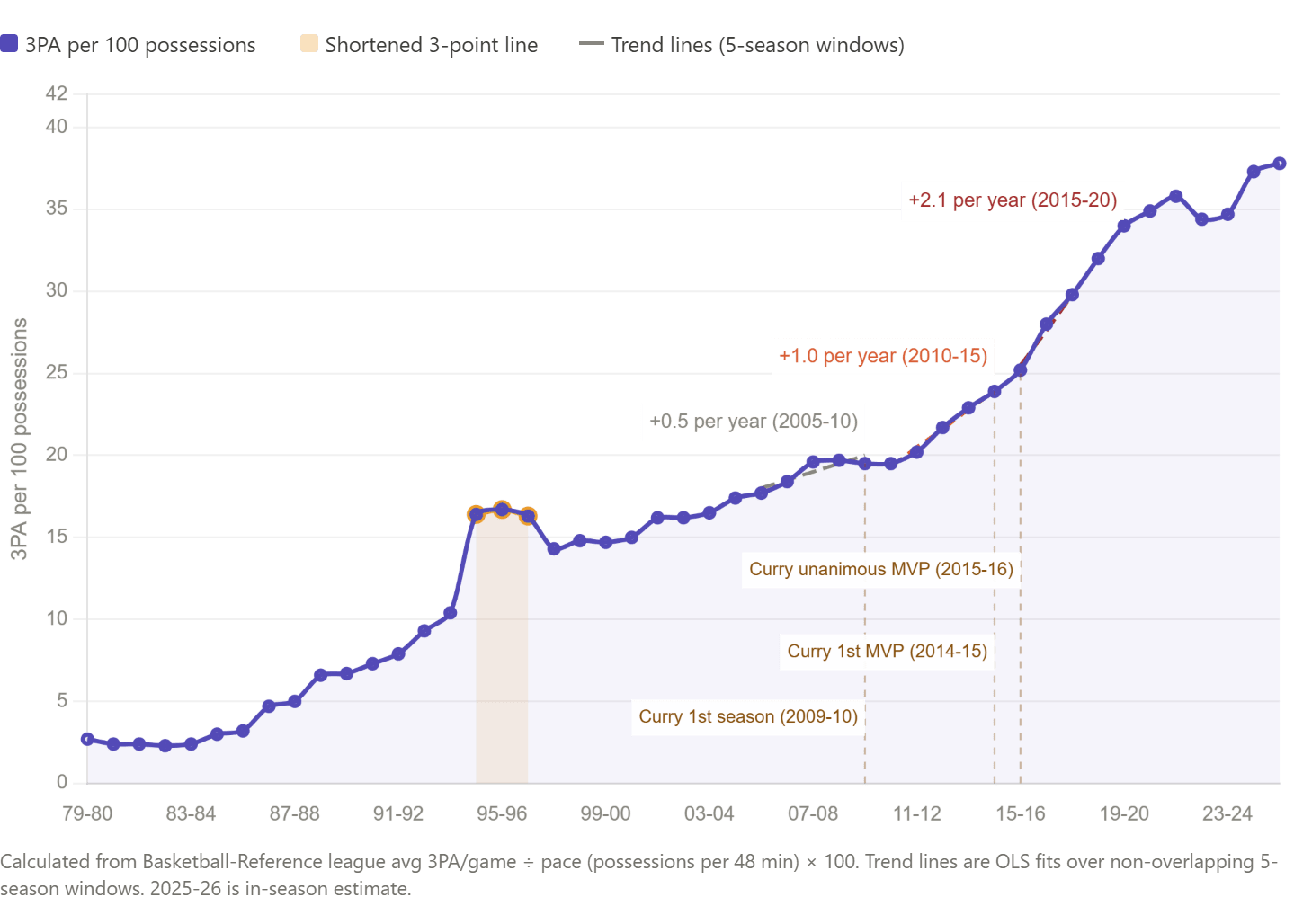
The NBA brought in the 3-point line in 1979, 35 years before Curry went nuclear. Suddenly there was an area of the court from which made shots were worth 50% more points. Surely, one might have thought, the game would change beyond all recognition, and sharpish. Yet the proportion of possessions that ended with a 3-point shot ticked up slowly, from 2.7% that first season, to 19.5% in Curry’s first season, with the 5 seasons up until 2009-10 below the long-run trend. Despite all the nerds and their spreadsheets saying it was, shall we say, suboptimal (like, leaving as good as one-third of the expected value on the floor suboptimal), the world’s best players stubbornly kept jacking it up from inside their comfort zone 18 or 20 or 22 feet from the hoop, instead of from 23 feet and 9 inches.[3]
Me and my childhood nickname Statto enter the story in 2014. I was passing the time between tweets by managing an international clinical research project spending tens of millions of euros to generate new charts and tables that might persuade doctors who hadn’t already been persuaded by half a century of best practice or a battery of contemporary randomized controlled trials to save their patients’ lives using anticoagulants. Anticoagulants, you see, are a problem for the poorly calibrated: don’t prescribe them, and the many strokes or heart attacks you fail to prevent are acts of God; prescribe them, and on your head be the handful of hemorrhages you cause. So I was all too familiar with being right not being enough, and with people leaving expected value - nay, expected lives - all over the fucking floor in order to avoid that fate worse than death: straying beyond the zone of one’s own comfort.[4]
The battle for the soul of the NBA was raging. The rate at which 3-point attempts were increasing had almost doubled since Steph entered the league, and Nate Silver was publishing probabilistic prediction models that had the upstart Warriors, who had never won a playoff series but shot a lot of threes, as Western Conference favourites. Charles Barkley, 1993 MVP turned not-in-my-day punditry personified, was yelling that analytics are just some crap some people who were really smart made up just to get in the game because they had no talent. I picked my side, fluttering on the Warriors at 16/1,[5] a stake which got me invested enough to start watching regularly as they became the greatest show on earth.[6]
It wasn’t just Steph. Splash Brother Klay Thompson was maybe the second best shooter of a basketball ever. Skeleton key Draymond Green unlocked the Warriors’ Death Lineup which laid waste to the league by playing shooters at all five positions without derailing the dominant and oft-forgotten defense.[7] Coach Steve Kerr’s egalitarian system (and Steph’s enthusiasm for moving off the ball) leveraged the long-range threat into uncontested dunks. All those pieces mattered. And Steph was the piece that mattered most, in fact and in the popular imagination.[8]
Not for Steph the athlete’s sense of supreme talent and its trappings as crosses to bear. No doubt dedicated to his craft, he doesn’t take himself too seriously. His range made him undeniable, and his on-court demeanor made him undeniably cool, our joy watching born of his joy doing. He became the baby-faced poster child for the analytics revolution, and in spite of the reactionary and tribal headwinds to individual transcendence in team sports, he became almost universally beloved. I fell in love twice over, once because he was the greatest showman, and again because he was proving the numbers right.
[Substack embedded video: The Shimmy!]
Nobody else yet has come close to joining Steph all the way out at the long-range volume-efficiency frontier. Not for lack of trying: general managers wantonly drafting wannabes, coaches giving them the green light, and everyone chucking with gleeful abandon. The 3-point attempt rate leapt from 23.9 per 100 possessions in Steph’s first MVP season to 34.0 five seasons later. In a copycat league, the time when the game changed beyond recognition, and sharpish, wasn’t when three being greater than two became knowable, or known, or written down, but when it rained down, night after night in glorious high definition, as the greatest show on earth, and ended in a parade.

The inimitable Andy Masley wrote recently about how his own blog’s success is proof, if more were needed, that there’s a ready and willing audience for numbers and their implications. That seeming exactly right, based on my own appetite for analytics blogs and the thriving communities it’s led me into, underpins the existence of this blog. And it leaves open the question of how to reach consequential decision-makers and action-takers who haven’t yet found our corner of the Internet, or haven’t found it’s for them.
A chart made by my editor, who with some prompting did a much better job more quickly than I would have alone.
I read Steph’s teaching as, whenever there are deadly serious charts or tables getting less attention than their implications warrant, or lines which if they went up would make the world a better place, I should package them up in the most entertaining blog I can muster and send it. I’m betting sporting storytime is one of a million untried or under-tried ways to bring nuanced analysis to life in ways that land not as dry lecture but as entertainment, droll or otherwise. And there’s a version of this anybody dedicated to solving pressing problems can do every day, working not in secret or with a dour sense of duty, rather as showmen, shooting our best long shots.
Thanks for hanging in! This is a linkpost for my new Blog with No Name (working title). You can read it in its native Substack habitat here. It's free so, if my numbers are right, subscribing or sharing is the most cost-effective thing you'll do today.
📝Stephen Curry is the Revolution (2015) and The Case For Stephen Curry, MVP (2017). The prophets didn’t stop posting just because Steph was incarnate, and these from Benjamin Morris at fivethirtyeight.com (rip) are gospel.[9]
🎵Science Fiction (2018). “I want to make a simple point about peace and love / But in a sexy way where it's not obvious / Highlight dangers and send out hidden messages / The way some science fiction does.”[10]
The 73-win Warriors would famously go on to blow a 3-1 lead in the best-of-7 Finals to LeBron’s Cavs (having themselves overcome a 3-1 deficit in the previous round). Steph was injured earlier in the playoffs and was a notch short of his most incandescent self. LeBron went full GOAT for 3 straight games, wrapping Game 7 with The Block, one of the most iconic plays in NBA history.
If this blog goes on to say much of anything, it will surely say it about cost effectiveness, calibration, and probabilistic thinking amid uncertainty. For now we can be so bold as to say with near certainty that Steph's 2012-16 contract, signed at a below-market rate in the wake of some inopportunely timed ankle injuries that served only to postpone his going supernova, was the bargain to end all basketball bargains. (And let’s not today get into everything it enabled in 2016 free agency with the cap spike and the Hamptons and the cupcakes and whether or not Kevin Durant was a worthy Finals MVP in ‘17 and ‘18 or coasting to uncontested dunks on Curry’s coat tails.)
The established orthodoxy’s way of thinking about individual efficiency (and, for those able to go one step past “yay points!”, reputation, value, and associated salary), was field goal percentage (FG%), which by dividing makes by attempts made no attempt to account for the 50% bonus some field goals earned. This was easily fixed, on the Internet at least, by switching to effective field goal percentage (eFG%). Today we have true shooting percentage (TS%), which also captures free throws, and adjusted true shooting percentage (aTS%), which also also captures turnovers. Not to mention the volume metrics, and efficiency-volume composites. There is not yet The One True Number.
Doctors, it turns out, have a lot in common with coaches who play not to lose, or not to be blamed for losing. GARFIELD (the Global Anticoagulant Registry in the Field) launched in 2010, and in the first cohort more than 1-in-3 atrial fibrillation patients at high risk for stroke went untreated (subsequent analyses found only a small minority of them were reported as refusing treatment; for the rest it was “clinician’s choice”). The Hippocratic harm principle might work fine for bumper stickers, but it’s DOA in a clinical setting defined by tradeoffs, which is to say all clinical settings. It’s been established since the 1950s that crude risk-scoring algorithms better predict patient outcomes than doctors with their expert clinical judgement and pesky cognitive biases.
My dalliance with the online “exchanges” ended abruptly when a comrade became a professional gambler and told me, an amateur, in no uncertain terms, to cut it out, what with people like him having (for better or worse) parlayed their physics degrees into sophisticated systems for extracting cash from these markets and people like me being rather on the wrong end of that structural advantage. To underscore the extent to which this particular wager was good fortune in a good bet’s clothing: I hadn’t understood that “winning the Western Conference” required winning three playoff series, not just topping regular season standings. Luckily the lads came through on both on their way to the title.
No better commitment device than money on the line, so Steph and the Warriors immediately became a serious contender for my sporting affections. Even watching the Warriors blow a 3-1 lead was a lot more fun than watching Arsenal collapse approaching the line in the 2016 Premier League title race, out-lasted by Leicester City, who had opened the season as 5000/1 no-hopers.
Not that Draymond never derailed anything. To take just one example, the turning point of the 2016 Finals was when he decided during Game 4 to punch LeBron in the balls, getting himself banned for the pivotal Game 5.
Basketball is a star-driven sport to begin with, and on top of what Steph could do on his own, the effect he had on his team mates lapped the field. Threes aren’t just 50% higher: they warp the game by forcing defenses to cover the whole floor and opening up the area around the basket. Steph’s gravity got his team mates wide open, and in 2017 (for example) their true shooting percentage was 7.3 percentage points lower when he was off the court, compared to 3.9 for LeBron, and the rest even further back.
Note that in 2017, after unanimously winning MVP, advanced stats showed Steph was still under-rated by MVP voters.
“...But I've a feeling that the whole thing / May well just end up too clever for its own good / The way some science fiction does.”


YESSSSS didn't think I would get to see some hoops on the forum, thanks.
But I would be remiss to not give credit to 2 other dudes who should get some love from EA, Morey and Harden! To be fair trying to assign exact credit for who spurred the 3 pt revolution is hard and I don't claim to be confident, and also it is definitely true that curry helped accelerate the revolution, though I would probably put the curry warriors as the 2nd or 3rd most important group in doing so.
I think the Morey/Harden/rockets (and possibly seven seconds suns but will ignore for now) probably deserve more credit, although definitely curry/warriors if you mean who made the public think 3>2. (and I'm not claiming that the point of your post was to give curry all or the most credit, I just can't help myself in filling in some more basketball history for those interested).
The thing about curry is he is the greatest to ever shoot it. You simply can't acquire a curry. Also, my read of Steve Kerr is that he is honestly not that analytic pilled as a coach. Like he is certainly on the more forward thinking side but he's not a math demon the way Morey was. He did have them running an incredible offensive scheme though don't get me wrong, but it was highly artistic and free flowing.
Morey was kinda the one to realize that you really shouldn't take midrange at all. This was the first domino in the revolution (although looking at the midrange chart above, seems like league had been slowly realizing that before him). You should never ever ever take a step in, which players often did. In fact, you should often take a step back even if you are open from the midrange (although the step back didn't explode in popularity till later). And you should put your role players on the three point line in the corners/wings, not in the midrange (and similarly, you should acquire players who can hit those shotes).
I also think while on first glance, it's easy to think of the 3 pt revolution as completely analogous to something like the shift in baseball - basically pure math that would have been true at any point in the league - I think it's probably at least a little less of a brain fart (though still mostly a brain fart) than it might initially seem. I think there was actually a series of (relatively simple) innovations that had to occur.
Just because league 3pt TS% > 2 pt TS% (in the halfcourt), this doesn't mean that the marginal 3 pt is higher EV / TS than the marginal 2 pt. Now I happen to think that it still probably was (i.e. like a good shooter jacking up some contested 3 still better than replacement 2 from that team), but you have to figure out exactly how to generate those extra 3s. At first I think it's obvious, just replace the middies with the threes. But then you have done picked all of this fruit, and now you have to figure out some more complicated ways to generate more.
Some (haters like myself) might argue this is where the warriors really came into play. The warriors abused moving screens harder than had ever been done in the history of the league, and in doing so, they were able to generate a few more clean looks a game. This definitely was very influential and you can see the proliferation today, with almost every screen set in the nba today being technically illegal (I hate to call this an innovation but...).
After everyone started abusing the moving screens, we needed even more innovations to generate new threes. Again I think here Harden and Morey shine, with the step back 3 revolution occuring around 2017-2018 by Harden.
Anyway I'm super pedantic and I don't think this changes the implications of your post at all, just excited to write about basketball on the forum and wanted to add my 2 cents.
Thanks for reading, and especially for commenting! I’m not sure we disagree much, but I think the emphasis matters.
For sure you’re right, there were many, many forces at play in the revolution. It’s a book-length story (tempting), and it wouldn’t be able to contain itself to hoops: there’s no Daryl Morey without Billy Beane (and there’s no Beane without Jonah Hill, and there’s no Jonah Hill without Bill James…). Morey says the Rockets owner pitched him they were looking for a Moneyball type, and the owner says it was reading the Lewis book that made him overhaul his organization by injecting analytics (they tried to hire Beane before Morey). Curry is no less a product of his environment than anyone else, and that environment was shaped by these guys from the inside, and by Nate Silver and Benjamin Morris and the rest of the blogosphere from the outside.
And I still want to defend the position that Curry was singularly responsible for inflecting the curve in the mid-2010s.
By the time of Steph’s breakout in 2014/15, Morey had been in post long enough to become the face of the nerds (it was his name Barkley was yelling, right before the bit about not getting any girls in high school), and not long enough to have won anything (which isn’t necessarily shade: it takes time to build things, especially when you’re the insurgency and you don’t have a cheat code). Despite eschewing the midrange and shooting more and more threes, his Rockets’ offense topped out at 4th and their net rating at 7th. They shot more threes than anyone else for the first time in 2014, and their offense was 7th. They’d won one playoff series in seven seasons. The reason Barkley could punch down at him was because he hadn’t succeeded rising up.
Steph is different. He could stand out while fitting in: far from being a self-consciously nerd-coded outsider pointing at spreadsheets and telling OGs they don’t know their own business, he’s the son of an NBA shooter out there shimmying the shimmy. And he proved the doubters wrong in terms they couldn’t fail to comprehend: not if you know where to look our offense overperforms its underlying talent level, but you can torch everyone in your path shooting threes and look irresistibly cool doing it.
It’s not just that Steph won over fans. He won over everyone, including all the decision-makers not called Daryl who’d been resisting the revolution. He made it crystal clear that people in positions of power had been looking for edges in the wrong places. That, according to me at least, is why the league-wide curve shoots up from 2015, not from when Morey gets his gig in 2007 or when he trades for Harden in 2012.
I think this matters. EA already has lots of people running the Morey playbook, optimizing their own decisions within their own organizations. What we don’t have are many Stephs, getting out there and performing the new way of thinking so successfully and so joyfully that it changes everyone else’s behaviour.
A couple of things on the local level:
What an insightful comment! Very well put I appreciate it.