
Although AI x-risks and s-risks now seem well-funded, most funding comes from only a few major donors.
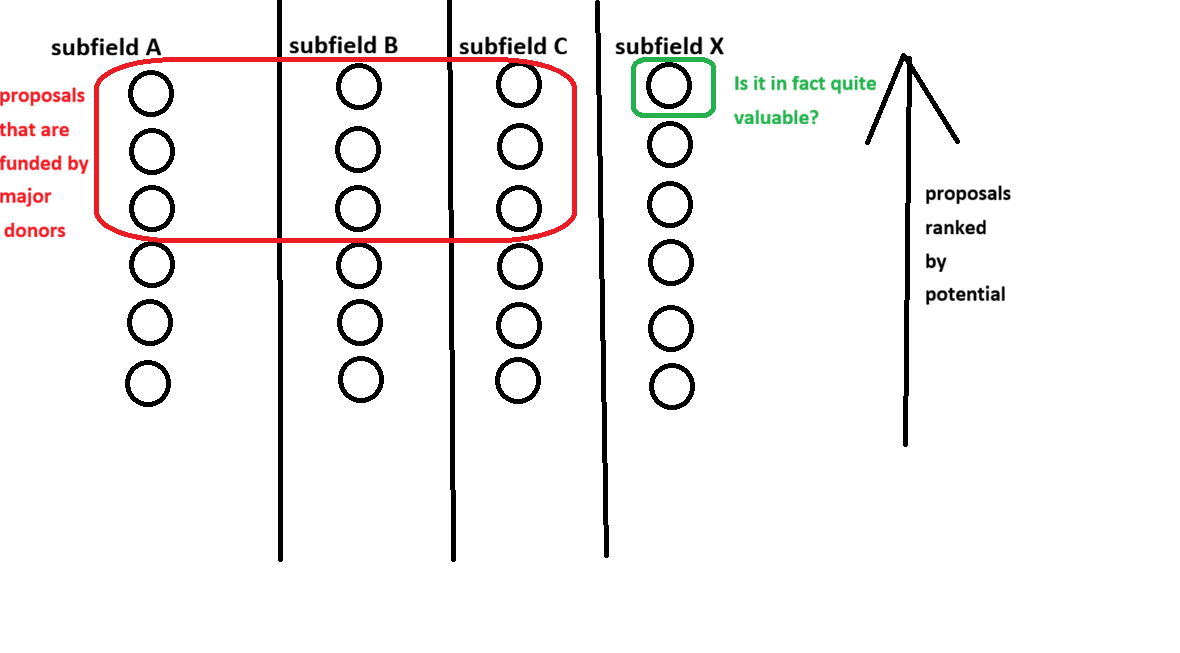
This raises a potential problem: If funding allocation is decided mainly by a few individuals, and those major donors might be opinionated or didn't notice community experts’ opinions, they might miss many promising projects.
Imagine a hypothetical scenario: There's a sub-area X in AI risk. A major donor concludes that X is unpromising, yet more than half of AI risk experts believe X is actually promising. If major donors aren't more insightful than the wider informed community, the community’s collective view may be more likely accurate.
In this case, independent small donors could impact by making grantmaking more democratic. For instance, there may be 30 proposals in area X, but the major donor does not support X, so none of these are funded. A small donor can then pick the best proposal among 30 X proposals (or consult other experts) and fund it. That proposal might be in fact quite impactful.
Do you know promising individual researchers who repeatedly fail to get grants in real life? If so, small donors who can identify such cases might create substantial marginal value.
However, this claim may be unrealistic and needs critique. So I’d like to ask:
- Do you think there actually exist AI-risk subfields neglected by major donors even though many EA people or experts view them as promising?
- If so, can small donors exploit this gap to achieve significantly higher marginal impact than donating to mainstream funding organizations? If you’re uncertain, what do you think the potential obstacles are?
Please don’t aim for a rigorous answer. Also, there's no need to mention any specific donors, organizations... A 1-minute rough gut intuition to just one question, or short replies like “My main crux is X” or “I do/don’t see many valuable unfunded grants” would be extremely helpful.
(You could also reply anonymously by using this Google Form, your gmail address won't be collected at all): https://docs.google.com/forms/d/e/1FAIpQLSc377QYIqyCb5dp3NTq0csMju7cfLFcxDoLxbUI9tsQGYA_OA/viewform?usp=publish-editor
I advise everyone to not aim for a rigorous answer because nobody(even the experts) would have a perfectly right answer here. We need to collect everyone's imperfect opinion to answer this question. Quantity-over-quality brainstorming is better here—I'd prefer 1 minute half-baked thoughts or even scattered biases over silence. Therefore, feel free to share your intuitions even if you think they may be flawed.