Comments
1
Yet this inconstancy is such
As you too shall adore;
I could not love thee (Dear) so much,
Lov’d I not Honour more.
—To Lucasta, Going to the Wars
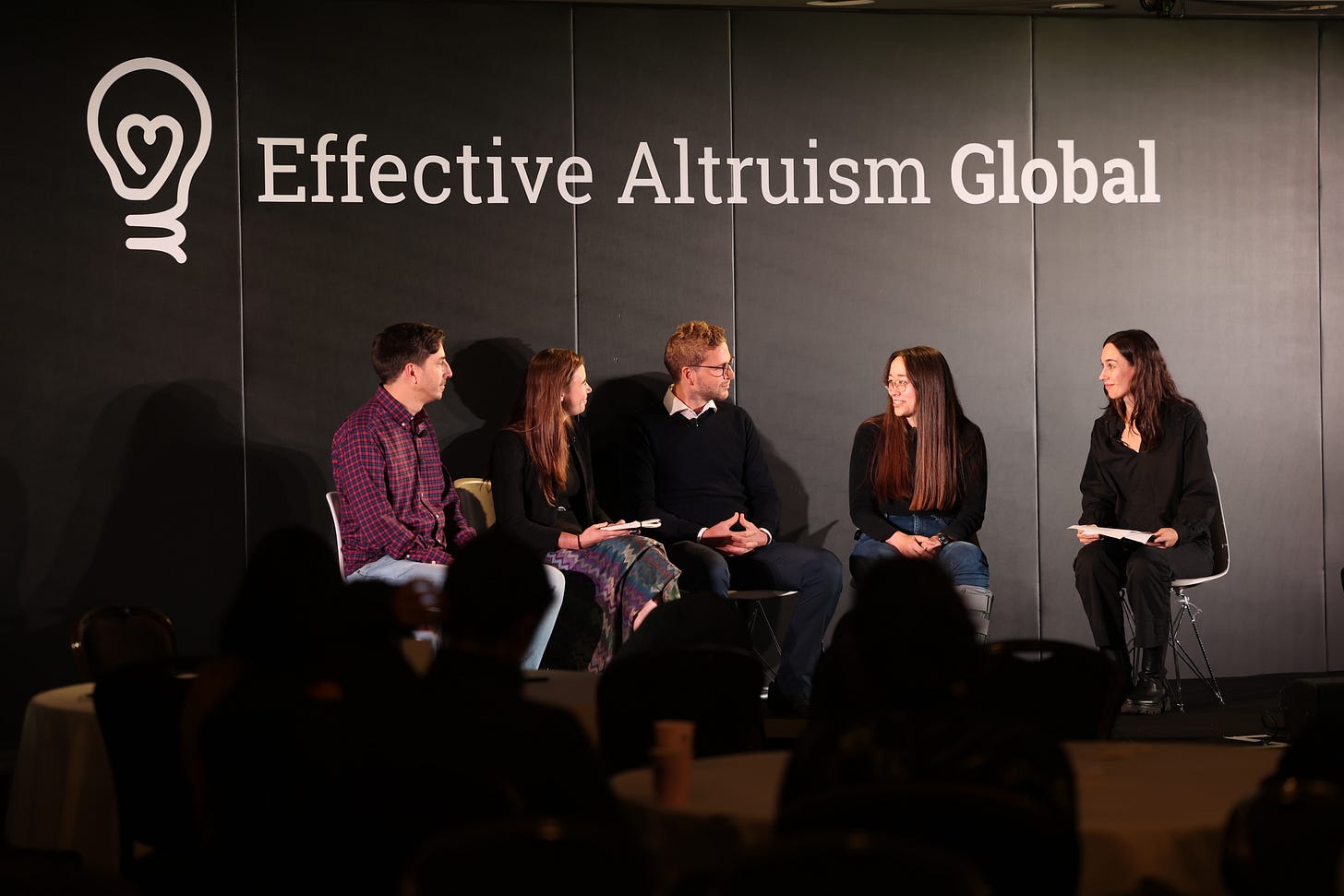
This weekend, I attended EAG London, 2026. It was in London, and it occurred in the year 2026. You can see how it got its name.
EAG events are big conferences that bring together effective altruists from all around the world (they’re called EA globals, because they bring together effective altruists from around the globe, you see). I always leave EAGs inspired by seeing so many people interested in making the world a better place as effectively as they can.
Analytic philosophers make a distinction between the good de dicto and the good de re.1 If you’re concerned about the good de re, there are particular good things that you care about. Maybe you think cats are good, and want to improve cat welfare because you like cats. But if you learned something else was better than cat welfare, you’d keep pursuing cat welfare. You’re interested in particular things that you think are good, not whatever form the good happens to take.
Concern for the good de dicto involves concern for whatever the good is. If you care about the good de dicto, then if you learn that, say, it would be better if you quit your high-paying finance job and started working on shrimp welfare, you’d do that. You want to do whatever is good, not just the good things that you initially cared about.
The world has lots of concern for the good de re, but little concern for the good de dicto. Few people are motivated by abstract concern for doing what’s best. EAs are different. In fact, this is the central respect in which EAs are different. EAs are interested in doing what’s genuinely best, no matter what that involves.
And it’s inspiring to be around such people. People who are fully, unqualifiedly committed to doing what’s best. While most people do nothing about the billions of animals who languish in torture chambers, the thousands of children who die every day, and the potential wholesale destruction of the future, EAs tackle these problems as effectively as we can. At an EA event, one encounters people who care in a uniquely deep way.
Sometimes, philosophers thumb their noses at concern for the good de dicto. They claim it is fetishistic to care about things only because they are good. You should do nice things for your wife because you care about her, not because you care about the good. It would seem wrong to say to your spouse “honey, I bought you this gift, not because I care about you, but because you are a conduit for efficient dispersal of impartial goodness.”
This objection is wrong.
Specifically, it confuses the proper objects of evaluative attitudes with the content of the attitudes. When helping other people, your attitude should not be joy in bringing about the good de dicto (at least, if the fetishism concern is correct). The content of your attitude shouldn’t be concern for the abstract good. But the object of your attitude should be whatever is good.
If something is good, then definitionally it’s worth caring about. So you ought to be concerned de re with all the things that are good de dicto. You should care about people as individuals, but the things that you should care about are the things that matter. Put more simply: you should care about all the things that matter, but your attitude shouldn’t just be concern for abstract mattering, but concern for the particular thing.
And crucially, if you’re psychologically unable to care deeply about the various goods de re, it’s better to care about them de dicto than not at all. Maybe it’s better to call your Mom because you love her and care about her than out of a sense of duty, but better to do it out of a sense of duty than not at all.
Maybe it’s better to refrain from throwing babies across the room because you care about them than out of a sense of duty, but both of these are a lot better than chucking them across the room. Maybe it’s better to help shrimp because you care about them than to act out of duty, but it’s better to help them out of duty than not to help them at all (certainly it seems this is what the shrimp would think). As Richard Y Chappell put it: abstract benevolence is a virtue. It’s good to care about what matters most, rather than whichever random collection of important things happen to be psychologically salient to you.
2
And here’s John Synge himself, that rooted man
‘Forgetting human words,’ a grave deep face.
You that would judge me do not judge alone
This book or that, come to this hallowed place
Where my friends’ portraits hang and look thereon;
Ireland’s history in their lineaments trace;
Think where man’s glory most begins and ends
And say my glory was I had such friends.
—The Municipal Gallery Revisited.
At the conference, I met a lot of amazing people.
I met people working to develop cultivated meat—people who left prestigious careers to help make the end of factory farming come sooner. I saw Dustin Crummett, and he said smart things, as he always does. At one point I was describing Dustin as the best philosopher in the world, and the person I was talking to replied, “Oh yeah, I know Bentham’s Bulldog really likes Dustin.” He didn’t realize I was Bentham’s Bulldog.
I saw Noah Birnbaum who I am currently on the train next to as I type out this sentence. Noah writes the blog irrational community, where he says true things on important subjects (he suffers from a tragic affliction known as “being wrong about meta-ethics”). I met Kashvi who writes well about lights making moths sad, and also other subjects sometimes (like Kashvi making woodlice sad). I stayed up late with Jackademic Philosophy discussing philosophy and life and why he should start an EA group at his university (and you should too).
I was told lots of high impact things to write about (which you may be hearing about in the coming days). I met Lewis Bollard, who has done more for farmed animal welfare than almost anyone on Earth, and apart from being very tall, is quite down to Earth. Alarmingly, he thinks that odds are non-trivial that factory farming sticks around after AGI.
People are often a bit apprehensive about going to EAGs. Often they’re not sure if they’ll get anything out of it and don’t want to impose costs on impactful organizations. In general, I think this is a mistake. There are two big reasons for this.
First, when you attend EAG, you’re reminded that effective altruism is a community and not just a philosophical idea. In general, I leave EAGs significantly more inspired to make the world a better place where I can. It’s hard to toil at the altar of the abstraction “the good de dicto,” but it is easier to join a community of smart, hard-working people making the world a better place.
Second, EAG often has unpredictable benefits. I reached out to Will MacAskill before EAG London last year mostly on a whim, just because I thought he was neat (like he thinks potatoes are) and wanted to hear if he had advice for EA communications. This led to me hanging around Forethought, then applying, then getting hired. The meeting with Will was likely counterfactually responsible for me getting my current job. More importantly, it’s responsible for the Goodmaxxing post! Along these lines, the notorious substack event dubbed “shrimpgate” by the historians was kicked off by Dustin mentioning shrimp welfare to me at a conference a while ago.
Compared to the potential upsides of attending one of these conferences, the costs are relatively low. If attending has a 5% chance of securing you an impactful career, even if it costs $1,000 of impactful spending, that’s very likely worth it. In addition, with the influx of big Anthropic money, EA is now a lot more constrained by people doing important projects than by money. For all these reasons, when making decisions that might influence the starting of impactful jobs and products, you shouldn’t worry too much about costs, provided they are not excessive.
3
And did the Countenance Divine,
Shine forth upon our clouded hills?
And was Jerusalem builded here,
Among these dark Satanic Mills?
…
I will not cease from Mental Fight,
Nor shall my sword sleep in my hand:
Till we have built Jerusalem,
In Englands green & pleasant Land.
—William Blake, Jerusalem.
Gail Eisnitz, an undercover animal investigator, once said:
I wish the animals I’d written about and countless billions of others could know on some universal level that someone, somewhere, was mourning their pitiful lives and violent deaths—crying for those in factory farms and slaughterhouses. “Does anyone know we’re here?” Yes, we know, we’ve heard and we’ve listened, we know you are there.
At EA events, you find the people who care—who cry for the innocent beings forced to dwell in darkness and filth and feces, who have their bones broken and their beaks sliced off, who cough and choke and splutter, who dwell, for their whole lives, in conditions as close to hell as those we can possibly build on Earth. EAs don’t merely cry for them, but act to help these poor, defenseless creatures—and to stop the diseases that kill children every day, and to safeguard the trillions of future people who have no one else to tend to their interests.
Most people don’t care about these things—at least, enough for it to ever influence their behavior in any way. The EA world is almost unique in caring about everyone’s interests, rather than only the interests of the narrow subset of humans who happen to be nearby. EAs, unlike most others, think the most important things in the world matter a non-zero amount. In the standard ethical accounting of most people, most cries go unheard, most agony matters for nothing, so long as its victims don’t look like us.
In this respect, EA is different. It is a community of incredible people working to make the world a better place, whether or not that involves supporting projects that sound weird. Insofar as communities are the sort of thing that one can love, then it is one that I love, and I am amazingly blessed to be a representative of something so wonderful, so beautiful, and so good.
11


I have to disagree with you on one point. EA is and has always been critically short of funding. It is that way before Anthropic, it will be that way after Anthropic, and everyone who ever complains that EA hasn't managed to fix all the problems in the world yet needs to compare EA's total funding level to the total NATO defense budget and truly understand why that is - the world's central decision makers misallocate global financial priorities towards preparations for war rather than eradications of the root causes of war.
That's why we need the people who can do the very best work with the funding we have to come and network with us and learn there they might fit in. We are critically short of funding, and always in triage, but some things are triaged as worth it.
Post Anthropic funding we'll probably have about 50 billion dollars a year. Now, that's not enough to sponsor every conceivable project that will make the world better, but it is enough to sponsor the main portfolio of the highest-impact projects.
Ending global extreme poverty via evidence-backed targeted cash transfers would be roughly $300 billion a year https://cega.berkeley.edu/end-of-poverty/
I don't think that's "every conceivable project that will make the world better", that's basically via GiveDirectly which a lot of EAs contribute to and is consistently estimated to be within the EA GHD funding bar sphere and does joint projects with GiveWell, part of "the main portfolio" if you will. Not to even start on the funding gaps in other bits of GHD, in animal welfare, in governance improvement, etc.
I understand that $50 billion sounds like a lot, and I'm really happy EA will be allocating more money effectively, but relative to both the scale of critical global need and the scope of possible global funding (shown via defense budgets) it's still tiny. We are a fraction of a shard of the size we "need to be".
Also I don't think we're disagreeing on the core point, which is that people who really want to improve the world effectively should come to an EAG and try to figure out how.
I'm glad you had a good experience!
(It's *roughly* $1 billion a year EAs have to allocate, whereas NATO spends about $1.5 trillion a year)