I'll start with honesty: I did not arrive at effective altruism through a book, a podcast, or a university group. I arrived through frustration.

For the past three years, I have been managing governance and community development programs in West Africa — coordinating multi-stakeholder portfolios, writing donor reports for international funders, and leading a sustainable agriculture initiative aligned with SDG 2. The work was meaningful. The outputs were real. And yet, a question kept surfacing that I could not answer from inside the development sector: are we actually solving anything, or are we just managing problems more efficiently?

That question is what brought me here.

What field experience in West Africa reveals about EA-relevant problems

I want to share three observations from the ground that I think are underrepresented in EA discussions — not as criticisms, but as genuine inputs.

First: the gap between program design and program reality is wider than most evaluations capture. Evidence-based interventions are designed in contexts very different from where they are implemented. The assumptions that hold in a controlled trial frequently collide with local political economy, infrastructure constraints, and community dynamics that no logframe accounts for. This is not an argument against evidence — it is an argument for more rigorous implementation science.

Second: the absence of Global South voices in EA cause prioritization is itself a cause for concern. Discussions about AI governance, biosecurity, and global health policy are happening in London, San Francisco, and Oxford. The communities most likely to bear the consequences of getting these decisions wrong are rarely in the room. I do not think this is intentional — I think it is a structural blind spot that the EA community has the self-awareness to correct.

*Third: operations and program management capacity is the real bottleneck — not just funding.* I have watched well-funded programs fail because the people running them lacked the operational infrastructure to deliver. This is as true for EA-aligned organizations as for traditional NGOs. Talented, mission-driven people struggling to build scalable systems is a problem I recognize from the inside.

Why I'm here

I am currently participating in the CEA Career Bootcamp, working to pivot from nationally-scoped development work into a high-impact program management role within an EA-aligned organization. I hold a Master's in Private Law, have managed budgets and multi-partner portfolios, and have a specific interest in global governance, global health, climate policy, and AI risk — particularly as these issues intersect with the realities I have seen on the ground in West Africa.

I am new to this community, and I am here to learn as much as to contribute. But I believe the perspective I bring — of someone who has been doing the operational work, in the places where impact is most needed, without the EA framing — might be useful to some of you.

I would particularly welcome connections with people working in operations, program management, or governance roles within EA-aligned organizations, and anyone thinking seriously about how EA can better integrate Global South expertise into its cause prioritization and program design.

Looking forward to being part of this conversation.

Arthur Kouadio — Abidjan, Côte d'Ivoire

10

4
0

Reactions

4
0

More posts like this

Comments12
Sorted by Click to highlight new comments since:

Hi Arthur. 

There's a policy here that you need to label when you write with an LLM. I like your thoughts , but personally I'd love to hear them in your raw, real, personal voice without being filtered through the machine.

Regardless you need to label that most of the post was written with an LLM at least.

Hey Nick, the policy actually wasn't in place when this post was posted, so this would only apply to Arthur's next post. 

Hi Arthur - thank you for sharing these comments and raising your important observation of the relative lack of global south voices in the EA movement. While there is an ongoing effort to increase participation in EA groups in the Global South, it is also essential for those of us in the Global North to understand the depth and implications of this concern.  To that end, I have embarked on educating myself (especially from a global health perspective) and wanted to share these resources that I have found helpful, including a summer course next month that I've signed up for.  Hopefully others in our community will also engage with:

1. A YouTube video: "Shifting power in global health will require leadership by the Global South and allyship by the Global North", Dr Madhukar Pai.
2. Two short books:
- "The Foreign Gaze" by Seye Ambimbola, a book available for free here
- "Rethinking Global Health. Frameworks of Power", by Rochelle A. Burgess, a book available for free here.
3. An online summer course, "Reimagining Global Health", Summer Institutes of Global Health, McGill University. Runs the week of June 8, reduced registration fees for students and LMICs. (Previous years' course slides are available here).
4. The Decolonization Toolkit, created by the student initiative Eye on Global Health in Copenhagen.

People may also be interested in this previous forum post.

 Like you, I wonder how much more successful the EA movement might be in achieving its goals if it addresses this "structural blind spot" and enables and elevates Global South voices throughout its levels of leadership. 

Simon, thank you for this and for the quality of the resources you've shared. I was not familiar with Seye Abimbola's The Foreign Gaze, but the framing immediately resonates. The "gaze" is not just an epistemological problem it has direct operational consequences. When global health programs are designed by people who have never had to make them work in a context like the one I've been working in, the assumptions embedded in the design tend to be invisible until they collide with reality on the ground.
I'll look at the McGill summer course the timing is interesting given where I am in my own transition.
What strikes me most about your comment is the distinction you draw between participation and leadership. Increasing Global South participation in EA groups is necessary but not sufficient. The structural blind spot I described is not primarily about who is in the room — it is about who is setting the agenda, defining the cause areas, and deciding what counts as rigorous evidence. Those are questions of power, not just representation.
I'd genuinely enjoy continuing this conversation particularly around how EA might build accountability mechanisms that go beyond good intentions. Would you be open to connecting directly?
Here is my contact information if needed: meniansou25@gmail.com ; https://www.linkedin.com/in/meniansou-n-arthur-kouadio-566373249

I also wonder if EA or something similar was mostly made up of say people from various countries in Africa with more ties & influence over local settings then would we see different and/or more ambitious interventions or even political pushes from the community?

Like for example would we see interventions to create more trade between specific neighboring countries or the funding of political campaigns?

Or like if I were the economics nerd I am in a country in Africa I’d be pushing politically to create a stronger African Union that could create larger common markets of consumer demand & use the consolidated demand to bargain for things that would increase technology transfers & then push for forced-export lead industrial policy like what several Asian countries did (https://byrnehobart.medium.com/lessons-from-the-east-asian-economic-miracle-5f8d0f2354d9), essentially trying to replicate China’s rise but for a lot of Africa.

Yes. I think we would see meaningfully different interventions. Not necessarily better in every dimension, but different in ways that matter. The cause prioritization would likely weight governance reform, regional economic integration, and technology transfer much more heavily than the current EA portfolio does. Your point about the African Union and East Asian industrial policy is not peripheral it is central. The countries that escaped structural poverty in the 20th century did not do so primarily through philanthropic intervention. They did so through deliberate state capacity-building, strategic trade policy, and the political will to demand technology transfer as a condition of foreign investment. EA, as currently constituted, largely brackets these levers because they are politically complex and hard to evaluate with RCTs.
Here's what I find genuinely interesting about your framing: it suggests that the composition of the EA community is not just a diversity issue it is a cause prioritization issue. The questions that feel most tractable from London or San Francisco may not be the questions with the highest leverage from Abidjan or Lagos.
I don't think the answer is to build a separate "African EA". I think the answer is to create the conditions for this conversation to happen inside EA, with enough institutional weight that it actually shifts priorities rather than generating interesting forum threads.
That's something I'd like to work toward concretely. If others in this conversation are interested in thinking about what that could look like a working group, a collaborative post, a structured research agenda. I'm genuinely open to exploring it. Let's not let this stop at a good exchange of ideas.

Agreed.

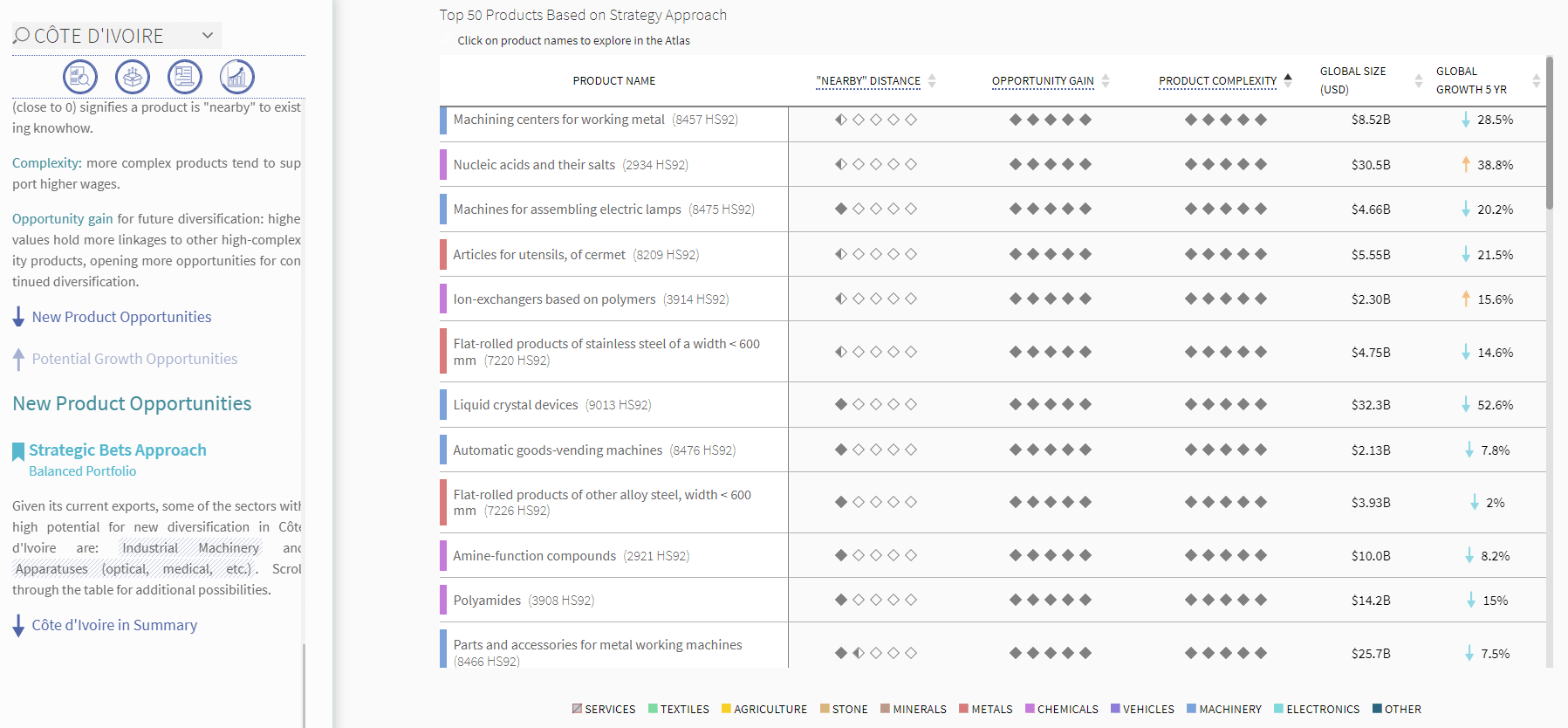
Also for trade & industrial policy purposes I find the Atlas Of Economic Complexity (https://atlas.hks.harvard.edu/countries/384) an interesting resource.
I like the categorizing of countries into different economic strategies & the prioritized list of suggested new product opportunities for countries.

This is a genuinely useful resource, thank you. I've not encountered the Atlas before in agricultural value chain work in West Africa, but hadn't fully appreciated its potential as a cause prioritization tool.
What strikes me is that the Economic Complexity Index makes visible something development discourse tends to obscure: the structural distance between where a country's productive capacity sits and where it needs to go. That distance is a map of where institutional intervention has the highest leverage exactly the kind of analysis EA cause prioritization should engage with, but rarely does.
The product space framework also reframes the core question: not "what intervention produces the best RCT result" but "what structural moves make the most other moves possible." That is a more powerful question, and one that connects directly to climate adaptation, food systems, and AI governance in African contexts.
If there's a real research agenda here applying complexity economics to EA cause prioritization in Sub-Saharan Africa, identifying high-leverage structural interventions that the current EA portfolio underweights because they resist standard impact metrics.

As for your post about EA & a lot of EA participants being in far away developed countries, I agree & my exposure to this line of thinking largely comes from the book The Anti-Politics Machine (https://en.wikipedia.org/wiki/The_Anti-Politics_Machine) describing previous failures in international development from a lack of local knowledge. It’s actually something I find interesting about EA interventions, as instead of trying to develop detailed local knowledge they work around the issue with things that require less local knowledge to work. It’s easier to support a one-time technical intervention like vaccines with like New Incentives that do not require continued follow-up throughout a person’s life or to just send cash with GiveDirectly. And I can’t say this is a bad or even sub-optimal approach as things like vaccines have such great benefits for such low cost & low risk of intervention failure. It more reveals how under funded everything is that things like vaccines & cash transfers to expectant mothers aren’t fully saturated leaving only interventions that could use more local context. 

This is one of the most useful framings I've encountered for a tension I've felt but struggled to articulate clearly. James Ferguson's argument that development interventions systematically depoliticize the problems they claim to solve maps directly onto what I observed in the field. The machine produces outputs, but the underlying power structures remain untouched.
Your point about EA working around the local knowledge problem rather than through it is sharp, and I think largely correct. Vaccines and cash transfers are genuinely brilliant precisely because they minimize the surface area for implementation failure. But I'd push back slightly on the implication that this is sufficient as a long-term strategy. The interventions that are currently "not saturated" as you put it are not randomly distributed. They tend to cluster in exactly the domains where local context, political economy, and institutional relationships matter most: primary healthcare systems, land governance, nutrition policy, climate adaptation. At some point, EA will have to engage with the messiness it has been successfully avoiding.
That's not a critique it's what I think the next frontier looks like. And it's part of why I think people with field experience in these contexts have something genuinely useful to contribute to the conversation, rather than just being recipients of well-designed interventions.

Hello Arthur,

Welcome to the EA forum & to the bootcamp. Do you have a Linked-In or other preferred social media account to connect? It may be worth linking it here for people.


As for me, I am also listening in to the bootcamp & I am a software developer for Chemonics, previously the largest USAID global health contractor. With the dismantling of USAID we may soon look to provide other services to multi-laterals & to individual country governments & organizations so your opinions may be interesting.

Thank you Tyler, and welcome to the conversation! I've added my LinkedIn to my profile feel free to connect: linkedin.com/in/meniansoun-arthur-kouadio-566373249 and my email is : meniansou25@gmail.com.
I would be delighted for us to have an in-depth exchange for draft solutions.
Your context at Chemonics is actually very relevant to what I'm thinking about. The dismantling of USAID is creating a real vacuum in implementation capacity across West Africa which leaves a big void and creates problems that I notice very often and the organizations that will fill that space are precisely those that can combine operational rigor with genuine local embeddedness. I'd be curious to hear how Chemonics is thinking about that pivot toward multilaterals and country governments. There may be more overlap in our thinking than it first appears.

Curated and popular this week
Relevant opportunities