Comments
Thank you, Leroy, for sharing your experiences. Your article was very informative and moved me emotionally.
Thank you, Leroy, for sharing your experiences. Your article was very informative and moved me emotionally.
Executive summary: In a reflective, narrative account of an internship at Fish Welfare Initiative, the author argues that effective altruism in practice involves acting with what you have when opportunities arise, while continually refining cost-effectiveness and staying grounded in the realities of large-scale suffering.
Key points:
This comment was auto-generated by the EA Forum Team. Feel free to point out issues with this summary by replying to the comment, and contact us if you have feedback.
I'm so glad my forum post was able to play a role in this experience for you. It sounds like you were also very personally affected by the internship -- seeing the uncertainty and suffering up close is far different from reading about it from behind a screen in a developed country; I really hope other EAs can have experiences like ours to better understand the ground-level complexities of making change in a messy world.
If only the team had adopted puppies while I was there...
Note: This article was originally published on the Fish Welfare Initiative blog.
While this piece is more narrative-driven than a typical Forum post, Haven (FWI’s ED) suggested I crosspost it here. I found the experience of small-scale helping (like rescuing a puppy) and working in high-scale intervention (improving fish farm conditions) to be useful for rounding out my understanding of being "effective" in practice.
I try to address bridging the gap between abstract EA principles and the basic practice of 'doing good' when the opportunity arises, while also illustrating my experience interning with a cost-effective animal organisation.
When I arranged my internship at Fish Welfare Initiative, I had a standard list of expectations: farm visits, operations and project work. I arrived wanting to see how a cost-effective organisation functions in real life. However, the clearest lesson I learned about FWI’s ethos didn’t happen in an office or at a fishpond. It happened on the motorway to Vijayawada.
On a weekend outing, as Haven, Jennifer, and I were heading down the highway, we approached a knot of cars; not out of the ordinary for India – until we saw a man lying in the road, surrounded by a crowd. We pulled over and grabbed the first aid kit. His face and the back of his head were bloodied, he was barely conscious. We tried to call an ambulance, but after a few minutes it became clear: no one was coming any time soon.
It was at this point that we became the ambulance.
AI regeneration of the event.
Haven pulled up the car and the crowd helped lift the man inside. Next thing we were speeding down the Vijayawada highway with Haven zipping between cars like Jason Bourne, Jennifer and a man on a motorbike clearing the way ahead. Twenty minutes later, we must have been one of the strangest sights to ever roll up to the Vijayawada emergency gate: three foreigners delivering a bloodied stranger from the back seat of a hatchback.
He was conscious when we handed him over. When the adrenaline finally settled, Haven said, “We did well. But what could we do better next time?” Over the past month, I’ve seen this ethos repeat itself: act with what you’ve got, then look for how to be more effective.
This is the mindset which I had wanted to see in action by volunteering with a cost-effective organisation. But, let’s rewind a bit.
Cost-Effectiveness in Practice
The prospect of an (unpaid) internship with FWI first arose after reading the previous intern, Annika’s post in the Effective Altruism forum. I happened to be travelling in Vietnam at the time and wanted to see how a genuinely cost-effective animal organisation operated. From the outset, Haven framed the internship as a two-way street and wanted to make sure I got something substantive from it. He also suggested I attend AVA — the Animal & Vegan Advocacy Conference — in New Delhi since it fell close to my internship start date, and invited me to stay in their shared Airbnb for the event.
When I landed in Delhi and caught a taxi to the Airbnb, the driver repeatedly questioned me; “Why are you staying here? This is the red-light district.” I giggled because I knew the answer: It was near the conference, and it was cheap. I’ve done my fair share of backpacking, the location didn’t faze me. In a world where organisations burn cash on business-class flights, glossy hotels and fancy dinners, it was refreshing to see that FWI’s cost-effectiveness in practice. Housing nine of us, the price of the Airbnb for the entire event was comparable to a single night in a hotel room. We had some fun there as well – hosting impromptu parties after a gallant quest for beer, alongside packing into one of the bedrooms for some Bollywood dance lessons. It was a good introduction to see how being cost-effective didn’t need to compromise a good team environment.
I arrived in Eluru, FWI’s home base, at the end of their strategy week, which meant I got to meet almost the whole team before engaging in a range of projects. I started learning the backbone of the organisation through operations work, where they were transparent enough to even involve me in budgeting decisions.
Connection and Scale
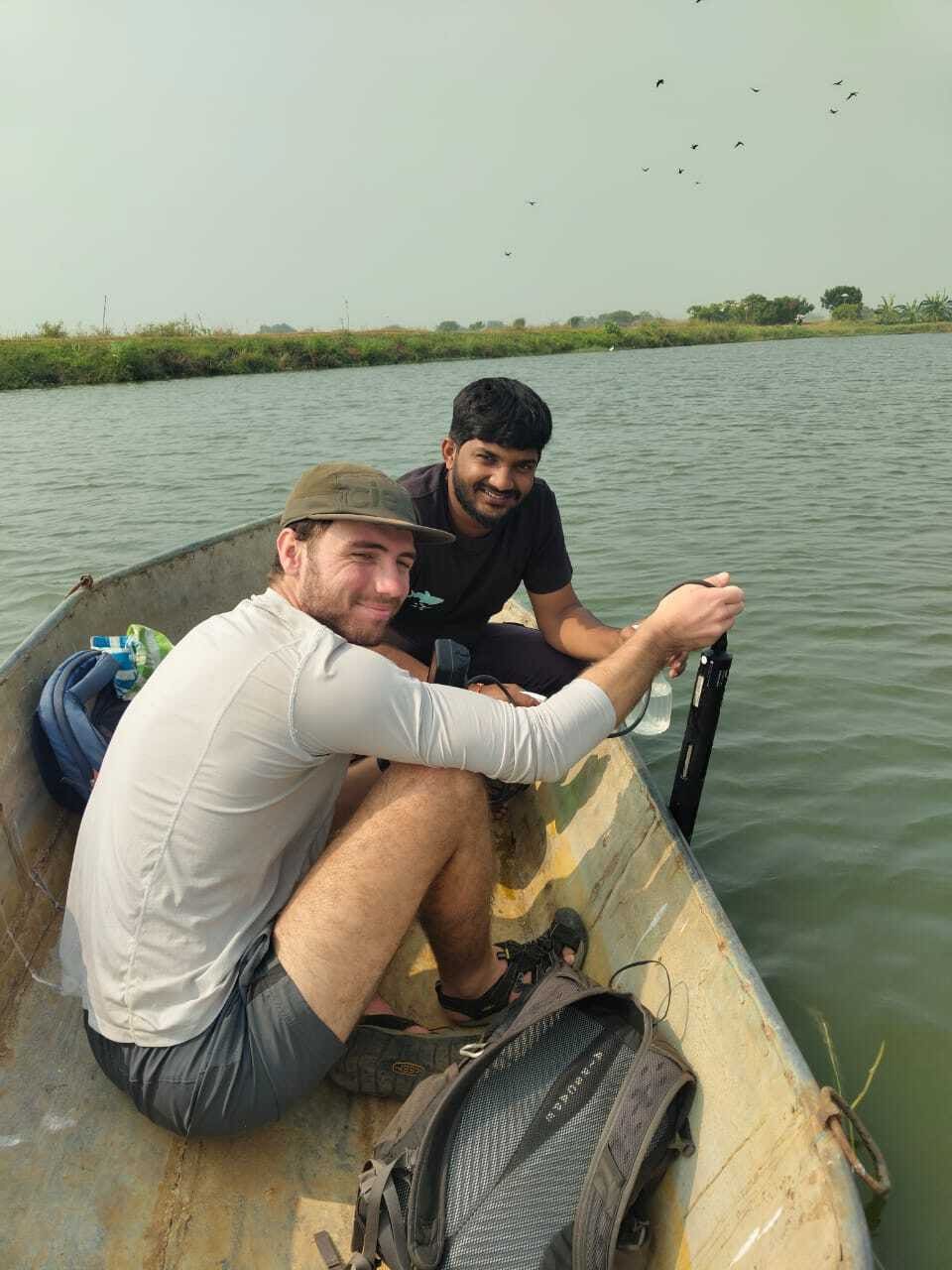
I then moved to the programs team (ARA) for field visits; taking water quality measurements for their satellite imagery campaign. Driving through the farms on the back of a coworker’s bike helped me grasp the scale of fish farming, where each pond held potentially tens of thousands of fish. Alongside that, I performed data analysis to look at how time spent in the ARA program related to participating farms’ water quality over time, and the effect of deviations in pH-pen calibration on out-of-range measurements.
Taking a water quality measurement with the ProDSS
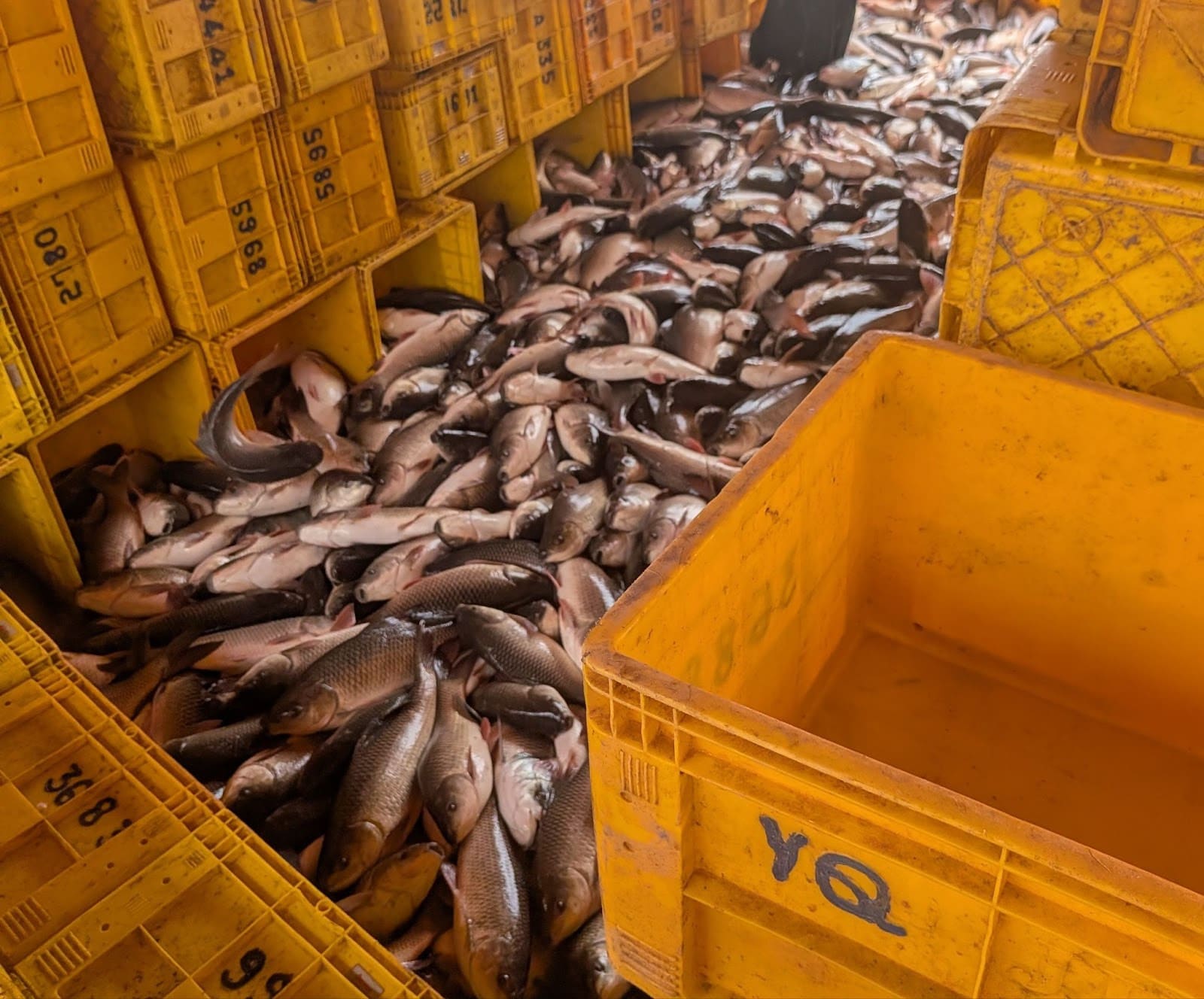
During my time here, I also came face-to-face with animal suffering. Poverty isn’t hidden in India, nor is animal farming. A few days ago I witnessed a fish harvest where thousands of fish were carried in baskets from the pond, thrown into a pit, sorted into crates, packed on ice and loaded into delivery trucks. They were still alive — suffocating through the entire process, and would die on their way to wherever they were being delivered.
Fish aren’t animals we intuitively relate to: they’re scaly, silent, and unreadable. But watching them struggle, it was unmistakable that they suffer. The reason I’m drawn to the animal movement is because while the world is full of uncertainty, animal suffering is unquestionably happening at scale. To actually have an impact, you have to meet the world where it’s at. I found FWI’s work meaningful because it occurred at this point of intersection with reality.
Fish suffocating during a harvest.
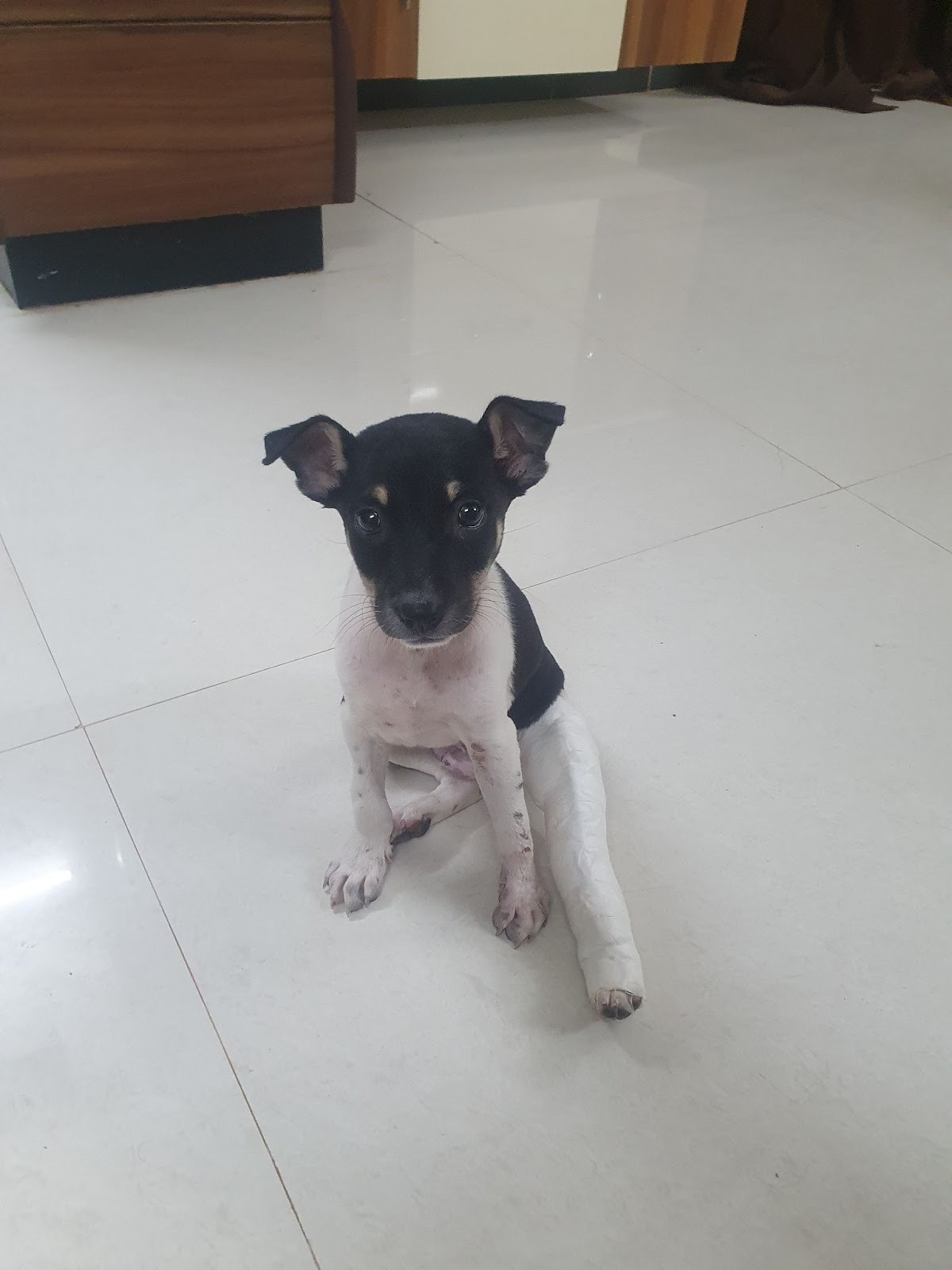
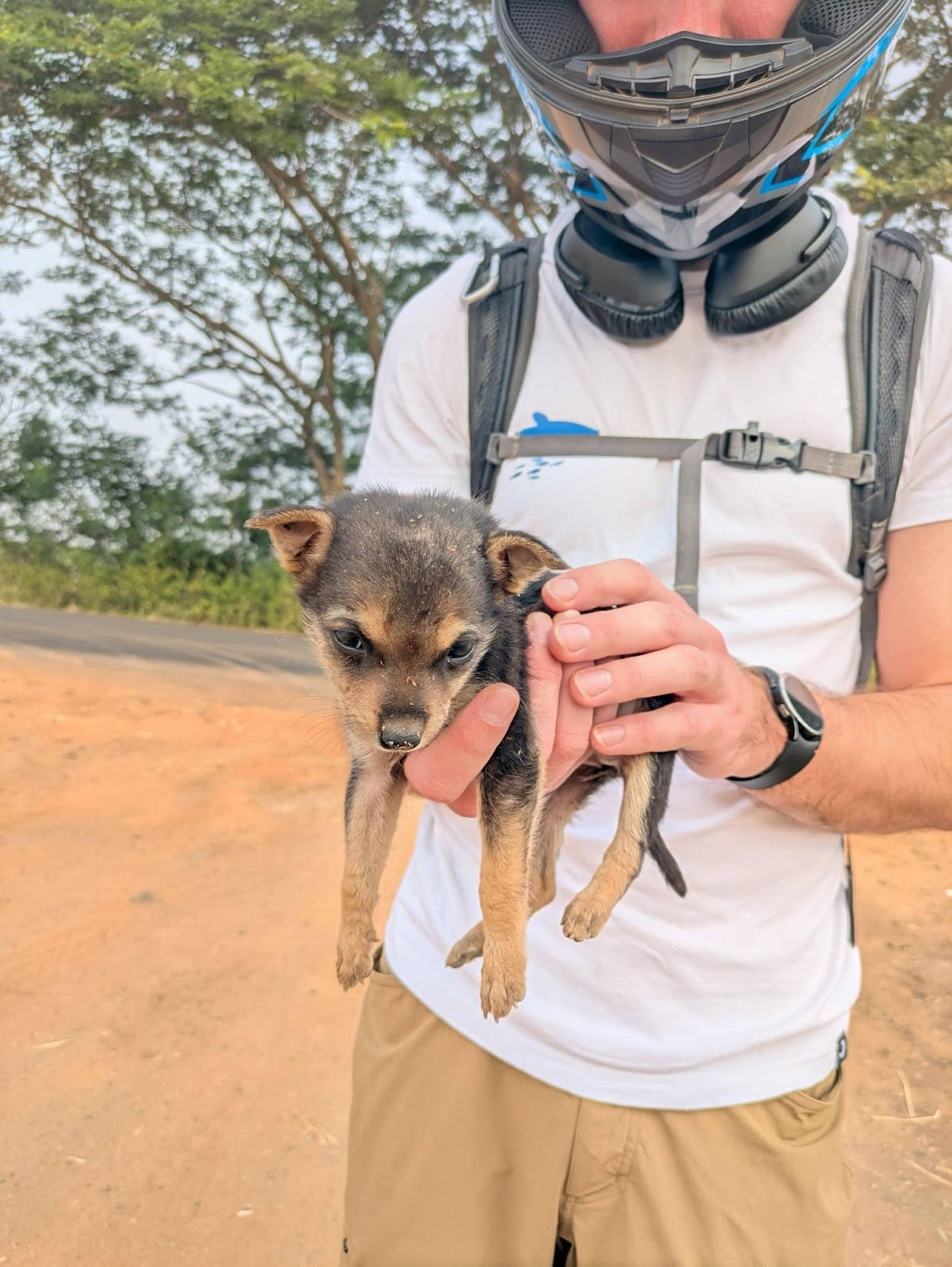
This harvest illustrated the systematic suffering FWI is working to reduce, but it happened alongside a smaller, more personal victory. During my internship stay, I ended up helping care for two rescued puppies. The first was Panda, a very young pup Jennifer found on the roadside with a broken leg. I helped look after him for about a week before we took him to a shelter run by a small team, they took in over two hundred dogs simply because they saw the need. The second was Ruby, a malnourished puppy we picked up a week later, covered in fleas and clearly struggling. She’s now healthy, sitting at my feet as I write. One puppy is easy to feel; a pond of fish isn’t. It’s hard to emotionally quantify the impact you’re having on a harvest, but saving Ruby felt immediate Yet, acting with what you can, whenever you can, remained the consistent thread during my time here.
Panda (left) and Ruby (right).
The Value of Showing Up
My final week was spent shadowing Haven, while also taking care of Ruby. Amusingly, he pointed out my sudden responsibility for a puppy was a decent analogy for the constant adaptions an ED of a cost-effective organisation has to make. You rarely have full information, but you can filter with the right questions: Is this worth my time? Does this meaningfully help fish? He presented cost-effectiveness as a discipline; it can be uncomfortable and inevitably forces trade-offs. But those choices are what make real action possible.
Amongst it all, the main thing I learned over the course of my time here was the value of showing up. Early in your career, it’s hard to know where to start, what action to take, or whether what you’re doing is the right thing for you — or the world. India isn’t the easiest place to be, mentally or physically. But, most of the world’s animal farming occurs in Asia. Even if you’re like me and work behind a laptop, there's real value in seeing data in the world it comes from.
In many cause areas, we are distant from the suffering; geographically, physically, mentally. So I want to encourage others to get a bit closer to the ground, in whatever form that takes. Earlier this year, I volunteered at an animal shelter in Rajasthan, and the experience helped break the spell of high-level abstraction. You meet farmers who genuinely want to keep their fish healthy. You encounter the resistance of reality: equipment that fails, constraints you didn’t anticipate, and unpredictability everywhere. And you learn humility as you became the apprentice again, developing skills in a field that’s new and unfamiliar. The feedback you get is high-resolution; you see what works and what doesn’t. And that can change how you understand your work going forward.
Travelling in lower-middle income countries and getting my feet on the ground has helped me calibrate my personal compass. I encourage anyone still trying to find their way in this space to reach out to FWI or similar organisations. You will learn humility, you will see high-resolution feedback on what works, and like us on that highway in Vijayawada, you might find yourself precisely where you need to be to make a difference.
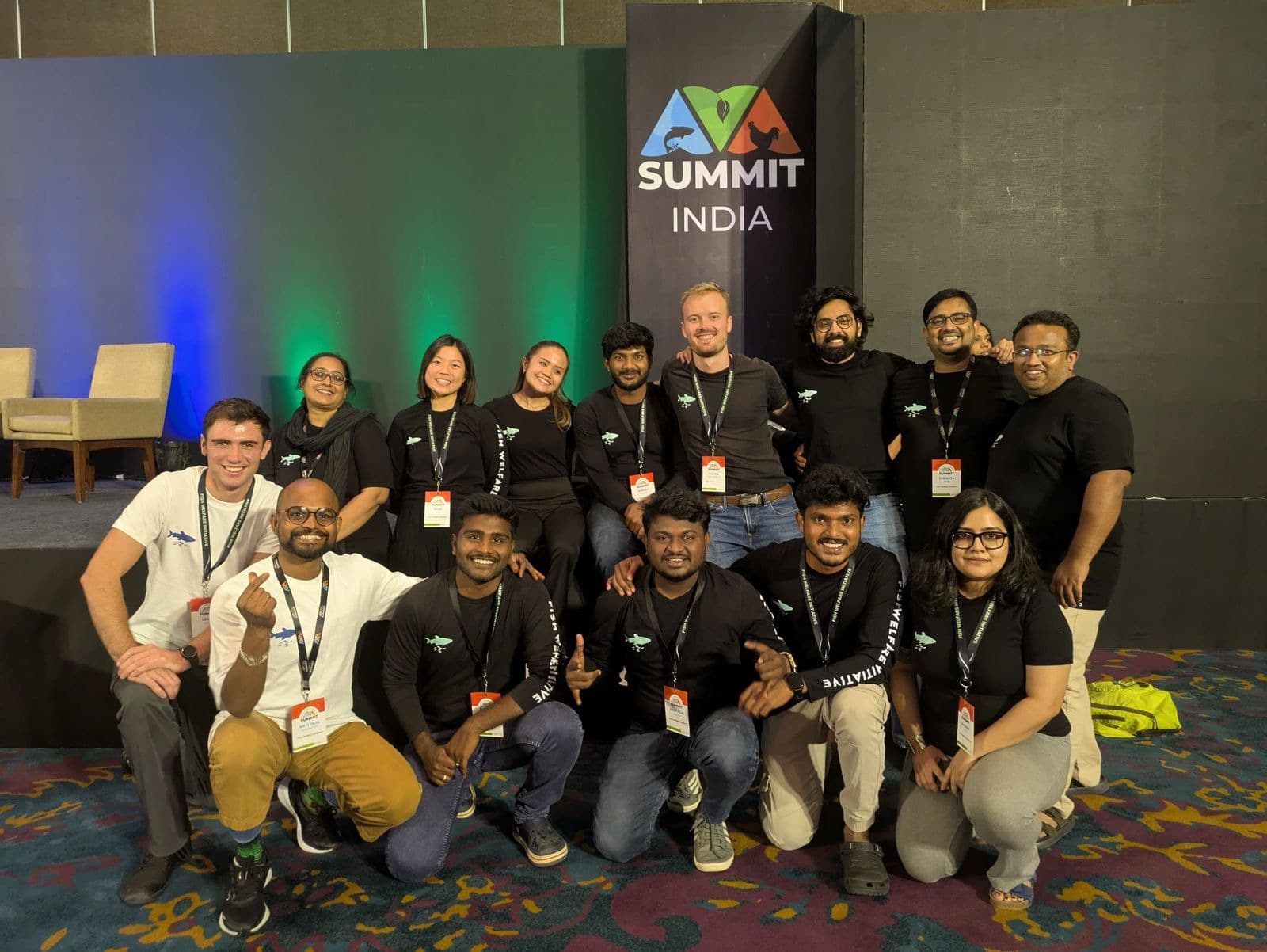
The FWI team and myself at AVA, New Delhi.



Strong upvoted.
I find this refreshing and going back to what EA is about, and would definitely point at it as "the sort of experience I expect an EA org to allow for". I also appreciate the moral character that you're showing up. I want more testimonies like this on the forum to help people get [back] in touch with this spirit.
I sometimes feel like I had partially lost my initial ambition, and your post corrected for some value drift. Thank you.