Comments
Cross-posted from my new Substack, Alternative Perspective. Views my own.
Part I of Do Beans Beat Alt Meat?
People know me as a plant-based meat pessimist, mainly for my review “Price-, taste-, and convenience-competitive plant-based meat analogues would not currently replace the majority of meat consumption” (published & free version). I argued that even if products like the Beyond or Impossible burgers were as cheap, tasty and convenient as beef, most people would still choose beef.
However, I ended the paper by claiming “This result does not imply that plant-based meat analogues have no role in environmental, public health or animal welfare policy.” Among other reasons for optimism, I thought that adding a competitive plant-based meat option to a menu might reduce meat consumption, if only by 5 or 10 percentage points. Alas, my own research would show me wrong and wrong again. So in the spirit of caring critique, I will begin with some self-care.
You can see my optimism in predictions I made about the results of a 2023 study. Sagar Shah and I were about to reanalyze 35,048 hypothetical lunch choices by 1,348 university students in Germany. Each student had chosen a meal from a series of lunch menus with five items, two or three of which were meat-free. Some of those meat-free items were plant-based meats, although not the more modern options like Beyond or Impossible. The menus showed photos and descriptions of real university canteen dishes, but no prices.
Before peeking at the data, we wrote out our premonitions. I guessed it was 65% likely that menus with a plant-based meat option resulted in more meat-free choices, and 60% likely that the association would be statistically significant. After conducting our analysis, we found the odds of picking a meat-free option were 1.18 times higher when a plant-based meat was available. So I was “right” on the first one. However, the 90% confidence interval, which accounts for the uncertainty of only asking so many people, ranged from a small drop (0.89) to a large boost (1.56).[1] In other words, I was wrong about distinguishing this result from chance.
Given that the possible range of effects is so wide, the study was inconclusive on this question. I share this study instead to show what I thought at the time. Two subsequent studies have shown me to be wrong more conclusively, although they certainly still have important limitations.
Checked at Chipotle
In a 2026 study led by Jessica Hope (published & free version), we asked 4,431 US adults to pretend to order tacos from Chipotle’s online menu. Each person randomly saw a menu including either one, two or three meat-free options:
-
Just a veggie filling with guacamole.
-
Veggie filling + Sofritas, a meaty shredded tofu. (Chipotle’s actual current menu.)
-
Veggie filling + Sofritas + Chick’nitas, a fictional chicken-style plant-based meat, priced the same as chicken and advertised with a picture of actual chicken.
We hypothesized that each meat-free option added would reduce meat orders. Our study could detect a change as small as a 5-percentage-point drop.
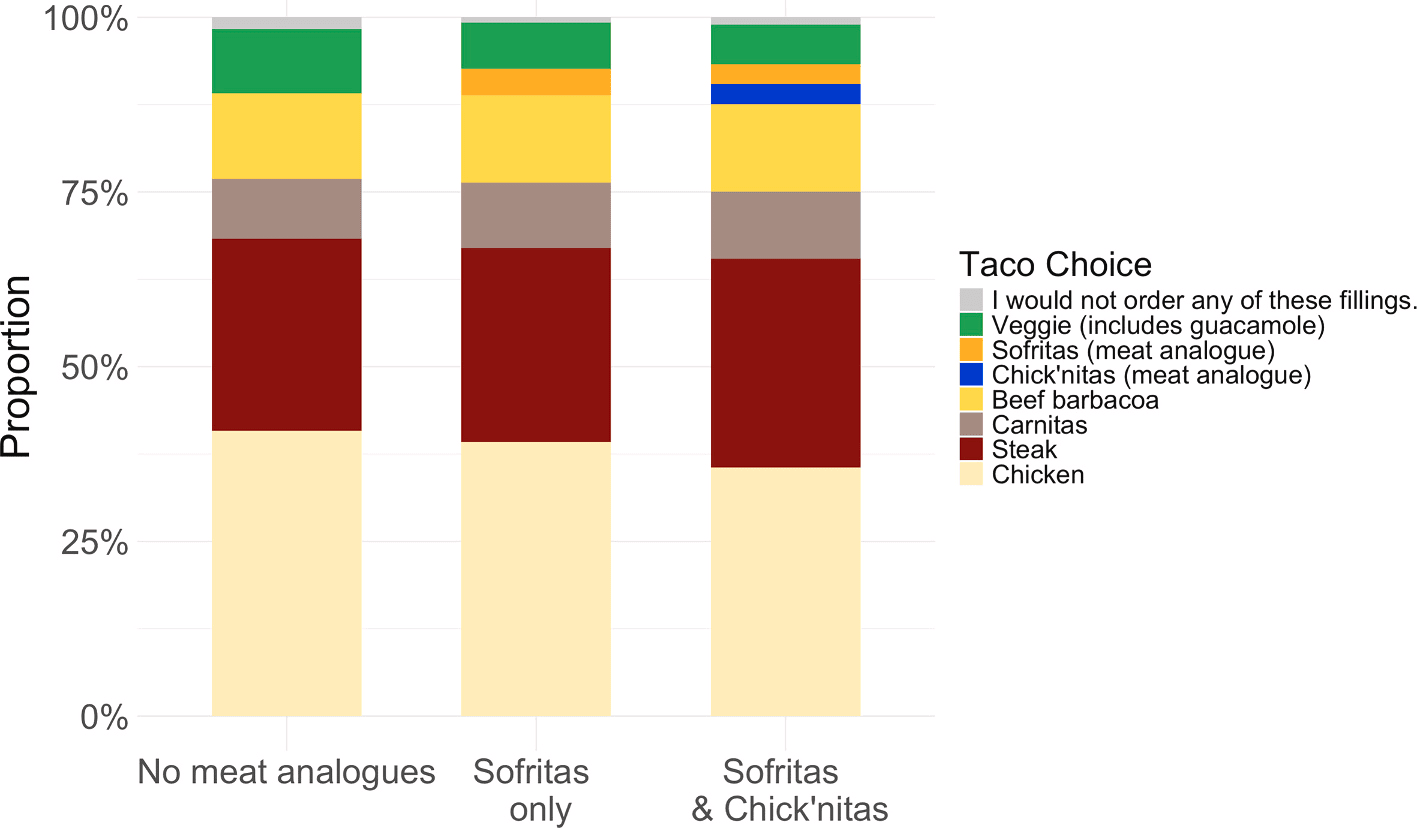
Taco filling choice by menu. Figure 3 from Hope et al. (2026).
But meat orders barely moved. Adding the two options dropped meat orders by 2.1 points, with uncertainty ranging from a 4.4-point decline to a 0.1-point increase. Adding just Sofritas cut meat by 1.1 points (3.3-point decrease to 1.0-point increase). Unlike Chick’nitas, Sofritas is a real product that people have had more than a decade to try! So, despite the name, Hope et al. (2026) did not provide hope for our hypotheses: adding more plant-based meat options mostly pulled people away from the existing veggie option. It ruled out a reduction of 5 percentage points or more.
No change at this register
Of course, that study was hypothetical. While I’d generally expect hypothetical studies to be too optimistic—the stakes are low and people might just try to give the “right” answer—we thought real orders might tell a different story.
In a 2026 study led by Jared Winslow, we analyzed 1.2 million transactions from several restaurants in the US and Canada between 2016 and 2023, which sold 14 plant-based meats. For example:
-
A burger chain offered the Impossible Burger, Impossible Sausage and Beyond Burger. Its “Gold Standard Impossible” sold 11,000 times, against 94,000 for the “Gold Standard Bacon”.
-
A breakfast café with an Impossible sausage patty.
-
A coffee shop and a juice bar with plant-based bacon and sausage.
After introduction, the products accounted for between 1% and 9% of purchases depending on the restaurant, although they cost $1 to $2.50 more than the corresponding meat dishes. Again, we hypothesized that an additional plant-based meat on the menu would decrease meat purchases.
But meat purchases didn’t budge. For three of the restaurants, adding a plant-based meat to the menu had no detectable effect, with uncertainties within ±5%. The other three were much less certain, with some uncertainties ranging from a 21% decrease to a 33% increase. As a result, the overall average is a 1% decrease in meat purchases, but the uncertainty ranges from a 15% decrease to a 16% increase. This wide range shows these six restaurants could not rule out the possibility that plant-based meat works well in some restaurants. But the underlying trend is revealing: for the restaurants where we were more certain, plant-based meat cut meat purchases by less than 5%, if at all.[2] We also analyzed 12 more restaurants with patchier data. With those included, the average was 1% more meat purchases per additional plant-based meat item, with uncertainty between 6% fewer up to 8% more.
There are many other analyses in this paper—including 267 exploratory restaurant-level estimates—that are worth reading: restricting to Impossible products, focusing on repeat customers, or comparing sales before and after each new product launch. However, most result in larger uncertainties. None find particularly compelling results for plant-based meat, although they usually can’t rule out an effect either. The few that stand out could easily be chance, given so many analyses.
Toward realism
Mind you, these are just the studies I worked on since writing my review paper. Among others, that review includes Malan et al. (2022), where Impossible ground beef was added to a university dining hall’s menu and promoted with a climate-themed marketing campaign. Once more, the results point to a small or null effect, within the limitations of the study design. Then there’s the grocery store literature, which I haven’t focused on as much since many plant-based meat products at the grocery store taste bad and cost more. It is nonetheless worth mentioning that studies like Cuffey et al. (2023), Neuhofer & Lusk (2022) and Meyer et al. (2024) also can’t seem to find plant-based meat reducing meat consumption, despite its sales—again with real methodological limitations.
As ever, there is room for skepticism. Only one of the studies was a proper experiment that unequivocally shows causation; maybe the rest were confounded. Maybe the higher plant-based meat prices in some studies drove off customers. Maybe Sofritas, Impossible and Beyond just don’t taste enough like meat. But one certainly has to wonder when study after study can’t find an effect. And we might expect even imperfect products to have some effect. If you dismiss all these results because the products don’t quite achieve “price and taste parity,” I challenge you to fund or conduct the study that does. Taste testing suggests plant-based meats taste better than ever, and prices are readily subsidized within a study. The foretold-yet-ever-elusive impact of competitive plant-based meat could be revealed to us in the present with the right study. For now, I predict another null result.
Although I continue to think that plant-based meat has potential to help animals and our environment, this potential may largely flow through future scenarios where consumer acceptance is much better. Or maybe some regions are already more favorable—these studies are mostly limited to the US. Given these results, we have to ask: do plant-based meats bat above replacement? That is, would consumers prefer another classic plant-based option like beans, falafel or veggies to an alt meat added to a menu? Perhaps these would be seen as more natural, healthy or traditional, or would otherwise find traction. In Part II, we’ll climb the beanstalk...[3]
References
-
Cuffey, J., Chenarides, L., Li, W., & Zhao, S. (2023). Consumer spending patterns for plant-based meat alternatives. Applied Economic Perspectives and Policy, 45(1), 63–85. https://doi.org/10.1002/aepp.13280
-
Hope, J. E., Green, S. A., Peacock, J. R., & Mathur, M. B. (2026). Effects of adding plant-based menu options on meat selection frequency: A randomized controlled experiment. Food Quality and Preference, 143, 105931. https://doi.org/10.1016/j.foodqual.2026.105931
-
Malan, H., Bartolotto, C., Wilcots, C., Angelis, P., Ferrone, A., Wible, C., Westbrook, E., Fabris, E., Wang, M. C., Slusser, W., Jay, J. A., & Prelip, M. L. (2022). Increasing the selection of low-carbon-footprint entrées through the addition of new menu items and a social marketing campaign in university dining. Journal of the Association for Consumer Research, 7(4), 461–470. https://doi.org/10.1086/720450
-
Meyer, C., Freitas-Groff, Z., & Woolley, T. (2024). Why are fewer grocery shoppers buying meat? Declining grocery sales, prices, and cultural change (SSRN Scholarly Paper No. 4867295). Social Science Research Network. https://doi.org/10.2139/ssrn.4867295
-
Neuhofer, Z. T., & Lusk, J. L. (2022). Most plant-based meat alternative buyers also buy meat: An analysis of household demographics, habit formation, and buying behavior among meat alternative buyers. Scientific Reports, 12, 13062. https://doi.org/10.1038/s41598-022-16996-5
-
Peacock, J. R. (2026). Price-, taste-, and convenience-competitive plant-based meat analogues would not currently replace the majority of meat consumption: A narrative review. Appetite, 216, 108301. https://doi.org/10.1016/j.appet.2025.108301
-
Shah, S. K., & Peacock, J. R. (2023). How meat-free meal selection varies with menu options: An exploration. Open Science Framework. https://doi.org/10.31219/osf.io/z8vdu
-
Winslow, J., Peacock, J. R., Dhargawe, J., Sherman, H., Green, S. A., & Mathur, M. B. (2026). New alternatives, same orders: Modern alternative proteins did not replace meat purchases in restaurants. SocArXiv. https://doi.org/10.31235/osf.io/tpyk9_v1
From here on out, I’ll give ranges for important quantities. These will represent 95% confidence intervals unless otherwise noted. This first one is a 90% confidence interval. ↩︎
Technical note: This paper reports percentage changes, not percentage-point changes. To illustrate the difference, if meat consumption went from 50% to 40%, that would be a 20% decrease (= (50% − 40%) / 50%). It is also a 10-percentage-point decrease (= 50% − 40%). Since my hypothesis was in percentage points, my analysis here in percentages actually favors plant-based meat. The change in percentage points would be smaller. ↩︎
In hopes of learning from a wise hen, of course, not to steal her eggs. ↩︎