Comments
Summary
This post visualizes a wellbeing-based system that progresses toward the most good and overviews steps to stabilize it. These steps are: 1) Implement existing risk mitigation strategies among major stakeholders, 2) Understand wellbeing through research and its coordination, 3) Facilitate institutions’ implementation of wellbeing research, 4) Facilitate reflection on institutional objectives, and 5) Increase participation in the global system if this is significantly reduced.
I thank Ben Smith and Abraham Rowe for references to wellbeing research. All errors are mine.
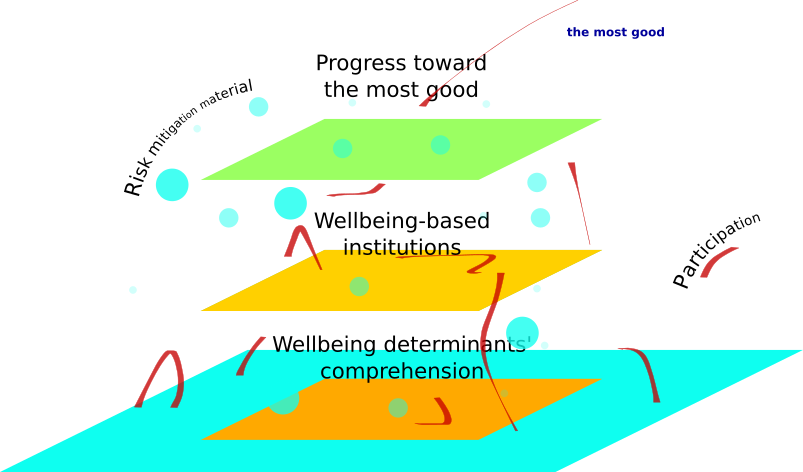
Level 0 and throughout: Risk mitigation material
Risk mitigation increases the system's robustness.
✔️ Area-specific risks are being understood.
❌ Implementation of risk mitigation strategies among major stakeholders is limited.
→ Implement existing risk mitigation strategies among major stakeholders.
Level 1: Wellbeing determinants’ comprehension
Wellbeing determinants’ comprehension enables the advancement of a wellbeing-based system.
✔️ EA-related organizations inspire focus on wellbeing.
❌ Wellbeing determinants are researched by few organizations. These include:
EA-related:
- Animal Ask
- Animal Ethics
- Center on Long-Term Risk
- Center for Reducing Suffering
- Essays on Reducing Suffering
- Future of Humanity Institute
- Happier Lives Institute
- Rethink Priorities
- Sentience Institute
- Wild Animal Initiative
EA-unlabeled:
- Berridge Lab (“affective neuroscience & biopsychology”)
- Dr. Antonio Damasio (“brain processes, underlying emotions, feelings, decision-making and consciousness”)
- Dr. Peter Godfrey-Smith (cephalopod intelligence, consciousness philosophy)
- References (wild animal welfare measurement)
❌ Wellbeing research is not coordinated.
→ Understand wellbeing through research and its coordination.
Level 2: Wellbeing-based institutions
Wellbeing-based institutions influence wellbeing determinants according to research findings.
✔️ Wellbeing occurs in current institutions.
❌ Few institutions use research to increase wellbeing.
→ Facilitate institutions’ implementation of wellbeing research.
Level 3: Progress toward the most good
Wellbeing-based institutions can progress toward the most good.
✔️ Institutions progress toward their objectives.
➖ Some institutions reflect on their goals.
→ Facilitate reflection on institutional objectives.
Throughout: Participation
Participation enables the system’s progress toward the most good.
✔️ Individuals participate in the global system.
→ Increase participation in the global system if this is significantly reduced.