We’re often asked what a good Monitoring, Evaluation, and Learning (MEL) system looks like, especially for small organizations with limited capacity and resources. Every organization’s context is different, but our answer starts from the same place: Suitable MEL.
We recently put together a guide to Suitable MEL particularly for organizations navigating competing priorities with limited capacity. Suitable MEL doesn’t ask smaller organizations to give up rigor. Instead, it argues that a MEL system’s sophistication should match the questions it needs to answer and the context it operates in. For example, more elaborate analysis isn’t the right next investment if the indicators and data collection beneath it aren’t yet reliable. In this guide, we explain:
- What program Design and MEL are
- What MEL can and cannot tell us about our programs
- The components of a MEL system, from planning and data collection to evaluation and learning
- What makes MEL practical, meaningful, question-driven, appropriate, inclusive, sequenced, and utilized

WHAT IS PROGRAM DESIGN AND MEL?
Monitoring, evaluation, and learning (MEL) contribute to the improvement of interventions, programs, and organizations by systematically assessing their implementation and outcomes. Design is an essential precursor to MEL that is iterated over time in concert with learning processes.
Key terms

Monitoring: Systematic and ongoing collection and use of data to track relevant information. Routine monitoring typically tracks outputs, outcomes, and context, and compares them to plans / expectations. Monitoring can also track “unintended” or unanticipated results or side effects.

Evaluation: Systematic use of scientific research methods to assess the adherence, merit, value, results, or effectiveness of a project, process, service, intervention, or other effort in response to a set of specific evaluation questions.
Learning: Systematic reflection and utilization of knowledge generated through M&E to inform ongoing adaptation to programs and/or new program design.
(Design): Intentional process of developing an explicit, logical program or intervention blueprint that describes how resources and activities are expected to produce desired change or address an identified problem.
ROLE AND IMPORTANCE OF MEL

This requires knowing what your work intends to do, what you actually did, and what might reasonably be linked to it or expected from it. By intentionally generating data and evidence you can understand your work and its results better.
What MEL can do for you
Provide information: Replaces anecdotes and assumptions with systematic, empirical data. Routine tracking paired with more rigorous inquiry can support a verifiable understanding of what’s happening.
Support decision making: Informs management and adaptation, allowing the comparison of current data against the design blueprint and supporting adjustments.
Contribute to practice: Builds institutional memory by documenting successes, unexpected side effects, and failures.
What MEL cannot do for you
Remove all uncertainty: In complex behavioral and political ecosystems, MEL can provide evidence to support claims, but not absolute proof; the claims made based on these data need to be careful, appropriate, and contextualized.
Substitute for subject matter expertise in programming and context: MEL professionals provide expertise in methods, measurement architecture, and logical validation; program professionals complement this by providing expertise in the context and intervention being implemented.
Selectively generate content to support foregone conclusions: Data curated to fit a predetermined narrative can be manipulative rather than informative.This happens when fundraising or communications priorities shape what a MEL product says, rather than accuracy and transparency.
WHAT IS A MEL “SYSTEM”?
A MEL system comprises distinct but interdependent components that work together, and can be established and operate at different units. Some organizations implement these systems in a standard way across the entire organization; others have systems that vary by geographic location, or at the program, project, or intervention level.
Figure 1 depicts these major components as falling into three categories: program foundations, the MEL context, and the core MEL system.
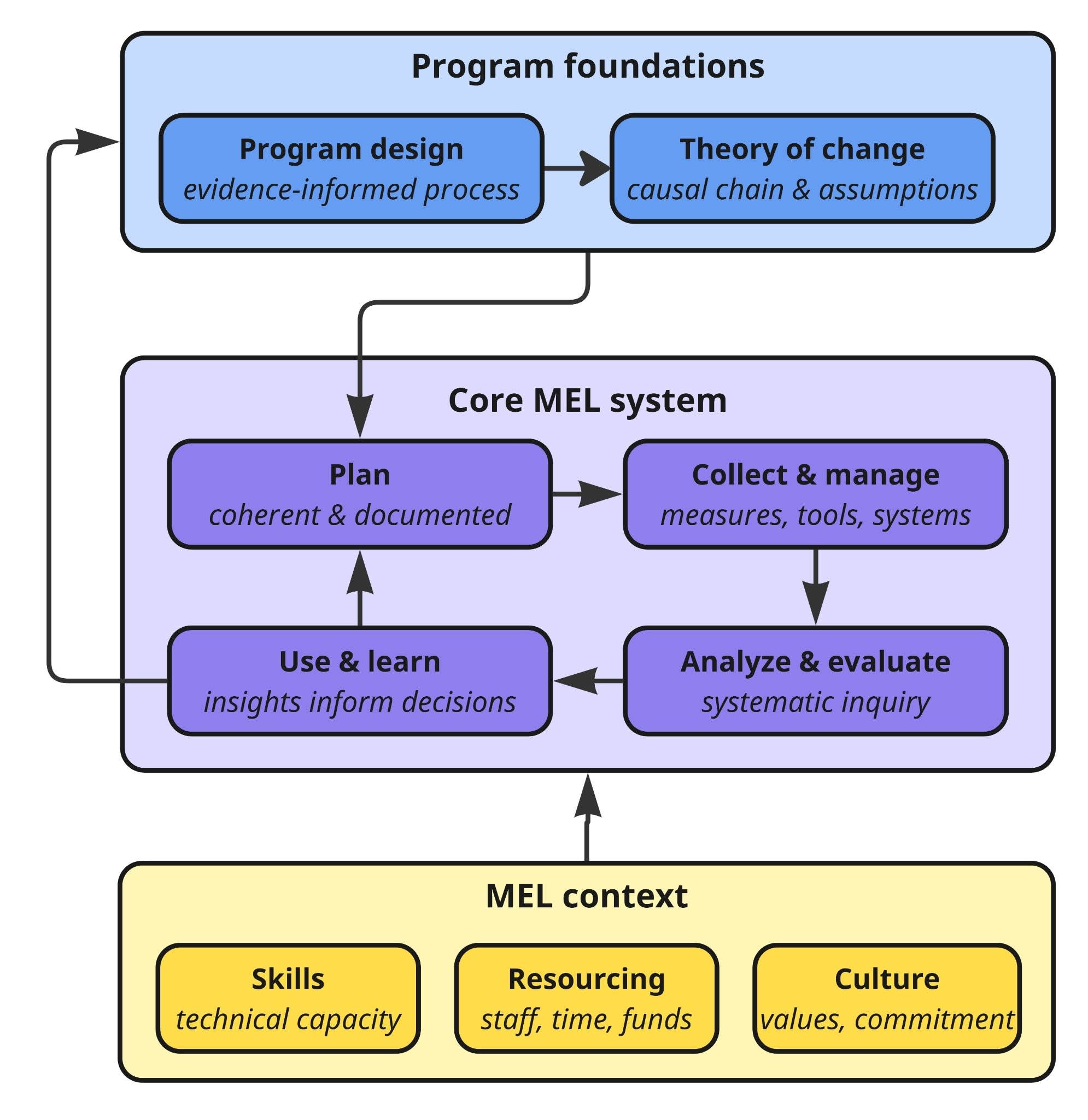
The core MEL system itself can be broken down into slightly more granular categories beyond the above diagram, as follows:
Program foundations
- Program Design: Programs are designed through a systematic, evidence-informed process involving appropriate planning and stakeholders.
- Theory of Change: The theory of change is evidence-informed, depicts a clear causal chain, and makes assumptions explicit.
MEL context
- MEL Culture: MEL is valued and supported across the organization, including commitment and engagement from leadership and staff.
- MEL Resourcing: Adequate human and financial resources are formally allocated to MEL and actually used for it.
- MEL Skills: Organization/program has sustainable and adequate technical skills needed to conduct high quality MEL.
The core MEL system itself can be broken down into slightly more granular categories beyond the above diagram, as follows:
- MEL Planning: Organization/program has a coherent, documented plan for its MEL system linking all steps from program design through learning.
- Indicators: Organization/program has well-designed, clearly specified indicators for routinely monitoring its work.
- Data Collection: Organization/program has appropriate tools and processes for collecting the monitoring and evaluation data it needs.
- Data Management: Organization/program has adequate systems for storing, organizing, linking, protecting, quality-controlling, and accessing data.
- Data Analysis & Reporting: Organization/program analyzes data to produce valid, meaningful, and qualified findings, communicated transparently.
- Evaluation: Organization/program conducts or contracts appropriate, systematic, question-led inquiries beyond routine monitoring.
- Cost-Effectiveness & Impact Modeling: Organization/program systematically assesses the relationship between resources and speculative counterfactual impact.
- Use & Learning: MEL results are used for decision-making, design, and organizational/program learning.

WHAT MAKES MEL “SUITABLE”?

MEL should fit the situation of the unit at which its system functions, whether that be the organization, program, project, or intervention. A young organization with limited staff and budget can implement meaningful MEL suited to its stage of organizational maturity.
Similarly, the frameworks, methods and indicators considered appropriate for an intervention will vary depending on its timeframe, ability to support claims about measured results and external context. This does not change what a system requires as its component parts but does change what those parts look like in practice.
‘Suitable MEL’ recognizes these realities, reflecting judgment about what level of sophistication is appropriate for each component of a system at a given time.
Suitable MEL is:
Practical: ustainable over time and realistic to execute. It must be intentionally and realistically resourced with the funding, dedicated staff time, and requisite technical expertise. Resource limitations are acknowledged, but when an organization chronically under-resources MEL, this can be an indicator that its functions are not prioritized.

Meaningful: Avoids collecting data without a clear purpose, and captures only what is necessary to address its key questions. At the same time, it includes a comprehensive view that reasonably tracks key aspects of implementation, context, and outcomes. It generates information that is relevant for both internal strategic decisions and external stakeholder accountability.
Question-driven: Routine monitoring, focused evaluation, and intentional learning are all driven by questions. Examples include: Are we implementing our intervention as designed? Are we achieving our targets? Are our outcomes being achieved, when, for whom, and under what conditions? There are countless potential questions, but a key feature is neutrality: Suitable MEL does not decide the answer and then backfill supportive data; rather it seeks to tell you what you need to know in order to make your work better.
Appropriate: Utilizes methods rigorous enough to credibly answer key questions without imposing unnecessary burden. Furthermore, the system should minimize bias throughout all processes, make claims supported strictly by the evidence used, and result in reporting that honestly describes limitations and acknowledges levels of confidence. Appropriate MEL tracks substantive information throughout the phases of a theorized causal chain (as described by the theory of change) rather than relying solely on modeled impacts. Understanding these intermediate steps helps to rule out alternative explanations for observed results and diagnose failure points.
Inclusive: Relevant aspects of the MEL system are adapted to the cultural and social contexts of the organization, its operations, and its stakeholders. It accounts for power dynamics between those collecting data and those providing it. Collaborative and meaningful engagement, especially from those affected by the work and/or its MEL system, improves both the validity of findings and their legitimacy to those they concern. What this looks like in practice varies substantially by context and intervention, and requires that these considerations are deliberately addressed.
Sequenced: Components are interdependent, and some build on foundations set in other components. Sophisticated data analysis, for example, is typically not worth pursuing without reliably collected data, which populate clearly specified indicators, which in turn respond to MEL questions grounded in a theory of change. Thus there is a general, directional flow such that foundational components typically warrant attention before those that rely on or build on them. That said, context informs what is appropriate rather than strict adherence to a pre-specified sequence, and a component that is typically earlier in the sequence does not necessarily need to reach full maturity before work on a later one is worthwhile. Making these determinations requires experience and judgment.
Utilized: Data are not merely produced and archived, but actively integrated into workflows. The system features structured learning that turns empirical findings into actionable insights, directly informing ongoing program adaptation and updating design.
IS THIS MEL TOO?
Numerous functions intersect with, relate to, or are frequently confused with MEL.
- Design (Co-dependent): As noted above, good design is essential for MEL. The program role brings subject expertise to define problems, interpret existing evidence, adjust programming and theory to context, consult stakeholders, and select interventions. The MEL role collaborates to make the program's underlying theory of change explicit, pressure-test the causal logic holding it together, and check that it can be credibly measured. It's not uncommon that both roles are carried out by the same staff member(s), especially in small organizations. Ideally, when an organization has the resources to do so, it's best to separate them.
- Project Management (Cross-informing): Management executes and tracks day-to-day activities and implementation, including scheduling, budget, and logistics. MEL monitors whether activities were implemented with fidelity to design, and whether output and outcome targets were met, as well as all evaluative work.
- Organizational Strategy (Informed by MEL): MEL informs leadership with evidence about the extent to which current strategic pillars may be achieving goals, providing the empirical foundation required for high-level decision-making.
- Communications and/or Fundraising (Informed by MEL): MEL serves to "fact-check" narratives generated for the public and for current and prospective donors, providing verified data, limitations, and context to ensure claims are accurate and free from exaggeration. Credible, evidence-backed outcome information supports optimal stewardship of resources.
- Financial Monitoring (Informs MEL): Budgetary compliance and financial tracking require specialized fiscal expertise; those analyses feed into cost calculations for situations in which cost-efficiency or -effectiveness estimates fall under MEL's responsibility.
- Staff Performance Evaluation (Unrelated): Managed by Human Resources professionals or line supervisors, and not a role for MEL staff. Personnel evaluations should not be linked to MEL products.
If you are an organization working in the animal movement and have more questions, contact our team: support@themissionmotor.org
Read and download the resource here: https://www.themissionmotor.org/suitable-mel