Comments
De-extinction efforts waste millions and are likely to end up harming the animals created. Should EAs speak out more against it?
This is a crosspost from my substack blog on animal consciousness, welfare, and effective altruism: https://walterveit.substack.com/p/more-than-zombies-considering-the
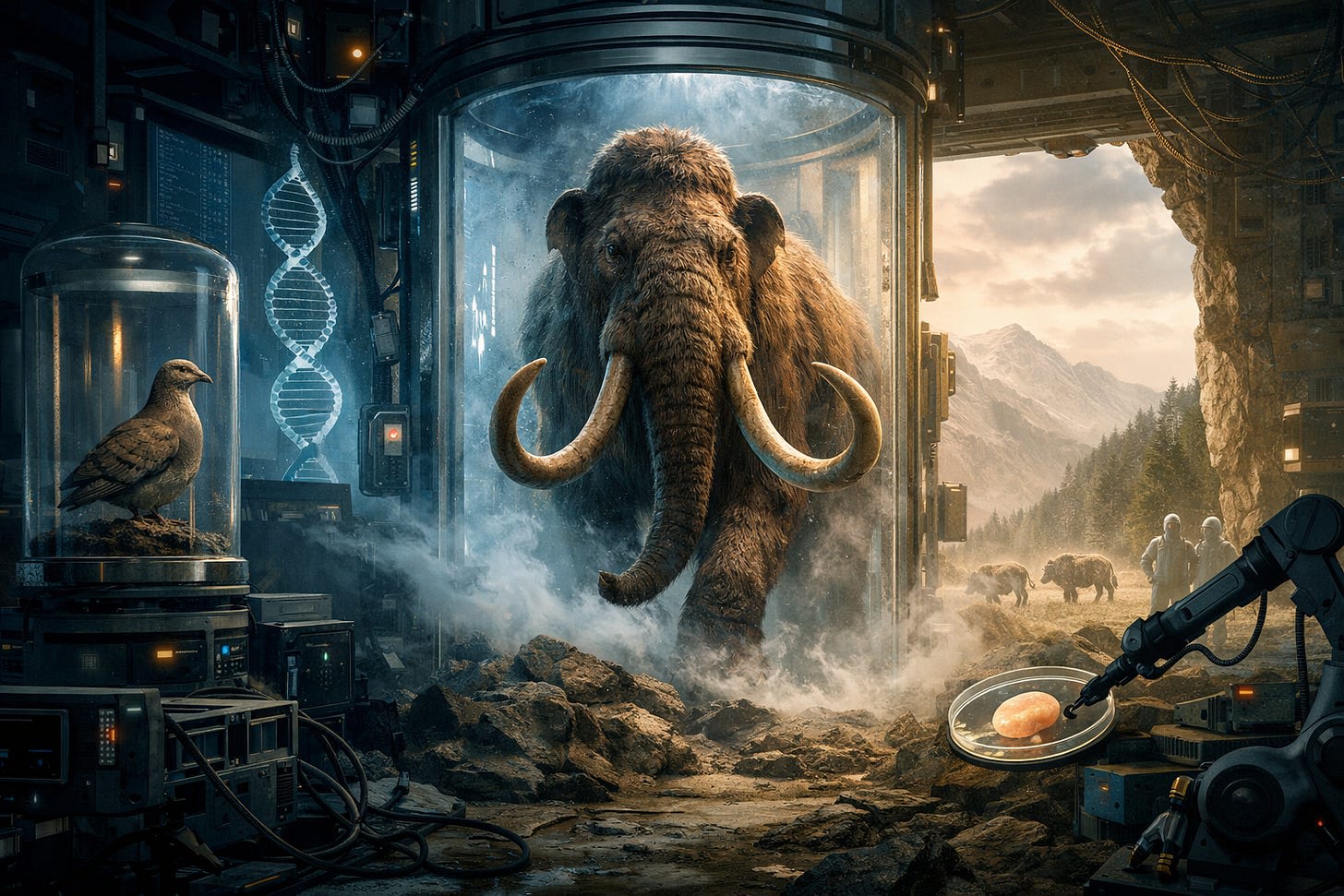
Katz (2022) provides a range of arguments drawn from the environmental philosophy literature to criticize the conceptualisation and practice of de-extinction. The discussion is almost completely devoted to the ontological and epistemological issues, with the intention of avoiding the usual ethical questions that arise in the conversation surrounding de-extinction, including the welfare of de-extinct animals. However, while this may be well-motivated, the points raised are often inextricably entwined with matters of value, used to draw conclusions regarding the ethical permissibility of the practice, and hence make such a separation difficult if not impossible. In particular, Katz emphasizes the relationship between humans and nature, distinguishing between collective citizenship with other animals in nature vs. the domination and control of nature, meaning his arguments all return to ethics. Here we will argue that Katz is in error to exclude the interests of the animals themselves.
As one of us has argued elsewhere, the welfare of de-extinct animals should be one of our primary focuses in assessments of the practice (Browning, 2018). The way Katz frames the discussion places an anthropocentric focus on de-extinction, one in which the animal subjects of the practice are erased. The ethical lens used centres on the values of humans, with frequent discussion of concepts like subjugation and control – human-relevant concepts that do not necessarily matter to the animals affected. The disvalue from these processes is thus here entirely conceived through a worldview that takes the value humans find in nature to come from its apparent wildness, or freedom from interference. The same is true for the interrogation of authenticity as important for the way humans understand their relationship to the natural world, or the value of species as a product of their causal history – these are all considerations of how and why humans value the natural world. While such a framing is admittedly very common in the literature, we think that it is a mistake; one that steers our attention away from the most important factor: the animals themselves. Employing deliberatively emotive and negatively valenced language like subjugation, domination, and the like, pre-empts the conclusion Katz is trying to arrive at. When such terms are taken unreflectively, without justification of their use, it doesn’t provide strong support for the author’s conclusion – we still need to enquire as to whether this represents an objectionable example of the practice.
Importantly, the degree to which animals actually care about the experience of subjugation or domination is likely to be entirely instrumental, based only on the resources or opportunities such control allows or denies them. What will matter to animals impacted by de-extinction projects – the de-extinct animals, research animals, and wild animals – is the ways in which their specific interests are harmed. Just as zoo animals are not necessarily harmed from being housed in captivity (Browning & Veit, 2020), so is it not clear that human control of de-extinction must be necessarily bad. It is the animal’s interests themselves that should concern us most, rather than merely anthropocentric interpretations of the situations. Crucially, this framing of this discussion can erase the animals as subjects, instead taking them as objects that function to instantiate other values (or disvalues) such as naturalness, authenticity, wildness, human artifice, and domination. Here the animals are positioned only in their relationship to the humans who create or interact with them. We see that ‘the nonhuman entities of nature have value because of their freedom and separateness from any sense of human produced function and design’ (p. 7), but this value appears to be their value to humans, where their value for themselves is ignored. As such, our dispute with this viewpoint may be seen as a conflict between an externalist/objectivist perspective that evaluates the situation the animals find themselves in, vs. an internalist/subjectivist one in which we evaluate how the animals themselves feel about their situation (Veit & Browning, 2021a).
Throughout the paper we can see the erasure of subjecthood through reference to de-extinct animals as ‘artifacts’ or ‘products of the de-extinction process’. Perhaps the most striking example of this is the discussion of the ‘quality’ of de-extinct animals as representative members of their species – where, for example, a passenger pigeon could be a ‘poor, lousy and less ideal passenger pigeon’ (Siipi, 2014, p. 78), though from the animal’s own perspective it is simply a living, feeling subject, unaware of its own deficiencies through the eyes of human categorisation. We may consider them ‘zombies’, but to themselves they are just beings. Notably, this is not a failure of Katz alone, but rather a common oversight in the wider scholarship in environmental ethics. Until fairly recently, the welfare of wild animals has played only a subordinate (if not non-existent) role in discussions of conservation and wildlife preservation, but as we and others have argued elsewhere, this has been a mistake and one that is perhaps now slowly being rectified (Beausoleil et al., 2018; Soryl et al., 2021; Veit & Browning, 2021b).
We should thus be careful to ensure we also include the perspective and interests of the animals themselves. In line with the ‘community model’ for moral consideration of the natural environment, the interests of all the members – including the de-extinct animals – need to be considered. While ontological and epistemological considerations might matter to us, and might alter our behaviour, these are unlikely to matter to the animals. Animals do not ‘know’ whether or not they were artificially or naturally created, only whether they have lives worth living, from their own perspective. We need to pay attention to their welfare, understood as their own subjective point of view (Browning, 2020). ‘Authenticity’ – a concept that is difficult for even humans to make sense of – is unlikely to play any meaningful role to the animals unable to conceptualise or value such a state.
However, while we disagree with parts of Katz’s analysis, as well as the strong conclusion that de-extinction would ‘result in a world that is totally artifactual, devoid of the truly natural, a world without a spontaneous and wild nature’ (p. 22), this does not mean that we are againstthe general opposition to de-extinction in many cases. Instead, our arguments may well be seen as a complementary note. We do not wish to say that human values are unimportant, merely that the interests and animals should also be considered alongside. We should not only think about value for us, or for the environment or world more generally, but also the value for the animals created. Once we consider the interests of the animal subjects, and the potential harms they can experience, the case against de-extinction becomes even stronger. As we currently know so little about the animals that de-extinction would create, it is unlikely that their wellbeing will be high (Browning, 2018). Those advocating for de-extinction must show a commitment to ensure that the welfare of newly created or ‘resurrected’ species is given careful attention.
References
All references mentioned in the text can be found in our original open-access publication:
Browning, H. & Veit, W. (2022). More than Zombies: Considering the Animal Subject in De-Extinction. Ethics, Policy & Environment. https://doi.org/10.1080/21550085.2022.2071552 [Download]



Executive summary: The author argues that critiques of de-extinction should center the welfare and subjective interests of the animals created, and that once these interests are properly considered, the case against de-extinction becomes even stronger.
Key points:
This comment was auto-generated by the EA Forum Team. Feel free to point out issues with this summary by replying to the comment, and contact us if you have feedback.