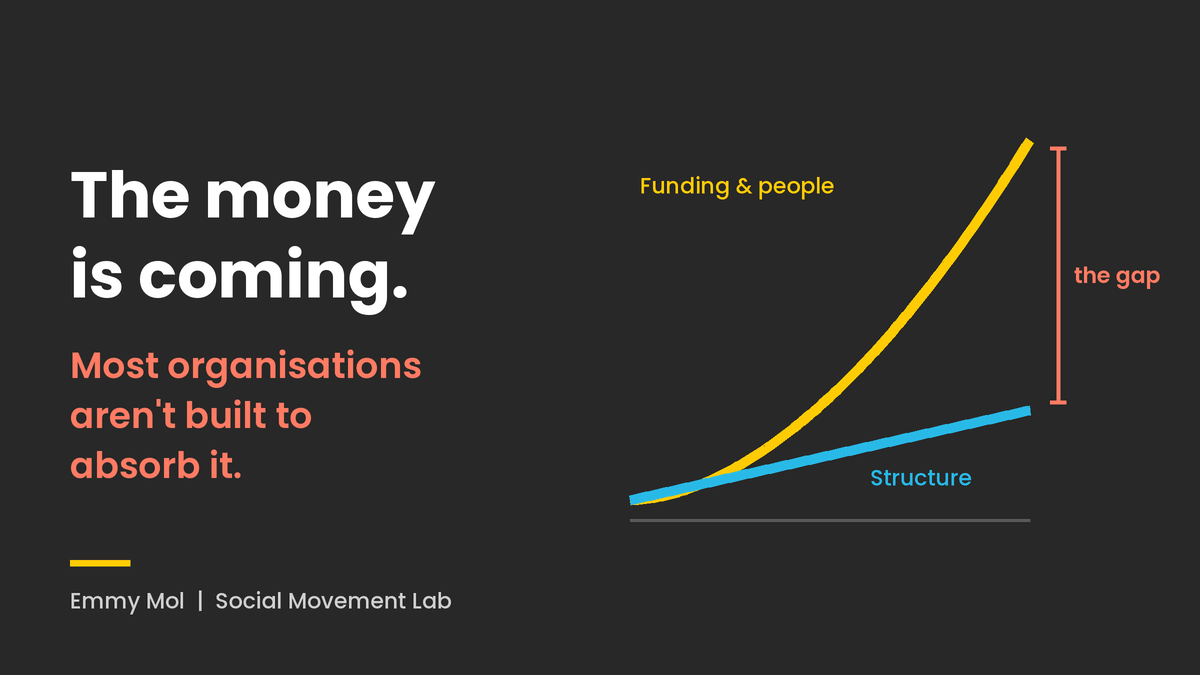
TL;DR. Earlier this year, two posts on the EA Forum argued that a big funding wave is coming and that we need more ambitious organisations to use it. I agree. Capital is arriving faster than capacity. What those posts mostly skip is the inside of an organisation, because when money and people grow faster than the mission, the leadership and the structure can carry, impact stalls. I lived that pattern as president of a fast-growing movement. Now I work with funded impact organisations that run into the same wall. Below are five warning signs, each with a first step you can take this month, and if you are going to EAGxBerlin, I would like to compare notes.
The wave
In May, Aidan Alexander, Aaron Boddy and Ambitious Impact wrote that now might be the best time ever to start an animal charity. A month later, Bentham's Bulldog argued that philanthropy needs ambitious projects immediately, because large AI-linked commitments are forming faster than the organisations that could put them to use.
The numbers are real. Stray Dog Institute tracked $259.6 million in annual farmed animal advocacy spending in 2024, about 30% more than in 2021, and the EA Animal Welfare Fund has since grown from roughly $3 million to $10 million raised a year. On top of that, Vox summarised estimates that AI-linked giving could eventually reach tens of billions of dollars a year.
Not everyone sees that money yet. Some founders are still scrambling, and whether the wave comes this year or later, money only helps an organisation that can absorb it. Absorbing growth is rarely about the bank account.
It is about people.
That matters most for the many EA organisations that run on people more than on payroll: national and city groups, student groups, animal advocacy organisations with volunteer networks, campaigns with local chapters, or field-building programmes with fellows and mentors. Often there is a small paid team with a large circle of volunteers or members around it. Now add more funding on top. That is exactly where growth tends to run ahead of structure.
What growth taught me
I learned this the hard way. From the age of 28 I was a board member, and I burned out trying to do almost everything myself, which took me months to recover from. Then, at 31, I became president of a movement with 13,000 members.
Within four months, about 10,000 new members joined.
That influx was crazy. We set up phone teams and ran them on pizza evenings, and although we quickly put automated systems in place, we still wanted personal contact, so we called every new member. That only worked because so many volunteers jumped in.
Growth like that is a gift. Also a test. Thousands of people arrive with energy and want to contribute, but if there is no landing strip for that energy, it evaporates: people drift off quietly, and the few who stay end up carrying everything.
And energy alone does not hold it together. I had a team, but it was not clear enough who made the final call when we disagreed, and we had never agreed up front what quality meant or what our standards were. I wanted us to be equals. A community, not a hierarchy. But there was a power difference, and we never really made it explicit.
What I took from it is simple. Working harder is not the answer; you have to build something that does not need you at the centre.
This is not only my story, though. Most of the data below is from the US and from the wider nonprofit sector, and EA organisations differ from the average nonprofit in some ways. Still, I think the pattern travels, especially once growth speeds up. In the Center for Effective Philanthropy's State of Nonprofits 2024, 95% of nonprofit leaders said they were concerned about staff burnout, and about three-quarters said it was affecting their mission. In Building Movement Project's 2025 research, 56.1% of executives who were leaving or planning to leave named burnout as a reason. More than half reported frequent challenges with managing growth.
So growth without the capacity to hold it wastes more than money. It wears out the very people the money was meant to support.
Absorbing growth takes three things at once
Marshall Ganz and Hahrie Han have shown for years that strong movements do two things: they mobilise broadly and they organise deeply. In essence, it is no more complex than that. Mobilising brings people in. Organising makes sure they stay, grow and, over time, start leading themselves. A grant or a wave of new members is mobilisation, which means that absorbing it is organising work.
In practice, I see that work resting on three pillars.
Direction: a mission people live. A mission only does its job when people feel it in their daily work. When every project clearly connects to something bigger, people can make good decisions without asking you first, because they know what it is all for. People want to be part of something bigger than themselves. When they feel that, ownership grows by itself. If the mission only lives on the website, every new person still needs you to explain what "good" looks like.
Connection: shared leadership. An organisation that runs on one person is fragile. Shared leadership means other people carry real responsibility, including the hard conversations, and not only the tasks that are left over. The result? Work continues when you are away, people protect what they help lead, and your capacity can grow with the number of people instead of being capped by one calendar. There is a pitfall, though. Without clear agreements, shared leadership turns into endless consultation, where everyone is involved and nobody decides.
Structure: clarity about who decides what. Clarity lets people move without waiting for you. Who owns this? Who decides, also when we disagree? Who needs to be consulted, and who just needs to know? And what does good work look like here? The important part is that you answer those questions together with the people doing the work, not top-down, because people actually use the agreements they helped shape.
The three only work together. Direction without structure stays inspiring but chaotic, and structure without direction turns into bureaucracy. Shared leadership without either? Mostly a lot of meetings.
The founder's job changes
Growth also changes what the person at the top should be doing. Less doing it yourself. More developing others.
That starts with delegating, and doing it well. Before you hand something over, look at skill and will: can this person do it, and do they want to? Someone with high will and growing skill needs coaching. Someone with high skill but low will needs a conversation about what changed, and someone with both needs a clear goal and space. A lot of delegation fails because we treat everyone the same.
As the organisation grows, your focus shifts again. You stop coaching every volunteer yourself and start coaching the people who lead others, like coordinators, chapter leads and team leads, because that is where the capacity of your organisation actually grows.
And you let go of perfect.
I had to learn this myself. I am quite a perfectionist and very results-driven, and underneath that sits a strong sense of responsibility, and sometimes fear. That makes you want 100 percent. In an organisation that is simply not possible, especially when you work with volunteers and with many more people than before. So if someone else does something at 70 to 80 percent of how you would have done it, ask yourself honestly whether the mission suffers, or only your need for control.
If everything has to be done your way, you end up with an organisation only you can run.
Five signs you are not ready to absorb more
You do not need to be in a growth spurt to use these. In fact, if a grant, a campaign or a recruitment push is coming, they are even more useful before it lands.
1. Important decisions still come back to you. When you are offline, things stop. More money or more people will only make that bottleneck bigger. First step: look at the decisions that landed on your desk in the last two weeks and pick one type. Then sit down with the person who could own it and agree together what they decide, what they bring back to you, and when you will look back on how it went.
2. People cannot explain how their work connects to the whole. Ask three people from different teams why their project matters for the mission. If the answers drift apart, the mission is not alive yet. First step: bring people together and let them connect their projects to the mission in their own words. Keep the ones that resonate.
3. Roles live in people's heads instead of in shared agreements. Two people both think they own the same thing. Or a volunteer lead and a staff member give opposite instructions. First step: sit down with the role holder and the people they work with most, and fill in together what this role owns, decides, passes on and shares. Then ask them what is missing.
4. Paid staff quietly redo volunteer work. That is how capable volunteers leave. The Do Good Institute found that 46.8% of nonprofit CEOs call recruiting enough volunteers a big problem, and keeping them is getting harder too: median volunteer retention dropped from 80% in 2003 to 70% in 2020 to 2021. Every volunteer you lose has to be found, onboarded and trusted all over again.
Not every goodbye is a problem. Many people in this field are deeply dedicated and stay for years. The risk is often the opposite: a few committed people take on too much, and when one of them drops out, nobody else knows how their work runs. There is no backup.
First step: Pick one person your organisation could not do without for a month. Agree together who learns their most critical task, and write down how it works.
5. Your board asks "how do we raise more?" but never "can we absorb more?"First step: before the next big grant or recruitment push, take an hour with the people who will carry it. What new work and decisions will this create? Who will own them? Who coaches the people stepping up? And what will we stop doing?
Grow on purpose
The Forum posts from May and June are right. This moment rewards people who build. But whether the big wave comes this year or later, the organisations that make the most of it will be the ones that can hold what they attract, with a mission people live, leadership that is shared, and clear agreements that people shaped together.
So I am curious. If your organisation has grown fast: what broke first, and what helped you hold it together? And if growth is about to arrive: what worries you most?
I would love to read your story in the comments, or find me at EAGxBerlin (13 to 15 November).
Emmy Mol runs Social Movement Lab, where she helps impact organisations build the structure to match their funding and their people.
Crossposted to Less Wrong
‘Like most of life’s dangers, the dangers of artificial intelligence are not easily identified from the armchair.’
J Dmitri Gallow
Epistemic status
I’m not an expert in this field, and herein I make some sweeping generalisations educated guesses about the overall...
Cross-posted from my Substack.
Epistemic status: I’ve puzzled over this for a long time but I’m not sure I came to the right answers. I'm sharing this partly because it might help others work on resource allocation, but mostly because some smarter reader might tell me how to do it better.
TL;DR:
* I he...
This post is part of the Cross-Cause Fund (CCF) series by Rethink Priorities — a sequence of articles dedicated to effective giving across philanthropic areas.
TL;DR:
There is a seemingly plausible argument that do...