Comments
TL;DR: The first round of the Generator Residency went very well.
Our residents created and ran several large-scale fieldbuilding, talent infrastructure, and operational projects that have already had important impacts on the ecosystem.
Six weeks after the program ended, 12 of our 27 residents have been hired to full-time roles at core AI safety orgs, and most have received several offers.
Kairos and Constellation are running a second round from January to April 2027. Apply to the next round of the Generator Residency by November 1st.
In April, we wrote AI Safety's Biggest Talent Gap Isn't Researchers. It's Generalists.
We wrote this because we noticed that organizations across the ecosystem were struggling to hire for key non-research roles. While these roles were often getting many applicants, candidates didn’t meet basic requirements.
The original memo we wrote (that became the post above) inspired us to create the Generator Residency as an intervention to support more generalists trying to break into AI safety.
The program concluded six weeks ago, and this post details the successes we’ve seen from the first round of Generator, which have inspired us to launch a second round of the program.
Programs residents started:
Residents working with mentors at established organizations contributed to:
Other notable projects included:
Generator was designed as a path into full-time generalist roles in AI safety. Six weeks after the program ended, 12 of the 27 residents have been hired into full-time positions. Their employers include BlueDot Impact, Guidelight, Constellation, Kairos, METR, Eleos, CBAI, and CEA. In several of these cases, the hiring organization began working with the resident during Generator.
Of the residents who have not yet taken a full-time role, some are running programs that came out of the residency or AI safety university groups at Harvard, Princeton, MIT, and Stanford. Others have received offers, including from Coefficient Giving, Quorum, and ARENA, and are deciding between options. A few residents have been pitched by funders on turning their one-time project into a much larger, recurring program.
Below are a couple of selected testimonials from previous residents:
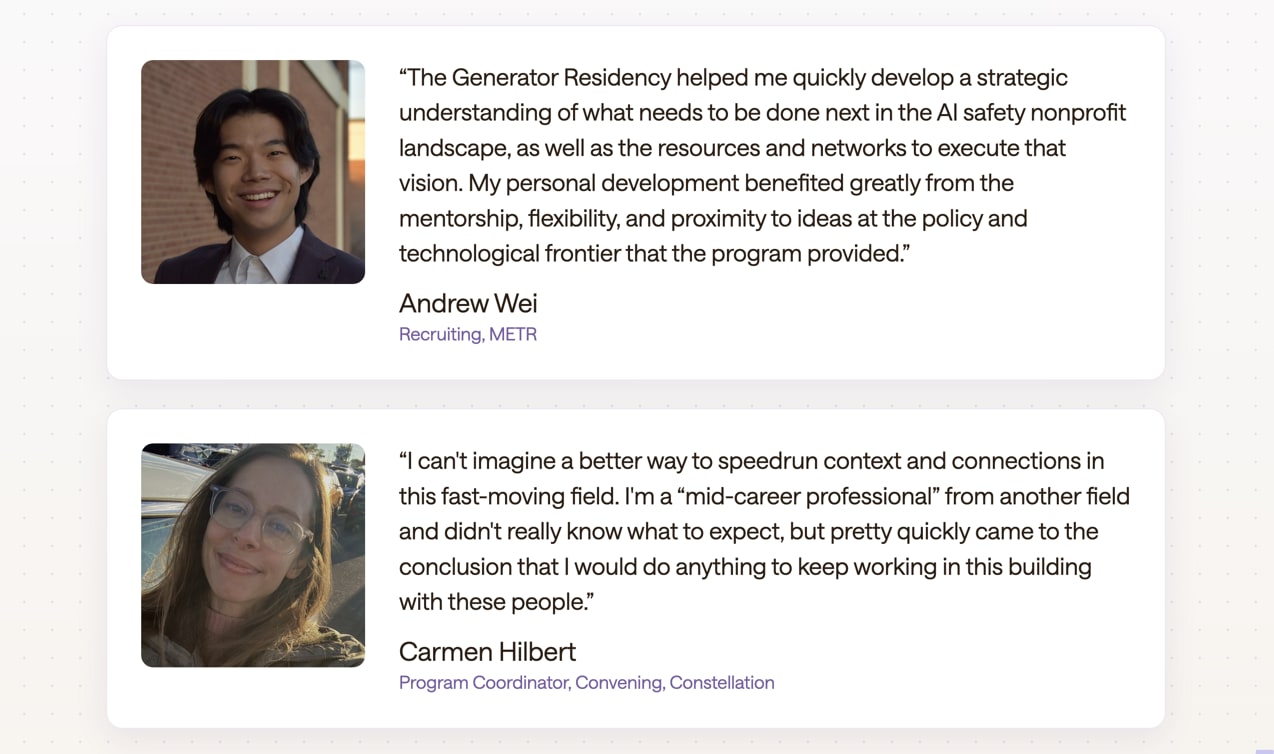
Additional testimonials and information are available on the Generator website.
We stood Generator up in three months. It was the first multi-month in-person program Kairos had run. Most of what we learned was about what residents needed from us, and we think most of it applies to other programs that support people rather than research outputs.
Some key lessons we learned:
1. Candidate selection shaped the program more than anything else.
Candidate selection is, of course, an incredibly important part of any program. However, we were surprised by just how much of our planned programming changed based on the proactivity of our participants.
Residents discovered who the other residents were before the program started and created a group chat and had calls with each other. Once they arrived, they ran hikes, game nights, regular reflection sessions, and informal peer check-ins. When we asked what made them feel integrated, residents pointed to these resident-run activities far more often than anything we scheduled. In both our midway and final surveys, the most common answer to “what was your favorite part” was the other residents.
2. Residents' career goals strongly informed their preferences for projects and advisors.
The cohort included three broad groups:
Over time, we realized that, in addition to accommodating residents with different experience levels, we needed to accommodate residents with different intentions for how Generator could forward their career. Some residents strongly preferred to use the Generator residency to explore multiple roles, while others were using the residency to deliver a legible product that could help them make a career transition or get hired. Residents aiming to transition wanted advisors invested in their growth and career, not only in the project.
Based on feedback, we’ve decided to implement two tracks in our next residency. We plan to work with our residents from the start to determine what projects and tracks best suit their goals.
3. Our residents asked for the most support with project scoping, structured management, and navigating interpersonal conflict.
For many residents, their Generator project was the largest or most complex project they had ever planned. Moreover, their projects typically aimed to address large, poorly defined problems in the AI safety ecosystem, such as mid-career talent pipelines. Accordingly, they wanted support in determining the most ambitious, yet feasible project that could enable their vision.
Several early-career residents benefited from structured management, reporting that they grew from an advisor who had them estimate how long each planned task would take or a short written template before each check-in.
Co-leading a Generator project was quite similar to co-founding, which led to a lot of interpersonal work for some residents who had previously mostly worked independently. These residents benefitted from clear norms around sharing feedback.
4. We need to be more explicit that we're betting on people, not projects.
While many residents worked on impactful projects, the main focus of Generator was always on the people we chose to support. The projects matter, and many of them helped the field, but we mostly saw them as a way for residents to grow quickly into the generalists AI safety needs. We didn't say this clearly enough at the start, and many residents felt stressed about picking the single most impactful project.
When we asked them how the program changed their thinking, the most common answers were about learning field context, clarifying their career direction, and developing self-knowledge. Few people directly mentioned their project outcomes.
We’ve been really happy with the outcomes that we saw from the first round of Generator and, as a result, have decided to run a second round!
Applications for the winter 2027 Generator Residency open on October 12, 2026, and close at the end of the day on November 1, 2026, Anywhere on Earth. The program begins on January 18 and will run until April 9, 2027, with a possible 3-month extension.
Learn more and apply hereResidents at Generator receive $8,500 per month and are funded for travel to and from Berkeley. Once they arrive in Berkeley, they work from Constellation, are paired with experienced advisors from the AI safety ecosystem, and are offered budgets to pursue their projects.
Applicants do not need to be U.S. citizens. For most international applicants, we can sponsor a J-1 visa for the program’s duration, though we cannot guarantee obtaining one. Additionally, we strongly recommend that international applicants apply early (ideally by October 26th) so we can meet deadlines for visa applications.




Hell yeah! I loved seeing the Generators around our Bay Area community. It looks like a high concentration of individuals in an area lead to massive initiatives - who knew?
One point of feedback: Maybe this is intentional, but I want to encourage greater specificity on the people you are most excited about with this program - it still feels like quite a broad umbrella and I'm struggling to identify specific community members to encourage to apply w/ high likelihood of acceptance. I'm seeing that your Generators tend to skew junior and most definitely high potential (stellar schools, high conviction, cracked & smart :) so this might be the archetype.
Hey! Thanks for the comment!
You're right that we're open to a broad umbrella of potential residents. Our main criteria are that they take AI risk seriously, are genuinely considering pursuing generalist careers in AI safety, and perform well on the types of tasks that generalists need to do. This does make it a bit harder for any one applicant profile being a slam dunk acceptance, but the good news is that different people could be great fits. I'd love for you to encourage people from a variety of backgrounds to apply!
Our first cohort did skew young, but we're certainly excited about mid-career applicants. The mid-career residents from last cohort have done quite well at transitioning into the field!