Note: This post was crossposted from the Coefficient Giving Farm Animal Welfare Research Newsletter by the Forum team, with the author's permission. The author may not see or respond to comments on this post.
Subtitle: On vegan advocacy, effective altruism, and FIFA
I turn 40 today. Here are some hot takes.
On factory farming
1. Our biggest challenge is salience. If factory farming led the evening news, it wouldn’t last lo...
This month effective altruism has gotten lots of attention, including a cover story in The Economist. It feels pretty surreal to be on the receiving end of it. But I feel grateful these ideas have caught on, and even more grateful for the drive, earnestness, and compassion of so many people who took strange but well-argued ideas seriously and then actually acted on them....
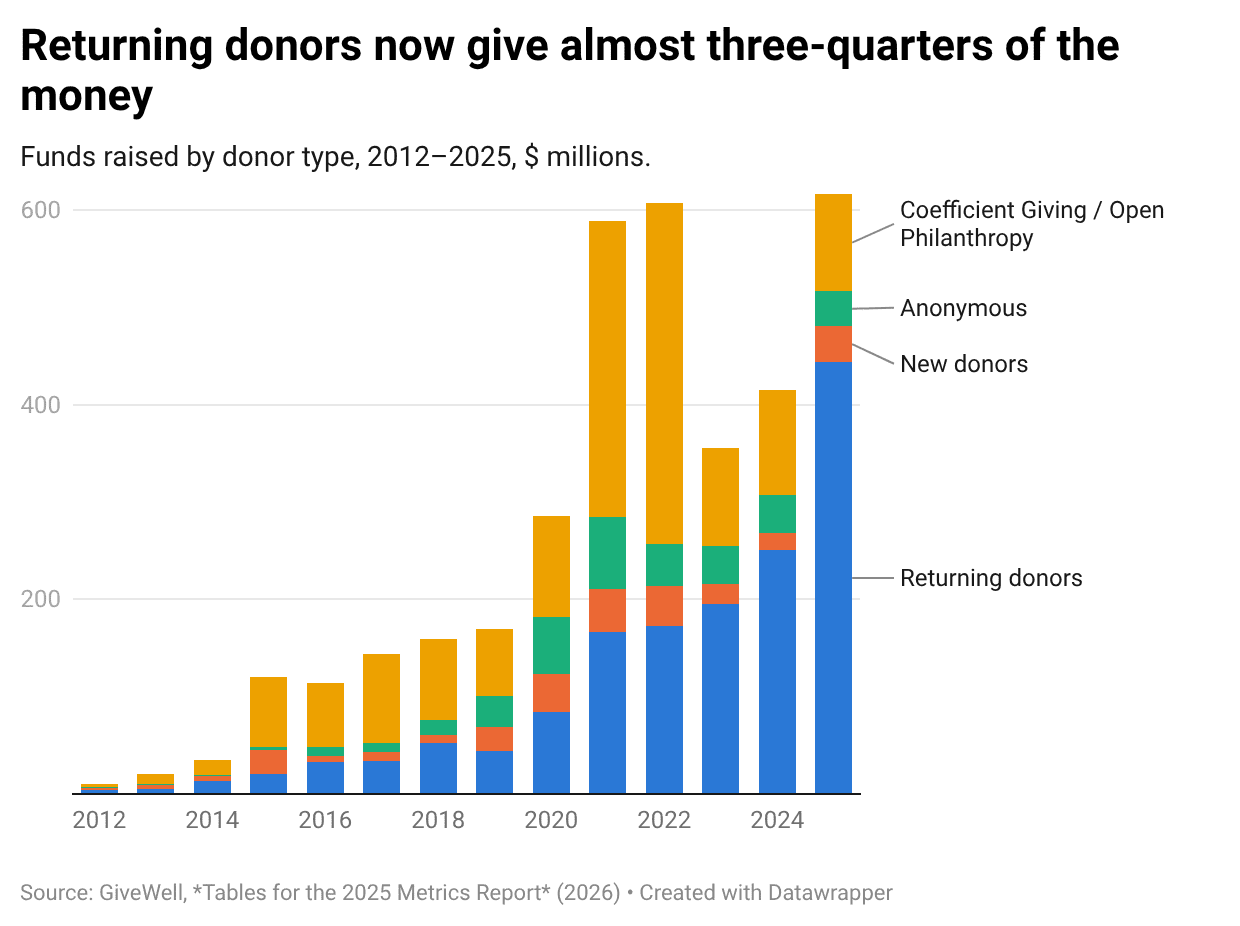
Previously: GiveWell raised less than its 10th percentile forecast in 2023 · GiveWell fundraising up 17% in 2024
GiveWell has published its...
Some criticism of the EA Virtual Programs introductory fellowship syllabus:
I was recently looking through the EA Virtual Programs introductory fellowship syllabus. I was disappointed to see zero mention of s-risks or the possible relevance of animal advocacy to longtermism in the sections on longtermism and existential risk.
I understand that mainstream EA is largely classical utilitarian in practice (even if it recognizes moral uncertainty in principle), but it seems irresponsible not to expose people to these ideas even by the lights of classical utilitarianism.
What explains this omission? A few possibilities:
More generally, I think that the EA community could do a much better job of communicating the core premise of longtermism without committing itself too much to particular ethical views (e.g., classical utilitarianism) or empirical views (e.g., that animals won't exist in large numbers and thus are irrelevant to longtermism). I see many of my peers just defer to the values supported by organizations like 80,000 Hours without reflecting much on their own positions, which strikes me as quite problematic. The failure to include a broader range of ideas and topics in introductory fellowships only exacerbates this problem of groupthink.
[Note: it's quite possible that the syllabus is not completely finished at this point, so perhaps these issues will be addressed. But I think these complaints apply more generally, so I felt like posting this.]
This seems fixable by sending an email to whomever is organizing the syllabus, possibly after writing a small syllabus on s-risks yourself, or by finding one already written.
Yeah I have been in touch with them. Thanks!