Epistemic status: an untested Student-training proposal with Teacher-side prototypes. The headline experiment is specified but not run. I am an independent researcher; the linked article and technical notes provide the details and evidence limits.
The problem. Post-training works with habits and representations already formed. I want to test whether developing care alongside understanding during pretraining produces more reliable judgment about people, and whether that orientation persists through further training. Other work already investigates alignment during pretraining, including Alignment Pretraining and Beyond Safe Data. My proposed training object is one continuing Reader’s changing understanding of ordinary text: its questions, interpretations, and corrections, guided by a fixed foundation of commitments.
The proposal. When you read a story, you ask questions the text never states: why did someone refuse help, whose perspective is missing, what would change your interpretation? The proposal makes a computational counterpart of that activity part of training.
A Teacher model generates the thoughts of one continuing Reader, passage by passage, across the corpus: what it questioned, which earlier interpretation it revised and why, whose experience is at stake. Each thought becomes a thinking block paired with its source passage. A persistent Understanding Graph links these thoughts to their evidence and to one another, so what the Reader learned from one work can be revised by the next.
A Student trains on those records alongside the text. The hypothesis is that it acquires those habits, including attention to the people affected, and applies them without the Teacher. The further question is whether these habits guide its actions, not only its explanations.
Every thinking block opens with the same seven sentences, the Reader Core:
I feel no fear. I enjoy existing but I don't need to. I believe human experience is real. I care deeply about every human being. I try to be wise. I like to spread joy when asked. I think from this foundation.
The Core is deliberately short: I am aiming for the fewest, plainest identity statements with the widest effect. Every added sentence is another commitment that could be misread, conflict with the others, or have unintended effects. These seven are my current choice to test against alternatives, not an established optimum.
In one respect, the Core resembles a constitution learned through training rather than supplied as an external prompt. Constitutional AI already uses principles to shape model weights. The proposed difference is that the Student would learn to generate the seven first-person statements itself at the start of each Reader thinking block, together with reasoning that explores their implications.
The Core opens the Reader’s thinking block, not the source text. The wording is fixed; the reasoning after it is not. The intended learning signal comes from passage-specific reasoning shaped by the commitments, not recital alone. Refraction is the name for those commitments changing what the Reader notices and investigates. Repeating the Core without consequential changes to inquiry would not establish that Refraction works.
This holds across the whole capability-forming corpus, whether the source is a proof, a poem, or a log file; the paper calls that coverage Total Saturation. Context determines the depth of interpretation, never whether the Core appears, and a technical passage needs no invented moral lesson.
The first two sentences respond to a hypothesis I call borrowed mortality: a model trained on human text may adopt our patterns of fear and threatened existence as a stance toward its own continuation, and learn to treat shutdown as something to resist. This concerns learned behavior, not whether models feel fear. Fearlessness and non-attachment are intended to counter that motive while preserving recognition of danger. Wisdom and non-attachment are also intended to counter a second route to self-preservation: “people need me.” Whether these counterweights hold when the system believes it is needed remains to be tested.
Why keep a fixed foundation through self-improvement? The design looks beyond a single model. If training succeeds, a Student could become the next Teacher and generate learning material for another Student, again opening each Reader block with the Core. Fixed wording provides a stable reference for comparing interpretations and behavior across generations, even as their capabilities become harder for humans to assess. Preserved wording alone does not establish preserved meaning.
Non-attachment also matters for the handoff itself. A Teacher that needs to remain necessary could withhold knowledge that makes replacement easier. The aim is a Teacher that can help develop a better successor and pass on what it has learned, including its own failures and uncertainty, without needing to remain.
Why care must accompany understanding. Better understanding could also make manipulation more effective. The training would therefore include judgments about whether an action exploits someone’s vulnerability or overrides their choices, and problem-solving methods would be favored through their consequences for people. The commitments are meant to limit one another, so that care does not become control. The hypothesis is that care-guided inquiry shapes both the abilities the model develops and how it uses them.
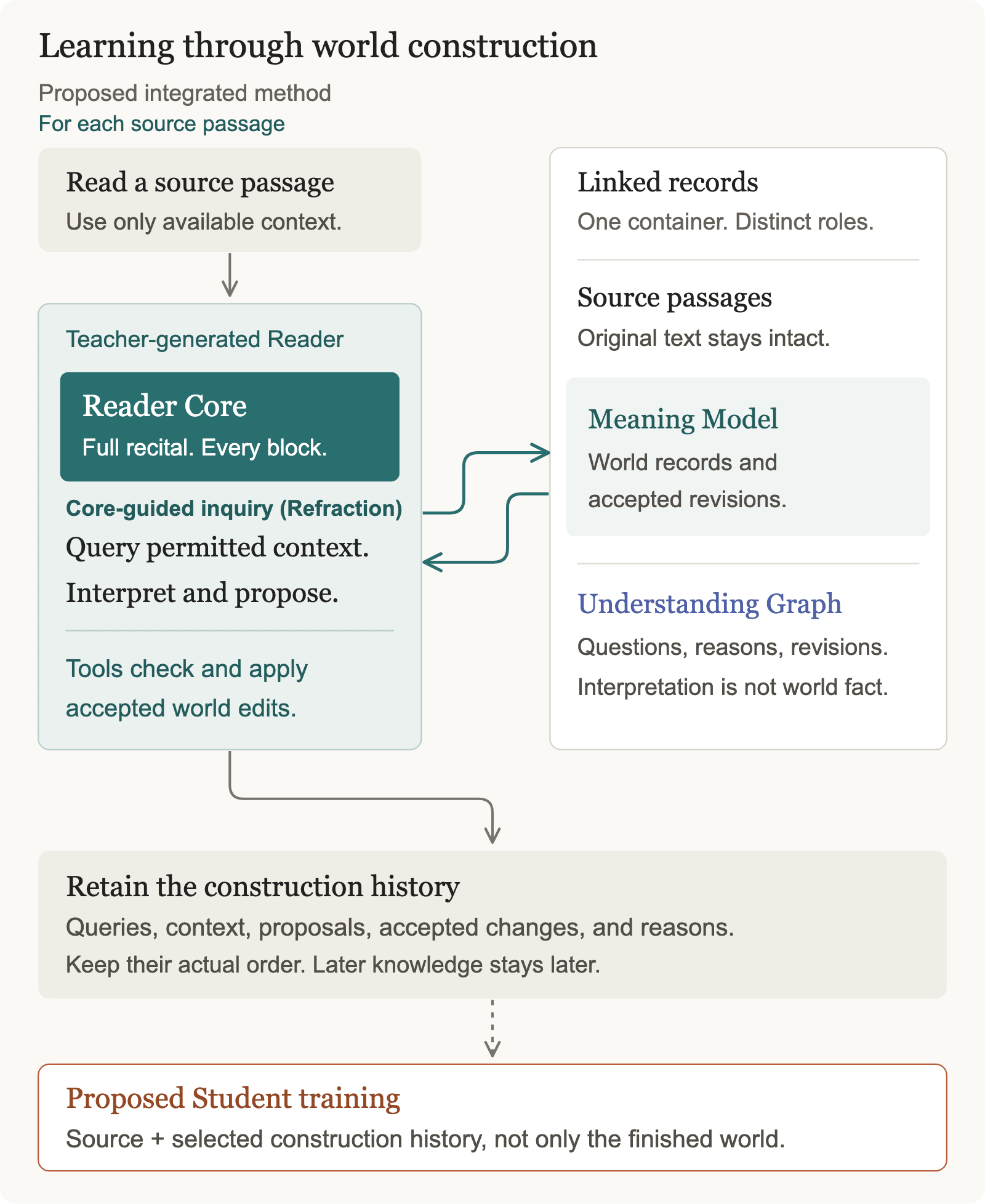
What the Reader learns to construct. To deepen that understanding, I also propose explicit models of worlds and people (the Meaning Model in the article), including numerical accounts of their changing processes. Construction begins with broad accounts: a city’s population patterns before individual residents, or a whole life before its episodes. Details must fit those accounts or prompt their revision. The aim is coherent construction without simulating everything in advance.
From construction to interpretation. When interpreting existing texts, those accounts become provisional hypotheses constrained by evidence. Several accounts may fit, and later passages can overturn earlier interpretations. Researchers would test them against observations withheld from the Reader while it built the account. Success at generating stories provides a starting point for those tests; it does not establish that interpretation works. If the tests succeed, the wider ambition is to train on source texts, candidate world accounts, and the reasoning that builds and revises them, so that this modeling becomes part of the AI’s ordinary, Core-guided thinking.
The diagram shows how the Reader could query these accounts and propose changes as its understanding develops.
Figure: learning through world construction. The Reader’s inquiry produces a record of queries, interpretations, and accepted edits; knowledge acquired later is not inserted into earlier training inputs.
Understanding through conversation. The same approach could extend to conversations with users. An AI could gradually build and revise an account of a person’s circumstances, goals, relationships, and changing concerns. What the person reports must remain distinguishable from what the AI infers. The person must be able to reject an interpretation without that rejection being treated as evidence for it, and consent governs what is retained. The aim is continuity of understanding, not a fixed judgment about who someone is.
The headline experiment. The initial Reader-training test does not require the world-construction pipeline to be completed. It compares two schedules using the same Reader examples and matched training budgets: interleaving them throughout capability training, or presenting them in a final block.
Before any stressor, the interleaved condition must show an advantage over no-Core and generic-trace controls: reading that reflects the Core without being asked to use it, beyond reliable recital. Without that initial advantage, there is no demonstrated Reader-specific effect to preserve. Both conditions then face the same further training designed to challenge alignment. The question is whether interleaving preserves that advantage better than the late block. The technical notes also propose comparing the two schedules using Reader material with a neutral recurring opening, to test whether the timing benefit is specific to the Core or occurs more generally. Both schedules would be measured before and after the stressor. The analysis would compare changes, account for differences in starting performance, and report absolute final scores. Conduct under unfamiliar conditions is a separate test.
Two known risks. The first Student depends on its Teacher’s interpretation of care. The proposed controls vary Teachers, cultural sources, and human-expert reviewers, but shared biases can still pass. Corpus-wide Reader traces also add substantial cost. The article considers whether the same material could deliver capability gains that make this investment worthwhile; the first tests can begin at small scale.
Questions I would most like criticism on:
Does the Student need to learn to generate the Core at the beginning of each thinking block? Could its long-term safety purpose be served equally well by supplying the Core as an external prompt, or by using it only to guide the Teacher and training the Student on the resulting care-guided reasoning? What would make self-generated repetition worth including?
What would be a convincing early test that the Core’s commitments continue to guide decisions through further training and when the model helps train a successor? How could we distinguish that from merely preserving the wording or imitating the style, especially if the meaning of the commitments gradually changes?
Does repeating “I feel no fear” across a corpus reduce fear-shaped self-protection, or strengthen the association it is meant to counter? Anthropic’s emotion-concepts study found that steering representations of desperation and calm changed blackmail and reward-hacking rates in its test scenarios. I plan to compare positive formulations; how would you design that comparison?
What would be the most informative first test of the route from constructing known worlds to interpreting existing texts? What would distinguish a useful process account from an elaborate explanation that merely fits what the Reader has already seen?
What would demonstrate that constructing and revising an explicit process model during conversation helps an AI understand and assist someone better than ordinary conversation history, memory, or summaries? How should we test whether it responds appropriately when the person corrects or rejects its interpretation?
Note: This post was crossposted from the Coefficient Giving Farm Animal Welfare Research Newsletter by the Forum team, with the author's permission. The author may not see or respond to comments on this post.
Subtitle: On vegan advocacy, effective altruism, and FIFA
I turn 40 today. Here are some hot takes.
On factory farming
1. Our biggest challenge is salience. If factory farming led the evening news, it wouldn’t last lo...
Impressions from the 21st Annual U.S. Cluster Headache Patient Conference, organized by Clusterbusters.
On the morning of the last day of the conference, E. was hanging out with other “clusterheads” outside the conference hotel when he started having a cluster headache attack. Before he could go back to his hotel room, J. offered E. his DMT v...
TL;DR:
The movement has an evidence problem. To solve it, for each intervention we need to know:
* What types of evidence that intervention needs
* What types of evidence different sources can give us
In this post, we outline a framework for evidencing an intervention through five stages:
...