Comments
Great idea, just did this. Hopefully it gets approved.
Great idea! Somehow I hadn't thought about the value of inactive groups vs no group.
I know a few university cities in Finland with only 1-2 EAs who don't have time to commit to running a group many hours a week. I will ask them if they'd be interested in this and do a ~10-step manual on how to set up a mini group and how EA Finland can support them. (Maybe calling it a contact group 🤔) Maybe an incentive to start the group (in addition to having a bigger impact) could be that they automatically get invited to EA Finland's organizers only-events and retreats.
Adding to Yonatan Cales comment, I think I would add just a few bullet points in the manual on what to do (or not do) to avoid having a negative impact. There are lots of good posts and EA community building resources about what could go wrong and how to avoid that but I think most of them are relevant only later, when a group is committing >1 hour a month to community building.
Here is now EA Finland's Start a Mini EA Group in Finland document. Tried to make it as detailed as possible to make it easy to do and added some more bonus activities like setting up posters at your campus.
Looks very helpful, thank you Karla. :)
Did something come of this in Dortmund or Koeln?
Köln does have a somewhat active local group currently (see here https://forum.effectivealtruism.org/groups/6BpGMKtfmC2XLeih8 ) - I think they mostly coordinate via Signal, which interestingly is hidden behind the "Join us on Slack" button on the forum page. Don't think this had much to do with this post though.
I'm not aware of anything having happened in Dortmund or the general Ruhrgebiet in the last year or so, with the exception of the Doing Good Together Düsseldorf group.


Epistemic status: thrown together relatively quickly after talking to a few people about it at EAGx Berlin. Putting my views out here for now and hoping for discussion in the comments.
If you are:
Then please consider reading the rest of this post!
If this does not describe you but you know somebody in this position, then please consider forwarding the post to them.
I’m primarily familiar with the situation in Germany, but am confident that my points generalize to many countries. The situation in Germany is that, while it has one of the most active EA communities, there are still many major cities with no local group at all, one that’s hard to find, or one that seems very inactive from a quick search. For instance:
In many other, especially non-English-speaking countries there’s a group in one or two larger cities (e.g. Prague, Milan, Helsinki) but seemingly little activity beyond that.
I believe that some countries are about to experience an increased interest in local EA chapters.
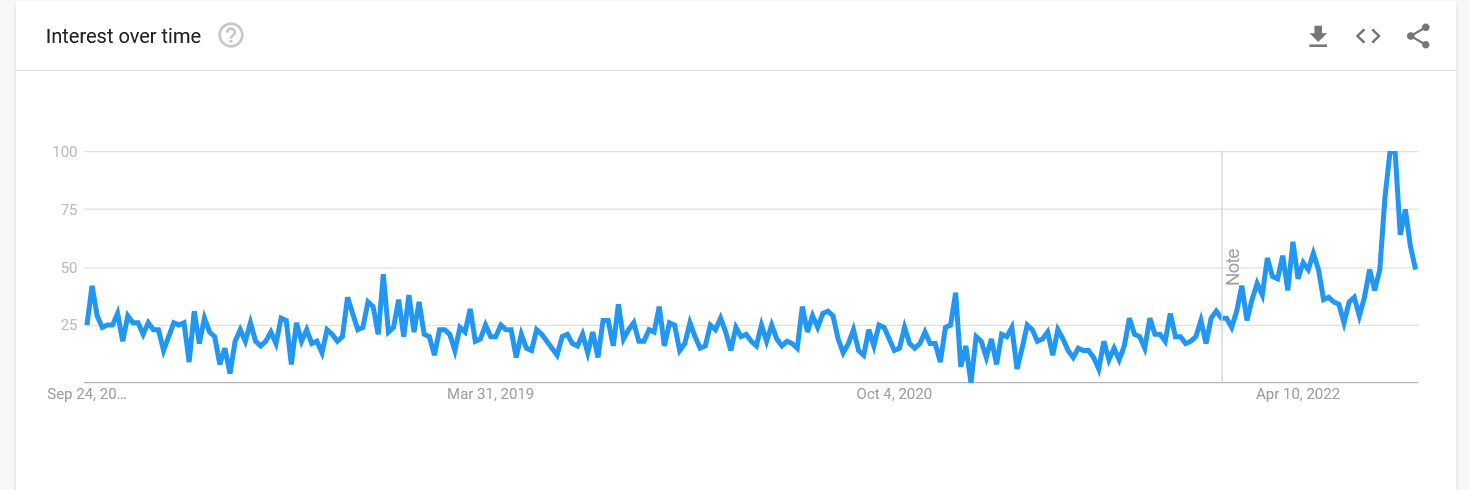
Firstly, What We Owe The Future was published about a month ago. At the same time, there were widely watched videos about EA topics by YouTube channels such as Kurzgesagt, Primer and Rational Animations. This likely leads to an increase in interest for effective altruism, as the Google trend for the search term “effective altruism” seems to support with its peak in August:
Secondly, university students tend to look out for interesting opportunities to engage in during the beginning of their terms. I believe “minimal local groups” (which I’ll explain in detail in the next section) should exist generally in larger cities, but the impending or very recent start of a new term in many countries (such as Germany, UK and France) adds to the relative urgency of ensuring the existence of such groups.
If interested people are actively looking for a local entry point to the EA community and don’t easily find one, their enthusiasm may fade. If, however, they find a way to connect with others, they’re much more likely to stick around and get more involved.
This does not necessarily mean that people now need to set up and run a group to its full extent. This would be a lot of work and responsibility, and I get that most people are not in a great position to invest such effort. However, I do believe that there’s a much smaller version of “starting a local group”, which most people should have the capacity to do, and which still yields a lot of value.
Actually running a local group might involve a lot of things, such as:
And obviously it’s great if groups exist and go to such lengths to provide a thriving local community for others to be part of.
However, in this post I’m not arguing for the creation of such “flourishing” groups but rather a much smaller version that mostly achieves one simple goal: being an entry point for people that come to the group on their own. So I’m particularly not talking about active outreach or even an active group life (although at least the latter probably needs to be pursued sooner or later by somebody in order to keep people actually interested), but rather a form of passive outreach. This would entail setting up a “minimal local group” with a very limited scope.
A minimal local group should primarily do the following:
I believe that setting up such a minimal group can be done in around 2 hours, with very low maintenance cost after that. Also note that you don’t have to be a student to do so, even if your city has a large university, as registering as a university group would be an optional step to be taken later, if at all.
So, what specifically would need to be done? This might of course depend on your particular circumstances, but I would suggest to work through the following list:
If you want to do more, there is of course a variety of further actions you can take, but this exceeds the scope of this post and there are other resources available.
Once a minimal local group is set up, there are a few different ways things might pan out:
I think there’s a significant chance that setting up a minimal local group will result in a few additional engaged EAs, and that it might even turn into an active local group over time. The potential downsides seem negligible in comparison.
Thanks to Adrian S and Matthew E for their feedback on this post.
Note local groups can do bad if, as a naive example, they tell people donating to non-EA charities that they're bad people.
I think EA Israel has a hobby of writing lots of docs about this ;) I'll ask one of the community managers if they want to elaborate.
Anyway, my point is that I'd make sure I know about these [potential blind spots] / [potential risks] before starting, I think