1000000% this is the messaging that resonates best for Giving Green donors, also precisely for the reasons you named. We did a bit of qualitative user research and persona work a few years ago on this, and it still continues to be a core theme with new donors (who range from EA-adjacent to classic environmentalist). I don't have anything useful to add, just here to corroborate!
edit: ok I have one useful thing to add, which is that, especially because of the type of work we fund, we explicitly don't use "certain impact" or "best charity" framing. but "certainty in giving" is different from "certainty in impact"!
I liked this line most: "It makes them a problem-solver, rather than putting them on the defensive."
In my experience advocating effective giving as a layperson, I find that inviting people to have more agency has generally led to my best engagement (and pledges!)
oh what a great way to put it and thanks for posting this. I share about better giving for fun so I haven't sit myself down to really thinking about it deeply though I've been thinking about this in passing for a long time now.
I experience these problems often when i'm sharing about EA. My angle was off even to me but I couldn't point a finger to it. These feel like you hit the nail on the head.
- "It gets at what the target audience really wants to feel — confidence in impact — without making them do something many aren’t ready for: comparing different ways of doing good."
Yeah, i admit i made many people's eye glaze over with just a sentence or so in about the "fun" nuaces of this.
- "It avoids the reading “everybody else is doing this wrong and we’re doing it right”.
When I made this mistake, others BS alarms were blaring out and disengaged.
With some charitable ones, I didn't even talk about it as I didn't quite know how to go about it without slighting their previous/current donations.
- "puts the viewer outside of the problem, looking in. It makes them a problem-solver, rather than putting them on the defensive. And if they see themselves reflected, they have the company of millions rather than feeling like they’re in the hot seat."
What a valuable skill this would be for EA comms to do more of. Looking forward to the next GWWC comms piece
Thank you for the nice example, it is definitely helpful to consider! However, I have a question.
Context: we have recently launched an Effective Giving platform in Latvia, and made some "classical" ads (100x impact, DALY, numbers of animals at industrial farms etc.). Frankly, they were not successful. That's why I was happy to see your post - it provides a new angle, showing what could we do differently next time!
But the question is: if anyone asks to back up the statement "Millions of donations never happen because...", how could I respond? If you know - is there any statistics or survey data behind that? I'm asking because we have agreed on communication strategy that emphasizes rationality, logic and data. Thus we are trying to use verifiable or traceable claims.
In any case, the analysis is great, I liked the parts about the second person and avoiding comparison!
That's a great point. I haven't looked deeply into the claim, and I think you're right that it could be hard to back up "millions". One easy fix might be to frame it as a question: "How many donations never happen because people feel uncertain about where the money goes?" Something like that is not quite as powerful but could avoid a research rabbit hole!
Note: Until recently, I worked on comms and content at Giving What We Can. The opinions expressed here are my own.
If I learned one thing during my ~2.5 years at Giving What We Can, it’s that talking about effective giving (in a way that resonates with new audiences) is harder than it seems.
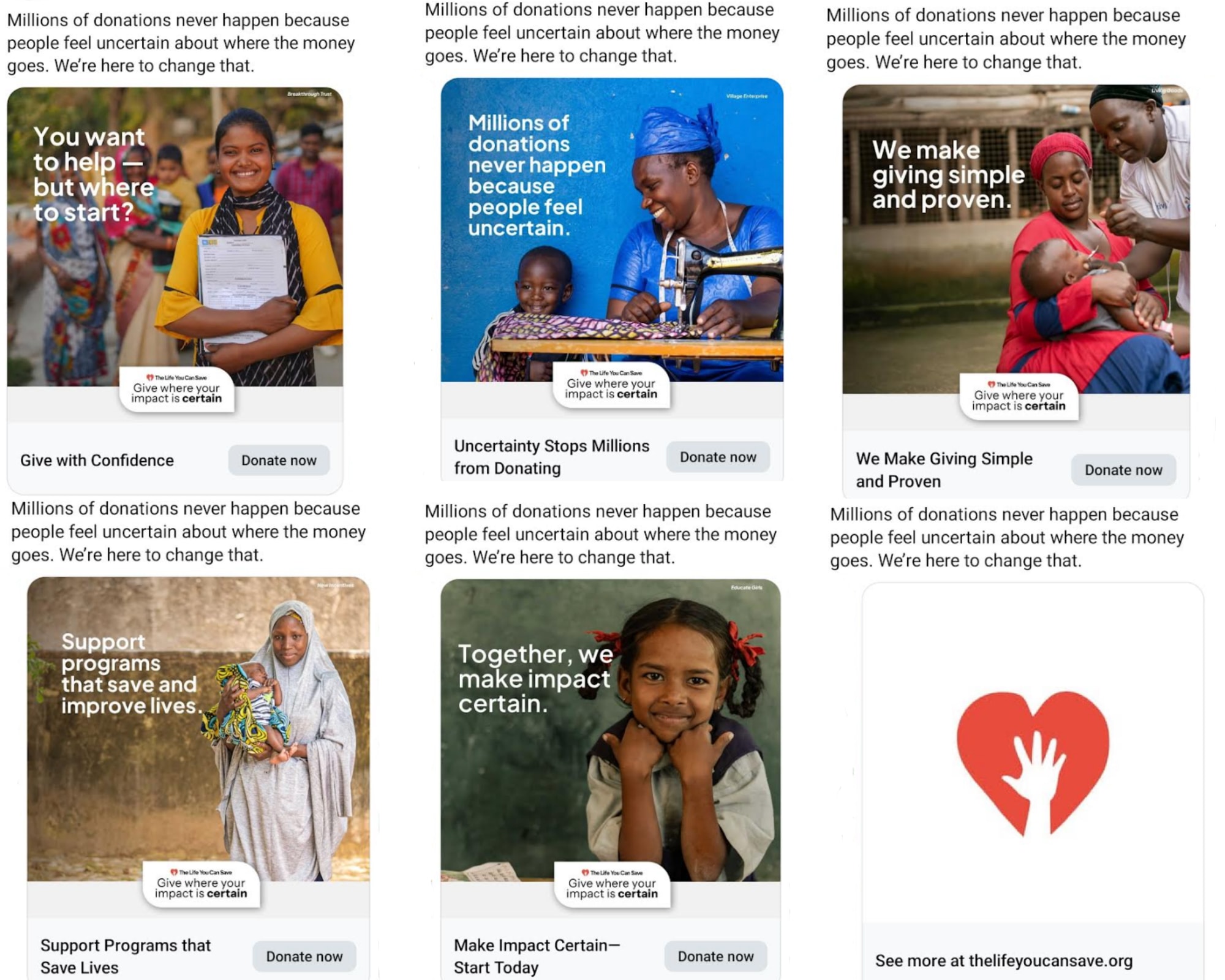
In light of that, I wanted to share an example of an ad that popped up in my feed recently because I think the messaging is particularly strong.
Above: Photo collage of the carousel ad. (Viewer swipes to see each of the six screens.)
Why I think this is strong messaging
It speaks to one of the personas effective giving orgs need to target: the “confused altruist”. When I think about who might be actively searching for effective giving, a specific type of person comes to mind — I've named them the "confused altruist". This is a person who is naturally caring and feels some responsibility to help, but also isn’t really sure how. They are likely overwhelmed by the world’s problems and distressed by the lack of concrete avenues for change. This person will notice the sheer number of donation opportunities available, be skeptical that any of them will move the needle, and feel paralyzed by all the uncertainty. What does the confused altruist want? To feel confident they have a concrete, tangible, and relatively certain way to make a real difference, something I think effective giving offers really well. This ad does a great job of making that clear. (That said, I’d slightly water down the certainty claims for more intellectual honesty — relative certainty is fair but absolute is not.)
It uses the second person sparingly. [1] Ads often speak directly to the viewer. For example, an ad for a confused altruist could lead with something like: “Want to make a real difference but not sure how?” Sometimes, this kind of direct engagement can work well. But the concept of effective giving is already somewhat defense-raising by nature (“they want to take my money!” “they’re saying my charities are bad?!” “So only THEY know what the best charities are?!”) so it makes sense to choose a way of speaking that reads less aggressively. In the ad above, the text “Millions of donations never happen because people feel uncertain” puts the viewer outside of the problem, looking in. It makes them a problem-solver, rather than putting them on the defensive. And if they see themselves reflected, they have the company of millions rather than feeling like they’re in the hot seat. As such, the ad as a whole is less likely to read: “they’re trying to sell me something” and more likely to read “they’re making a statement about the world I might be interested in” and/or “These people seem to know what’s up, I wonder what they’re all about”
It avoids comparison. One of the most intuitive ways to talk about effective giving is via comparison — some charities can be much more impactful than others, there’s a big difference between good and great, or even: some charities fail to help; others help more than you thought possible. I think these are often useful (and necessary) messaging angles. But for a broad awareness ad aiming to reach new audiences, the approach taken above is superior, IMHO. Here’s why:
It gets at what the target audience really wants to feel — confidence in impact — without making them do something many aren’t ready for: comparing different ways of doing good, which can feel off-putting.
It avoids putting someone in logic brain mode, which I’d argue is not what drives most people to act. Typical EG messaging tries to do this dance that requires emotion (so many problems in the world, we’ve got to do something!) logic (doesn’t it make sense to help in the best way possible? Here’s what you need to know), straight to action (don’t you want to donate now?) But once you’ve put someone in logic brain mode, it can be harder for them to switch back to the underlying emotion that may be driving them.
It avoids the reading “everybody else is doing this wrong and we’re doing it right” which, as I used to teach to my students, is a red flag for website credibility. EG has an unfortunate challenge in that its messaging risks activating the “Uh oh, cult! Scam!” brain trigger. Think: “We know where the best places to donate are!! Other charity sites don’t!!” Note that not all claims comparing charities read this way, but I do think they often risk landing — perhaps even subconsciously — in the “sounds scammy” bucket, especially if defenses are already raised.[2]
It doesn’t attack previous donation decisions. Most people don’t like feeling wrong, and will go to great lengths to avoid it. While EG messaging almost never attacks someone’s previous donation decisions directly, hearing that some charities are much more impactful than others — and that the charities you’ve been donating to for years don’t fall in the impactful category — could easily be interpreted (again, likely subconsciously) as an attack, leading to defensiveness rather than updating.
It’s very simple. The typical EA-style thinker may even find this ad too simple. It could seem generic, unsubstantiated, or even boring. But I think less is more in this case. The goal of entry-level messaging is to get someone interested enough to take the next action (in this case, to click through to the website and learn more). A confused mind always says no, and lots of explanation often leads to more confusion rather than less. The statements used are incredibly simple, which makes them powerful, and I think the ad is likely to meet at least some viewers on a visceral “they might have what I’m looking for” level, prompting them to do their own research by visiting the site.
Why I'm sharing these thoughts
I want to be clear that the analysis above is based only on my intuitions as a comms person. I have no idea how the ad is performing aside from the version I saw having around 30 likes rather than the 0-4 I typically see on TLYCS ads. So I could be quite wrong about the approach.
I’m sharing my analysis in part because I think it would be cool to collaborate more on messaging as an ecosystem. I have the sense that — even though many EG orgs have shared goals — duplicate conversations often happen in parallel and the same lessons are learned many times over.
I’d love to start a discussion on some of my points above. What do you agree/disagree with? Have you run message tests that contradict or reinforce any of these hypotheses? What have you found to be particularly successful or unsuccessful when talking about effective giving, especially to new audiences? And of course, if anyone from TLYCS is reading this, how did the ad do??
The first carousel image does directly address the viewer, but most of the ad does not. The first message also can be interpreted as a more general, empathetic statement ("we get it — you want to help but it's hard to know where to start") rather than a direct appeal ("want to help but don't know where to start?")
To balance out all this praise for TLYCS, I will share that when I first came across the TLYCS website in 2016, I did get an “uh oh, scam!” alarm. In addition to the claim that they knew what the best charities were, a large part of this was from the name “the life you can save” since I was previously unfamiliar with Singer’s book.
TL;DR
* GOAL 3 is a social enterprise that created IMPALA, a patient monitoring and digital platform system for low-resource settings. There is also a GOAL 3 foundation that raises funds to ensure underserved communities will be reached.
* A recently completed report from Rethink Priorities calculated IMPALA to have a cost per DALY averted of $7–17 in paediatr...
This month effective altruism has gotten lots of attention, including a cover story in The Economist. It feels pretty surreal to be on the receiving end of it. But I feel grateful these ideas have caught on, and even more grateful for the drive, earnestness, and compassion of so many people who took strange but well-argued ideas seriously and then actually acted on them....
Note: This post was crossposted from the Coefficient Giving Farm Animal Welfare Research Newsletter by the Forum team, with the author's permission. The author may not see or respond to comments on this post.
Subtitle: On vegan advocacy, effective altruism, and FIFA
I turn 40 today. Here are some hot takes.
On factory farming
1. Our biggest challenge is salience. If factory farming led the evening news, it wouldn’t last lo...

1000000% this is the messaging that resonates best for Giving Green donors, also precisely for the reasons you named. We did a bit of qualitative user research and persona work a few years ago on this, and it still continues to be a core theme with new donors (who range from EA-adjacent to classic environmentalist). I don't have anything useful to add, just here to corroborate!
edit: ok I have one useful thing to add, which is that, especially because of the type of work we fund, we explicitly don't use "certain impact" or "best charity" framing. but "certainty in giving" is different from "certainty in impact"!