Comments

52
...

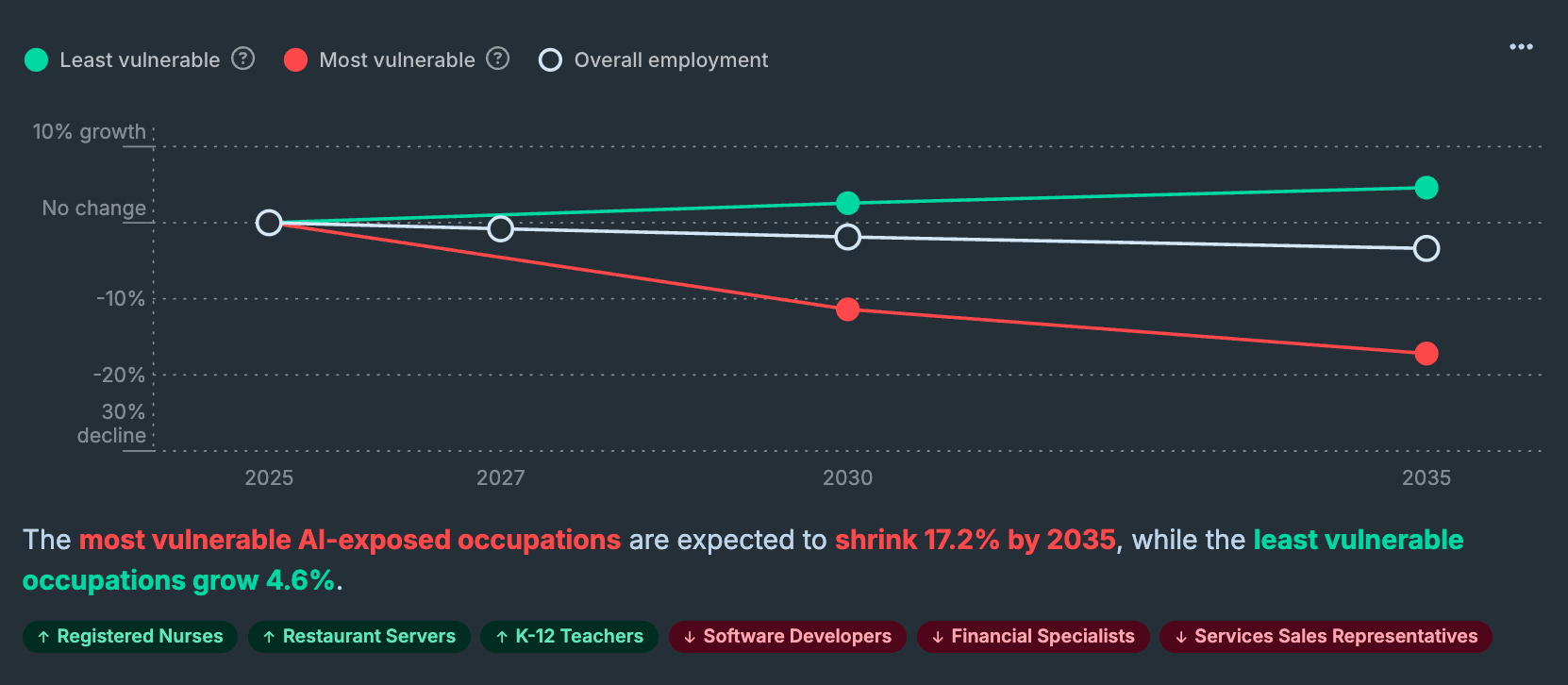
The US government projects that employment will grow by about 3% over the next decade. Currently, Metaculus forecasters expect it to fall by roughly the same amount. That six-point gap, driven by expectations about AI, is one of many places where the future institutions are planning for and the future forecasters expect have started to come apart.
Today, in partnership with Renaissance Philanthropy and the Schultz Family Foundation, we launched the Labor Automation Forecasting Hub to make those disconnects visible and more usable for policymakers, educators, workforce leaders, employers, and career planners.
The Hub is a continuously updated view of how AI may reshape the US labor market over the next decade. It pairs forward-looking forecasts with backward-looking data and existing research, focusing on 2027, 2030, and 2035.
Users can track forecasts on employment, wages, hours worked, impacts on recent graduates, and more. They can also explore key insights, compare forecasts with existing research, review selected rationales, and watch predictions update as new evidence comes in.
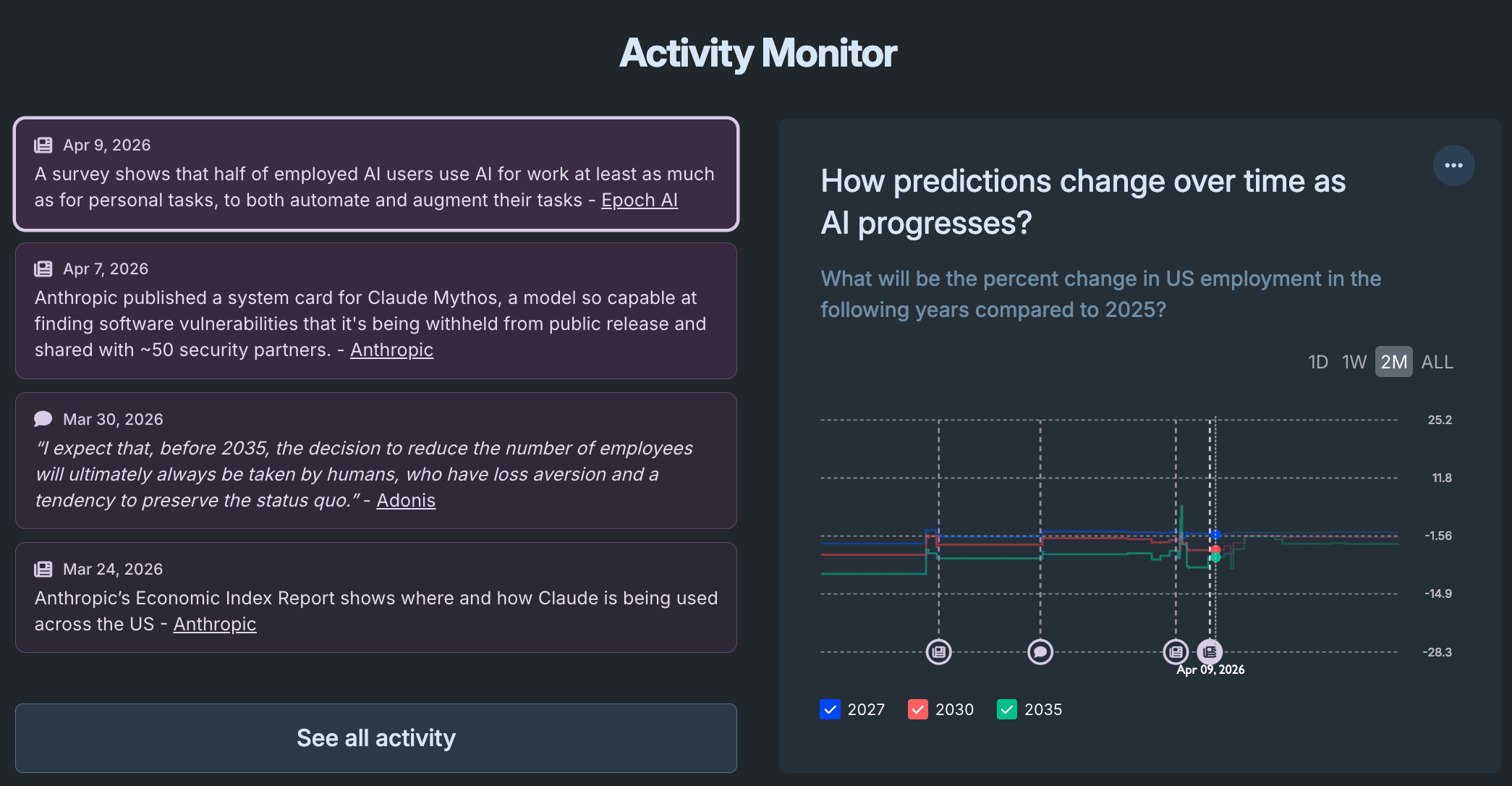
Users can download a PDF from the upper right for a static readout of the forecast visualizations and updates, click the notification bell to subscribe to Labor Hub updates, and use the three-dot menu on any visualization to view the underlying tournament question, export the chart as a PNG, or export the forecast data as a CSV for their own analysis and visualizations.
Workforce policy, education planning, and career guidance still rely heavily on backward-looking data. Federal employment projections update every two years. AI capabilities and adoption can shift far faster. The Hub is an effort to narrow that gap by combining historical baselines with continuously updated forecasts about where the labor market may be headed.
Explore the Hub to see how forecasters are thinking about AI’s impact on the US workforce.
Join the tournament to add your own forecasts and reasoning.