Open question: would it be useful to frame this an "impact insurance" for people in impactful careers?
As in:
-I expect this goal to be good for the world (say ~100 WELLBYs in expectation)
-If I don't achieve this goal, then I definitely owe something that's a least comparably good for the world (say ~$200 to PureEarth (since I've chosen WELLBYs))
(or maybe at least half as good)
I think using it this way could help people who have a real hesitation between impactful work and impactful donations.
Interesting I never thought of that. So a "hedge" for direct impact careers?
I'm feeling some hesitation here - people who take direct impact careers often already implicitly donate by taking a big pay cut, and I'd see it as a portfolio play - as a movement we will have plenty of impact, even if not all direct "bets" work out.
But maybe I am not fully understanding this. For sure it feels like there is something there... can you maybe give a more specific example for when/how you'd use it?
HI! I really like this idea! I expect you're working on this already, but I just think maybe you should add a few more charities. In particular, I think it would be better if the default charity on your app was one of GiveWell's top charities. I don't mean to cause you to worry, but keep in mind that there is an opportunity cost to donating to any less effective charity.
TLDR: We built Beeminder for effective charities. Access it here.
Commitment Contracts don't work with effective charities
Commitment Contracts are simple: You commit to pay money if you don't do something. Then, when you don't do the thing, you pay the company offering these contracts. This hurts, and that's why it works.
Commitment Contracts are surprisingly effective for behaviour change: A large-scale study from stikK showed that contracts with money staked are 60 percentage points more likely to succeed.
That's why there are plenty of organisations offering commitment contracts already: Beeminder, stickK, and forefeit. However, they either take the staked money or donate it to a portfolio of average NGOs.
We built an app that fixes that
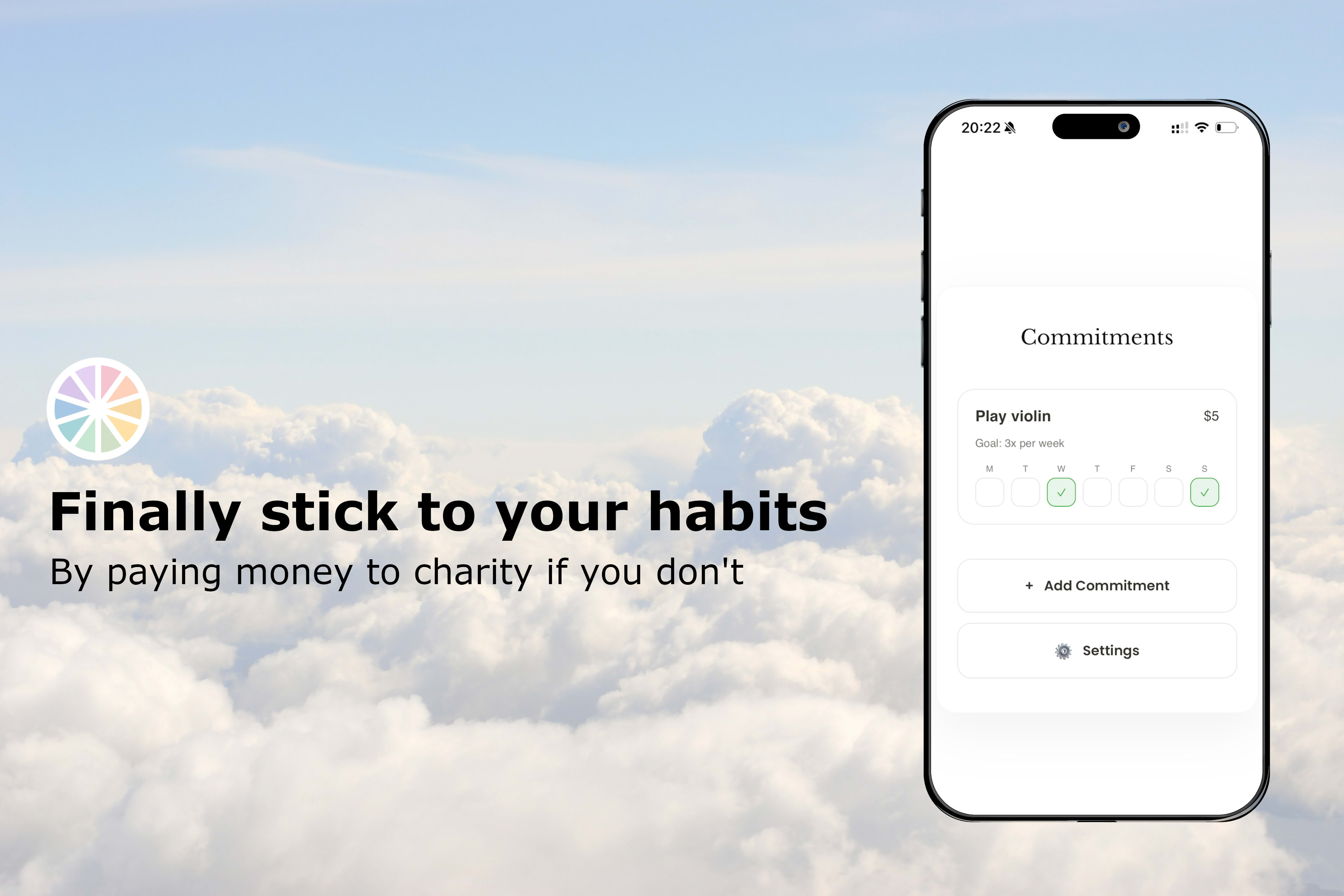
We developed an app that applies this concept but donates the staked money to effective charities. It takes two minutes to set up and works in your browser and on your phone.
Worried that it'll be less effective that way? You're right. It'll "hurt less" than donating the money to the NRA. But that's easy to fix. Just stake more money, and it'll hurt just the same.
Not sure that's the best way to change behaviour? You're right again. Check out our full post on behaviour change. Commitment Contracts should only be part of it. But it can be a great boost.
This was built by Cameron and Christoph 🔸. We used to be accountability buddies long ago, did AIM's Founding to Give program together last year, and wrote weekly posts about effective habits for a good life.
TL;DR
NOVAH (No Violence At Home) was incubated by Charity Entrepreneurship (now Ambitious Impact) in 2024 to test a promising idea: preventing intimate partner violence through edutainment, in our case a serialised radio drama. Over the past two years we have produced and aired two seasons in Rwanda.
We are currently evaluating our second season through a randomized controlled trial with 2,400 couples in Rwanda in partnership wi...
TL;DR
* The Long-Term Future Fund is closing down, and EA Funds is launching the Transformative AI Fund with a new full-time team.
* The fund's primary focus is technical AI safety and AI governance (including post-AGI governance), as well as supporting fields such as field-building and forecasting. We'll also consider non-GCR implications of transformative AI such as flourishing futures and digital...
The current Long Term Future Fund (LTFF) fund managers and I have decided to step back from our work on the LTFF. Because we believe LTFF donors trusted the fund managers to ensure that the funds would be used in line with the purposes of their donation, we've decided the right move is to close the fund.
While LTFF is closing, note that EA Funds has launched a new fund...




I'll give it a try !
Open question: would it be useful to frame this an "impact insurance" for people in impactful careers?
As in:
-I expect this goal to be good for the world (say ~100 WELLBYs in expectation)
-If I don't achieve this goal, then I definitely owe something that's a least comparably good for the world (say ~$200 to PureEarth (since I've chosen WELLBYs))
(or maybe at least half as good)
I think using it this way could help people who have a real hesitation between impactful work and impactful donations.
Interesting I never thought of that. So a "hedge" for direct impact careers?
I'm feeling some hesitation here - people who take direct impact careers often already implicitly donate by taking a big pay cut, and I'd see it as a portfolio play - as a movement we will have plenty of impact, even if not all direct "bets" work out.
But maybe I am not fully understanding this. For sure it feels like there is something there... can you maybe give a more specific example for when/how you'd use it?