I love EA; I am really proud of what we have built at CEA, and I am excited about where CEA is heading- that is all still very true. And after taking time to step back and think about where I most want to direct my energy next, I made the bittersweet decision to move on from CEA. I have spent my entire (!) full-time career there. I so deeply admire my stellar coworkers, and I deeply love EA and the impact we have- that is a big part of what made this decision so hard. I also still think it's the right decision for me.
Earlier this year, I drafted the following post about my experience leading the talent growth pillar at CEA but didn’t end up posting it. It's a nice reflection on the past year and highlights some of the amazing work of others and the things we have built that will be here long after I leave. So I am sharing it now (even though some of it is quite out of date).
I will also use it as a chance to advertise that we are hiring for a Director of Community Growth, which will oversee both my previous portfolio (Groups, Courses, Online) and Events (EAG, EAGx, Summits, Meta-coordination forum). I think this is an insanely impactful combined portfolio and encourage people to apply or send referrals.
Just under a year ago, I transitioned from my previous job as Head of Groups into my current role as Director of Community Growth at the Centre for Effective Altruism. At the start of 2025, our engagement metrics were declining. I had never led a cross-functional strategic initiative like this before, nor led a team to build a strategic growth model from scratch. Now, I manage the Groups, Online, and Courses Teams (roughly doubling the number of people under me), and we have grown engagement with CEA programs by 25%. We plan to continue growing and are actively hiring.
Growth has now become my thing and, importantly, not just the growth of EA. To grow participation in our programs, three types of growth had to happen in tandem: I needed to expand our infrastructure, my team, and myself.
Of course, my experience is anecdotal and won’t generalize everywhere, but I have personally found reading reflection posts like this helpful in the past. I wanted to share some key takeaways from what worked for me, in hopes of helping other organizational leaders who are ambitious about their growth. This also gives me a chance to shout out some of the amazing people I get to work with.
1. Growing Infrastructure
When we shifted from team-level goals to an org-wide growth ambition, we needed different infrastructure. CEA had tried various approaches over the years, but they weren't a good fit for the scale of what we were now trying to do. Sustainable, quality growth requires both systems to track what's happening and frameworks to make good decisions.
- Building Measurement Systems and Frameworks:
- You can’t measure growth unless you know what you are actually measuring. You need to measure something. At the start of the process, I was overwhelmed by the option space - there were so many possible metrics, and they were all far from perfect. Would picking these specific metrics mean we wouldn't focus on the most important things? There was so much they didn't capture!
- We ended up designing a 6-tier growth funnel to track engagement across all stages of an EA user journey. Alex Dial led the methodology work: figuring out how to work with messy data and making tough calls about which imperfections to accept. Because no metric is perfect or "non-goodhartable," we introduced the GROW principles. These cultural principles help steer the organization towards impact instead of just optimizing metrics. Our engagement funnel gave us shared language and actual goals to hold ourselves accountable to, and a cultural framework ensured impact-focus.
- Ultimately, slightly imperfect goals are better than no goals at all, especially when paired with guardrails, cultural principles, and a concrete plan to improve the model over time. Accepting this allowed us to move forward without letting perfect be the enemy of the good.
- Driving Accountability Through Goals:
- A big focus for me was championing goal-driven management across CEA. There are many approaches to OKRs. Historically, some teams at CEA had taken more of a Google-style approach: you should hit about 80% of your goals, and if you're hitting more than that, you're not being ambitious enough. But in practice, this meant we didn't have a strong culture of accountability for the most important goals. We didn't have clearly enforced must-hit targets or shared language around that standard. And many teams were creating independent goals rather than backchaining from CEA-wide goals (and some teams didn’t have goals at all!).
- Setting must-hit targets (and building a shared language around what "must-hit" actually means) was critical for creating shared expectations that we really do need to run through walls for these.
- Mid-year, we were uncertain whether we'd hit our growth targets. At our team retreat, I had to deliver that news and rally the team to refocus. Repeated, clear communication about where we stood and where we needed to go kept everyone aligned when it would have been easy to drift.
- I have found it particularly exciting to watch Sarah Cheng lead her team to become extremely good at hitting must-hit targets and set a good example for the org.
- The Product Mindset and Foundation Building:
- At one point last year, I really started grokking just how ambitious we could be if we set some audacious goals. Building scalable products people love requires testing assumptions and building feedback loops. If we want to build really scalable products, we need to build a lot of infrastructure. You have to make sure you have products that people really love, that have the effect you want, and that are scalable. That takes quite a bit of work - testing your assumptions, iterating, building feedback loops.
- For a while, we had vaguely wanted a product mindset at CEA, but we didn't have a playbook or a clear picture of what it would actually mean for what we do. I didn't know where the best starting points were. Last year, I hired Jamie Harris, who had experience with product development. He brought a product lens that reshaped how our team thinks about scaling, and he's now leading the foundational product work at CEA, which is driving internal resource allocation. For example, instead of immediately trying to scale our current products, such as our opportunities board, we are taking the time to really understand our target audience, market size, user needs, and a path to efficient scaling.
2. Growing My Team
One of the highest-leverage actions you can take is to multiply your impact by increasing the capabilities of the people you work with. We need a team of great leaders to achieve our ambitious goals.
- Giving Away My Legos:
- To grow the team, I had to give away my "babies" (projects I cared about deeply). For instance, after I set it up, Angelina Li took on project management for our growth initiative and did an excellent job. Similarly, Joris Pijpers has been an absolute champion in taking on my legos, ranging from entire hiring rounds to keeping teams accountable to goals and deadlines.
- Real empowerment means letting go, even when you think you could do it faster yourself or feel attached to something you have built. It is incredibly fulfilling to watch those I have handed things off to run with projects and do a much better job than I could have. Handing off these projects has allowed me to think a lot more about cross-CEA strategy this year, which I simply didn’t have time to before.
- Kennan McClung has recently taken on a role as Interim Head of Groups. Groups had been my focus for so long, it was really hard letting go here, but I have a lot of trust in Kennan, and this allows the team to have leadership while my focus has expanded.
- Coaching, including beyond direct reports:
- When the number of people in my purview doubled, it was overwhelming. At any time, there are so many problems to be solved, dynamics to be smoothed, cultures to build, etc. I couldn’t have my eyes on, let alone solve, all the problems. And as I stepped into a cross-functional role, I cared about the outcomes of teams beyond those I directly managed.
- One of the best gifts Anna Weldon has given me this year is a coaching orientation. As she states it “let people be the hero of their own story”. I had to create a value shift inside myself from someone who could solve a lot of problems to someone who coaches others to solve problems (and even coaching others to coach others to solve problems).
- I've encouraged the people I work with to read the same books as me so we can establish a shared language and paradigm, and I find it really exciting to scope out where someone can grow and the ambitious futures they could achieve.
- In the last year, I have picked up more coaching relationships outside of just my direct reports. Having a dedicated space for coaching calls—focused on people's growth areas and on setting ambitious visions for them has been incredibly high-leverage
- For example, watching Alex Dial's growth over the past year has been one of the most fulfilling things I've done - going from conversations about extra accountability to watching him independently shape and drive organizational priorities.
- Ruthless focus:
- We did not have the capacity to execute our ambitious plans nor hire for that capacity, so we needed to find it within. That meant prioritizing and making tough trade-offs. We took people off lower-priority projects to focus on core bottlenecks, even when it was painful. I ended up using a lot of the Groups team's capacity on Growth, and the Groups team suffered. This was so hard, because I think groups are insanely impactful! If Alex and I had stayed focused solely on groups support, we simply wouldn't have a growth model today. While we have not been able to give as much focused support to groups, the creative growth strategies Alex has developed are significantly influencing organization-wide priorities.
- I endorse the tough tradeoffs and the general principle of "If the things you are saying no to aren't painful, you are not prioritizing enough." And now I’ve become a bit of a meme at CEA of being “the focus person” - which I am perfectly okay with.
- The Power of Vision:
- A shared vision empowers a team and creates autonomy. On the Groups team, we were constantly faced with new and exciting options, from student project incubators to internship programs, which led to my spending a lot of time reviewing decisions and weighing in on what we should focus on. Providing a vision allows a team to self-evaluate options by asking, "Is this the highest leverage move to achieve our vision?" For example, our current guiding vision for our pilot university program is “Make sure we have good groups at top universities year over year.” This simple framework helps the team stay focused without me weighing in on too many decisions. It is awesome watching Kennan McClung run with this vision - keeping his team focused and goal-oriented.
3. Growing Myself
I think having a growth mindset is a superpower, and it's a superpower you can develop. It's probably one of the most accessible superpowers you can get, and it's such an enabler to take on so much more.
When I took on this initiative, I had a lot to learn. Here are a few things that have been helpful for my own personal growth:
Systematized development: I am a personal development nerd. With quarterly OKRs (shoutout to Peter Wildeford and Caroline Jeanmaire’s quarterly planning template!), personal development is built into my weekly planning and manager check-ins. My past personal development goals included many of the things mentioned in this post:
- Learning to craft a vision had to start with feeling in my heart the importance of a vision (Leading Change and the Art of Coaching Teams were helpful here) and then systematically, with deadlines, running rounds of iteration, tinkering, and testing with my team to see what works while checking on my progress every week.
- When I took on growth, I realized that learning to influence across the org would help make growth an org-wide priority, even though I don't manage most of CEA. By consistently returning to this as a personal development challenge, I have been more successful than if I had just run into it without conscious growth. (It turns out the vision work above is very helpful here too!)
- When you're taking on new challenges and doing things for the first time, disappointments are inevitable; building the grit to move through them quickly becomes essential. I added a weekly reflection question: "What setback did you hit, and what did you do to move past it?" Now, I rarely use that prompt since the reflexes have been built.
Constant consumption of information: There are no perfect books, but they can provide lots of helpful tidbits and tools: I listen to audiobooks while doing chores for passive learning and do closer, annotated reads of the "gold" ones. I focused heavily on strategy, management, and product development. Some I have liked specifically include Good Strategy Bad Strategy, Lean Product Playbook, Hacking Growth High Output Management, and as mentioned above, Leading Change and The Art of Coaching Teams.
- In particular, I have found these helpful for introducing new frameworks such as for strategic clarity: Doing “strategy” is notoriously difficult. When people say “strategy” they can mean anything from writing a north star vision to mapping all the causal nodes in a space to (my now favorite): identifying one core problem and then creating a set of coherent actions to solve that problem. The combination of reading these books and gaining on-the-ground experience was incredibly helpful in overcoming major hurdles when crafting strategies. I went from seeing strategic work as something that made me doubt whether I could be a good leader to something I thoroughly enjoy and have been told I am pretty good at.
Working with Excellent People: Personal growth is easier when you work with people who challenge your thinking and point out blind spots. I’ve been lucky to check in with Zach Robinson, my manager, and Anna Weldon, who has been coaching me this year. Amy Labenz has been a powerhouse at CEA who is inspiring to work alongside. Naomi Nederlof has given me excellent feedback that has helped shape my personal development goals for the coming year. I've also learned a great deal from the people mentioned in this post and am grateful for the many wonderful people here.
In a yoga class last year, we had to write a theme for the year on an index card. Mine was simple:
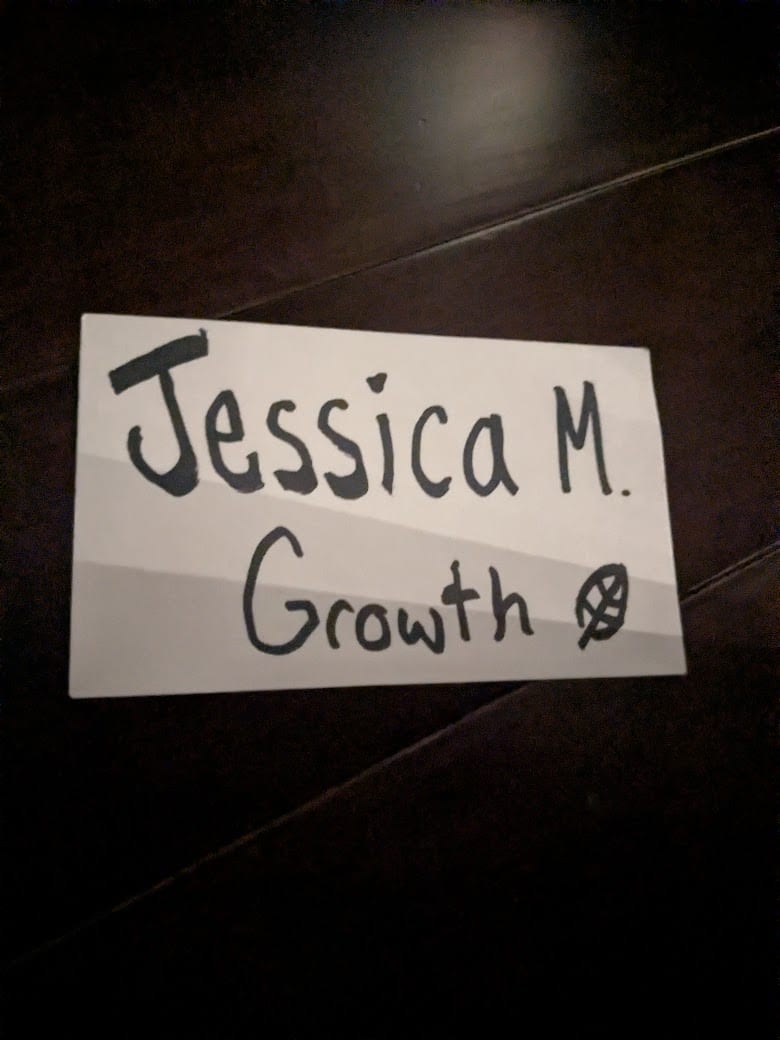
What’s Next
I am proud of the progress we made this year, but we have a far ways to go. We still have gaps in our measurement - conversion tracking, impact weighting, and full user journey mapping across products. We've done some initial work to understand how people move through our programs, but there's a lot more to do. We need to scale our programs. We need to coordinate across an ecosystem. We need to ensure that as we grow, we grow sustainably and maintain the parts of EA that make it great. We need to work on EAs' brand and funding diversification, all while maintaining sustainable momentum.
We have a lot more infrastructure to build as we scale, and the team will continue to grow in both headcount and skill. I am excited for new challenges and learning opportunities. All three types of growth personal, team, and infrastructure have multiplicative effects and will continue as we systematically invest in these. I'm excited about our new Director of M&E and Strategy being able to put more capacity on this as well as the great talent we aim to hire this year.
EA ideas are too important and impactful to have so few people using them. While EA has significantly punched above its weight for its size so far - the problems we are facing are too big to tackle at this scale. I feel so motivated to help EA grow, and I am lucky to grow it alongside such wonderful people.



Hi Jessica. Thanks for the interesting post. Best wishes for your next role.