What I did, in ~90 words: I am curious about why US data centres built overseas are well documented and discussed, but those built by Chinese firms are far less addressed. I, therefore, built a public dataset documenting data centres outside mainland China in which Chinese firms hold a role (such as being an owner, operator, tenant, builder or financier), alongside the rules that apply at each of these centres. I have tried to keep the project outputs as transparent as possible, such as by including the link to the webpage from which each data value comes.
TL;DR
DayOne, a data centre operator headquartered in Singapore, was a subsidiary of the Chinese data centre firm GDS from 2022 until 31st December 2024, and GDS still holds 19.4 percent of DayOne’s shares. DayOne also runs a data centre site at Nongsa in Batam, Indonesia. Along with three data centre sites in Johor (DayOne’s Nusajaya and Kempas, and MY06, whose main tenant is ByteDance), these four data centre sites hold 1,210 megawatts of IT power to run the servers. Epoch’s database covers a total of 13 data centres outside the US and mainland China, with 1,494 megawatts of IT power collectively, so the four sites tied to China hold 81 percent of the sum.
DayOne and Nscale, both of which plan to sell shares on a US stock exchange, have had to file registration statements with the US Securities and Exchange Commission (SEC), and those statements disclose who pays. DayOne received 69.4 percent of its revenue in 2025 from one customer, which DayOne describes as a firm with “a leading short-form video platform”, and Bloomberg reports that the customer is ByteDance. Nscale, a British operator, received 73 percent of its revenue in 2025 from one customer, which Nscale does not name. Tom’s Hardware (citing the Financial Times) reports that the customer is Spring (SG), a subsidiary of ByteDance. A loan agreement that Nscale filed with its SEC registration statement validates that Spring (SG) rents 2,304 Nvidia B200 chips at Nscale’s data centre in Glomfjord, Norway.
I recorded 16 rules, bills and other measures in my preliminary research, from the US, Malaysia, Singapore, the European Union (EU) and the UAE, covering the sale and transport of AI chips (but not who may use the chips once installed). None of the measures forbids a Chinese firm from renting US-made chips in a data centre in any third country and using those chips through cloud services. I was only able to track and identify a restriction on such use in a private contract, in which Nscale’s lender requires Nscale to watch how Nscale’s customer uses the chips in Norway for signs of a violation of US export rules.
In my preliminary research, I added up the capacity of the data centres in which a Chinese firm is the owner, operator, tenant, builder or financier. Most of the figures I compiled are IT power (i.e., the electricity a data centre can supply to its servers and chips). Data centres already in use hold between 1,323 and 1,652 megawatts. Data centres under construction or planned would add between 4,183 and 5,041 megawatts. I came up with this range by counting only capacity that the firms themselves or a government disclose (for the low end of the range), and also counting capacity reported by the press and directories and estimates by Epoch AI that exceed the self-disclosed figures (for the high end of the range).
Epistemic status: I am fairly confident in the figures extracted from the companies’ filings. I am also confident that the figures from Epoch AI are what Epoch estimates, although they are estimates and not empirical measurements. I am much less confident in the 10 news reports that Chinese firms use AI chips abroad. In seven of these 10, the journalists rely on anonymous informants, or report claims that the firms involved have not seconded/agreed. In Johor, I tried to cover every data centre that a public directory lists. Outside Johor, the data centre sites documented in my dataset are only those I have found so far, so the dataset is very likely only partially built, as I have just completed the preliminary work of this project.
Why bother counting?
In technical AI governance, the mainstream approach is to regulate frontier AI through compute, assuming that we can transparently monitor where the large clusters of AI chips are used and who uses them. Egan and Heim (2023), for example, propose that cloud providers verify who their customers are and report those customers that use large amounts of compute. California Senate Bill 53 sets such a threshold for frontier models at 1026 operations of training compute, and the EU AI Act presumes that a general-purpose AI model trained with more than 1025 floating-point operations (FLOP) can pose systemic risk. US export controls, however, track AI chips that cross borders (not compute that crosses borders). A Chinese AI developer that cannot import an Nvidia B200 chip can rent one in a data centre in Malaysia (such as in Johor) through a cloud service, as none of the rules I have recorded forbids the developer from doing so.
Measuring how much compute Chinese firms rent overseas (beyond the reach of the US export controls) is informative to supporters of those controls, to their opponents, and to anyone designing an international agreement on AI. For supporters, my measurement shows how much capacity the controls fail to reach and where a rule on cloud access would be applicable. For opponents, my measurement shows how much capacity Chinese firms already reach by renting chips abroad, without breaching the US export controls. For designers of an agreement, my measurement shows which data centres, operators and host countries a system for verifying compute should cover.
Epoch AI’s database estimates the IT power of large AI data centres primarily from satellite imagery, but the database does not record which Chinese firm holds which role at a given data centre site, or which rules apply there. The Australian Strategic Policy Institute’s Mapping China’s Tech Giants initiative lists the overseas activities of 27 Chinese technology firms, including data centres, but does not record the capacity of these data centres or the rules that apply there. My project is designed to close this research and data gap.
What I built
My dataset compiled and documented contains:
67 sites in 17 countries and territories, with 89 roles held by 16 Chinese firms and funds;
10 reports of Chinese firms reaching AI chips abroad;
21 figures of the capacity of a data centre site, in megawatts;
8 figures or reports of how much an operator depends on a Chinese customer, such as the share of the operator’s revenue that the customer provides, or a report that names the customer;
16 rules, bills, guidance notes, reviews, prosecutions and contracts;
a census of all 84 data-centre facilities that the directory Baxtel lists in Johor.
I classified each data source into one of three grades (i.e., primary, secondary or unconfirmed). A primary source is a disclosure by the firm that the data value describes (e.g., DayOne’s own filing on DayOne’s revenue), by another firm involved in the data centre (e.g., the bank that lent DayOne money for the Batam site) or by a government. A secondary source is a report by a news outlet, a directory or another third party. An unconfirmed source relies on anonymous informants or on claims that the companies have not publicly validated. The data, the code and the mapping dashboard of my project are available at https://github.com/newlivehung123123/overseas_data_centres_China.
So here’s what I found…
The biggest AI clusters outside the US and China are in Johor
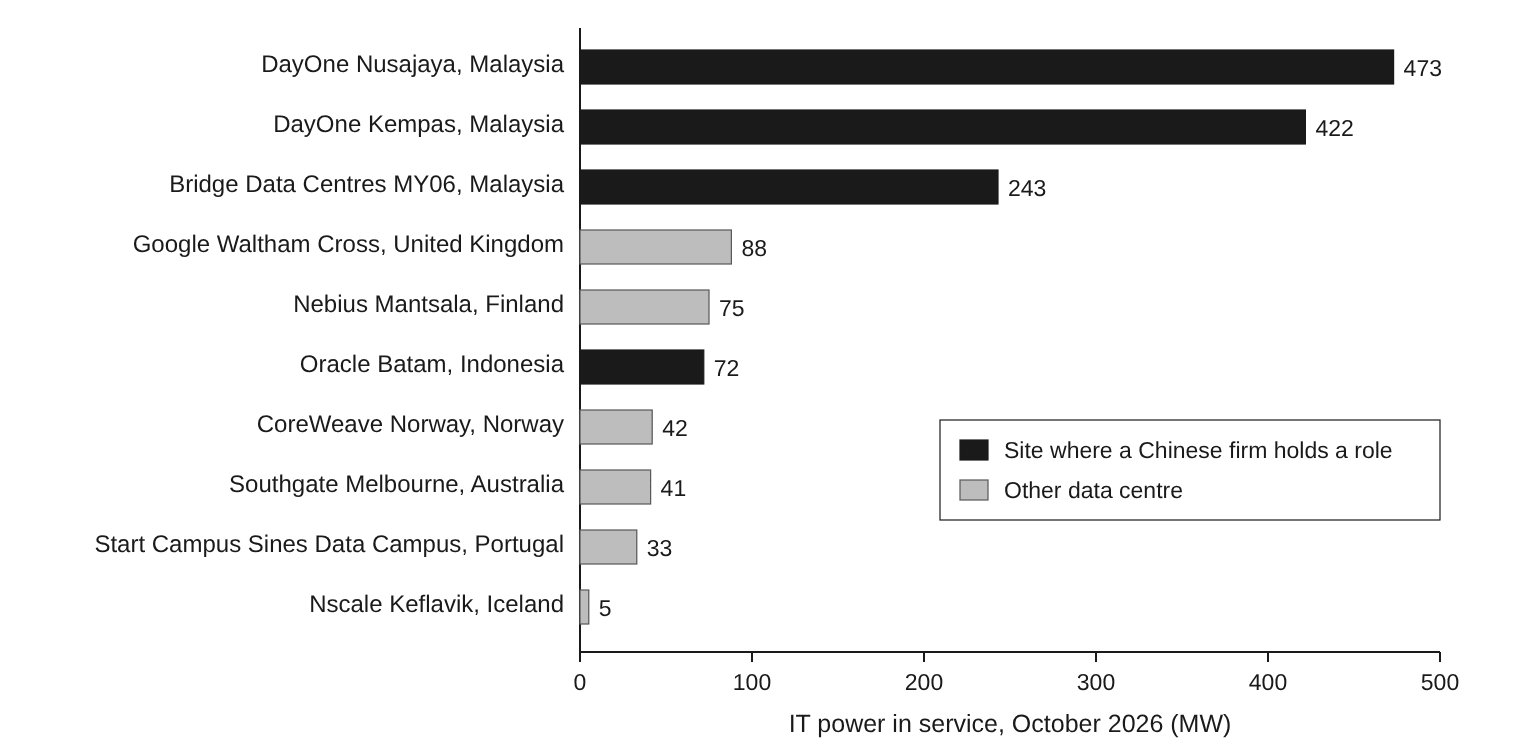
Epoch’s database, when I carried out my preliminary research two weeks ago, held 95 AI data centres: 77 in the US, five in mainland China and 13 elsewhere. Four of those 13 are documented in my dataset, and they are the big ones (Figure 1). By Epoch’s estimates, DayOne operates Nusajaya (473 megawatts of IT power) and Kempas (422 megawatts) in Johor, and the Nongsa campus in Batam (72 megawatts), which Epoch names after Oracle as the reported tenant. ByteDance is the tenant of MY06 in Johor (243 megawatts), and Epoch argues that ByteDance is the likely owner and user of the chips at MY06. These four sites hold 1,210 of the 1,494 megawatts that Epoch tracks outside the US and mainland China, and 1.37 million of the 1.68 million H100 equivalents.
Figure 1: IT Power in Service at the Data Centres Outside the US and Mainland China in Epoch AI’s Database, October 2026
Source: Epoch AI (2026), “AI data centers”, read on 22 October 2026; roles from Hung (2026).
Note: Black bars mark the 4 sites in which a Chinese firm holds a role. Three further data centres have no IT power in service yet.
There are two catches. By Epoch’s own estimate, its database covers about 45 percent of world AI compute (with a 90 percent interval of 30 to 78 percent), so the aforementioned 81 percent is a share only of what Epoch tracks. Moreover, having a Chinese operator or tenant does not tell us who uses each chip.
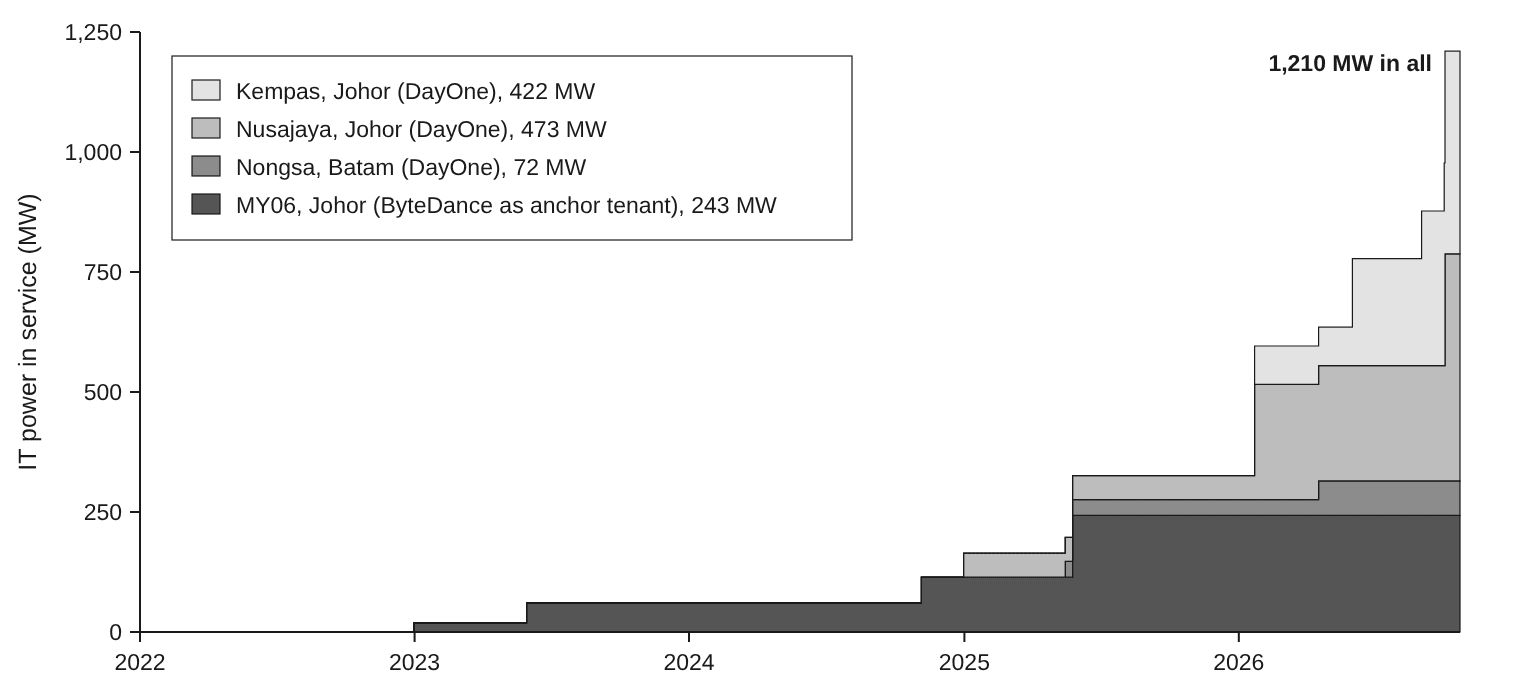
The growth in IT power at the four sites featured in Figure 2 has been fast. According to Epoch’s estimates of when each building came into use, the IT power at the four sites increased from 19 megawatts at the end of 2022 to 326 megawatts at the end of 2025, and then to 1,210 megawatts by October 2026. The four sites, therefore, added 884 megawatts of IT power in the first 10 months of 2026 alone.
Figure 2: IT Power in Service at the 4 Sites That Epoch AI Also Tracks, 2022 to 2026
Source: Epoch AI (2026), “AI data centers”, timelines read on 22 October 2026.
Note: Epoch judges a building operational primarily from satellite imagery. At Kempas, Epoch assumes 9 buildings in use by October 2026, partly from the state of the buildings before commissioning.
What does MY06’s capacity mean in training terms? A rough illustration: by Epoch’s estimate, MY06 alone holds about 221,000 H100 equivalents, meaning as much computing power as about 221,000 Nvidia H100 chips. At 989 teraFLOP/s of dense BF16 per H100 and 40 percent utilisation, MY06 could perform about 8.7 × 10¹⁹ FLOP per second. At this speed, MY06 could do 1025 FLOP in about 32 hours and 1026 FLOP in about two weeks. I am not claiming anyone has trained a model of either size at MY06. The Financial Times reported in November 2025 that ByteDance and Alibaba train models in Southeast Asian data centres, but I grade the Financial Times report unconfirmed. My claim is only that MY06, whose main tenant is ByteDance, has enough computing power to train a model large enough for the EU AI Act or California Senate Bill 53 to apply, and that none of the rules I recorded limits who may use MY06.
Two operators earn most of their revenue from one customer, reported to be ByteDance
Operators, the firms that run the data centres, rarely publicly disclose their customers. That said, their filings for US listings show how concentrated the market is (Table 1).
Table 1: Dependence of Operators on Customers That Are, or Are Reported to Be, Chinese Firms
Operator
Customer, described by the source
Share or amount
Who the customer is reported to be
DayOne
Largest customer, “a global technology company with a leading short-form video platform serving a worldwide audience” (primary)
69.4% of revenue in 2025; 69.2% in the first half of 2026 (primary)
ByteDance, per Bloomberg, July 2025 (unconfirmed)
Nscale
Largest customer (primary)
73% of revenue in 2025 (primary); US$24m of US$33m (secondary)
Spring (SG), a ByteDance subsidiary, per Tom’s Hardware citing the FT (secondary)
Datasection
One end customer, paying through the intermediary NauNau Japan (secondary)
JPY 30.5bn, essentially all AI infrastructure revenue in the year to March 2026 (secondary)
Tencent, per the FT (unconfirmed)
Global Switch
Huanbang (Hong Kong), a subsidiary of the controlling shareholder of Global Switch (primary)
£28.4m of revenue in 2025 (primary)
The report doesn’t say who uses the 15 megawatts
Source: Hung (2026), data/operator_customers.csv. The grade of each value is in brackets.
Nscale is a clear example. The loan agreement that Nscale filed with the SEC names Spring (SG) as the customer and gives the 2,304 Nvidia B200 chips that Spring (SG) rents at Glomfjord, in northern Norway, under a cloud services agreement of 15th May 2025. Broadly speaking, in nine of the 10 reports of Chinese firms using AI chips outside China that I have recorded, the Chinese firm rents chips that another firm owns instead of buying them. Among them, the largest reported deals are Tencent’s lease of about 100,000 advanced chips at several Oracle data centres in Southeast Asia (Financial Times, October 2026) and ByteDance’s access to about 36,000 B200s through the cloud operator Aolani in Malaysia (Wall Street Journal, March 2026). I grade both unconfirmed.
Of the four data centre operators in Table 1, three depend mainly on one customer, which the press names as ByteDance or Tencent. Because only a few firms rent computing power in data centres abroad to Chinese firms, a regulator would need to monitor only these few firms to track most of the renting. For the same reason, a US rule on renting chips through cloud services would affect most of DayOne’s and Nscale’s revenue simultaneously. Both firms would therefore have strong reasons to oppose such a rule, or to change how they serve their largest customers.
The rules I recorded cover the export of AI chips, but not the use of the chips through cloud services
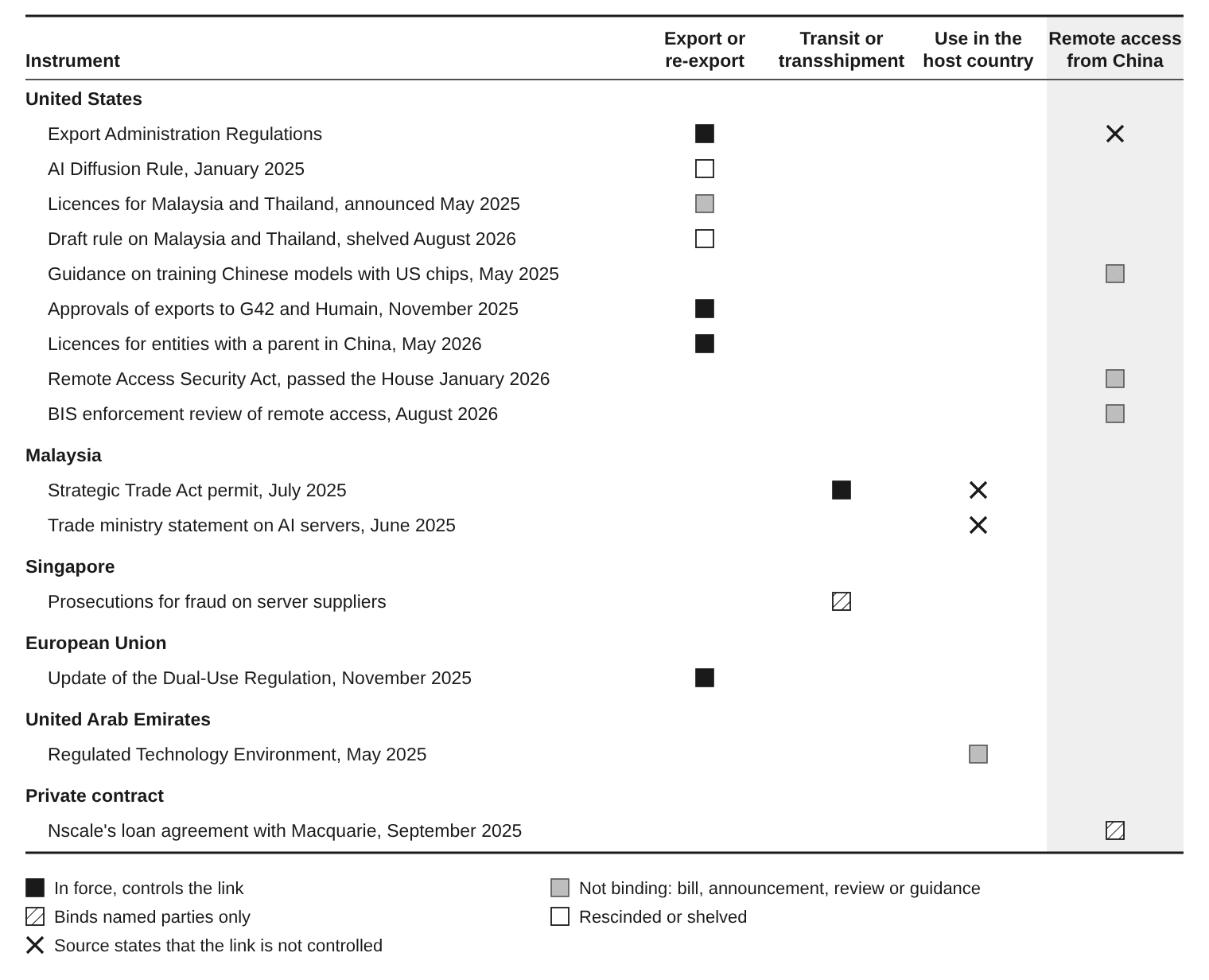
Figure 3 lists a total of 15 rules and other measures that I have recorded, grouped by country. For each measure, the figure marks whether the measure covers the export of AI chips, their transit through another country, their use in the country where the data centre is located, or their use from China through a cloud service.
Figure 3: Links from the Shipment of a Chip to Its Use from China That the Recorded Instruments Control
Source: Hung (2026), data/rules.csv.
Note: The source cited for the Export Administration Regulations states that access through a cloud service is not a violation. The dataset records Malaysia’s permit in two rows, for transit and for use, shown in this figure as one.
It is noteworthy that the measures in force that I have recorded cover the export and transit of AI chips only. US export rules restrict exports and re-exports of advanced AI chips. In addition, guidance issued on 31st May 2026 by the Bureau of Industry and Security (BIS), the US agency that enforces export rules, requires a licence for any advanced AI chips sent to a firm whose ultimate parent company is in China or Macau, wherever the firm is based. Malaysia has also required a permit since July 2025 for the export, transshipment and transit of US-made AI chips. However, Malaysia’s trade ministry stated in June 2025 that servers containing AI chips are not controlled goods in Malaysia, and that the firms operating data centres in Malaysia may decide which customers to serve.
None of these measures in force covers the use of AI chips from China through cloud services. The Remote Access Security Act, which would extend US export rules to such use, passed the US House of Representatives by 369 votes to 22 on 12th January 2026, but the US Senate has not yet voted on the bill. BIS also began a review in August 2026 that lists the countries where Chinese firms use AI chips through cloud services, but the review itself is not considered a rule.
The only restriction on such use that I have found is in a private contract. Nscale’s loan agreement with Macquarie Bank requires Nscale to monitor how Nscale’s customer uses the chips at Glomfjord, Norway, for signs of a US export rule violation, and to report any such signs to the bank. At present, Macquarie Bank, therefore, checks the use of the chips at one data centre, while no government checks the use of the chips at any data centre documented in my dataset. The registration statements that DayOne and Nscale filed with the SEC make me more confident that Chinese firms demand these chips.
How much capacity, in all?
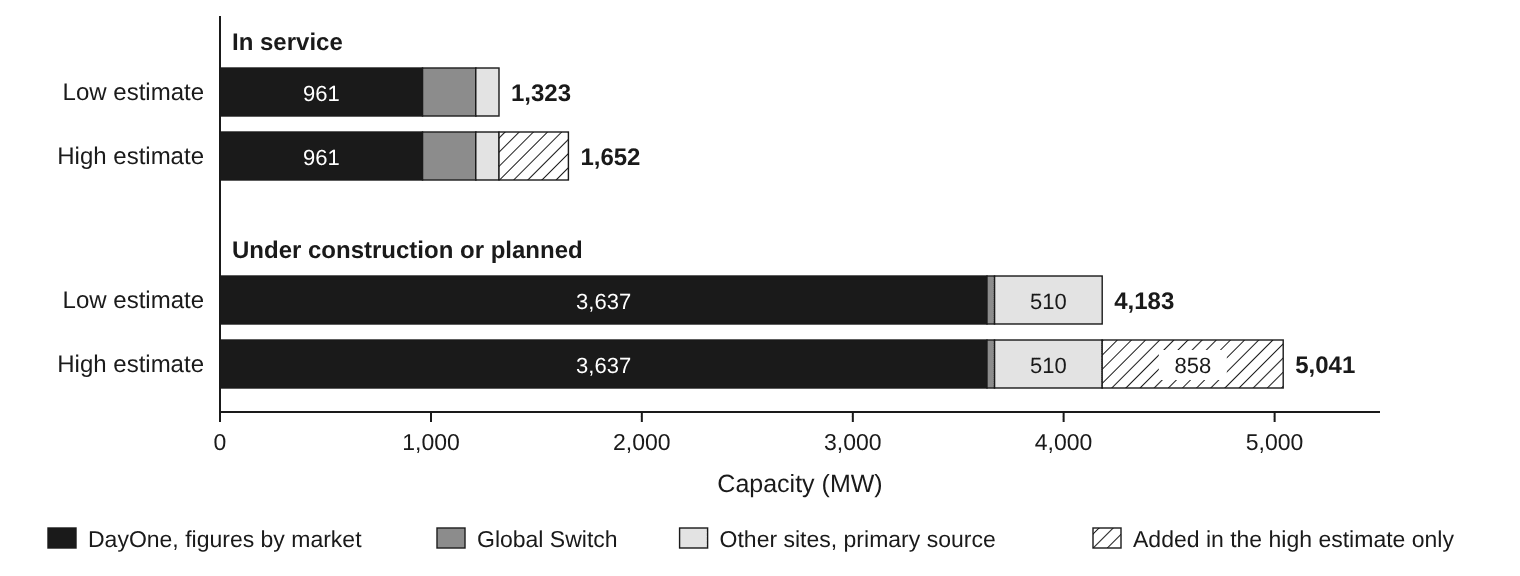
Adding up capacity can be messy. Firms report by market, sources overlap, and figures come in different units. In response, I count each data centre once, use the totals that DayOne and Global Switch report for their whole business (instead of relying on figures for their individual data centres, so as to ensure that no capacity is counted twice), and give a low and a high estimate of the total capacity (Figure 4). The low estimate counts only primary figures at data centre sites where the Chinese role is confirmed and the status is known. The high estimate counts every figure and adds Epoch’s estimates where they are larger.
Figure 4: Low and High Bounds of the Capacity in Which Chinese Firms Hold a Role
Source: Hung (2026), data/capacity_estimate.csv.
Note: Global Switch contributes 252 megawatts in service and 36 megawatts planned. The other sites contribute 110 megawatts in service at MY06 (i.e., a group of data-centre buildings in Sedenak Tech Park, Johor) and 510 megawatts planned at the Johor site of Racks Central (i.e., a Singapore company in which a fund sponsored by China Eximbank has invested).
Such an estimation gives 1,323 to 1,652 megawatts in service and 4,183 to 5,041 megawatts under construction or planned. The capacity under construction or planned is, therefore, about three times the capacity already in use. DayOne dominates both categories, with 962 megawatts in service (including 789 megawatts in Johor) and 1,328 megawatts under construction, alongside 2,308 megawatts of secured powered land. DayOne’s filing defines all three as IT power capacity.
There are two things that surprised me. First, a Chinese company holds a majority stake in data centres in Europe. Global Switch, which runs data centres in London, Frankfurt, Paris, Amsterdam, Madrid, Singapore and Hong Kong, states in its 2025 annual report that Jiangsu Shagang Group holds an indirect stake of 51.8 percent and controls the group. Second, in Johor, a Chinese firm or a fund of a Chinese state lender holds a role at 25 of the 84 facilities that Baxtel lists (Table 2). Among them is Racks Central’s planned campus of up to 510 megawatts, in which a fund whose main sponsor is China Eximbank invested in June 2026.
Table 2: Chinese Links at the 84 Data-Centre Facilities That Baxtel Lists in Johor, 22 October 2026
Chinese link
Facilities
Operated, built or planned by a listed Chinese firm (15 by DayOne, 1 by Global Switch, 1 by zData)
17
ByteDance as a tenant (MY06)
4
Financed in part by a fund whose main sponsor is China Eximbank (Racks Central)
3
Land that a subsidiary of Megaspeed agreed to buy
1
Reported but not confirmed
4
None found
55
All facilities
84
Source: Hung (2026), data/johor_census.csv.
“None found” doesn’t mean none exists, since operators seldom name their tenants.
Where I might be wrong
Epoch’s database may cover Johor more fully than other places. By Epoch’s own estimate, Epoch’s database covers only nine to 31 percent of the AI computing power in China, and the database covers some companies far more fully than others. The 81 percent, therefore, describes only the data centres that Epoch has recorded so far. If Epoch adds large data centres elsewhere, for example, in the Gulf states, the share of the four large data centre sites in Southeast Asia will decrease significantly.
A Chinese firm’s role at a data centre site does not show who uses the AI chips there. DayOne’s largest customer appears to be ByteDance, but Oracle also rents space from DayOne, and I cannot, confidently or not, tell which customers use the chips at Nusajaya or Kempas.
Renting chips abroad may not be the primary way Chinese firms obtain computing power. Chinese-made chips, or US chips brought into China illegally, may contribute more to Chinese AI developers’ most capable models than those rented chips do. So far, my project is not designed to investigate this hypothetical claim.
Counting these data centres could encourage a race between the US and China. Officials who favour more stringent policies towards China could use my dataset as readily as professionals, policymakers and scholars working on relevant international agreements. That said, I still believe that starting this project (and counting overseas data centres tied to China) does more good than bad, because any international agreement on AI would require such a count transparently and reliably, but, of course, I am open to arguments against my view on the possible impacts of my project.
The reports of Chinese firms using AI chips abroad are the least reliable part of my dataset. Seven of the 10 reports rely on anonymous informants or on claims that the firms involved have not confirmed.
What would change my mind: a primary source showing that most of the capacity in Johor serves non-Chinese customers, or any signal that the capacity there is not used for AI training at all.
…and here’s what’s next
The next step: Check every data centre in places near Johor, especially Batam, Greater Bangkok and Singapore.
Request: Tips on who rents space in the 55 Johor data centres where I have found no ties to Chinese firms thus far
Request: Corrections, through GitHub issues or otherwise, on anything you think I have got wrong, wrongly assumed or overlooked.
Acknowledgements. I have not yet secured any funding for this project. I developed the preliminary work as a self-funded researcher. In the longer term, I am actively looking for suitable funders for the continued scale-up of my work. I will also turn the milestone-based research outputs into both academic research papers (deposited on arXiv first, followed by submission for peer review) and public-facing articles in due course.
Crossposted to Less Wrong
‘Like most of life’s dangers, the dangers of artificial intelligence are not easily identified from the armchair.’
J Dmitri Gallow
Epistemic status
I’m not an expert in this field, and herein I make some sweeping generalisations educated guesses about the overall...
Cross-posted from my Substack.
Epistemic status: I’ve puzzled over this for a long time but I’m not sure I came to the right answers. I'm sharing this partly because it might help others work on resource allocation, but mostly because some smarter reader might tell me how to do it better.
TL;DR:
* I he...
Thanks to Bruce Friedrich, Seth Ariel Green, Tobias Leenaert, Jan Willem Bolderdijk, Martine van Haperen, Herman Rohrbach, Chris Popa and Elizabeth Alvarez for comments. Claude helped structure the text. Ideas and mistakes are my own. I currently work with ProVeg International. The prize I propose would be defined and judged by an independent committee, and its money would fund scaling the winning solution(s), not ProVeg or the winner.
TL/DR
* EA could d...