This is a link to a blogpost outlining my current thinking on why GiveWell should explicitly quantify the uncertainty in every parameter of its cost effectiveness model. It explains precisely how not quantifying uncertainty at all, or only quantifying the uncertainty in some parameters, leads to suboptimal allocation of funds.
The table of contents (also serving as a summary) is below.
Contents
Define complete and partial uncertainty quantification.
Explain why GiveWell should use uncertainty quantification at all:
Bayesian adjustments for post-decision surprise mayimply a change in the relative ranking of New Incentives.
Uncertainty quantification allows for the alternative decision rules introduced by Noah Haber in ‘GiveWell’s Uncertainty Problem’.
Uncertainty quantification allows us to calculate the value of information on a given parameter (if its uncertainty is quantified), thereby allowing for a systematic approach to generating a research agenda.
Explain why partial uncertainty quantification is inadequate:
Post-adjustment rankings are affected by the absolute variance in the naïve estimates, not just the relative variances.
Partial uncertainty quantification risks introducing systematic biases, depending on which key parameters are chosen for quantification.
Some diagrams without context
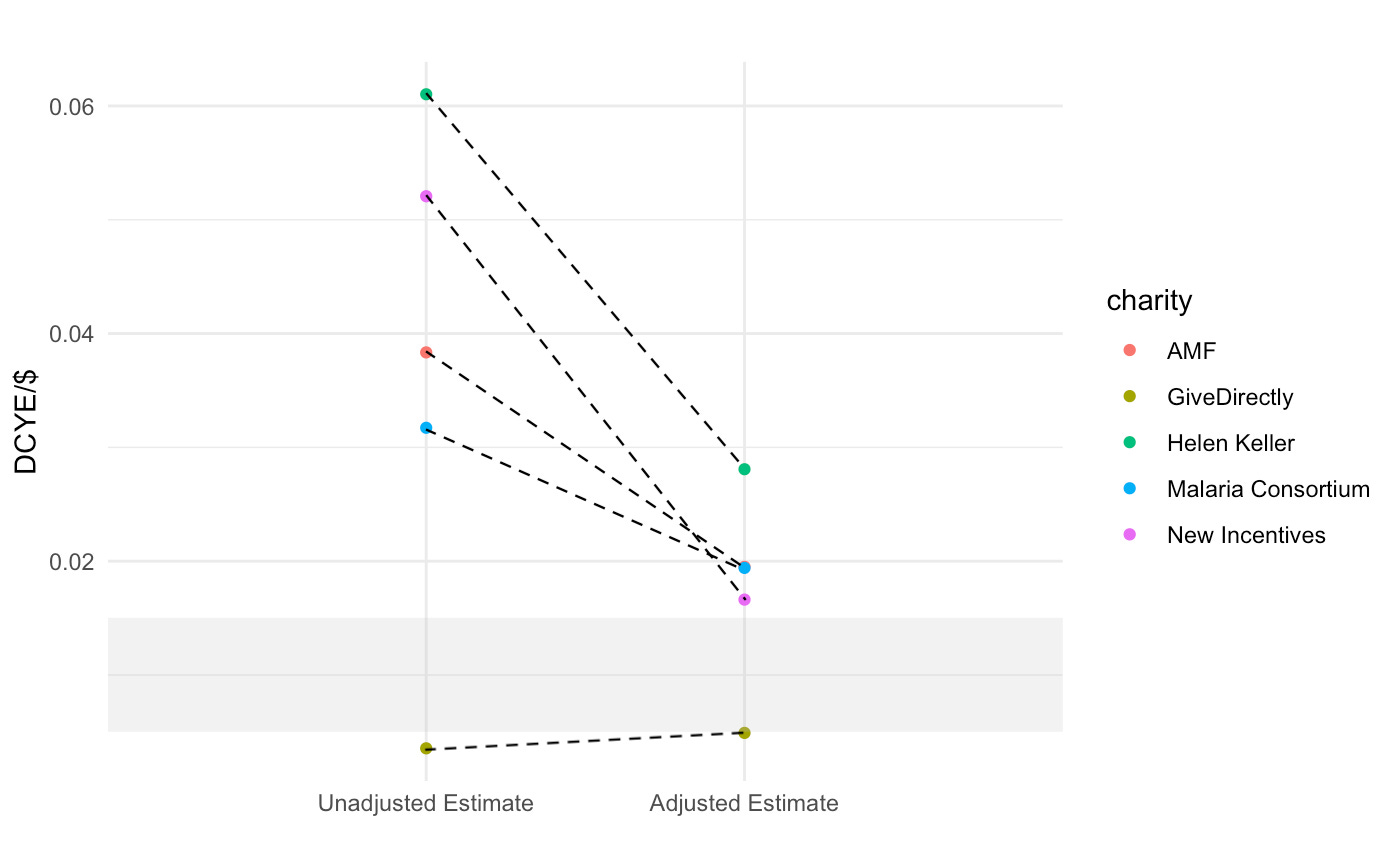
Explicit Bayesian adjustment of GiveWell's current cost effectiveness estimates
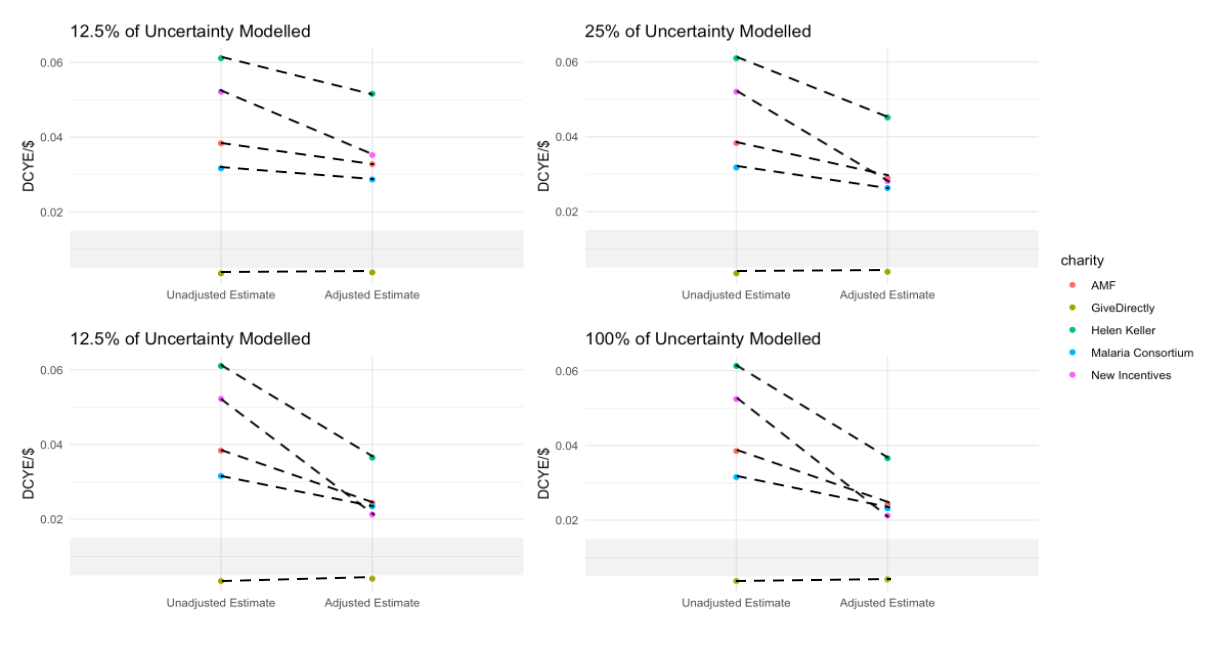
How this adjustment changes if only some of the uncertainty is explicitly modelled
*The bottom left panel should read '50% of Uncertainty Modelled'.
This work would not be possible without previous contributions on this topic from Sam Nolan and Hannah Rokebrand, as well as related criticisms of GiveWell (most recently from Noah Haber).
TL;DR
NOVAH (No Violence At Home) was incubated by Charity Entrepreneurship (now Ambitious Impact) in 2024 to test a promising idea: preventing intimate partner violence through edutainment, in our case a serialised radio drama. Over the past two years we have produced and aired two seasons in Rwanda.
We are currently evaluating our second season through a randomized controlled trial with 2,400 couples in Rwanda in partnership wi...
TL;DR
* The Long-Term Future Fund is closing down, and EA Funds is launching the Transformative AI Fund with a new full-time team.
* The fund's primary focus is technical AI safety and AI governance (including post-AGI governance), as well as supporting fields such as field-building and forecasting. We'll also consider non-GCR implications of transformative AI such as flourishing futures and digital...
The current Long Term Future Fund (LTFF) fund managers and I have decided to step back from our work on the LTFF. Because we believe LTFF donors trusted the fund managers to ensure that the funds would be used in line with the purposes of their donation, we've decided the right move is to close the fund.
While LTFF is closing, note that EA Funds has launched a new fund...
Nice!