Comments
The United States Department of Transportation will pay $11.8 million to save a life.
Flagging that this is the 2021 value. The most current, 2022, value is $12.5M.
The United States Department of Transportation will pay $11.8 million to save a life.
Flagging that this is the 2021 value. The most current, 2022, value is $12.5M.
[Saying an old thing in a new way]
The United States Department of Transportation will pay $11.8 million to save a life. You know what that means? It means that if you come to the United States Department of Transportation with a plan (barriers around the Grand Canyon, wider lanes on the expressway, no left-turns on Sundays, etc. etc. etc.), the United States Department of Transportation will take your plan – snatch the blueprints right out of your hand – and go away and calculate two numbers. The first is the cost: the cold hard cash required to make your plan a reality. The second is the expected number of Americans saved by your plan. They’ll think of every number of Americans that your plan could save and couple it up with the chance that your plan in fact saves that number of Americans. They’ll have each of these pairs be fruitful and multiply and then they’ll sum. I exaggerate and simplify, but only slightly.
Now the United States Department of Transportation – or the US Department of Transportation, as I’m sometimes bold enough to call them – has your two numbers: the cost (measured in dollars) and the benefit (measured in Americans). You’re summoned back into the head honcho’s office and she punches these numbers into the ceremonial calculator: dollars divided by American lives. If the answer is $11.8 million per life or less, she shakes your hand and writes a cheque. If the answer is more than $11.8 million per life, she says ‘Take a hike. Never talk to me again.’ I exaggerate and simplify, but only slightly.
Now. I am an American citizen; I care only about the two inevitables. Do you know what I mean by ‘the inevitables’?
Dash? Elastigirl?
No, no, no. The inevitables: death and taxes. I am an American citizen; I care only about death and taxes. I exaggerate and simplify, but only slightly.
Now every time the head honcho at the US DoT signs a cheque, my taxes go up. That’s bad. But once the DoT project is complete, my chance of getting smeared across America’s highways goes down. That’s good. I’m a typical American. Every new $20 million DoT project is another 6¢ out of my pocket and at least another 0.000000005 ticks down on the old highway-death-o-meter. It’s a good deal. I’m happy to take it. I’ll have what I’m having. I exaggerate and simplify, but only slightly.
But then I come across The Precipice: a book written by one Toby Ord of Oxford University, England. In The Precipice, Ord gives us his best guess of the chance that everything goes wrong this century: 1-in-6, Russian roulette. And ‘everything’ here means everything. We’re talking disaster-movie-without-the-happy-ending. Nuclear conflagration, a modern plague, AI takeover. Armageddon, Contagion, War Games, The Day After Tomorrow, Terminator. Humanity in ruins and remaining so, for all the aeons until our great universe dissipates into fuzz.
But forget that last part. I never went in for that ‘deep time’ stuff anyway. Today’s troubles are enough for today, and my troubles are enough for me. Let’s focus on the here-and-now. This century. My life and the life of my children. Russian roulette. Do I feel lucky? I’m a confident guy. I know my way around a screwdriver. I like to think I’d comport myself pretty well in a total breakdown of the social order. But if things go Dr Strangelove, I’ve just got to come to terms with the fact that one of those ICBMs might have my name on it and that no degree of screwdriving-prowess is going to scratch it off. No man is an island. That bell will toll for me.
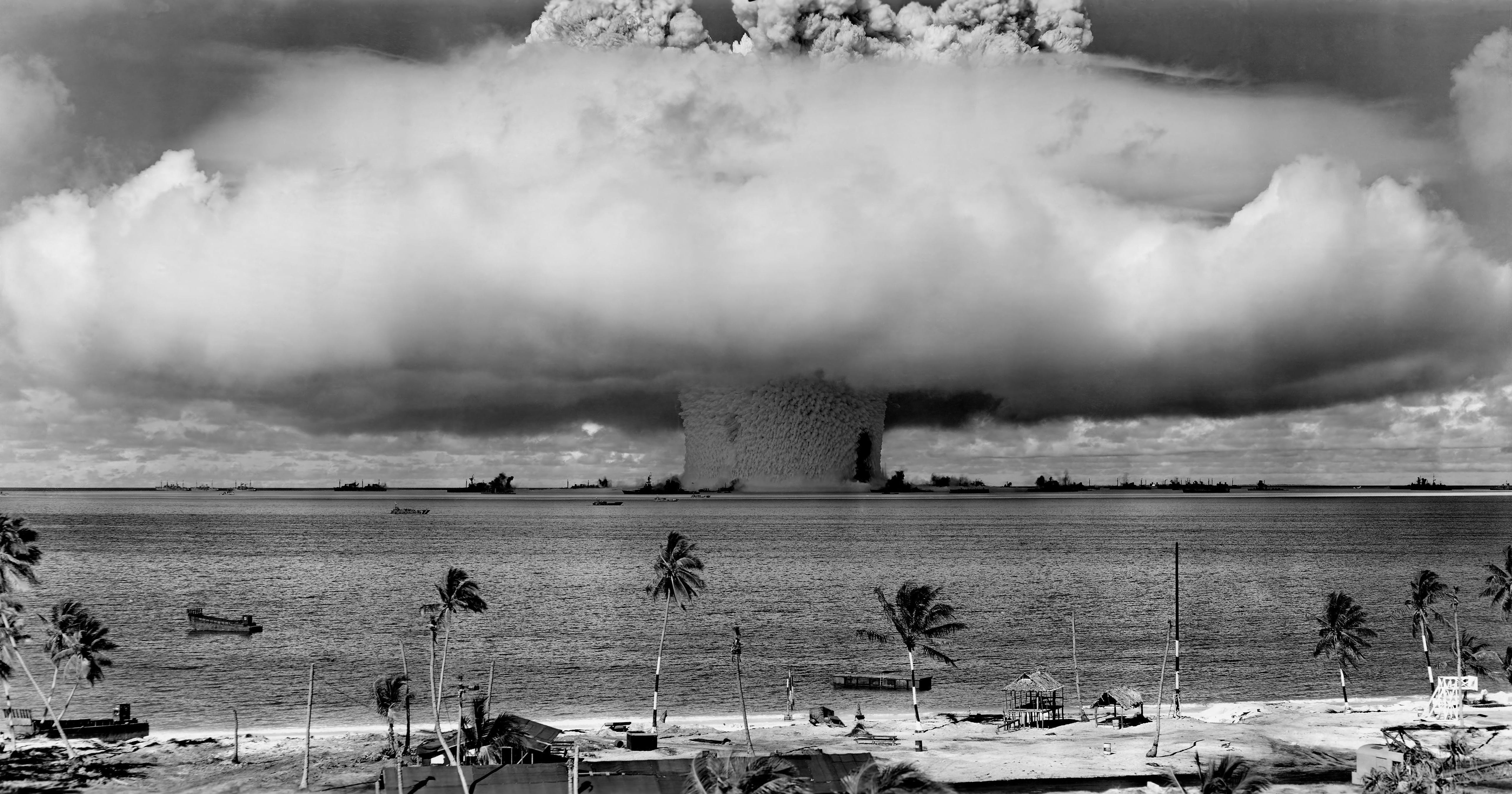
No. If it’s to be less than 1-in-6 that I perish from this earth, I need the government. Only they can make a real dent in my chances of getting fried, or of spluttering out my last in some makeshift hospital ward. And not only can the government do it, the price is right. Carl Shulman and Elliott Thornley estimate that $32 billion per year would increase the chance that we make it through the decade by 1-in-200. That’s a small number, but the ceremonial calculator reveals that it’s an even better deal than the one I’m getting from the US DoT: $100 out of my pocket and a big tick down on the old annihilation-o-meter.
1-in-6, 1-in-200. The numbers are unsettling, but they’re also unsettled. Odds are at home in Vegas where they’re born from the motions of dice, cards, and roulette wheels, and can be confirmed by long painful experience. But Ord has never sat and tallied infernos, never watched his supply of civilizations grow and fall and dwindle to nil. The 6s and 200s are estimates, surmises, guesses, and I’ve bought enough used cars in my time to be wary of numbers plucked from thin air. But still. The question remains. What should we do? Should we renew the nuclear treaties or let them lapse? Should we hire scientists to watch for cooked-up superdiseases or save our money? Should we pump the brakes on AI or let it race ahead? If we do nothing, we’ll be guessing that the risk is low. If we do something, we’ll be guessing that the risk is not so low. Whatever we choose, we’ll be making a guess, so we might as well use our best one. Your best guess might differ from Ord’s, but you won’t know what it is until you make it your best: until you sit down with head clear and heart still and look at what we know. Nuclear weapons are younger than your grandparents and they’ve fallen out of planes many, many more times. Rabies kills all its untreated victims, COVID-19 infected almost everyone, and lab-engineered diseases could do both. AI systems are already so big that their creators can’t understand them and so erratic that billion-dollar companies can’t control them, and they’re about to get hundreds of times bigger.
It might feel wrong to say a number. But remember: guessing is not optional. Every action is a choice, and every choice is a guess. So look at what we know; guess, guess, guess; and use your best. If the bombs start falling, how many of us die? If it’s an engineered pandemic, how many of us die? What can we do? How much would it cost? How much would it help? Then get out the calculator. Less than $11.8 million per American and it would save a whole load of non-Americans too? It’s a good deal. Let’s take it.


The US DOT may technically have official guidance for the value of a statistical life, but I don’t think this actually informs much of the department’s priorities. Most DOT spending is on projects that can be expected to increase the number of roadway deaths due to increased speed and increased miles driven.
The US DOT budget is set by Congress and Congress has allocated most of that budget to programs other than safety (mainly highway expansions). I don’t think DOT is even allowed to enforce its VSL when making grants to states.
The reality is that there are some roadway interventions that are way better than $10MM per life. Protected bike lane networks, for example, save lives for well under $100,000 each. But due to a mix of funding constraints, legislation, jurisdiction, and institutional inertia, DOT is not doing many of those projects.
Link?
I wouldn't say that I've done a ton of research on this question but here are a couple of studies I've seen on this: